Fact-checked by the MyFinancial101 editorial team
A 2024 survey by EMARKETER found that 43.3% of U.S. shoppers said finding a better price was the single factor that led them to make a purchase, outranking discounts, brand loyalty, and convenience combined. That statistic isn’t just interesting; it explains why price matching retailers spend enormous energy publicizing their price-match policies and why understanding the real rules of those policies is worth your time. Most shoppers have a vague sense that price matching exists. Far fewer know how to use it correctly, and even fewer realize that the rules have changed significantly in the past year.
The policy environment shifted materially between mid-2025 and early 2026. Target ended external competitor price matching in July 2025, abandoning a policy it had held since 2013. Macy’s dropped competitor matching entirely around the same period. If you’re working from any guide written before those changes, you’re operating on outdated information that could send you to a customer service desk for nothing. Meanwhile, a Digital Commerce 360 survey found that 52.61% of consumers said better prices are what drive them to shop on online marketplaces rather than directly with a retailer, a dynamic that puts enormous pressure on stores to compete on price and shapes exactly which matching policies they’re willing to offer.
This guide covers everything that actually matters about price matching at major U.S. retailers: which stores still offer genuine competitor matching, which have quietly scaled back, the rules most likely to sink your request, and how to combine price matching with coupons and credit card protections to get the best possible price. By the end, you’ll know when the effort is worth it and when another strategy will serve you better.
Key Takeaways
- 43.3% of U.S. shoppers cite finding a better price as the top factor that converts them to a purchase, making price knowledge the single most powerful savings tool available.
- Target ended external competitor price matching in July 2025; Macy’s followed suit. Any guide that still lists them as competitor-matchers is giving you bad advice.
- Best Buy’s standard post-purchase price adjustment window is 15 days; My Best Buy Plus and Total members receive a 30-day window, a detail worth weighing against those programs’ annual fees.
- Walmart’s price-match policy is internal only, Walmart.com versus in-store, and does not match any outside competitor. Amazon offers no competitor price matching at all.
- Staples goes further than matching: it beats competitor prices by subtracting 10% of the price difference, so a $200 item priced at $180 elsewhere costs $178 at Staples, $2 cheaper than the competing price itself.
- Price matching is most defensibly worth the effort on items with a gap of at least $15–$20. For smaller purchases, the research and documentation time routinely exceeds the dollar savings.
In This Guide
- What Price Matching Actually Is (And the Three Forms It Takes)
- Which Major Retailers Still Offer Real Price Matching in 2026
- The Universal Rules That Can Sink a Match Request
- How to Actually Execute a Price Match, In-Store and Online
- Stacking Price Matches With Coupons and Loyalty Rewards
- Tools and Apps That Do the Legwork Before You Walk In
- When Price Matching Is Worth the Effort (And When It Isn’t)
- Price Matching vs. Price Beating vs. Price Adjustments: Which Saves More
What Price Matching Actually Is (And the Three Forms It Takes)
Most people use “price matching” to mean any situation where a store lowers its price to meet a competitor. The reality is more precise, and getting the terminology right matters because the rules differ depending on which type you’re requesting.
Competitor Price Matching
Competitor price matching is what most shoppers picture: Store A agrees to sell an item at the same price Store B is currently advertising. This is the most powerful form because it forces direct competition between retailers. Best Buy is the clearest example, matching prices from roughly 20 major competitors including Amazon (for items sold and shipped directly by Amazon, not third-party Marketplace sellers). The catch is that all standard qualifications apply: identical item, in stock at the competitor, not a marketplace or clearance listing.
Own-Channel Price Matching
Own-channel matching, sometimes called internal price matching, means a retailer matches its own online price to its in-store price, or vice versa. This is now Walmart’s only form of price matching. If Walmart.com shows a lower price than the shelf tag, a store associate can match it at checkout. What Walmart will not do is match a price from Target, Home Depot, or any other outside competitor. This distinction is buried in fine print and trips up shoppers constantly.
Post-Purchase Price Adjustments
Post-purchase price adjustments are a separate mechanism entirely: if you buy an item and the retailer’s own price drops within a defined window, you return to customer service and collect a refund of the difference. This isn’t matching a competitor; it’s a protection against buying just before a sale. Lowe’s currently offers a 30-day adjustment window. Best Buy’s standard window is 15 days, extending to 30 days for My Best Buy Plus and Total members. Always check the adjustment window at checkout, because it’s the easiest savings most shoppers never claim.
Some retailers go beyond matching and actually beat competitor prices. Staples subtracts 10% of the price difference from the competitor’s price, so if a $200 item is $180 elsewhere, Staples charges $178, not $180. That 10%-of-the-difference formula is meaningfully better than a straight match and is almost never mentioned in price-match roundups.
Knowing which type you’re requesting before you walk up to the counter matters. If you ask Walmart for a competitor match, you’ll be turned away, not because the policy doesn’t exist, but because that specific form doesn’t apply at that store. Knowing the distinction in advance saves the trip and the frustration.
Which Major Retailers Still Offer Real Price Matching in 2026
The price-match picture looks noticeably different in early 2026 than it did two years ago. Target and Macy’s have both scaled back significantly, and several other retailers have quietly tightened their eligibility requirements. Here’s an honest current-state view.
The Strongest Programs
Best Buy remains the benchmark for competitor price matching for most general shoppers. The policy covers a wide range of competing retailers, including Amazon for qualifying direct-sold items, and extends to online purchases. The standard post-purchase adjustment window is 15 days. For shoppers enrolled in My Best Buy Plus or My Best Buy Total (paid tiers), that window extends to 30 days. This membership-tier dimension is consistently underreported: if you’re paying an annual fee for a loyalty tier, the extended adjustment window is a concrete, dollar-quantifiable benefit that deserves to factor into whether the membership pays for itself.
Lowe’s currently matches both in-store and online purchases from qualifying competitors, with a 30-day window for post-purchase price adjustments. Home Depot offers a similar program and will also beat a competitor’s price by 10% on identical items. Staples beats rather than matches; its 10%-of-the-difference formula makes it the most aggressive price policy of any major office retailer.
The Recent Policy Retreats
Target ended external competitor price matching in July 2025, a significant rollback from the policy it had maintained since 2013. Target’s price-match policy now covers only prices within its own ecosystem: Target.com, Target stores, the Target app, and Target Plus (its third-party marketplace). If Target.com shows $49 and the shelf price is $54, the store will match that internal discrepancy. It will not match Best Buy, Amazon, or any other outside retailer. Shoppers using guides written before July 2025 will find this information absent or incorrect.
Macy’s dropped competitor matching entirely in the same period. Its current policy addresses only own-price adjustments for items that drop at Macy’s itself within a narrow window. This is a significant change for shoppers who regularly bought apparel, bedding, or housewares and relied on Macy’s as a place to match department-store competitors.
88% of U.S. consumers expressed frustration with high prices across groceries, gas, and restaurants in 2024, according to a survey by RRD and Prosper Insights & Analytics, a level of price sensitivity that makes understanding retailer price-match policies directly relevant to everyday household budgeting.
Programs That Don’t Match Competitors at All
Walmart and Amazon are the two most important cases here, because they’re the two largest U.S. retailers and shoppers frequently assume their size means aggressive price matching. Walmart’s policy is internal only. Amazon offers no competitor price-matching policy whatsoever; its pricing is algorithmic, updating constantly, and the expectation is that its prices are already competitive. If you want to use a competitor price to get a better deal at Amazon, there is no formal mechanism to do so.
| Retailer | Competitor Matching | Post-Purchase Adjustment Window | Notable Condition |
|---|---|---|---|
| Best Buy | Yes (approx. 20 competitors) | 15 days standard; 30 days for Plus/Total members | Amazon matches only on direct-sold items, not Marketplace |
| Lowe’s | Yes (in-store and online) | 30 days | Cannot combine with other offers |
| Home Depot | Yes (beats by 10%) | 30 days | Item must be identical and in stock at competitor |
| Staples | Yes (beats by 10% of difference) | 14 days | In-store purchases only; not available on Staples.com |
| Target | No (own ecosystem only since July 2025) | 14 days | Matches Target.com, stores, app, and Target Plus only |
| Walmart | No (internal only) | Not publicly specified | Matches Walmart.com vs. in-store price only |
| Macy’s | No (dropped competitor matching) | Limited own-price adjustment | No external matching |
| Amazon | No | None | Algorithmic pricing; no formal match mechanism |

The Universal Rules That Can Sink a Match Request
Policies vary by retailer, but the reasons match requests get denied are remarkably consistent across stores. Knowing these before you request a match is the difference between a successful outcome and a wasted trip to the customer service counter.
The Identical Item Requirement
The identical item rule is the single most common reason a match request fails. “Identical” means brand, model number, size, and color. Not a similar model. Not last year’s version with the same name. Not a bundle that includes accessories. If a competitor is selling the 65-inch Samsung QN90D and you’re standing in front of the 65-inch QN90D, you’re set. If the competitor’s listing is a bundle that includes a soundbar, that’s a different product, and the retailer will decline the match. This matters particularly for electronics, where manufacturers sometimes create retailer-specific model numbers that look identical on the floor but are technically distinct products.
Automatic Disqualifiers
Certain price sources are excluded by almost every major retailer’s policy, regardless of how good the deal looks:
- Third-party marketplace listings: An item sold by a third-party seller on Amazon Marketplace, Walmart Marketplace, or eBay does not qualify. The item must be sold directly by the retailer itself.
- Membership-gated pricing: Costco member prices, Amazon Prime Day prices, and Sam’s Club member pricing are excluded by every major competitor. The logic is that those prices are access-restricted.
- Clearance and liquidation prices: These are excluded because they reflect inventory the competitor is trying to move, not a standard selling price.
- Holiday blackout periods: Nearly every major retailer excludes Thanksgiving through Cyber Monday from price-match eligibility. This is the window when the biggest sales happen and the window when the policy goes dark.
Research tracking 25 major retailers found that 21 ran continuous “sales” off prices they rarely or never actually charged. Before investing time in a price-match request, verify that the competitor’s “sale” price is a genuine reduction and not a reference to an inflated “original” price that was never the real selling price. A match to an inflated sale price isn’t the savings it appears to be.
Proof and Availability Requirements
Most stores require a live, in-stock competitor listing at the time of the match request. A screenshot, a printed flyer, or a link to an expired sale won’t work. The competing item must also be available to ship to your address; if it’s out of stock for delivery to your zip code, the retailer can reasonably decline the match. For in-store requests, pull up the competitor’s product page on your phone before you reach the register and confirm the item shows as in stock. For online requests, have the direct URL ready before you open a chat session, because associates will check it in real time.
How to Actually Execute a Price Match, In-Store and Online
Knowing a policy exists and knowing how to use it are two different things. The execution differs meaningfully between in-store and online requests, and the post-purchase adjustment process is its own separate workflow.
The In-Store Process
Before you get in line, open the competitor’s product page on your phone and confirm three things: the item is identical (check the model number), the price is lower, and the item shows in stock. At the register, state the item, the competing price, and the competing retailer’s name clearly. Most cashiers can process a price match directly, but some retailers route these to a Customer Service associate. Don’t read a referral to customer service as a rejection; it’s usually just the correct channel. Stay calm and specific. The clearer your information, the faster the process moves.
If you encounter any hesitation about eligibility, ask the associate to pull up the written policy. Having the retailer’s own policy in front of both of you removes ambiguity and keeps the conversation factual rather than negotiable.
The Online Process
Online price-match requests typically go through live chat or phone customer service. The process is slower, but it works. Have the direct URL to the competitor’s product page ready: not a search result, not a category page, but the specific product listing. Most online retailers will ask you to wait while they verify the listing in real time, which can take a few minutes. If the item is in your cart or already ordered, customer service can usually apply the adjustment to the existing transaction rather than requiring you to cancel and repurchase.
For big-ticket purchases, request the price match before you finalize the transaction whenever possible. It’s faster than a post-purchase adjustment, and you avoid the risk that the competitor’s price changes or goes out of stock in the hours between purchase and adjustment request.
Post-Purchase Adjustments
If a retailer’s own price drops after you’ve already bought, whether because of a sale, a promotion, or a simple price reduction, you may be entitled to a refund of the difference. Bring your receipt (or reference your order number online) to the customer service desk within the adjustment window. Most stores require the item to still be in stock at the new price. If you paid by credit card, confirm whether your card also offers price protection (more on this in the final section), because the two mechanisms can sometimes work in tandem even when one falls short.
Stacking Price Matches With Coupons and Loyalty Rewards
Price matching and coupons are usually taught as separate strategies. At some retailers, they can be combined, and the combined value is meaningfully larger than either tactic alone.
The January 2026 Target Policy Update
One of the most widely missed recent changes: in January 2026, Target updated its policy to allow Target Circle loyalty deals to be stacked with a same-ecosystem price match. If Target.com shows a lower price than the shelf, and you’re also holding a Target Circle offer on that item, you can apply both. This is a meaningful carve-out because previous policy explicitly prohibited combining a price match with any coupon or offer. The updated stacking rule applies only within Target’s own ecosystem; it doesn’t revive external competitor matching, but it’s a genuine improvement for loyal Target shoppers that most guides have not yet captured.
Where Stacking Is Blocked
Not every retailer allows this combination, and the restrictions are worth knowing before you try:
- Lowe’s explicitly prohibits combining a price match with any other offer, including its own loyalty discounts and coupons.
- Kohl’s price-match policy excludes all brands already excluded from coupon use, which covers a significant portion of its inventory.
- Staples limits price matching to in-store purchases only and does not allow it on Staples.com orders, which reduces its usefulness for shoppers who primarily buy online.
- Best Buy generally does not allow price matches to be combined with other promotional offers, though loyalty rewards accumulated from a purchase can still apply.
The broader principle: always read the policy’s stacking clause before assuming you can combine tactics. Retailers that allow stacking advertise it poorly, and those that prohibit it rarely make the restriction obvious until you’re standing at the register. Pair price matching with your coupon research; resources like how coupon stackers are beating inflation can sharpen that side of your strategy.
The January 2026 Target Circle stacking update is absent from virtually every current price-match roundup. If you’ve read another guide recently and it doesn’t mention this change, you’re working from an incomplete picture of what’s currently possible at Target.
Tools and Apps That Do the Legwork Before You Walk In
The research step is where most shoppers give up. Finding a competing price, verifying the model number matches, confirming the item is in stock: all of that takes time. These tools cut the work significantly.
Price Research Tools Worth Using
Google Shopping surfaces live competitor prices across dozens of retailers and, for many stores, is an accepted form of price proof at the customer service counter. Pull up Google Shopping on your phone at the register and the associate can see the competitor’s current listing directly in the results. CamelCamelCamel tracks the price history of Amazon listings, which helps you evaluate whether a competitor’s current price is genuinely low or just the item’s normal selling price dressed up as a sale. ShopSavvy lets you scan a barcode while standing in a store and immediately surfaces competing prices from nearby retailers and online sources, useful for in-store decisions where you don’t have time for a full research session.
The Changing Research Environment
The tools available for deal hunting are evolving quickly. A January 2026 study from IBM and the National Retail Federation found that 31% of consumers now use AI tools as part of their deal-hunting process, and platforms like PayPal Honey have integrated AI chatbot features to surface price comparisons and coupon codes simultaneously. This doesn’t replace the manual verification step; you still need to confirm the model number and stock status before requesting a match, but it compresses the research window from fifteen minutes to two or three.
For ongoing price awareness across the major categories where price matching matters most, pairing these tools with budget-tracking habits makes the effort stick. If you’re also working on broader household savings strategies, the approach to keeping grocery bills under control follows similar logic: know the standard price before you can evaluate whether any deal is actually better.

When Price Matching Is Worth the Effort (And When It Isn’t)
There’s a real opportunity cost to price matching that most guides don’t acknowledge. The time it takes to research a competing price, document it correctly, and request the match is not zero, and on small purchases, that time cost regularly exceeds the savings.
The Honest Personal Finance Case
The strongest case for price matching is on big-ticket items with a gap of at least $15–$20. A $200 appliance showing up $25 cheaper at a competitor is worth five minutes of documentation and a customer service conversation. A $12 kitchen gadget showing up $2 cheaper at a competing store is not. The math is simple, but shoppers routinely apply the same effort to both scenarios and feel frustrated when the return doesn’t match the energy spent.
Retailers know this. The psychological design of price-match policies relies on the fact that most consumers who are aware the policy exists will still not use it, because the process feels like friction. The counter to that friction isn’t ignoring price matching; it’s learning the policy for your two or three most-visited stores well enough that the process becomes routine rather than effortful. Once you know exactly what Best Buy or Lowe’s requires, executing a match request takes minutes.
52.61% of consumers say better prices are what drive them to shop on online marketplaces rather than directly with a retailer, according to Digital Commerce 360’s 2024 Online Marketplaces Consumer Survey. That price sensitivity is real, and price matching is one of the few tools that lets you capture a competitive price without switching platforms or losing the customer service and return advantages of shopping with a major retailer directly.
When to Skip the Match and Use Another Approach
A price match doesn’t beat every alternative, and it’s worth being honest about where other strategies win. Sometimes a retailer without a price-match policy charges less overall than any competitor would match. Sometimes a coupon stacked at checkout, particularly at a store like Kohl’s, which has a deep coupon culture, outperforms any match you could obtain from a competing store. And sometimes the item is genuinely cheapest at a warehouse club whose membership pricing is specifically excluded from competitor matching.
If you’re managing a tight household budget, combining coupons with strategic store selection often produces larger savings than chasing price matches on individual items. Think of price matching as a precision tool: most powerful when you already know where you want to buy and have found a specific competing price to reference, not a substitute for broader price awareness.
Don’t conflate a price match with a guarantee that you’re getting the lowest possible price. The competitor’s price you’re matching could itself be a routine price, not a genuine sale. And the retailer matching it is only committing to meet that specific price, not to beat the market. Use price history tools like CamelCamelCamel to verify that the competing price is actually lower than historical norms before investing in the match request.
Price Matching vs. Price Beating vs. Price Adjustments: Which Saves More
These three mechanisms are often lumped together as variations of the same thing. They produce meaningfully different outcomes, and seeing the dollar difference in a concrete example makes the distinction clear.
A Concrete Dollar Comparison
Take a $200 item that a competitor is selling for $180.
| Mechanism | What Happens | Your Final Price | Savings vs. $200 |
|---|---|---|---|
| Price Match (standard) | Retailer matches competitor’s $180 | $180.00 | $20.00 |
| Price Beat (10% of difference) | 10% of $20 difference = $2 subtracted from $180 | $178.00 | $22.00 |
| Own-Price Adjustment | Retailer’s own price drops to $175 after purchase; you claim the difference | $175.00 | $25.00 |
| No action taken | Pay shelf price | $200.00 | $0 |
The price-beat formula at Home Depot and Staples adds $2 to your savings on a $20 price gap. That sounds modest, but on a $500 appliance with a $50 gap, the beat saves an extra $5 versus a straight match. On a $1,000 item with a $100 gap, that’s $10 more in your pocket for the same effort. The formula rewards larger purchases consistently.
Credit Card Price Protection: The Overlooked Backstop
Credit card price protection is a mechanism almost no price-match guide addresses, even though it functions as a savings layer that operates entirely independently of any retailer’s policy. Some credit cards, historically more common before a wave of benefit cuts in the late 2010s, but still offered by select issuers including certain Chase and Citi products, automatically refund the price difference if an item you purchased drops in price within a defined window, typically 60 to 90 days. You file a claim with the card issuer, not the retailer, and the refund arrives as a statement credit. The Consumer Financial Protection Bureau (CFPB) notes that cardholders are often unaware of purchase protections embedded in their card agreements, a gap that applies directly here.
This matters most in situations where the retailer’s own policy excludes your purchase: if a price drops after your adjustment window closes, if the item is in a category the store excludes, or if you bought during a blackout period. Check your card’s benefits guide. Most people who have this benefit don’t know it. If you’re also working to reduce credit costs generally, resources on negotiating your credit card APR pair well with maximizing card benefits like price protection.
Credit card price protection is a backstop that works even when a retailer’s policy doesn’t apply. If your card offers it, it can cover purchases during blackout periods, after a store’s adjustment window closes, or in product categories a retailer excludes from its own matching policy, all without any interaction with the store itself.
Combining Mechanisms for Maximum Impact
The highest-savings scenario combines mechanisms: buy at a store with a price-beat policy, use a loyalty program that earns cash back on the transaction, and register the purchase with a credit card that offers price protection as a backstop. None of these steps cancel out the others. A shopper who understands all three layers and applies them to a $500 purchase on a consistent basis will outperform one who relies on any single tactic. Managing household finances this way, treating savings as a system rather than a series of one-off wins, is the same logic behind how dedicated coupon stackers are beating inflation.
Real-World Example: Getting the Best Price on a Laptop
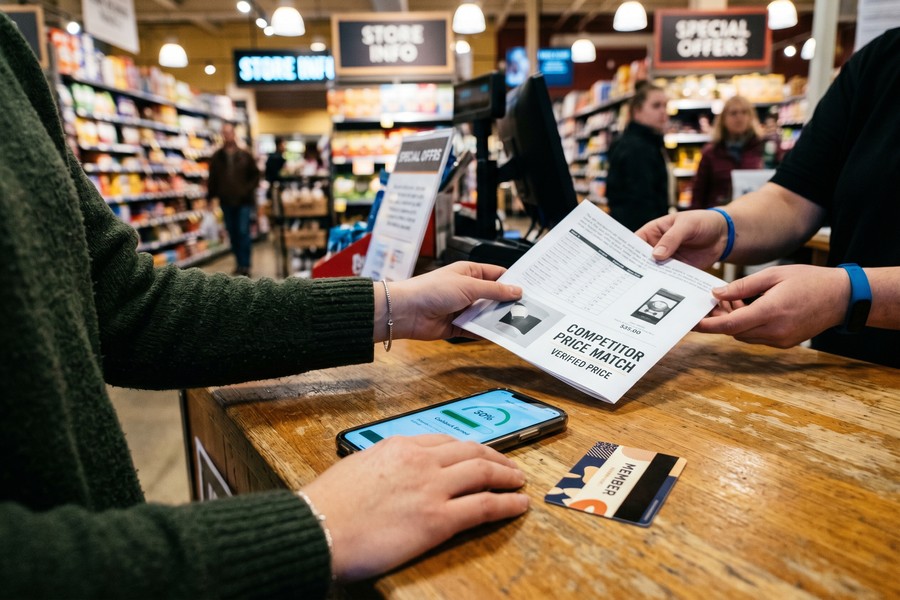
Consider an illustrative example: a shopper needs a mid-range laptop for a college student and has found the exact model, a specific 15-inch model with a defined model number, priced at $749 at Best Buy and $699 at a competing online retailer that sells and ships the item directly (not through a marketplace).
Before visiting Best Buy, she pulls up Google Shopping to confirm the competitor’s listing is live, in stock, and ships to her zip code. The model number matches exactly. She also checks CamelCamelCamel and finds the competing retailer has held this price for three weeks, so it’s not a flash sale that might expire before she can complete the match.
At Best Buy, she shows the associate the live competitor listing on her phone. The associate processes the price match: $749 drops to $699, saving $50. She’s a My Best Buy Plus member, so her post-purchase adjustment window is 30 days. Two weeks later, Best Buy itself drops the laptop to $679 as part of a seasonal promotion. She returns to customer service with her receipt and collects a $20 adjustment, bringing her effective price to $679.
Total saved versus original shelf price: $70. Total time invested: approximately 15 minutes of research and two short customer service interactions. On a $749 item, that return on time invested is clearly worthwhile. Had the original gap been $10 instead of $50, the calculus would look very different, which is exactly why the $15–$20 threshold is a reasonable personal filter for deciding when to pursue a match.
Your Action Plan
-
Identify the two or three stores where you spend the most
Price matching delivers the most value when you know the policy for your habitual shopping destinations. Look up the current written policy for each store, not a third-party summary, but the store’s own policy page, and note whether it covers competitor matching, own-channel matching, or both, along with the adjustment window length.
-
Confirm the policy hasn’t changed recently
Given that Target and Macy’s both changed their policies materially in 2025, treat any guide or article more than six months old as potentially outdated. Check the “last updated” date on a retailer’s price-match policy page before relying on it. Policies change quietly and without press releases.
-
Bookmark Google Shopping and CamelCamelCamel on your phone
For any purchase over $50, run a quick Google Shopping search before committing. If it’s an Amazon listing, check CamelCamelCamel to verify the price is genuinely lower than historical norms. Both tools take under two minutes and often surface a competing price you can use at the register on the same trip.
-
Verify the competing item before you request the match
Check the model number character by character against what’s on the shelf or in your cart. Confirm the item ships to your address and is in stock. This 90-second step eliminates the most common reason match requests are denied and saves you the friction of a back-and-forth with a customer service associate.
-
Ask about stacking at the point of purchase
If you have a loyalty coupon or a store credit available, ask directly whether it can be combined with the price match. Policies on stacking vary and change; the January 2026 Target Circle update is a recent example of a retailer loosening restrictions, and the only way to know is to ask at the time of the transaction.
-
Set a calendar reminder for the adjustment window
After any big-ticket purchase, note the store’s post-purchase adjustment window and set a reminder for two days before it expires. Spend five minutes checking whether the retailer’s own price has dropped. If it has, request the adjustment. This one habit, applied consistently, is where shoppers leave the most unclaimed money.
-
Check your credit card benefits for price protection
Log into your credit card account and search your benefits guide for “price protection” or “purchase protection.” If your card offers it, note the window (typically 60 to 90 days) and the claim process. Use this as a backstop on purchases where the retailer’s own policy doesn’t apply, particularly during holiday blackout periods.
-
Apply the $15–$20 threshold as a filter
Before investing research time in a price match, estimate the dollar gap. If it’s less than $15–$20, ask honestly whether the time and effort are worth it relative to other savings opportunities. The tactic pays off on large purchases and loses its edge on small ones; treat your time as the scarce resource it is. For broader household budget strategies that pair well with this approach, see how other readers are combining savings tactics to beat inflation.
Frequently Asked Questions
Does Walmart price match competitors in 2026?
No. Walmart’s price-match policy is internal only. The store will match a price discrepancy between Walmart.com and its physical store shelves, but it does not match prices from any outside competitor, not Target, not Amazon, not any other retailer. This is a common source of confusion because Walmart historically offered broader matching, and many older guides still describe the previous policy.
Does Amazon offer price matching?
Amazon does not offer a formal competitor price-matching policy. Its pricing is algorithmic and changes frequently, sometimes multiple times per day. There is no mechanism to submit a competing price and receive a match. If you find a lower price elsewhere, your options are to buy from that competitor directly or to check whether your credit card offers price protection as a separate backstop.
What happened to Target’s price-match policy?
In July 2025, Target ended the external competitor price matching it had offered since 2013. The current policy covers price matching only within Target’s own ecosystem: Target.com, Target stores, the Target app, and Target Plus. In January 2026, Target updated its policy to allow Target Circle loyalty deals to be stacked with a same-ecosystem price match, which is a genuine improvement within those constraints. But if you’re hoping to bring in a Best Buy or Amazon price, Target will not match it.
How long do I have to request a price match after purchase?
Adjustment windows vary by retailer. Lowe’s offers 30 days. Best Buy offers 15 days for standard shoppers and 30 days for My Best Buy Plus and Total members. Home Depot offers 30 days. Staples offers 14 days. Target offers 14 days. Always confirm the window at the time of purchase, because policies update and customer service associates don’t always volunteer this information proactively.
Can I price match using a screenshot?
Generally, no. Most major retailers require a live, in-stock listing on the competitor’s website at the time of the match request. A screenshot, a photo of a print ad, or a link to an expired sale page will typically be rejected. Pull up the live product page on your phone at the time of the request and confirm the item is currently in stock and available to ship to your address.
Can I use a price match on marketplace sellers like Amazon Marketplace or Walmart Marketplace?
No. Third-party marketplace listings are excluded from price matching at every major retailer. The item must be sold and shipped directly by the retailer itself: Amazon.com selling the item directly, not a third-party seller listing on Amazon’s platform. This distinction matters because a significant portion of Amazon’s product catalog is sold by third-party sellers, not Amazon directly. Always check the “Sold by” field before planning to use a competing Amazon price as your matching reference.
Are holiday sale prices eligible for price matching?
Not during the blackout period. Nearly every major retailer suspends competitor price matching from approximately Thanksgiving through Cyber Monday. This covers the exact window when the most aggressive deals appear. Post-purchase adjustment policies may also have separate blackout terms. If you’re shopping in that window, plan to pay the current price or shop at a retailer whose prices are lowest outright rather than relying on a match.
What is price beating and how is it different from price matching?
Price beating goes one step further: instead of simply meeting a competitor’s price, the retailer subtracts an additional amount, typically a percentage of the price difference. Home Depot beats by 10% of the competitor’s price. Staples beats by subtracting 10% of the difference between its price and the competitor’s price. On a $200 item priced at $180 elsewhere, a straight match gives you $180 at the matching store; a 10%-of-difference beat gives you $178. The formula benefits most on large purchases with meaningful price gaps.
Does price matching work on refurbished or open-box items?
No. Certified refurbished, open-box, and factory-reconditioned products are treated as different items from new products, regardless of whether they carry the same model number. If the competing item is an open-box unit and you’re buying new, the match will be declined. Conversely, if you’re buying an open-box item, you typically can’t use a new-price competitor listing as your matching reference.
Can I combine price matching with a credit card’s price protection benefit?
Yes, in many cases. These are separate mechanisms operated by different parties. If you obtain a price match at the register, your final purchase price is lower. If the price then drops again within your credit card’s price protection window, you may be able to file a claim with the card issuer for the additional difference. Check your card’s specific terms, because some policies state that the claim amount is based on the price you paid, not the original shelf price, which could affect the math. Either way, the two benefits are not mutually exclusive and can stack in your favor. If managing debt alongside these savings strategies is relevant to your situation, the guidance on prioritizing and negotiating credit card debt provides additional context on making your cards work harder for you.
Sources
- EMARKETER, Navigating the Path to Purchase: 3 Considerations for Retailers (2024)
- Digital Commerce 360, Online Marketplaces Consumer Survey 2024
- Food Business News, Survey: Nearly 90% of Consumers Frustrated Over Grocery Pricing (RRD/Prosper Insights 2024)
- Home Depot, Price Guarantee
- Target, Price Match Guarantee (Updated Policy 2025–2026)
- Walmart, Price Match Policy


