
Fact-checked by the MyFinancial101 editorial team
Quick Answer
Yes, you can negotiate a medical bill after insurance has paid. The patient-responsibility balance shown on your bill is not fixed. 93% of people who tried negotiating reported at least partial success, and providers routinely accept 30–50% less for a prompt lump-sum payment. Start by requesting an itemized bill, checking it against your Explanation of Benefits, and then calling the billing department directly.
To negotiate a medical bill after insurance, request an itemized statement, verify every charge against your Explanation of Benefits, and then call the billing department to ask for a reduced settlement. According to a LendingTree survey on medical bill negotiation, 93% of Americans who tried negotiating a medical bill reported at least partial success, yet most patients assume the balance left after insurance is the final word and pay without question.
The reality is that billing staff negotiate daily, and the patient-responsibility line on your statement is a starting point, not a ceiling. This guide walks through how to read your bill for errors, which legal protections reduce what you legitimately owe, how to run the negotiation itself, and when to escalate or ask for charity care that could wipe the balance entirely.
Key Takeaways
- 93% of patients who negotiated a medical bill reported at least partial success, according to a LendingTree survey (2025).
- Medical billing error rates are estimated between 49% and 80% of all bills, making a careful line-by-line review the highest-return action before any negotiation begins.
- 58% of U.S. adults fear they would accumulate medical debt after a major health event, per the West Health-Gallup Healthcare Survey (2025).
- 58% of U.S. community hospitals are nonprofit and federally required to provide charity care under IRS Section 501(r), according to KFF (2025), many programs cover households earning up to 400% of the federal poverty level.
- As of mid-2026, the three major credit bureaus, Equifax, Experian, and TransUnion, voluntarily exclude medical debts under $500 and debts delinquent less than one year, giving patients more time to negotiate than they typically realize.
In This Guide
- Why Your Bill Isn’t Final Just Because Insurance Paid
- What Should You Look for Before Negotiating?
- What Legal Protections Apply Before You Negotiate a Dollar?
- How to Run the Negotiation: Scripts, Levers, and Escalation
- Hospital Charity Care: The Discount Most People Never Ask About
- Using Hospital Price Transparency Data as a Negotiation Weapon
- If the Bill Goes to Collections, You Still Have Options
Why Your Bill Isn’t Final Just Because Insurance Paid
The patient-responsibility balance left after insurance processes a claim is negotiable, full stop. Providers routinely adjust balances, accept settlements, and forgive portions of debt. The billing department exists partly to collect, but it also has authority to compromise.
Many patients confuse the Explanation of Benefits (EOB) with an actual bill. The EOB is a summary document from your insurer showing what was billed, what the insurer paid, and what they say you owe. It is not a bill and not a legally binding payment demand. Your actual obligation comes from the provider’s statement. These two documents can, and often do, conflict, which is the first thing worth checking.
The Scale of the Problem
According to the West Health-Gallup Healthcare Survey (2025), approximately 31 million Americans borrowed an estimated $74 billion to pay for healthcare in 2024, despite most having some form of health insurance. That figure reflects how routinely patients pay balances they never questioned. If you’ve already paid a bill you’re now unsure about, know that some states and providers accept retroactive disputes. It is worth asking regardless.
Billing staff at hospitals and medical groups negotiate patient balances every single day. Asking for a reduced amount is not unusual or aggressive. It is an expected part of the collection process, and front-line representatives often have standing authority to reduce balances by a meaningful percentage without supervisor approval.
What Should You Look for Before Negotiating?
Before calling anyone, request an itemized bill. Not the one-page summary you likely received, but a line-by-line statement listing every service, procedure code, and charge. Your provider is required to give you one upon request.
Match each line against your EOB. Look specifically for charges for services you don’t recall receiving, duplicate line items, the wrong procedure date, or a CPT code (Current Procedural Terminology code) that doesn’t match the service described. A mismatch between the code submitted by the provider and the code processed by your insurer is one of the most common sources of overcharges, and correcting it often reduces the bill without any negotiation at all.
How Common Are Billing Errors?
Billing error rates are estimated between 49% and 80% of all medical bills, with larger bills over $10,000 carrying average errors of approximately $1,300. These are not rare exceptions. Treat finding an error as the likely outcome rather than a long shot.
The first pass through an itemized bill consistently produces the highest return per hour of effort, more than any subsequent negotiation on a technically correct bill. Two free tools help you benchmark charges independently. FAIR Health Consumer lets you look up typical costs for specific CPT codes by ZIP code. Medicare’s Procedure Price Lookup tool shows what Medicare pays for the same service at the same facility. These figures give you a documented, neutral reference point when disputing what you’ve been charged.
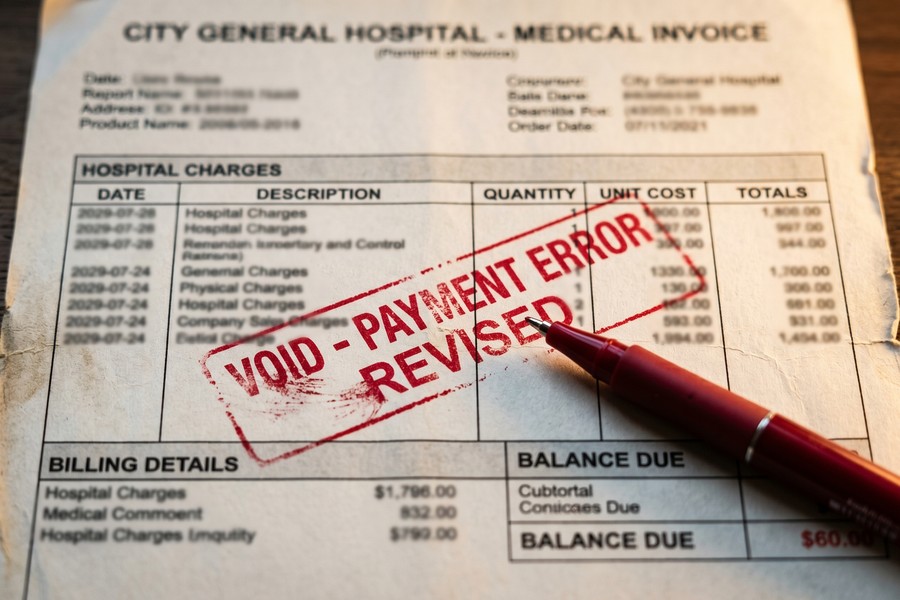
An estimated 49% to 80% of all medical bills contain at least one billing error. For bills exceeding $10,000, the average error totals approximately $1,300. Reviewing your itemized statement before negotiating is not caution, it is statistically justified.
What Legal Protections Apply Before You Negotiate a Dollar?
Several legal protections may reduce what you legitimately owe, separate from any negotiation. Knowing these before you call the billing department means you aren’t negotiating away rights you already have.
The No Surprises Act
Effective since 2022 and actively enforced, the No Surprises Act prohibits balance billing for emergency services and for many in-network facility situations where an out-of-network provider, such as an anesthesiologist or radiologist, was involved without your consent. The Centers for Medicare & Medicaid Services (CMS) overview of No Surprises Act protections explains that patients can dispute charges that violate this rule through a patient-provider dispute resolution process. If you received a large out-of-network charge at an in-network facility, check whether it qualifies as an illegal balance bill before paying a cent.
Medical Debt and Your Credit Report in 2026
The credit-reporting picture in mid-2026 requires a clear-eyed summary, because several competing articles have it wrong. The Consumer Financial Protection Bureau (CFPB) finalized a rule in early 2025 that would have banned medical debt from credit reports entirely, but that rule was vacated by federal courts in July 2025. It is not currently in effect.
What does remain in effect are voluntary policies adopted by the three major credit bureaus, Equifax, Experian, and TransUnion, which exclude medical debts under $500 from credit reports and exclude debts that have been delinquent less than one year. In practice, this means most patients have at least 12 months to negotiate before a medical debt can affect their credit score, which is meaningfully more runway than most people assume. The CFPB also advises patients to avoid paying with a credit card, as doing so converts a negotiable medical debt into non-negotiable consumer debt, eliminating your leverage entirely.
One more protection worth using: if your insurer denied a claim, you have up to 180 days to file an internal appeal. If the internal appeal fails, you can escalate to a binding external review by an independent third party. Only 0.1% of denied ACA marketplace claims are ever appealed, despite meaningful appeal success rates, making this one of the most underused tools available to insured patients.
How to Run the Negotiation: Scripts, Levers, and Escalation
Call the billing department directly, not the general customer service line, and ask one specific question early in the conversation: “What is the settlement amount to close this account today?” That phrase signals a lump-sum close and typically produces a more concrete offer than a general request for a discount.
The Two Main Financial Levers
The first lever is a prompt-pay lump sum. Providers frequently accept 30–50% less than the stated balance in exchange for immediate payment, particularly on accounts that have aged 60 days or more. This isn’t a guarantee, but it is a documented pattern reported by NPR, AARP, and multiple financial journalists who have tested the approach.
The second lever is an interest-free payment plan through the provider directly. If you cannot afford a lump sum, most hospitals offer installment plans at zero interest. This almost always beats paying with a credit card, which carries an average APR well above 20%. If you’re also managing other consumer debt, our guide to prioritizing and negotiating credit card debt covers how to sequence those obligations alongside medical bills.
If the first representative cannot help, ask specifically for a billing supervisor, a financial counselor, or the hospital’s patient advocate. Front-line reps often have limited discretion. These are not the same role, and a patient advocate at a large hospital system can sometimes negotiate terms that billing staff cannot.
The Escalation Path When Billing Refuses
Most articles tell readers to “be persistent.” Here is what that actually means in practice, in order:
- Front-line billing representative (first call)
- Billing supervisor or financial counselor (request on the same or second call)
- Hospital patient advocate or patient financial services director
- Certified mail dispute letter to the billing department, creating a dated paper trail
- Simultaneous letter addressed to both the billing department and the hospital’s CEO or legal department
- Complaint filed with your state insurance commissioner or the state attorney general’s consumer protection office
Each step up raises the cost of ignoring you. Most disputes resolve at steps one through three. Steps four and five are reserved for legitimate billing errors or No Surprises Act violations. Step six is a last resort, but state regulators do act on well-documented complaints.
One honest caveat: success rates vary depending on how you define success. The LendingTree figure of 93% includes any partial reduction. A Commonwealth Fund report placed the share of patients who obtained a price reduction or forgiveness at around 40%. Both figures are accurate; they measure different outcomes. Most people who try get something. Full bill elimination is less common, and going in with that expectation protects you from being disappointed by a partial win that still saves you hundreds of dollars.
Hospital Charity Care: The Discount Most People Never Ask About
If your income is strained, or even moderate, ask about the hospital’s Financial Assistance Policy before negotiating on price. Under IRS Section 501(r)(4), every nonprofit hospital must maintain a written financial assistance policy covering all emergency and medically necessary care, publicize it widely, and charge FAP-eligible patients no more than the amounts generally billed to insured patients.
Who Actually Qualifies
According to KFF (2025), 58% of U.S. community hospitals are nonprofit. In 2026, many of these hospitals have extended their financial assistance thresholds to households earning up to 400% of the federal poverty level, meaning a family of four earning roughly $125,000 annually may qualify for free or heavily discounted care. This is not a program only for low-income patients; it covers a substantial share of middle-class households.
The CFPB’s research on required financial assistance notes that nonprofit hospitals must widely publicize these policies on billing statements and in public hospital spaces. Still, a significant share of eligible patients never receive that information or apply. Search for the term “501(r) Financial Assistance Policy” on your hospital’s website, or ask the billing department directly for a paper application.
Under IRS Section 501(r)(6), nonprofit hospitals must make reasonable efforts to determine whether a patient qualifies for financial assistance before pursuing extraordinary collection actions against them. If a hospital sent your bill to collections without offering you a chance to apply for assistance, that is a potential legal violation worth raising directly with the hospital’s compliance office.
Search your hospital’s website for “financial assistance policy” or “charity care application” before calling the billing department. Downloading and submitting this form often produces a larger reduction than negotiating the raw balance, because FAP-eligible patients are protected by federal law from being charged more than what insured patients pay, not just whatever a front-line rep is willing to cut.
Using Hospital Price Transparency Data as a Negotiation Weapon
Since January 2021, CMS has required hospitals to publish machine-readable price files listing their standard charges, including negotiated rates with each insurer and self-pay or cash-pay prices. This data gives you access to what your hospital contractually agreed to accept from your insurer for the exact CPT code on your bill.
How to Use It, and Its Limits
To find the file, go to your hospital’s website and search for “price transparency” or “standard charges.” Download the file, locate the CPT code from your itemized bill, and find the negotiated rate for your specific insurance plan. If the amount on your patient bill exceeds that negotiated rate, you have a documented, specific basis for a dispute. Not a vague complaint about costs being high, but a concrete citation of the hospital’s own published contract.
That said, the honest caveat is worth stating clearly: a study found that only about one-third of facilities were fully compliant with the transparency rule in its first 10 months of enforcement. As of mid-2026, the data is used primarily by insurers and health systems in their own internal contract negotiations, not by patients. Use this tool when the file is available and readable, but don’t assume the data is complete or current. If you cannot locate or parse the file, the Medicare rate benchmarks available through the Medicare Procedure Price Lookup tool remain a reliable and accessible alternative reference point.

| Negotiation Method | Typical Savings | Best For |
|---|---|---|
| Billing Error Correction | Up to $1,300 on bills over $10,000 | Any bill; always do this first |
| Prompt-Pay Lump Sum | 30–50% off balance | Bills 60+ days old; ability to pay in full |
| Interest-Free Payment Plan | 0% interest vs. 20%+ on credit cards | Patients who cannot pay lump sum |
| Financial Assistance (501(r)) | 50–100% reduction or full forgiveness | Households up to ~400% federal poverty level |
| Price Transparency Dispute | Varies; corrects overcharges above negotiated rate | Bills where published rate is locatable |
| Collections Settlement | 25–50 cents on the dollar | Accounts already in collections |
If the Bill Goes to Collections, You Still Have Options
A bill entering collections does not end your ability to negotiate, it restructures it. Debt collectors routinely accept 25–50 cents on the dollar for lump-sum settlements on medical accounts, because they typically purchased the debt for far less than face value and any recovery above their purchase price is profit.
Your Rights Under the FDCPA
Before paying anything to a collector, send a written debt validation request within 30 days of their first contact. Under the Fair Debt Collection Practices Act (FDCPA), the collector must cease collection activity until they verify the debt in writing. This step also confirms the debt is yours, the amount is accurate, and the collector has the legal right to collect it.
Collectors cannot call before 8 a.m. or after 9 p.m., cannot harass or threaten you, and must stop contacting you upon a written cease-and-desist request. If a collection agency files suit, free legal aid through organizations like the Legal Services Corporation is available to qualifying individuals. If you’re managing broader financial pressure alongside a medical collection, our coverage of rising poverty guidelines in 2026 explains which income thresholds now qualify households for additional federal assistance.
Any settlement agreement must be in writing before you pay. Request a letter stating the agreed amount satisfies the debt in full, and keep it permanently. This protects you if the remaining balance is later sold to another collector, a practice known as “zombie debt” resale that is more common than most consumers realize.
When a medical account goes to collections, the original provider has often already written it off as a loss. The collection agency purchased the debt for pennies on the dollar. This means the collector has significant room to settle, and reaching out proactively with a documented lump-sum offer puts you in a stronger position than waiting for repeated calls.
One situation worth planning for: a single hospitalization can generate separate invoices from the hospital, the attending physician, the anesthesiologist, and a radiologist, each billed by a different entity with a different billing department and negotiation window. Prioritize the largest balance first, but track all open accounts simultaneously. Missing a collections notice on a smaller radiologist bill while focused on the hospital’s statement is a common and avoidable mistake.
If the complexity feels unmanageable, nonprofit organizations like the Patient Advocate Foundation provide free case management, and Dollar For specifically assists patients in applying for charity care. These are meaningful free alternatives to paid professional negotiators, whose contingency fees of roughly 25% on savings for bills between $5,000 and $15,000 can erode the value of a reduction on a balance already worked down through error correction.
For patients dealing with financial stress beyond medical bills, our article on how credit card debt affects low-income families outlines the broader debt management options available alongside negotiating healthcare costs. And if you’re looking for ways to build income while managing these bills, our guide on jobs paying $19 or more per hour in 2026 covers accessible entry points worth exploring.
Related reading: How a 45.
Frequently Asked Questions
Can you negotiate a medical bill after insurance has already paid its portion?
Yes. The patient-responsibility balance remaining after insurance pays is negotiable with the provider directly. You can request a reduction, a lump-sum settlement, a payment plan, or a financial assistance application regardless of what insurance paid, these are separate transactions.
What is the best opening line when calling to negotiate a medical bill?
Ask: “What is the settlement amount to close this account today?” This signals you’re prepared to pay in full immediately, which gives the billing representative a reason to offer a meaningful reduction. Citing a specific benchmark, such as the Medicare rate for the same procedure, strengthens your position further.
How much can I realistically expect to reduce a medical bill?
Results vary, but providers frequently accept 30–50% less for a prompt lump-sum payment on accounts that have aged. Financial assistance programs at nonprofit hospitals can eliminate balances entirely for qualifying patients. A LendingTree survey found 93% of people who negotiated reported at least partial success, though full elimination is less common than partial reductions.
Does negotiating a medical bill hurt your credit score?
Not directly. Negotiating a balance does not appear on your credit report. As of mid-2026, Equifax, Experian, and TransUnion voluntarily exclude medical debts under $500 and debts delinquent less than one year from credit reports. A debt only affects your score if it remains unpaid and exceeds those thresholds after the exclusion period.
What is a 501(r) Financial Assistance Policy, and how do I find it?
Under IRS Section 501(r), every nonprofit hospital must maintain a written financial assistance policy covering emergency and medically necessary care and make it publicly available. Search the hospital’s website for “financial assistance policy” or ask the billing department for an application. Many programs in 2026 cover households earning up to 400% of the federal poverty level.
Can I still negotiate after a medical bill goes to collections?
Yes. Debt collectors routinely settle medical accounts for 25–50 cents on the dollar. Send a written debt validation request first, then make a documented lump-sum offer. Always get the settlement agreement in writing before paying, and request a “paid in full” letter to protect your credit record.
Should I pay a medical bill with a credit card to buy time?
No. The CFPB specifically advises against paying medical debt with a credit card, because doing so converts a negotiable medical debt into consumer credit card debt, eliminating your ability to negotiate the balance and adding interest rates typically exceeding 20% APR on top of what you owe.
Sources
- LendingTree, How to Negotiate Medical Bills (2025)
- West Health & Gallup, Americans Borrow Estimated $74 Billion for Medical Bills (2025)
- KFF, Hospital Charity Care: How It Works and Why It Matters (2025)
- Consumer Financial Protection Bureau, What Should I Do If I Can’t Pay a Medical Bill?
- Consumer Financial Protection Bureau, Understanding Required Financial Assistance in Medical Care
- IRS, Financial Assistance Policy and Emergency Medical Care Policy, Section 501(r)(4)
- IRS, Billing and Collections, Section 501(r)(6)
- Centers for Medicare & Medicaid Services, No Surprises Act: Overview of Rules and Fact Sheets
- FAIR Health Consumer, Procedure Cost Lookup Tool
- Policygenius, An Interview with Marshall Allen, ProPublica