
Fact-checked by the MyFinancial101 editorial team
A February 2026 Economic Brief from the Federal Reserve Bank of Richmond puts total U.S. buy now pay later purchase volume at roughly $70 billion in 2025, with an implied outstanding debt stock of approximately $3.02 billion at any given moment. Those numbers would have been almost unimaginable a decade ago, yet they arrived quietly, embedded in checkout flows so frictionless that most users cannot name the exact terms of the loan they just signed. The phrase buy now pay later 2026 now covers a product category that looks nothing like it did when Afterpay was a novelty. Regulators on two continents have moved, the federal consumer protection architecture in the U.S. has been partly dismantled, and the apps themselves have diverged sharply in how they handle credit reporting, late fees, and dispute rights.
The scale of that divergence matters. Payment value growth for BNPL is projected to fall from 27.1% in 2024 to 14.0% in 2026 as the market matures, yet usage breadth continues to expand in ways that signal risk rather than convenience. 25% of U.S. BNPL users are now financing grocery purchases, up from 14% in 2024. The Consumer Financial Protection Bureau found that roughly 63% of BNPL borrowers held multiple simultaneous loans at some point during the year, and 33% borrowed from multiple providers at once. Meanwhile, 41% of users made at least one late payment in 2025, up from 34% in 2023. These are not outlier behaviors. Statistically, they describe the median heavy user of the product.
This guide will walk you through every major change that has reshaped BNPL since late 2024, explain exactly where the consumer protection gaps now sit, and give you a clear framework for deciding when these apps are a genuinely smart financial tool and when they are quietly expensive. By the end, you will know how to read the fine print that actually matters, which providers carry the most risk for your credit file, and what questions to ask before you click “Pay in 4” on anything.
Key Takeaways
- U.S. BNPL purchase volume reached approximately $70 billion in 2025, with an outstanding debt stock of roughly $3.02 billion at any point in time, according to the Federal Reserve Bank of Richmond.
- The CFPB rescinded its 2024 interpretive rule in May 2025, removing federal credit-card-level protections from BNPL products and leaving a regulatory gap that only a handful of states are actively filling.
- The UK’s Financial Conduct Authority finalizes full BNPL regulation on July 15, 2026, mandating affordability checks, standardized disclosures, and missed-payment support, protections most U.S. consumers still lack.
- Affirm now reports all pay-over-time loans to Experian and TransUnion; however, both bureaus have stated these trade lines will not affect traditional FICO scores “in the near term,” making the credit-building pitch weaker than most articles suggest.
- 41% of U.S. BNPL users made at least one late payment in 2025, up from 34% in 2023, meaning frequent users are statistically more likely to miss a payment than not.
- BNPL growth is decelerating sharply: payment value growth is forecast to drop from 27.1% in 2024 to 14.0% in 2026, signaling a maturing market where provider terms, fees, and app availability may shift.
In This Guide
- What Actually Changed With BNPL in 2025–2026
- The U.S. Regulatory Patchwork: Why Your State Now Sets the Rules
- The Credit Score Trap Most Articles Get Wrong
- The Hidden Debt Problem: Loan Stacking and Ghost Debt
- When BNPL Actually Makes Financial Sense in 2026
- When BNPL Is a Bad Idea
- Choosing Between BNPL Apps in 2026: A Provider Reality Check
- The 2026 Pre-Purchase Checklist
What Actually Changed With BNPL in 2025–2026
The single most consequential event in the U.S. BNPL market over the past 12 months was not a product launch or a market entry. It was a regulatory retreat. The Consumer Financial Protection Bureau had issued an interpretive rule in May 2024 classifying BNPL digital accounts as credit cards under Regulation Z, which would have entitled users to the same dispute rights, billing statement requirements, and refund protections that apply to Visa and Mastercard. In May 2025, the CFPB announced it would not prioritize enforcement of that rule and confirmed it did not intend to reissue it, citing procedural defects and the ill fit of open-end credit regulations applied to what are structurally closed-end installment products.
That rollback matters practically, not just symbolically. A BNPL user who pays for a faulty product, a cancelled service, or a return dispute has no federally guaranteed right to dispute the charge the way a credit card holder does. The protections that existed briefly in 2024 are gone at the federal level, and replacement protections depend entirely on which state you live in.
The UK Sets a Different Template
While the U.S. stepped back, the United Kingdom moved forward. The Financial Conduct Authority finalized its rules for Deferred Payment Credit in Policy Statement PS26/1 in February 2026, with full regulation beginning July 15, 2026. Under the FCA’s BNPL framework, lenders must conduct affordability checks on every transaction, provide clear pre-contract disclosures, support customers who fall into financial difficulty, and hold proper FCA authorization. Firms that cannot meet those standards must stop offering the product.
The FCA has been explicit about its rationale: the goal is a sector that thrives by lending responsibly, not one that grows by lending to people who cannot repay. According to the FCA’s published guidance, no one should be lent to if they are unable to repay, because doing so worsens their financial position. That principle has no equivalent federal counterpart in the U.S. right now.
The EU is following a similar path. The EU Consumer Credit Directive II, which takes effect in November 2026, extends standardized credit protections to BNPL products across member states. Taken together, the UK and EU frameworks represent what full BNPL consumer protection looks like in practice, and they are explicit benchmarks for what U.S. consumers in most states still do not have.
New York as a National Model
Within the U.S., New York published sweeping proposed BNPL regulations in February 2026 that would require providers to register with state regulators, cap fees, conduct affordability checks, restrict the use of consumer data for marketing, and provide formal dispute rights. The National Consumer Law Center called the New York framework a national model in guidance published the same month, urging other states to adopt similar rules after the CFPB’s federal rollback. The honest caveat: proposed rules are not yet law, and implementation timelines vary.

The U.S. Regulatory Patchwork: Why Your State Now Sets the Rules
There is no single answer to “what are my rights as a BNPL user?” in the United States. The answer depends almost entirely on your state of residence. Most states are applying whatever preexisting statutes fit best: payday lending laws, small-loan acts, or consumer finance licensing requirements. The fit is often poor. Some providers have responded by pulling out of states where compliance costs are high or licensing requirements are unclear. Zip, for example, has exited certain U.S. states rather than navigate complex licensing frameworks.
The practical consequences are significant. A consumer in New York, if proposed rules are enacted, will have affordability check protections, fee caps, and dispute rights. A consumer in a state with no BNPL-specific legislation may have none of those things, and their only recourse after a missed-payment fee or a botched return may be a civil lawsuit against the provider. BNPL content written for a national audience almost never addresses this gap, but it is material to anyone evaluating financial risk.
The CFPB’s rescinded 2024 interpretive rule would have given BNPL users the same chargeback and billing dispute rights as credit card holders. Without it, dispute resolution depends on each provider’s own policies, and on your state’s consumer protection statutes.
What This Means for Your Consumer Rights Today
At the federal level, the primary remaining protections come from the FTC Act’s prohibition on unfair or deceptive practices and general contract law. Neither provides the specific, enforceable rights that Regulation Z would have. If a BNPL provider fails to process your return and continues collecting payments, your recourse is to dispute with the merchant directly, complain to your state attorney general, or file a CFPB complaint. None of those options are as fast or certain as a credit card chargeback.
For anyone planning a significant BNPL purchase, researching your state’s specific consumer finance laws before proceeding is no longer optional advice. It is the difference between having formal legal recourse and hoping the provider’s customer service resolves your issue voluntarily.
The Credit Score Trap Most Articles Get Wrong
Most personal finance coverage of BNPL credit reporting conflates two distinct things: a loan appearing on a credit file and that loan being factored into a credit score. These are not the same event, and the distinction matters more in 2026 than it ever has.
Affirm began reporting all pay-over-time products, including Pay in 4, to Experian and TransUnion in 2023. Both bureaus have explicitly stated that Affirm’s BNPL trade lines will not affect traditional FICO scores “in the near term.” The data sits in the file; the scoring model does not yet read it. This is an important nuance that most articles skip: if you miss an Affirm payment, it will appear on your Experian and TransUnion reports, but its effect on your numeric score may be limited until FICO and the bureaus update their models. That is not zero risk. It is uncertain risk, which in some ways is harder to plan around.
FICO announced in July 2025 that it would incorporate BNPL data into select scoring models. Simulations show average score changes of approximately plus or minus 10 points for BNPL trade lines, comparable to opening any new account, not the meaningful credit-building lift that marketing materials often imply.
The Asymmetry Between Providers
For Klarna, Afterpay, and PayPal Pay in 4, standard four-payment plans still largely go unreported to U.S. credit bureaus. This creates a lopsided situation where a missed payment on Affirm now carries real consequences for your credit file, while an equivalent missed payment on Klarna may have no credit reporting effect at all. That asymmetry is useful if you understand it and choose providers deliberately. It is a trap if you assume all BNPL loans are treated the same way.
The credit-building pitch for BNPL deserves particular skepticism. Affirm reports to only two of the three major bureaus (not Equifax), FICO’s BNPL-inclusive models are not yet in wide use, and the score changes observed in simulations are modest. For someone with a thin credit file who wants to build history, a secured credit card with a small limit will likely produce more reliable, better-documented results than a BNPL plan.
The Mortgage Risk Nobody Talks About
One angle that almost never appears in BNPL coverage is the mortgage qualification risk. HUD issued a formal Request for Information in June 2025 specifically studying how BNPL debt affects FHA mortgage applicants’ financial profiles. The core problem: mortgage underwriters calculate debt-to-income ratio using verified debt obligations, but because most BNPL loans do not appear on credit reports, underwriters may not see them at all during the review process. The result is an applicant who appears less indebted than they actually are, until the underwriter manually requests bank statements and discovers a pattern of BNPL payments that pushes DTI over the qualifying threshold. Someone stacking multiple BNPL loans while saving for a down payment may be quietly undermining their own mortgage application without knowing it.
The Hidden Debt Problem: Loan Stacking and Ghost Debt
Because most BNPL loans do not appear on credit reports, no single lender can see the full picture of a borrower’s obligations. The CFPB found that roughly 63% of BNPL borrowers originated multiple simultaneous loans at some point during the year, and 33% borrowed from multiple providers at once. This is loan stacking: a user with open balances at Affirm, Klarna, and Afterpay simultaneously, where the aggregate obligation is invisible to each individual lender.
The term “ghost debt” describes this accurately. It exists, it must be repaid, but it does not show up in the places where financial institutions check. For a borrower with steady income and strong habits, this may be merely an organizational challenge. For a borrower already under financial pressure, the invisibility is what makes the debt dangerous: it accumulates without any of the natural friction that visible debt creates.
If you are applying for a mortgage, auto loan, or personal loan, disclose all BNPL balances proactively to your lender. Underwriters increasingly request bank statements, and unreported BNPL payments appearing there can delay or derail your application at the worst possible moment.
The Grocery Signal
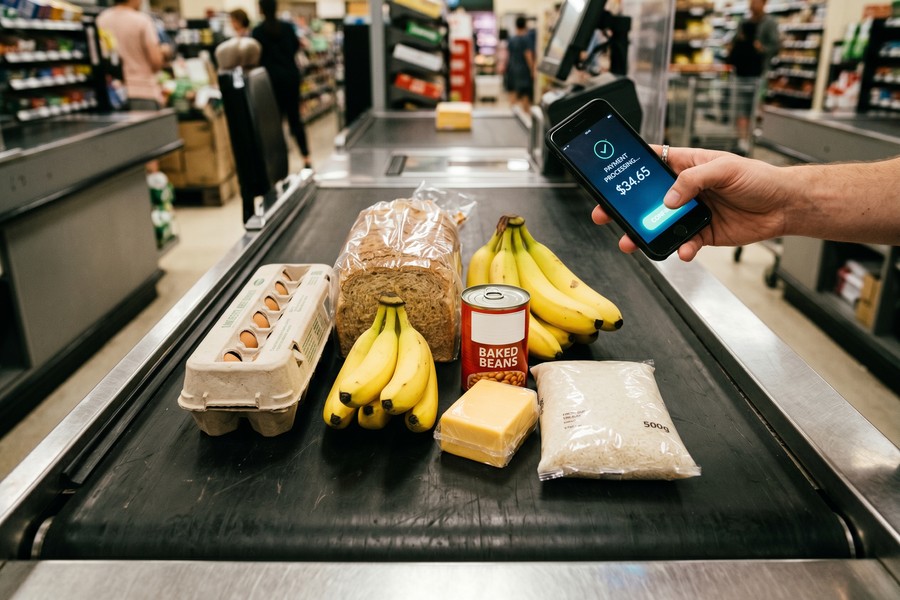
One data point deserves more attention than it usually gets: 25% of U.S. BNPL users are now financing grocery purchases, up from 14% in 2024. Competitors in this content space tend to treat this as a neutral feature expansion. It is not. When a consumer finances a grocery run, they are borrowing money to buy food that will be consumed before the final payment is due. There is no asset to show for it.
This is a structural shift in the risk profile of the product for that user segment, and it tracks alongside rising late-payment rates. If you find yourself reaching for a BNPL option at the grocery checkout, that is a signal worth pausing on, not because BNPL is uniquely problematic, but because it points to a cash-flow gap that the loan does not solve and that could cascade into missed payments and fees.
For households dealing with tight budgets, resources like SNAP benefits guidance may address the underlying pressure more sustainably than short-term installment credit on consumables.
When BNPL Actually Makes Financial Sense in 2026
There is a real use case for BNPL, and it is worth being precise about it rather than dismissing the product entirely. The Federal Reserve’s 2024 consumer finance survey found the top two reasons people use BNPL are spreading payments (87% of respondents) and convenience (82%). The majority of users are not financing purchases because they cannot afford them. They are managing cash flow deliberately. That describes a legitimate financial behavior.
The clearest scenario where BNPL makes sense: a zero-interest Pay-in-4 plan on a planned, durable purchase such as a laptop, appliance, or travel booking, where you already have the cash in your account and are simply choosing to preserve liquidity over six weeks. The loan costs you nothing in interest, the purchase has lasting value, and the payment schedule imposes no financial stress. Used this way, BNPL functions as a free short-term loan.
Before using any BNPL plan, set a calendar reminder for each payment date. Most late fees are not large, but they represent 100% interest on a zero-cost transaction, and a single missed payment eliminates the entire financial benefit of using BNPL over a debit card.
Comparing BNPL to Zero-APR Credit Cards
For larger purchases, the comparison that matters is not BNPL versus credit cards in general. It is BNPL versus a 0% APR introductory credit card. Many cards offer 12 to 24 months of interest-free financing on new purchases for qualified applicants, which gives substantially more runway than BNPL’s typical six-week window. If you can qualify for a 0% APR card and the purchase is large enough to benefit from longer-term payments, the card almost always wins on flexibility and consumer protection.
BNPL does retain a defensible niche for consumers who cannot qualify for a credit card, who want a fixed payment schedule without a revolving credit line, or who are making a specific purchase at a merchant where a BNPL provider is offering a genuine promotional rate (not deferred interest). The distinction between zero interest and deferred interest is covered in the fine print section below, and it is one of the most consequential things to understand before signing up for any BNPL plan longer than six weeks.
| Feature | BNPL Pay-in-4 | 0% APR Credit Card | Standard Credit Card |
|---|---|---|---|
| Interest cost | $0 (if on time) | $0 (intro period) | 21–29% APR ongoing |
| Repayment window | 6 weeks typical | 12–24 months | Revolving (flexible) |
| Dispute rights | Provider policy only | Federal Regulation Z | Federal Regulation Z |
| Credit reporting | Varies by provider | Yes, all bureaus | Yes, all bureaus |
| Credit check | Soft check typical | Hard inquiry | Hard inquiry |
| Late fee | $5–$15 typical | Up to $32 federal cap | Up to $32 federal cap |
When BNPL Is a Bad Idea
The clearest warning sign is financing consumables. Paying for groceries, food delivery, streaming services, or concert tickets on a BNPL plan means your last payment arrives after the purchased item has zero residual value. Most personal finance frameworks classify this as bad debt: you are borrowing to consume, not to acquire. The borrowed money provides no lasting financial benefit and leaves you with a future payment obligation on something you have already used up.
Beyond consumables, the numbers on user experience are sobering. A March 2025 Bankrate survey found that 49% of U.S. BNPL users reported at least one problem with the product, 25% said it made them spend more than intended, and 41% made at least one late payment in 2025. These are not edge cases. They describe behavior that is common enough to be considered a baseline risk for regular users.
If you return a BNPL purchase while installment payments are still scheduled, many providers continue collecting payments while the refund is processed. Credit card chargebacks typically freeze payment collection immediately, a protection that BNPL largely lacks, and that the now-rescinded CFPB rule would have addressed.
The Deferred Interest Trap
One of the most underreported risks in BNPL is the difference between zero interest and deferred interest. Standard Pay-in-4 plans genuinely charge no interest. But some BNPL providers offer longer-term financing plans, 6, 12, or 24 months, that are structured as deferred interest: no interest accrues if you pay in full by the end of the promotional period, but if you miss the final payment or carry a balance beyond the deadline, retroactive interest on the entire original purchase amount is applied immediately. This is functionally identical to how store-branded credit cards work, and it can turn a $600 appliance purchase into a $780 debt overnight. Read the fine print carefully. The phrase “no interest if paid in full” is the signal that deferred interest may be in play.
The Spending Behavior Problem
There is a behavioral dimension that data consistently supports. Breaking a $200 purchase into four $50 payments reduces the psychological weight of the transaction at the point of purchase. That is useful for cash flow management, and it is also precisely what makes BNPL more likely to be used for purchases that wouldn’t otherwise be made. A quarter of users acknowledge they spent more than intended.
For anyone carrying existing credit card balances, adding BNPL obligations on top is a compounding risk. If you are already working through credit card debt, reviewing strategies for managing high-interest debt before taking on additional installment obligations is the more productive sequence.
Choosing Between BNPL Apps in 2026: A Provider Reality Check
The five major U.S. BNPL providers differ meaningfully on credit reporting, fee structures, merchant reach, and the financial profile of the user they serve best. Understanding those differences is more useful than picking an app based on which checkout button you see most often.
According to J.D. Power’s banking and payments research, BNPL is the fastest-growing payment method they track. That growth has not been uniform across providers. Affirm holds the clearest position on credit reporting: it reports all loans to Experian and TransUnion, which makes it both the most credit-transparent option and the one where payment behavior has the most direct consequence for your file. PayPal Pay Later has expanded rapidly, and its BNPL product offers 5% cash back on purchases while maintaining different reporting practices from Affirm. Klarna and Afterpay still do not report standard four-payment plans to U.S. credit bureaus, which can be strategically useful for short-term liquidity management without credit file exposure, but only when payments are made on time every time.
| Provider | Credit Reporting (U.S.) | Typical Late Fee | Longer-Term Plans Available | Best For |
|---|---|---|---|---|
| Affirm | Experian + TransUnion (all loans) | None (no late fees) | Yes (up to 36 months) | Users comfortable with credit file transparency |
| Klarna | Not reported (Pay in 4) | Up to $7 | Yes (Financing option) | Short-term, low-risk cash flow management |
| Afterpay | Not reported (Pay in 4) | Up to $8 | No | Small purchases under $2,000 |
| PayPal Pay Later | Not reported (Pay in 4) | None stated | Yes (Pay Monthly) | Users who want rewards and wide merchant acceptance |
| Zip (Quadpay) | Not reported (Pay in 4) | Up to $7 | No | Broad merchant compatibility |
Affirm’s no-late-fee policy is genuinely useful as a consumer protection feature. Missing a payment does not trigger a fee, though interest may accrue on longer plans. The tradeoff is that the lack of a fee penalty does not prevent the missed payment from appearing on your credit report. For users building or protecting their credit, that distinction matters more than the fee amount.
U.S. BNPL purchase volume reached approximately $70 billion in 2025, with an implied outstanding debt stock of $3.02 billion at any point in time, according to the Federal Reserve Bank of Richmond’s March 2026 Economic Brief. Total volume growth is forecast to decelerate to 14.0% in 2026, down from 27.1% in 2024.
Thinking About Provider Stability
BNPL growth is decelerating, and margin pressure on providers will increase as regulation tightens and user acquisition costs rise. That is relevant context for a product you may rely on regularly: terms can change, apps can be acquired, and some providers in certain states have already pulled back from markets where compliance is costly. Not building habitual dependence on a single app is reasonable financial hygiene given the current industry trajectory.

The 2026 Pre-Purchase Checklist: Reading the Fine Print That Actually Matters
Most BNPL fine print is written to be skimmed and skipped. Four questions cut through it effectively, and they apply across every provider and every purchase size.
First: Is this zero interest or deferred interest? Look for the phrase “no interest if paid in full by [date].” That is the deferred interest flag. True zero-interest plans state simply that no interest applies. Second: does this provider report to credit bureaus, and are you comfortable with that? If you are approaching a mortgage or major loan application, credit file visibility from BNPL may work against you. Third: what happens if you return the item? Read the specific return and refund policy for the BNPL provider, not just the merchant’s return policy. They are separate agreements with separate timelines. Fourth: do you already have an open BNPL balance? If so, adding another increases your aggregate obligation in a way that is invisible to every lender who checks your credit report.
| Question to Ask | What to Look For | Red Flag |
|---|---|---|
| Interest type | “0% APR” or “no interest” | “No interest if paid in full” (deferred) |
| Credit reporting | Provider disclosure or FAQ | Affirm reports; others may not |
| Return policy | BNPL provider’s specific refund terms | Payments continue during return processing |
| Existing balances | Count all open BNPL loans across providers | More than one concurrent loan |
| Purchase type | Durable, planned, lasting value | Consumables, groceries, events |
For consumers trying to reduce total debt load rather than manage cash flow, BNPL is almost never the right tool. The better path is finding ways to reduce the interest cost on existing balances or building a cash buffer that makes short-term borrowing unnecessary. And if you are using BNPL because income has become irregular, exploring options for additional income, such as micro-freelancing platforms that have expanded significantly in 2026, addresses the root problem rather than borrowing around it.
The EU’s Consumer Credit Directive II, effective November 2026, will require BNPL providers operating across EU member states to conduct formal creditworthiness assessments, provide standardized pre-contract disclosures, and support borrowers in financial hardship, protections that parallel the FCA’s July 2026 UK rules and have no equivalent federal counterpart for most U.S. consumers.
Some longer-term BNPL financing plans advertised as “0% interest” are structured as deferred interest. If you miss the final payment or carry any balance past the promotional end date, retroactive interest on the full original purchase amount applies immediately. Always confirm which structure applies before signing.
63% of BNPL borrowers held multiple simultaneous loans at some point during the year, and 33% borrowed from more than one provider at the same time, according to CFPB data. No single lender can see this aggregate debt load because most BNPL loans do not appear on credit reports.
Real-World Example: The Hidden Cost of Stacking BNPL Loans
Consider an illustrative example: a 29-year-old renter with a household income of $58,000 uses BNPL across three providers over a six-month period. In January, she finances a $480 laptop through Affirm on a six-week Pay-in-4 plan ($120 per installment). In February, she uses Klarna for a $160 pair of running shoes ($40 per installment). In March, she adds an Afterpay plan for $220 in household goods ($55 per installment). At peak, she is managing three simultaneous BNPL obligations totaling $860, with a combined monthly payment of roughly $215 across providers.
None of the three lenders can see the others. Her credit report shows only the Affirm trade line. When she applies for an apartment in April, her bank statements reveal the three recurring BNPL payment streams. The landlord’s screening service flags the pattern as unresolved installment debt. She qualifies for the apartment, but a lender reviewing the same statements for a car loan three months later is less accommodating. The debt-to-income calculation, done correctly using bank statement evidence rather than her credit report, pushes her DTI to 41%, above the threshold for the loan terms she wanted.
Meanwhile, she misses one Afterpay payment in April due to a paycheck timing issue. The $8 late fee is minor. But the missed payment, though not reported to credit bureaus by Afterpay, triggers a payment freeze on her Afterpay account. She cannot initiate new purchases on the platform until the balance is resolved. She also returns the household goods purchase and discovers that Afterpay will process her refund within 3 to 10 business days, but the missed payment remains outstanding in the interim. The refund and the outstanding balance are two separate transactions from Afterpay’s perspective.
The outcome: $8 in fees, a two-week account freeze, a delayed refund process, and a loan application that required extra documentation and came in at a higher APR than anticipated. None of these outcomes were catastrophic. But each was a direct consequence of loan stacking across providers, a behavior that 33% of active BNPL users exhibit, according to CFPB data, and that the current U.S. reporting architecture makes nearly impossible for any single lender to detect in advance.
Your Action Plan
-
Audit your current BNPL exposure before taking on any new plan
List every open BNPL balance across all providers, the remaining payment amounts, and the due dates. If the aggregate monthly obligation exceeds 5% of your take-home pay, pause new BNPL activity until existing balances are cleared. This is the step most users skip, and it is the one most directly connected to the loan-stacking problem.
-
Identify the interest structure of any plan before you accept it
For any plan longer than six weeks, locate the specific language in the offer about interest. True zero-interest and deferred-interest plans look similar at the top of the page and differ dramatically in the fine print. If you see “no interest if paid in full,” that is deferred interest. Confirm the exact promotional end date and set a reminder 30 days prior.
-
Check whether the provider reports to credit bureaus, and decide if that matters for you
If you have a mortgage application, major loan, or lease review within the next 12 months, Affirm’s bureau reporting means missed payments will affect your file. If credit file exposure is a concern, Klarna or Afterpay Pay-in-4 may be lower-risk options for short-term cash flow management, provided you pay on time without exception.
-
Research your state’s specific BNPL consumer protections
The CFPB’s federal rollback means your rights depend on your state. Search your state attorney general’s website or consumer finance division for any BNPL-specific regulations, licensing requirements, or complaint procedures that apply in your jurisdiction. New York residents should monitor the proposed 2026 rules for updates on implementation timing.
-
Apply the four pre-purchase questions to every BNPL transaction
Before confirming any BNPL plan: (1) Is this zero interest or deferred interest? (2) Does this provider report to credit bureaus? (3) What is the provider’s specific refund and return policy if I need to return the item? (4) Do I already have an open BNPL balance anywhere? If the answer to question four is yes, the risk calculus changes meaningfully.
-
Avoid BNPL for consumables, recurring services, and events
Draw a firm line at financing items with no lasting value. Groceries, restaurant delivery, concert tickets, and subscription services financed on BNPL mean you are carrying installment debt on something you have already consumed. This is the category where 25% of current users are spending, and it correlates with higher late-payment rates.
-
Disclose all BNPL balances proactively to mortgage and loan underwriters
Do not assume that because a BNPL loan does not appear on your credit report, it is invisible to underwriters. Bank statements reveal payment patterns. Proactively disclosing and documenting your BNPL obligations gives you control over the narrative, rather than leaving an underwriter to interpret an unexplained recurring outflow.
-
If you are using BNPL to cover a cash-flow gap, address the gap directly
BNPL resolves a payment timing problem, not an income problem. If you find yourself using it to cover groceries, utility bills, or recurring expenses, that is a sign the underlying budget needs attention. Options like checking updated eligibility for income-based assistance programs in 2026 or finding supplemental income through additional work may address the root cause more durably than a six-week installment plan.
Frequently Asked Questions
Does using BNPL hurt your credit score in 2026?
It depends on the provider and the scoring model. Affirm reports all loans to Experian and TransUnion, so missed payments will appear on your credit file with those bureaus and may affect your score under models that incorporate BNPL data. Klarna, Afterpay, and PayPal Pay in 4 still do not report standard four-payment plans, meaning payment behavior with those providers does not appear on your credit report in most cases. The key caveat: both Experian and TransUnion have stated that Affirm’s BNPL trade lines will not affect traditional FICO scores “in the near term,” but FICO announced in July 2025 that it is incorporating BNPL data into select scoring models. The landscape is shifting, and assuming BNPL is permanently invisible to credit scoring is not a safe assumption.
What happened to the CFPB’s BNPL protections?
The CFPB issued an interpretive rule in May 2024 that classified BNPL digital accounts as credit cards under Regulation Z, which would have given users formal dispute rights, billing statement requirements, and refund protections equivalent to credit card holders. In May 2025, the CFPB announced it would not prioritize enforcement of that rule and confirmed it would not reissue it. The rescission was based on procedural grounds and the argument that open-end credit regulations were a poor fit for closed-end BNPL products. Those federal protections are not in effect, and consumer rights in the U.S. depend on state law and individual provider policies.
What is the difference between zero interest and deferred interest on BNPL plans?
Zero interest means no interest is charged under any circumstances for the plan duration. You pay exactly what you borrowed, regardless of when individual payments are made. Deferred interest means interest is not charged only if the full balance is paid by the promotional end date. If you miss that deadline or carry any remaining balance, retroactive interest on the entire original purchase amount is applied immediately. Some longer-term BNPL plans are structured this way, and the language “no interest if paid in full” is the signal to look for. Always confirm which structure applies before accepting any BNPL plan longer than six weeks.
Can BNPL affect my ability to get a mortgage?
Yes, though the mechanism is often indirect. Most BNPL loans do not appear on credit reports, so they are invisible to underwriters who review only your credit file. However, underwriters also review bank statements, and recurring BNPL payments will appear there. If you are stacking multiple BNPL loans, the aggregate payment obligation can push your debt-to-income ratio above qualifying thresholds when correctly calculated using bank statement data. HUD issued a formal Request for Information in June 2025 specifically investigating how BNPL affects FHA mortgage applicants’ financial profiles. The safest approach before any mortgage application is to disclose all BNPL balances proactively and pay them off before applying if possible.
Which BNPL app is safest to use in 2026?
There is no single answer, because “safest” depends on your specific financial situation. For users who want credit file transparency and are confident they will pay on time, Affirm’s bureau reporting is a feature. For users who are close to a mortgage application or need short-term cash flow management without credit file impact, Klarna or Afterpay’s non-reporting policy may be preferable. Affirm’s no-late-fee structure is a genuine consumer protection feature. Across all providers, the safest use case is a zero-interest Pay-in-4 on a planned durable purchase when you already have the cash available.
Is BNPL regulated in the United States?
At the federal level, BNPL is subject to general FTC consumer protection standards and contract law, but no specific federal framework is currently active following the CFPB’s 2025 rollback. Regulation is handled at the state level, and the landscape is uneven. New York has proposed detailed BNPL rules including licensing requirements, fee caps, affordability checks, and data use restrictions. Most other states apply preexisting consumer finance statutes that were not written with BNPL in mind. Consumers in states with active regulation have meaningfully stronger legal protections than those in states without it.
How is BNPL regulated in the UK and EU compared to the U.S.?
The UK’s Financial Conduct Authority begins full BNPL regulation on July 15, 2026, requiring all providers to conduct affordability checks, provide pre-contract disclosures, obtain FCA authorization, and support customers in financial difficulty. The EU’s Consumer Credit Directive II takes effect in November 2026 with similar requirements across member states. Both frameworks provide standardized consumer protections, formal complaint rights, and enforcement mechanisms. U.S. consumers in most states have none of these protections at this time, making the risk profile of BNPL products meaningfully higher for American users than for their European counterparts.
Does BNPL build credit?
Weakly, and only under specific conditions. Affirm reports to Experian and TransUnion, but not Equifax. FICO simulations suggest average score changes of approximately plus or minus 10 points from BNPL trade lines, which is comparable to opening any new account and not the meaningful credit-building effect that some marketing suggests. For someone with a thin credit file, a secured credit card will typically produce more reliable and better-documented credit-building results than BNPL, and comes with federal consumer protections that BNPL lacks.
What should I do if a BNPL provider keeps charging me after I return an item?
First, document your return with written confirmation from the merchant: a return receipt, email acknowledgment, or tracking number. Then contact the BNPL provider directly with that documentation and request a payment suspension pending refund processing. If the provider does not cooperate, file a complaint with the CFPB at consumerfinance.gov and with your state attorney general’s consumer protection office. If you used a credit card to fund your BNPL account, check whether your card issuer will process a chargeback. This situation is one of the most concrete harms that the now-rescinded CFPB rule was designed to prevent. The absence of federal chargeback rights for BNPL users makes documentation and escalation more important.
How do I know if I am using BNPL too much?
Three clear signals: you have more than one open BNPL balance at any time; you have used BNPL for groceries, food delivery, or other consumables in the past 90 days; or you have missed a payment in the past 12 months. Any one of these warrants a review of your overall cash-flow management rather than another BNPL plan. The 41% late-payment rate among users in 2025 suggests that the product is regularly used by people who are already stretched, not just by people managing cash flow deliberately. If BNPL is filling a gap rather than providing convenience, the underlying budget gap is the problem to address.
Sources
- Federal Reserve Bank of Richmond, Economic Brief: “Buy Now, Pay Later: Recent Developments and Implications” (March 2026)
- Consumer Financial Protection Bureau, CFPB Announcement Regarding Enforcement Actions Related to Buy Now Pay Later Loans
- Financial Conduct Authority (UK), Buy Now Pay Later Consumer Information
- Financial Conduct Authority (UK), Policy Statement PS26/1: Regulating Buy Now Pay Later
- National Consumer Law Center, States Can Protect Buy Now Pay Later Borrowers (February 2026)
- The Financial Brand, J.D. Power Buy Now Pay Later Study: Sean Gelles on BNPL Growth
- AM Online, New Buy Now Pay Later Rules to Begin in July 2026, FCA Says
- Consumer Financial Protection Bureau, Buy Now, Pay Later: Market Trends and Consumer Impacts
- Bankrate, Buy Now Pay Later Statistics and Survey Results (2025)
- Federal Reserve, Report on the Economic Well-Being of U.S. Households (2024)
- U.S. Department of Housing and Urban Development, HUD Press Releases and Regulatory Information
- FICO Newsroom, FICO Score and BNPL Data Incorporation Announcement (July 2025)