
Fact-checked by the MyFinancial101 editorial team
Quick Answer
The zero-based budgeting method works better for aggressive debt payoff; pay yourself first works better for building long-term savings once debt is under control. Both outperform having no system, but the right choice depends on your financial stage. Only 42% of Americans currently track their spending at all, making any consistent method a significant upgrade.
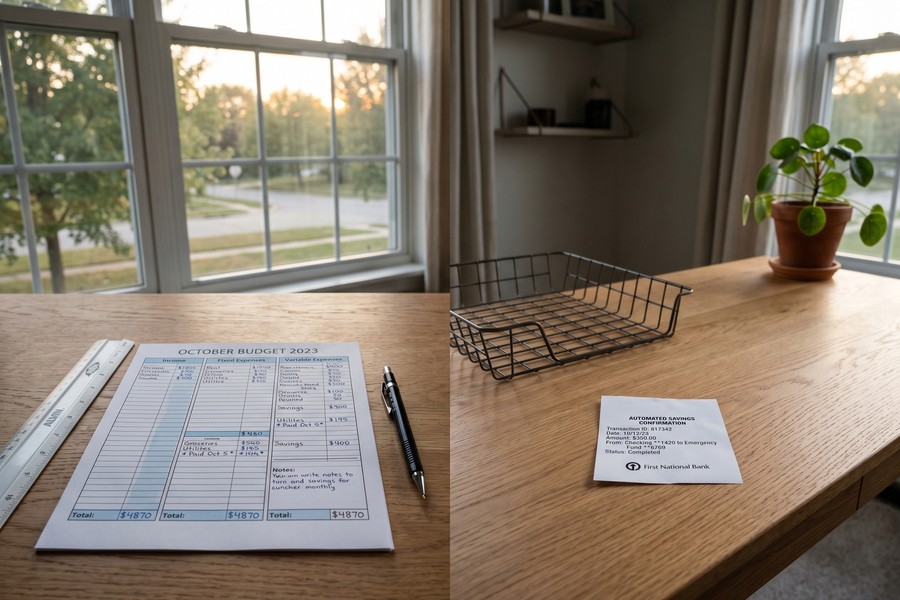
The zero-based budgeting method assigns every dollar of income a specific destination before the month begins, rent, groceries, debt payments, and savings all get named line items, leaving a balance of exactly zero unallocated. It traces its roots to corporate finance, where Peter Pyhrr developed it at Texas Instruments in the 1970s, and was later adapted for personal use by Dave Ramsey and the budgeting software YNAB (You Need A Budget). According to the NFCC’s 2024 Financial Capability Survey, only 42% of Americans report having a budget and actively tracking their spending, which means the comparison between methods matters far less than most people assume, because starting with either one puts you ahead of the majority.
The alternative approach, pay yourself first, is not really a full budget. It is a savings-sequencing strategy: the moment income arrives, a predetermined amount transfers automatically to savings or investments, and whatever remains funds living expenses. This article breaks down exactly when each method gives you a structural edge, what each one costs you in time and stress, and why the choice between them should depend on your current financial stage, not your personality type.
Key Takeaways
- 67% of U.S. workers reported living paycheck to paycheck in 2025, up from 63% the previous year, per PNC Bank’s Annual Financial Wellness in the Workplace Report, making structured budgeting a financial necessity, not a nice-to-have.
- The U.S. personal savings rate stood at just 3.60% of disposable income, according to Federal Reserve FRED data, confirming that most Americans spend first and save whatever is left, exactly the behavior pay yourself first is designed to correct.
- 59% of Americans in 2025 could not cover an unexpected $1,000 emergency expense from savings, per Bankrate’s 2025 Annual Emergency Savings Report, a gap that neither method can close unless it is used consistently for months, not weeks.
- Only 46% of U.S. adults had enough saved to cover three months of expenses, down from 53% in 2021, according to the FINRA Foundation’s National Financial Capability Study, reinforcing that building savings requires a reliable system, not just intention.
- The zero-based budgeting method, when built correctly, places savings as the first named line item, functionally embedding the pay yourself first principle inside it, a nuance almost no comparison article acknowledges.
In This Guide
What These Two Methods Actually Do (and Where Most Explanations Get It Wrong)
Zero-based budgeting does not mean your bank account hits zero at the end of the month. It means every dollar of expected income is assigned a purpose on paper before the month begins, and that total assignment equals your total income, leaving no unallocated remainder. Savings, emergency fund contributions, and debt payments are explicit line items, not afterthoughts. The Consumer Financial Protection Bureau (CFPB) frames structured budgeting of this kind as a foundational step toward managing debt and reaching savings goals of any size.
The reverse-budgeting alternative works differently. Income arrives, a fixed transfer goes immediately to savings or an investment account, and the rest funds whatever comes next. There is no category-level tracking after that transfer happens. That is simultaneously its greatest advantage and its most significant blind spot, more on that in a moment.
The Conceptual Overlap Nobody Names
Here is the nuance almost every comparison article skips: a correctly built zero-based budget already incorporates the pay yourself first principle. When savings appears as the first line item in a ZBB, before groceries, before entertainment, before anything discretionary, the money is functionally set aside first. The two methods are not opposites. They sit on a spectrum from full spending visibility (ZBB) to minimal tracking with automated savings priority (pay yourself first). Knowing where you fall on that spectrum is more useful than declaring a winner.
The zero-based budgeting method was originally developed by Peter Pyhrr at Texas Instruments in the 1970s as a corporate financial planning tool. It was adapted for personal finance decades later, most prominently by Dave Ramsey and the software platform YNAB, giving it an institutional track record that predates most personal finance trends by decades.
The Core Trade-Off: Control vs. Consistency
Zero-based budgeting delivers spending visibility no other method can match, but that visibility has a real price. Building a monthly ZBB typically takes 30 to 60 minutes of setup at the start of each month, plus mid-month check-ins to catch overspending before it compounds. As CFP Sheri Conklin explains:
“You will need to keep a list of the assumptions that go into the numbers, so you will be able to analyze monthly why you have over- or underspent in a category.”
That ongoing analysis is the point of ZBB, but it is also the reason people quit. The reverse approach removes most of that burden through automation. Once the recurring transfer is set up, the monthly decision-making work is done. Behavioral research consistently finds that people who automate savings contributions, whether into a high-yield savings account at SoFi or a brokerage account at Fidelity, save more reliably than those who plan to transfer money manually each month. The intention-action gap is real, and automation closes it.
Precision vs. Autopilot
Think of this as a precision-versus-autopilot axis rather than a better-versus-worse question. ZBB gives you a complete map of where every dollar goes. The automated approach gives you one guaranteed outcome, savings happen, while the rest of spending remains unmapped. Neither is morally superior. The right answer depends on your financial situation: how much debt you carry, how predictable your income is, and how much tracking bandwidth you realistically have each month.
Which Method Wins for Debt Payoff?
Zero-based budgeting is objectively stronger for aggressive debt payoff, and the reason is mechanical rather than motivational. In a ZBB, a $1,200 monthly debt payment is a named line item filled before any discretionary category gets a dollar. The money cannot be quietly absorbed by restaurant spending or streaming subscriptions because those categories are filled from what remains after the debt line is satisfied. The pay yourself first model has no equivalent mechanism: it automates savings, but debt payments are left to compete with all other spending.
A Concrete Example
Consider someone earning $4,000 per month after tax, carrying $8,000 in credit card debt tracked on an Experian credit report with a high APR dragging their FICO Score down. If they use the automated savings approach and transfer $400 to savings, they have $3,600 left untracked. Without category-level control, lifestyle spending can easily absorb $1,000 that could have gone to debt, slowing payoff significantly. Under ZBB, that same person assigns $1,200 to debt repayment as a line item before any discretionary category is touched, leaving roughly $2,400 for fixed and variable expenses. At that rate, the $8,000 balance is cleared in under seven months without touching the $400 savings contribution. If you are currently working through a credit card debt payoff plan, ZBB’s category-level structure gives you the clearest path forward.
If you use pay yourself first during a debt payoff phase, set up a separate automatic transfer specifically for your target debt payment, treating it exactly like a savings contribution. This borrows ZBB’s discipline without requiring a full monthly budget rebuild, and it outperforms leaving the debt payment unautomated.
The honest counter-argument: automating even a fixed minimum debt payment under the reverse-budgeting approach still outperforms doing nothing. A simpler system used consistently beats a superior system abandoned after six weeks. For anyone carrying high-interest credit card debt, where APR rates from Chase, Citibank, and other major issuers routinely exceed 20%, the structural precision of ZBB is worth the additional setup time.
Which Method Wins for Building Long-Term Wealth?
Automated savings strategies have a clear edge for wealth-building when debt is not a primary concern. The mechanism is simple: savings happen before any spending decision is made, which means they are not subject to the month’s unexpected expenses or impulse purchases. With the U.S. personal savings rate sitting at just 3.60% per Federal Reserve FRED data, the average American is spending 96 cents of every take-home dollar. An automatic savings transfer attacks that pattern directly by making saving the first transaction rather than the last.
The Hidden Cost of Untracked Spending
What the pay yourself first approach does not reveal is where the remaining 80% to 95% of income goes. A person can hit their savings target every single month while simultaneously running up credit card balances on unmonitored discretionary spending, and the savings account balance will look healthy right up until the card statements arrive. This is a concession that advocates of the method rarely make directly. If you are building wealth through regular investing and want guidance on where those automated contributions should go, a grounding in basic investing principles will help you choose the right FDIC-insured accounts or brokerage options before you set up the automation.
Only 46% of U.S. adults had three months of living expenses saved, down sharply from 53% in 2021, per the FINRA Foundation’s National Financial Capability Study. The decline happened during a period of historically elevated wages, suggesting that income growth alone does not build savings, a reliable sequencing system does.
| Feature | Zero-Based Budgeting | Pay Yourself First |
|---|---|---|
| Monthly setup time | 30–60 minutes | 5–10 minutes (initial setup only) |
| Spending visibility | Full, category-level | None after savings transfer |
| Best for debt payoff | Yes, debt as named line item | Only if debt payment is also automated |
| Best for wealth-building | Yes, but requires more effort | Yes, automation ensures consistency |
| Works with variable income | Yes, rebuilt monthly around actual income | Risk of overdraft in lean months |
| Dropout risk | High, monthly rebuild is the top cited reason | Low, automation reduces decision fatigue |
| Detects lifestyle inflation | Yes, category overspending is visible | No, spending is untracked |
The Variable-Income Problem: Which Method Survives an Irregular Paycheck?
Freelancers, gig workers, and commission earners face a specific structural problem with automated savings strategies that almost no budgeting article names directly. When income fluctuates month to month, a fixed automated transfer can overdraw an account during a lean month, or force the saver to manually cancel or reverse the transfer, defeating the automation entirely. If you have been exploring micro-freelancing or gig income as a way to build earnings, your budgeting method needs to account for income that does not arrive on a predictable schedule.
Zero-based budgeting is more resilient here because it rebuilds around actual income each month. The income floor approach, budgeting based on your lowest expected monthly income rather than your average, prevents overspending during down months while allowing surplus allocation during strong ones. A practical hybrid works well for variable earners: build a one-month income buffer first, then use last month’s known earnings as this month’s ZBB starting number. That single step eliminates income volatility as a variable entirely, and it combines the structural precision of ZBB with the safety net that automated savings transfers require to function without overdraft risk. The Federal Reserve’s consumer finance research reinforces this point: households with a cash buffer, even a small one, are substantially less likely to carry revolving credit card debt that raises their debt-to-income (DTI) ratio and depresses their FICO Score over time.

67% of U.S. workers reported living paycheck to paycheck in 2025, up from 63% in 2024, according to PNC Bank’s Annual Financial Wellness in the Workplace Report. For workers in this situation, the sequencing and automation built into either budgeting method can make the difference between building a savings cushion and remaining financially exposed to any unexpected expense.
Honest Costs, Dropout Risk, and How to Choose
Zero-based budgeting carries real dropout risk that most advocates understate. The monthly rebuild is the most commonly cited reason people abandon structured budgeting altogether, and a budget abandoned after 30 days produces worse long-term outcomes than a simpler method maintained consistently for years. As the CFPB’s financial education guidance and the California DFPI’s 2026 financial planning framework both acknowledge, flexible approaches like the 50/30/20 rule exist precisely because rigid systems lose adherents. The method you will still be using in month four is the correct one, not the method that is theoretically optimal on a spreadsheet.
Automated savings also carries a quiet cost that its proponents rarely surface: without category-level tracking, there is no early warning when spending is trending toward overdraft or credit card dependency. The checking account balance looks fine, the savings balance grows, and then the Chase or Citibank statement arrives with $600 more in charges than expected. The PNC Bank consumer guidance on pay yourself first notes this directly: both methods emphasize intentionality, but they differ substantially in the structure and mindset each requires. Treating savings as a nonnegotiable, fixed obligation, the way you would an auto loan payment reported to Experian or Equifax, is the core behavioral shift that makes the approach work.
A Direct Decision Framework
The clearest way to choose is by financial life stage, not temperament:
- Carrying high-interest debt: Use the zero-based budgeting method with your debt payment as the first named line item, before any discretionary spending category is assigned a dollar. If you need help negotiating the rates on that debt, understanding how to negotiate your credit card APR can lower the balance you are racing against.
- Debt-free with a savings gap: Pay yourself first. Set a specific savings percentage, not a dollar amount, so the transfer scales automatically with variable income months.
- Variable income or recovering from chronic overspending: Zero-based budgeting with the income floor approach. Build one month of buffer before automating anything.
- Already saving adequately but seeing lifestyle creep: A hybrid: automate savings first (PYF), then zero-base the remaining dollars across spending categories (ZBB). This is the structure that resolves the false choice between the two methods.
The U.S. Government Accountability Office’s assessment of zero-based budgeting found that managers using ZBB examine current objectives, operations, and costs, then rank priorities by importance. The same logic applies at the household level. Knowing which financial problem you are solving right now tells you which tool fits. For most people, that answer changes at least once over a decade of personal financial management, and revisiting the choice is not a failure, it is good financial thinking.
Related reading: hidden money management mistakes hurt.
Frequently Asked Questions
Is zero-based budgeting better than pay yourself first for most people?
It depends on whether you are in a debt-payoff phase or a wealth-building phase. Zero-based budgeting is structurally superior for eliminating debt because every dollar is explicitly assigned, including the debt payment, before discretionary spending is funded. The automated savings approach is more effective for long-term savings once debt is under control, because automation removes the monthly decision-making burden that causes most people to save inconsistently.
Can I use both methods at the same time?
Yes, and this hybrid is arguably the most effective approach for most households. Automate a savings contribution and any fixed debt payment the moment income arrives (pay yourself first logic), then assign every remaining dollar to spending categories before the month begins (zero-based budgeting logic). This gives you behavioral consistency on savings and full visibility on expenses simultaneously.
Does pay yourself first work if my income varies month to month?
Only with modifications. A fixed automated transfer on a variable income risks overdrawing your account during lean months, which can also trigger overdraft fees at banks like Chase or Bank of America that add to your costs. The safer approach is to set your automated transfer as a percentage of income rather than a fixed dollar amount, or to use ZBB with last month’s actual earnings as your starting number, eliminating income uncertainty before you budget any category.
How long does it take to set up a zero-based budget each month?
Most people require 30 to 60 minutes of setup at the start of the month, plus periodic check-ins of roughly 10 to 15 minutes mid-month to catch category overruns early. This time investment is the primary reason people abandon ZBB for simpler systems, so if that time is genuinely not available, a well-automated pay yourself first setup maintained consistently will outperform a zero-based budget that gets abandoned.
What percentage of income should I pay myself first?
A common starting point is 20% of take-home pay toward savings and debt repayment combined, aligned with the savings portion of the 50/30/20 framework referenced by both the CFPB and the California DFPI. The right number for your situation depends on your debt load, income stability, and existing emergency fund, but even starting at 5% to 10% and automating it consistently produces better outcomes than manually saving whatever is left each month.
Sources
- Consumer Financial Protection Bureau (CFPB), Budgeting: How to Create a Budget and Stick With It
- U.S. Government Accountability Office (GAO), Zero-Base Budgeting: Origins, Use, and Potential for Federal Budgeting
- Newsweek, PNC Bank Annual Financial Wellness in the Workplace Report: 67% of U.S. Workers Living Paycheck to Paycheck in 2025
- FINRA Foundation, 2024 National Financial Capability Study
- CBS News / Bankrate, 2025 Annual Emergency Savings Report: 59% of Americans Cannot Cover a $1,000 Emergency
- California Department of Financial Protection and Innovation (DFPI), 6-Step Financial Plan for 2026