Fact-checked by the MyFinancial101 editorial team
Quick Answer
Micro-investing apps for freelancers work by using round-ups, fractional shares, and flexible recurring deposits that adapt to variable income. Platforms like Acorns, Stash, and M1 Finance accept contributions as low as $1, and $5 daily invested consistently can grow to roughly $10,500 after five years at typical market returns. The key is automation over willpower.
Most investing advice assumes a steady paycheck. For freelancers, that assumption breaks almost everything: fixed monthly transfers fail during slow months, whole-share minimums exclude small deposits, and the psychological swing between a flush week and a dry one makes discipline nearly impossible. Micro-investing apps for freelancers solve this by replacing fixed-amount logic with percentage-based rules, round-up automation, and fractional share access that FINRA’s guidance on digital investment tools acknowledges are designed specifically to lower the barrier for retail investors with non-standard cash flows.
The apps are not magic. A $3 monthly subscription fee can quietly erase a year’s gains on a small account, and no platform eliminates market risk. This guide covers which apps actually fit freelance realities, how to automate contributions when income is lumpy, and what to build before you invest a single dollar.
Key Takeaways
- $5 per day invested in a diversified portfolio can compound to roughly $10,500 after five years at typical market returns, according to CNBC’s analysis of micro-investing growth.
- Acorns charges $3 to $5 per month depending on the tier; on accounts under $5,000 with sporadic deposits, that fee represents a significant drag on net returns (Acorns pricing, 2025).
- Fractional shares on platforms like Robinhood and Public allow investors to buy portions of ETFs or stocks for as little as $1, removing the whole-share price barrier entirely (Robinhood fractional shares documentation).
- The SEC has identified that digital engagement practices in mobile investing apps can introduce suitability risks, particularly for retail investors without consistent income profiles (SEC Request for Information on Digital Engagement Practices, 2021).
- Self-employed investors can contribute up to 25% of net self-employment income (capped at $69,000 for 2024) to a SEP IRA, making it a powerful complement to any taxable micro-investing account (IRS SEP Plan FAQs).
In This Guide
Why Irregular Income Makes Standard Investing Advice Fail
Fixed-dollar recurring transfers are the enemy of the freelance budget. The standard advice to “automate $400 a month into your brokerage” works fine for a salaried employee; it creates overdrafts and account raids for a graphic designer whose monthly income swings between $1,200 and $8,000. The problem is structural, not behavioral.
The Feast-or-Famine Trap
Freelancers tend to overspend during high-income months and over-withdraw investments during slow ones. This pattern, sometimes called income volatility whiplash, is documented across the gig economy. The rise of micro-freelancing has expanded the number of workers dealing with exactly this cycle, where project-based income arrives in batches rather than biweekly installments. When a big invoice clears, there is a temptation to invest aggressively. When there is a dry spell, that account becomes a target for cash.
The result is a net investing rate that feels active but actually amounts to near zero over time. Raiding a taxable account during slow months can also trigger short-term capital gains taxes on any appreciated positions, compounding the damage. Recognizing this pattern is step one. Designing around it with the right tools is step two.
Why Traditional Brokerages Fall Short
Traditional brokerage accounts from firms like Fidelity or Charles Schwab are excellent for investors with predictable cash flow. They offer broad investment options, low costs, and no mandatory monthly minimums. But their interface is built around intentional, manual trades. For a freelancer whose bandwidth is consumed by client deliverables, that model requires active engagement at the exact moment it is hardest to provide. The appeal of micro-investing platforms is automation that keeps money moving even when attention is elsewhere.
Freelancers and independent contractors made up roughly 36% of the U.S. workforce as of recent estimates, yet nearly all mainstream personal finance tools are calibrated for W-2 earners with predictable monthly income.
How Micro-Investing Apps Fit Freelance Realities
Round-ups, fractional shares, and percentage-based recurring deposits each solve a different piece of the irregular-income puzzle. Together, they make it possible to stay invested without manually deciding when or how much to invest.
Round-Ups and Fractional Shares
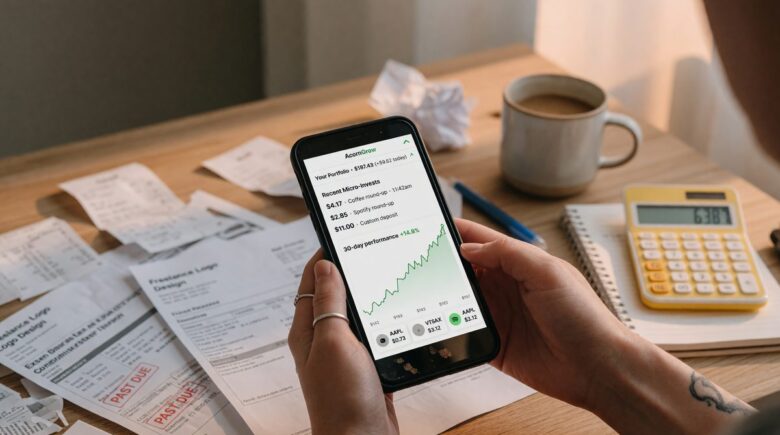
Round-up investing works by rounding each debit or credit card purchase to the nearest dollar and investing the spare change. Spend $4.60 on coffee and $0.40 goes into your portfolio. The amount is trivial per transaction, but the aggregate across dozens of weekly purchases adds up without any decision-making required. Acorns pioneered this mechanic, and it now supports round-ups from both personal and business debit cards, which matters for freelancers who run expenses through a separate business account.
Fractional shares take a different angle. On platforms like Robinhood and Public, you can invest exactly $23.47 in an S&P 500 ETF without needing to buy a whole share. This removes the psychological friction of waiting until you have “enough” to invest, a barrier that causes many freelancers to let cash sit idle in a checking account rather than putting it to work. If you want to understand the broader investing options available before committing to any platform, the beginner’s guide to investing with zero experience on this site is a solid starting point.
Automation Features Designed for Variable Income
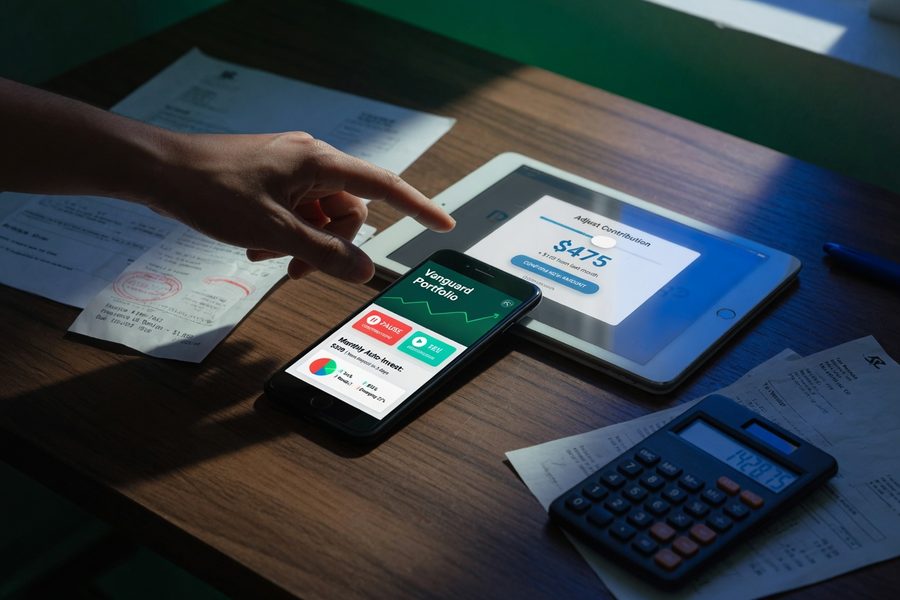
The best micro-investing apps for freelancers include features to pause, resume, or scale contributions without fees or penalties. M1 Finance lets users set recurring transfers but imposes no penalty for changing the amount or skipping a cycle entirely. Betterment and Wealthfront offer robo-advisor portfolios that rebalance automatically, so even if deposits are sporadic, the existing balance stays optimally allocated without active intervention. This matters for anyone whose attention is on billable client work rather than portfolio management.
One feature gap that most reviews overlook: linking micro-investing apps directly to freelance invoicing platforms. Tools like QuickBooks, FreshBooks, and Stripe can trigger automatic percentage sweeps when a client payment clears. Rather than waiting to feel financially comfortable enough to invest, a pre-set rule moves a fixed percentage, say, 10%, into a brokerage or savings account the moment revenue arrives. This makes investing a first expense rather than a last one.
Best Micro-Investing Apps for Freelancers in 2026
Four platforms stand out for freelancers specifically, though the right choice depends on how irregular your income actually is and how much the fee structure will matter at your current account size.
| App | Minimum Investment | Monthly Fee | Best For Freelancers |
|---|---|---|---|
| Acorns | $0 to start, $5 first investment | $3 (Personal) / $5 (Family) | Round-ups on business and personal cards |
| Stash | $0 to start | $3 (Growth) / $9 (Plus) | Fractional shares + auto-invest scheduling |
| M1 Finance | $100 initial, $0 recurring | $0 (basic) / $3/mo (M1 Plus) | Flexible recurring deposits, no trade fees |
| Betterment | $0 | 0.25% annually (no fixed fee) | Robo-advisor; scales with balance, not deposits |
The fee structure deserves direct scrutiny. A $3 monthly fee on a $600 account equals a 6% annual cost, far higher than what any diversified ETF portfolio is likely to return net of that drag. Acorns and Stash make financial sense only once an account reaches a meaningful balance, generally above $5,000. Below that threshold, Betterment’s percentage-based fee model (0.25% annually) is significantly cheaper for accounts that grow slowly through sporadic deposits.
According to CNBC’s micro-investing analysis, $5 per day invested in a diversified portfolio grows to roughly $2,000 after one year and $10,500 after five years at historical market return rates. That math holds even with irregular deposit timing, as long as the average contribution rate is maintained.
How Do You Automate Investing When Your Paycheck Changes Every Month?
Percentage-based rules beat fixed-dollar rules every time for non-W-2 earners. The logic is straightforward: if you commit to investing 15% of every payment received, a $500 project contributes $75 and a $5,000 project contributes $750. The discipline is in the rule itself, not in manually deciding each time.
Linking Apps to Your Income Flow
The most effective setup for freelancers uses two accounts working in tandem. The first is a high-yield savings account or business checking account where all client payments land. The second is the micro-investing platform, linked to that account with a recurring transfer that fires on a percentage basis. Payment processors like Stripe support automatic routing to multiple bank accounts on receipt of funds, meaning you can configure the transfer before you even invoice the client, removing the human decision entirely.
For those who manage income and expenses through QuickBooks Self-Employed, the profit-first accounting method works naturally alongside micro-investing automation: allocate a percentage to tax savings, a percentage to operating expenses, a percentage to owner pay, and a percentage to investment. When a client pays, every dollar has a destination before it touches your checking balance.
The SEC’s 2021 guidance on digital engagement practices notes that automated nudges and default settings in investing apps can serve retail investors well, but also cautions that users should review whether app-recommended allocations are actually suitable for their financial situation. For freelancers with debt obligations or thin cash reserves, an app’s default aggressive allocation may not be appropriate.
Pausing Without Penalty
Not every platform is equally forgiving about pausing contributions. M1 Finance and Betterment allow users to stop or reduce transfers at any time with no fee. Acorns similarly allows round-up pausing. During a prolonged dry spell, the ability to pause without penalty is not a convenience feature, it is a risk management tool. Forced liquidation of invested positions to cover short-term expenses is one of the most common ways small investors lock in losses.
Connect your micro-investing app to your business debit or credit card rather than your personal card. Business purchases are typically higher in volume, which generates more round-up capital, and keeping the flows separate makes bookkeeping cleaner for quarterly tax filings.
Build the Safety Net Before You Invest
Here is the counterintuitive advice: for most freelancers, building a cash runway should come before aggressive micro-investing. Three to six months of operating expenses in a high-yield savings account, earning anywhere from 4% to 5% APY as of mid-2026, is not a conservative move. It is the structural foundation that prevents investment accounts from becoming emergency funds.
Integrating the Emergency Fund With Your Investing Strategy
A dedicated “runway account” separate from both operating income and the investment portfolio does one important thing: it stops the cycle of investing during good months and withdrawing during bad ones. Without it, market timing becomes accidental and forced. With it, invested positions can stay invested through slow periods because there is a separate pool of cash available. The case for prioritizing retirement savings over other financial goals applies here too, the compounding advantage of leaving invested money untouched is significant, but only achievable if an emergency fund exists to absorb income gaps.
If your cash reserves are thin and existing debt is expensive, that debt likely deserves priority over any investment account. A useful reference for managing that trade-off is this breakdown of how to prioritize and negotiate credit card debt, a direct cost that micro-investing returns rarely outpace. Some freelancers also benefit from pairing their savings strategy with supplemental income, and a look at high-paying hourly jobs available in 2026 can help bridge income gaps while reserves are being built.

The tax dimension of micro-investing often gets ignored until it becomes a problem. Taxable brokerage accounts, where most micro-investing apps deposit funds, generate capital gains, dividends, and in some cases wash-sale complications if positions are sold during a cash crunch. Self-employed investors have a significant advantage here: contributions to a SEP IRA or Solo 401(k) are tax-deductible, reduce quarterly estimated tax liability, and grow tax-deferred. A SEP IRA allows contributions up to 25% of net self-employment income, capped at $69,000 for tax year 2024, according to IRS SEP Plan guidance. For freelancers earning meaningfully above expenses, routing some investment capital into a SEP IRA before topping up a taxable micro-investing account is the more tax-efficient sequence.
Frequently Asked Questions
Are micro-investing apps safe for freelancers with no steady income?
Yes, with the right setup. The safety concern is not the apps themselves but using them before a cash emergency fund exists. If invested funds become the only liquid asset during a slow month, forced selling at a loss is the likely outcome. Build three to six months of expenses in a separate high-yield savings account first, then automate micro-investing contributions as a percentage of incoming payments rather than a fixed monthly amount.
Which micro-investing app has the lowest fees for small accounts?
Betterment charges 0.25% annually with no fixed monthly fee, making it the most cost-effective option for accounts under $5,000 that grow slowly. Fixed-fee apps like Acorns ($3/month) and Stash ($3 to $9/month) can impose an effective annual cost of 6% or more on small balances, which erodes returns significantly for sporadic depositors.
Can freelancers use micro-investing apps for retirement savings?
Micro-investing apps primarily open taxable brokerage accounts, not retirement accounts. However, Betterment and Stash offer IRA options, and self-employed individuals can open a SEP IRA directly through a major brokerage alongside any micro-investing app. Because SEP IRA contributions are tax-deductible, they often provide a better after-tax return than an equivalent taxable micro-investing deposit for freelancers in higher income brackets.
How does round-up investing actually work?
Round-up investing automatically tracks purchases made on a linked card, rounds each transaction up to the nearest dollar, and transfers the accumulated difference into an investment account, typically at daily or weekly intervals. A $14.75 purchase generates a $0.25 round-up. Across 50 to 100 weekly transactions, this typically produces $10 to $30 per week in micro-contributions, all without any manual decision.
Should a freelancer invest in a micro-app or a SEP IRA first?
For most freelancers with net income above roughly $30,000 annually, a SEP IRA contribution should come before taxable micro-investing because it reduces self-employment tax liability dollar for dollar. After maximizing retirement contributions that are realistically affordable, a taxable micro-investing account through Betterment or M1 Finance is a sensible complement for medium-term goals. The two are not mutually exclusive, but sequencing matters for tax efficiency.