Fact-checked by the MyFinancial101 editorial team
Quick Answer
Making $500 a month cover your college needs is possible when housing and tuition are paid separately. Allocate roughly $150 for food, $75 for transportation, $75 for personal care and supplies, and $200 for everything else. Track spending weekly, use student discounts consistently, and cut textbook costs by 50–70% through rentals or library reserves.
Most college spending advice assumes you have more money than you do. The reality: families reported spending an average of $30,837 on college costs in 2025 according to Sallie Mae’s How America Pays for College report, yet a significant share of students are managing their day-to-day expenses on far less. If your discretionary budget lands around $500 a month after housing and tuition are handled, the right college student spending tips don’t just help, they’re the difference between finishing the semester solvent or drowning in small-dollar debt.
The current environment makes this harder than it was two years ago. Food prices remain elevated, rideshare surge pricing has gotten more aggressive, and textbook publishers keep pushing expensive digital subscriptions over affordable print rentals. Students on fixed monthly budgets feel all three of those pressures at once. Knowing where to cut without damaging your health or academic performance is the real skill.
This guide is for any college student, community college, four-year public, or private, whose monthly spending money sits at or near $500. Follow the five steps below and you will know exactly where every dollar goes, which costs you can cut without sacrifice, and where spending a little more actually protects your budget long term.
Key Takeaways
- The average total student budget at a public two-year college is $21,320 per year in 2025–26, according to the College Board’s 2025 Trends in College Pricing report, meaning monthly non-housing costs are a manageable target to optimize.
- 74% of families used parent income or savings to help pay for college in 2025 per Sallie Mae’s 2025 research, but that support rarely covers every daily expense, students still need their own spending plan.
- A proven $500 split keeps food at $150 or less, transportation at $75, and personal care at $75, with the remaining $200 covering supplies, entertainment, and an emergency buffer.
- Typical semester textbook spending runs $400–$600; using rentals, library reserves, or PDF sharing routinely cuts that cost by 50–70%, freeing roughly $100–$200 per month.
- Student discount programs through Apple, Adobe, Spotify, and transit agencies consistently save 10–30% on recurring costs, savings that compound every month they are used.
- The Consumer Financial Protection Bureau’s budgeting curriculum recommends the 50/30/20 rule as a starting framework, even when total income is small, the proportions hold as a guide.
In This Guide
- Step 1: Is $500 a Month Realistic for Your Actual Needs?
- Step 2: Map Every Income Source Before You Spend a Dollar
- Step 3: Track Spending Without Making It a Part-Time Job
- Step 4: How Do I Eat Well on $150 a Month or Less?
- Step 5: Cut Textbook, Supply, and Daily Costs With Student Perks
- Frequently Asked Questions
Step 1: Is $500 a Month Realistic for Your Actual Needs?
Five hundred dollars a month covers essential non-housing costs for most college students, but only if housing, tuition, and a meal plan are paid separately. Once you remove rent and tuition from the equation, your remaining needs shrink to food (when dining halls don’t cover everything), local transportation, personal care, and school supplies. Those four categories are manageable on $500 in most college towns in 2026.
What $500 Actually Has to Cover
The working split that shows up consistently in student budgeting guides is: $150 for food, $75 for transportation, $75 for personal care and household supplies, and $200 for a flexible category that absorbs textbooks, clothing, social spending, and a small emergency buffer. That $200 flex amount is the one you need to protect most aggressively, because it doubles as your safety net.
Location changes the math. Students in rural college towns typically spend less on transportation and food because grocery prices are lower and everything is nearby. Urban students at schools in Boston, San Francisco, or Chicago face grocery costs 15–25% above the national average and are more likely to need paid transit. A $500 budget is tighter there, but not impossible. The key variable is whether you are splitting costs with roommates for subscriptions, cleaning supplies, and bulk food purchases.
What to Watch Out For
The most common miscalculation is treating a partial meal plan as full coverage. Many plans cover 10–14 meals per week, which leaves 7–10 meals that students either skip or buy elsewhere. Those uncovered meals can easily add $100–$150 to monthly food costs without any conscious decision to eat out. Build that gap into your starting assumptions.
The average total student budget for a full-time in-district student at a public two-year college is $21,320 for 2025–26 per the College Board’s 2025 pricing data. That works out to roughly $1,777 per month all-in, meaning discretionary spending is a relatively small slice of a larger financial picture.

Step 2: Map Every Income Source Before You Spend a Dollar
Most students have irregular income, not a steady paycheck, and that timing problem causes more budget failures than the dollar amount itself. Aid refunds arrive once or twice a semester. Work-study pay comes weekly or biweekly but often runs a week behind. Family support may be monthly or sporadic. Before you assign a single dollar, write down every source of income, its typical amount, and when it actually lands in your account.
How to Do This
List every inflow from the past 60 days: financial aid disbursements, work-study earnings, part-time job wages, family transfers, and any freelance or gig income. Then divide the total by two to get your actual monthly average. Students consistently overestimate their income by counting a one-time aid refund as monthly recurring money. That refund has to stretch across three or four months, not just one.
If your income genuinely averages $500 per month, the FDIC’s Money Smart for Young Adults program recommends building a simple spending and saving plan that aligns outflows with actual inflow timing, not theoretical totals. Set up a free checking account with no minimum balance (many credit unions offer these to students) and treat each deposit as the beginning of a micro-budget cycle, not a windfall.
If you want to increase that income floor, micro-freelancing gigs and hourly jobs paying $19 or more are realistic options for students with 8–10 free hours per week, enough to add $200–$400 per month without destroying study time.
What to Watch Out For
Aid disbursement delays are real and common. If your refund check is late by even five days, rent and utility auto-payments can overdraft your account and trigger fees averaging $25–$35 per incident. Keep a minimum $50–$100 buffer in checking at all times, even if it means spending slightly less in the weeks leading up to a disbursement.
Set a recurring phone calendar event for every expected income date. When the deposit lands, immediately transfer your pre-planned category amounts to separate savings buckets or sub-accounts. Treating income as already allocated the moment it arrives removes the temptation to spend it before covering essentials.
Step 3: Track Spending Without Making It a Part-Time Job
You do not need an app, a spreadsheet, or a color-coded planner. The simplest tracking system that works for students is a weekly photo of your bank statement and three categories written on a sticky note: food, transportation, and everything else.
Spend 10 minutes every Sunday reviewing the past seven days against those three buckets. If food is already at $50 by day 7, you have roughly $100 left for the next three weeks, and you know it early enough to adjust. That single weekly review catches most budget derailments before they become crises. The students who run out of money by the 20th of the month rarely checked their balance between the 1st and the 15th. Don’t avoid looking.
Campus coffee shops, vending machines, and food trucks are the top three spending leaks for college students on tight budgets. Each purchase looks small ($4–$8) but five per week adds up to $80–$160 per month, enough to blow a $150 food budget entirely on convenience purchases alone.

Step 4: How Do I Eat Well on $150 a Month or Less?
Cooking at home is the single largest lever in a $500 college budget. Annual dining-out spending for the average American household runs near $4,000 per year according to Bureau of Labor Statistics consumer expenditure data, roughly $333 per month. Cutting that in half by cooking more is the fastest way to stay inside $150.
How to Do This
Build your grocery list around five cheap, high-nutrition staples: eggs, oats, dried beans or lentils, rice, and frozen vegetables. These five categories together cost roughly $35–$50 per month and form the base of 80% of cheap student meals. Add a protein (canned tuna, chicken thighs, or tofu) and fresh produce on a rotating basis. Total monthly grocery spend with this approach typically lands at $90–$130 for one person.
Here is a quick worked example: at $120 per month on groceries, you have $30 left in your food budget for coffee, occasional campus dining, or a group meal out. Compare that to the student who buys lunch on campus four times per week at $9 each, that is $36 per week, or $144 per month on lunch alone, before a single item is bought at a grocery store. The gap is $114 per month, or $1,368 per year.
Batch cooking on Sundays reduces the temptation to buy convenience food mid-week. A pot of rice and beans, a tray of roasted vegetables, and a dozen hard-boiled eggs takes about 45 minutes and covers 4–5 dinners. Students with only a microwave and a mini-fridge can still do this using a rice cooker ($20 used) and a hot plate, both of which are permitted in many dorms when used in designated areas.
What to Watch Out For
Extreme food restriction backfires. Students who cut food spending below $80 per month to free up money elsewhere frequently report fatigue, poor concentration, and higher rates of illness, all of which cost more in the long run through missed classes, medical visits, or academic penalties. The $150 food target is already lean; going much lower is a false economy. If your budget is genuinely too tight to cover adequate nutrition, check whether you qualify for SNAP benefits, many students do but never apply.
For those looking for ways to stretch grocery dollars even further, coupon stacking strategies have proven effective against inflation and work just as well on a student’s modest grocery haul.
Most campus libraries offer free printing (typically 20–50 pages per day), free access to software like Microsoft 365, and free event food, pizza, sandwiches, or catered leftovers from campus meetings, if you follow campus event boards. Students who check their school’s events calendar weekly often eat one or two free meals per month without any extra effort.
| Food Strategy | Estimated Monthly Cost | Time Required | Best For |
|---|---|---|---|
| Home cooking (batch prep) | $90–$130 | 45–60 min/week | Students with a kitchen or hot plate |
| Campus dining plan only | $0 extra (plan pre-paid) | None | Students with full 21-meal plans |
| Partial meal plan + grocery fill-in | $50–$80 extra | 30 min/week | Students on 10–14 meal plans |
| Campus dining + occasional takeout | $100–$200 extra | Minimal | Students with high convenience needs |
| Takeout/delivery only | $250–$400 | None | Not recommended on $500 budgets |
Step 5: Cut Textbook, Supply, and Daily Costs With Student Perks
Textbooks are where most students lose $100–$200 per month without realizing it, because they buy new at the campus bookstore on impulse during the first week of class. Semester textbook spending typically runs $400–$600 per term; using rentals, library reserves, or older editions routinely cuts that by 50–70%, freeing $100–$210 per semester, or about $50–$105 per month over a five-month term.
How to Do This
Before buying anything, check three sources in order: your campus library’s course reserve system (free), Chegg or VitalSource for rentals ($15–$40 per book vs. $80–$200 to buy new), and the course subreddit or Facebook group for your school where students sell books peer-to-peer. For older editions, cross-reference the table of contents on Amazon with the current edition, most undergraduate courses in economics, history, and general education use editions that differ only in chapter order or one updated chapter. Your professor will often confirm this if you email them directly before the semester starts.
Student discounts stack up faster than most students realize. Spotify and Hulu’s student bundle runs $5.99 per month versus $17.99 for the standard plan, a $144 annual saving. Apple offers up to 10% off hardware and software for students with a .edu email. Adobe’s Creative Cloud student plan is roughly 60% cheaper than the standard subscription. Many transit agencies in college towns offer student passes at 50–75% of the standard monthly fare. These discounts exist regardless of your budget size; the difference is whether you claim them.
Your campus library is a separate resource worth treating as a financial tool. Beyond textbooks, many libraries now offer free access to streaming services, museum passes, and productivity software. Your library likely gives away more than you think, including tools that most students pay for out of pocket.
What to Watch Out For
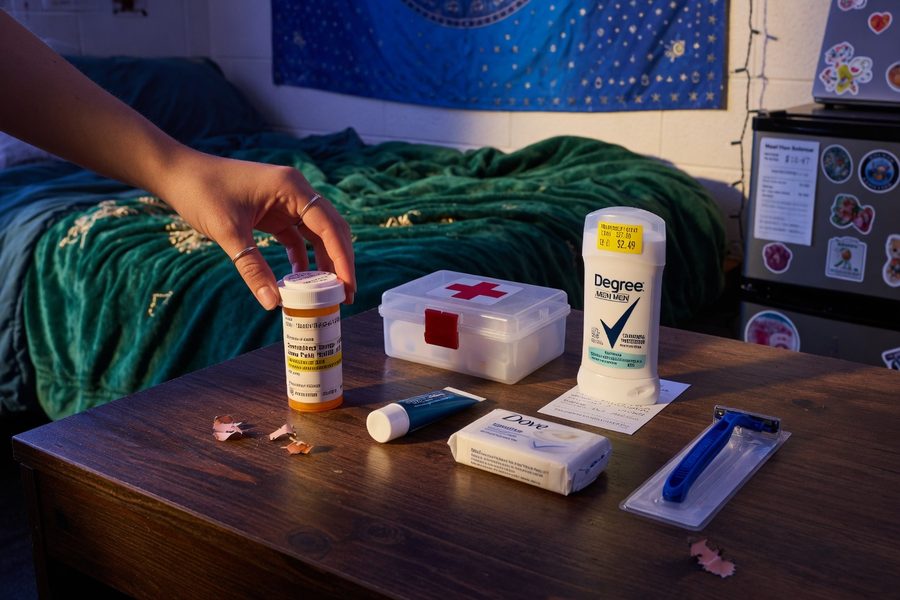
One area where spending a bit more makes sense: personal hygiene and health supplies. Cutting corners on deodorant, medications, or basic first-aid items is a false economy on a tight budget. Campus health centers often provide free or low-cost medications, contraception, and over-the-counter supplies. Use them. Similarly, if you are using a credit card at all on a $500 budget, keep the balance at zero every month. If you carry a balance, interest charges can erase weeks of careful saving. If you are concerned about high-interest debt already, reviewing your options early is worth the time, understanding how to prioritize and negotiate credit card debt before it compounds is a skill that protects your budget for years.
At the end of each semester, sell your rented or purchased textbooks back to classmates before the campus buyback period opens. Peer-to-peer pricing typically beats the bookstore by 20–40%, putting an extra $30–$80 in your pocket that you can roll into the next semester’s book fund.
The Federal Reserve Education’s Budgeting 101 resources frame smart money management as goal-setting first, not restriction first. That framing matters for students: define what you are protecting your money for (finishing school debt-free, building a $500 emergency fund, studying without financial anxiety), and the spending choices become more deliberate and less painful.
The CFPB’s budget analysis tools apply the 50/30/20 framework even at low income levels: 50% for needs, 30% for wants, 20% for savings. On a $500 budget, that means $250 on needs, $150 on wants, and $100 saved or invested. Even saving $50–$100 per month at this stage builds the emergency cushion that prevents one car repair or medical bill from derailing everything.
Frequently Asked Questions
Can $500 a month actually cover college living expenses in 2026?
Yes, but only when housing and tuition are paid separately. With those covered, $500 is workable for food, transportation, personal care, and supplies in most college towns. Students in high-cost urban areas may need to trim more aggressively or supplement with part-time income. The split that works most consistently: $150 food, $75 transit, $75 personal, $200 flex.
What should I do if my financial aid refund is late and I need cash now?
Contact your school’s financial aid office directly, processing delays are often correctable within 24–48 hours with a single call or email. While you wait, use your $50–$100 buffer in checking to cover immediate needs, and avoid payday loans or credit card cash advances at all costs. If the delay exceeds a week and you have no buffer, most campuses have emergency student funds that can bridge a short gap.
How do I stop impulse spending on campus when food and coffee are everywhere?
Eat before you leave your room. That one habit eliminates most campus impulse food purchases. For coffee, a $15 electric kettle and instant coffee packets or a French press reduce per-cup cost from $4–$6 to under $0.50. The campus atmosphere is specifically designed for casual spending; removing hunger as a variable is the fastest fix.
Should I use a credit card as a college student on a tight budget?
A student credit card used for one fixed monthly purchase and paid in full each month builds credit history without risk. The danger is carrying a balance: even a $200 balance at a typical student card APR of 20–25% costs $40–$50 per year in interest, which is $40–$50 you cannot spend on food or supplies. If carrying a balance is a real risk for you, a debit card is safer until your spending habits are more predictable.
What are the best student discounts worth using every month in 2026?
The highest-value recurring discounts are the Spotify and Hulu student bundle ($5.99/month vs. $17.99 standard), student transit passes (50–75% off in most college towns), and Amazon Prime Student (50% off the standard annual rate with a six-month free trial). Adobe Creative Cloud and Microsoft 365 are worth claiming if your coursework requires them, since both are 50–60% cheaper on student plans. Always verify with a .edu email at point of purchase.
How much should I spend on textbooks per semester when I am on a $500 monthly budget?
Target under $100 per semester, not $100 per month. Semester textbook spending typically runs $400–$600 if you buy new; rentals, library reserves, and prior editions routinely cut that to $100–$200 for the full term. That works out to $20–$40 per month over a five-month semester, a budget-friendly number when you plan ahead before the first week of class.
Is it worth getting a part-time job if I am already on a tight budget?
Eight to ten hours per week of paid work at $15–$20 per hour adds $480–$800 per month, potentially doubling your discretionary budget. The trade-off is study time and stress. Work-study jobs on campus are generally the best option: they schedule around classes, pay reliable wages, and count as financial aid. Off-campus jobs pay more but add commute time. Local school and event jobs are another option that often fit a student’s schedule well.
How do I build an emergency fund when I barely have $500 to live on?
Start with $25–$50 per month transferred to a separate savings account the day income arrives, before you spend anything else. A $500 emergency fund is the realistic first goal for students, enough to cover a medical copay, a car repair, or a gap between aid disbursements without going into debt. It takes 10–20 months at $25–$50 per month, but starting now matters more than the speed.
What if I qualify for SNAP or other government benefits as a college student?
College students can qualify for SNAP benefits if they work at least 20 hours per week, participate in a work-study program, or meet specific exemptions. The updated 2026 federal poverty guidelines affect who qualifies, and income thresholds are more favorable than many students expect. Apply through your state’s SNAP agency online. Eligibility is worth checking even if you assume you won’t qualify, many students who do qualify never apply.
Sources
- College Board, Trends in College Pricing and Student Aid 2025
- Sallie Mae, How America Pays for College 2025
- Consumer Financial Protection Bureau, Learning About Budgets (50/30/20 Rule)
- Consumer Financial Protection Bureau, Analyzing Budgets
- FDIC, Money Smart for Young Adults Program
- Federal Reserve Education, Budgeting 101
- Bureau of Labor Statistics, Consumer Expenditure Surveys