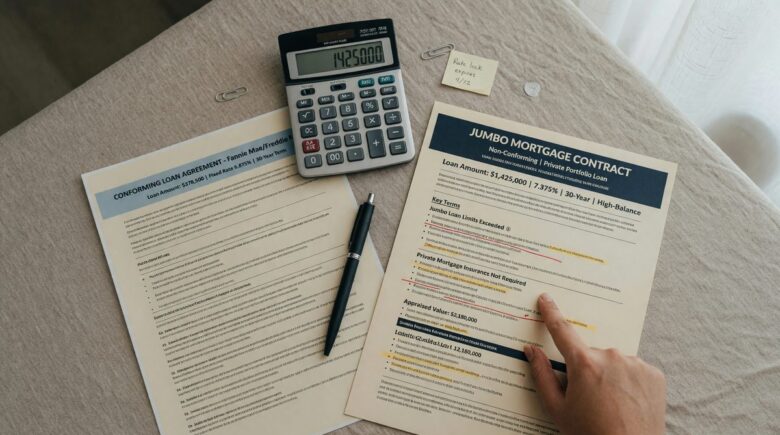
Fact-checked by the MyFinancial101 editorial team
Quick Answer
A jumbo mortgage is required when your loan amount exceeds the 2026 conforming loan limit of $832,750 for most U.S. counties (or up to $1,249,125 in high-cost areas). Jumbo loans demand stronger credit, larger reserves, and typically a 10–20% down payment, but can sometimes carry competitive rates.
Here is the question most buyers do not ask until they are already under contract: does the size of this loan actually change what kind of mortgage I qualify for? The answer, in many U.S. markets today, is yes. And the difference between a conforming loan and a jumbo mortgage shapes not just your rate, but your required documentation, your closing timeline, and how much cash you need sitting in the bank the day you sign. This is the core of the jumbo vs conforming mortgage decision, and it is worth understanding before you fall in love with a house.
The Federal Housing Finance Agency (FHFA) set the 2026 baseline conforming loan limit at $832,750 for one-unit properties in most of the country, a $26,250 increase from 2025. That adjustment reflects a 3.26% rise in U.S. home prices between the third quarters of 2024 and 2025. Once your loan exceeds that number, you are in jumbo territory, and lenders apply a noticeably different set of rules.
This guide gives you a clear framework for determining which loan type fits your situation. You will find a breakdown of 2026 limits, side-by-side qualification standards, a worked dollar example showing when a larger down payment keeps you conforming, and an honest accounting of where jumbo loans win and where they cost you. If you are also thinking through the broader financial picture of homeownership, managing your credit card debt before you apply can meaningfully affect which loan type you can access.
Key Takeaways
- The 2026 baseline conforming loan limit is $832,750 for one-unit properties in most U.S. counties (FHFA, 2025), meaning any loan above this amount automatically requires jumbo financing in standard-cost markets.
- High-cost counties carry a 2026 conforming limit ceiling of $1,249,125 (FHFA, 2025), giving buyers in expensive metros more room before crossing into jumbo territory.
- Jumbo loans typically require a minimum credit score of 700, compared to the 620 minimum common for conforming loans, reflecting the higher underwriting standards lenders apply to non-agency loans.
- Jumbo loan applicants are generally expected to show 6–12 months of cash reserves, versus 2–6 months for most conforming loan programs, directly reducing liquid assets available for other financial goals.
- Conforming loans can be purchased by Fannie Mae and Freddie Mac, while jumbo loans cannot, so lenders bear the full credit risk and perform manual underwriting that can extend closing timelines to 45–60 days versus 30–45 days for conforming loans.
- A buyer purchasing a $900,000 home in a standard-cost county must put down at least $67,251 to keep the loan conforming, according to the 2026 FHFA limit of $832,750 (FHFA, 2025).
In This Guide
- Understanding Conforming Loan Limits in 2026
- How Jumbo and Conforming Loans Actually Differ
- When Your Home Purchase Forces a Jumbo Loan
- Costs, Rates, and Long-Term Financial Impact
- Qualifying for a Jumbo Loan: Realistic Requirements
- Deciding Which Loan Fits Your Situation
- Jumbo vs Conforming Mortgage: Head-to-Head Comparison
- A Worked Dollar Example: Staying Conforming vs Going Jumbo
Understanding Conforming Loan Limits in 2026
The 2026 conforming loan limit for a single-family home in most U.S. counties is $832,750, set by the FHFA in late 2025. That is the ceiling Fannie Mae and Freddie Mac are legally permitted to use when purchasing conventional loans. Go one dollar above it without a sufficient down payment, and your loan becomes a jumbo.
The High-Cost Area Exception
Not every county uses the baseline. In designated high-cost areas, parts of California, New York, Hawaii, and Colorado, plus a growing list of mid-sized metros where home prices run well above national averages, the 2026 ceiling reaches $1,249,125 for a one-unit property, which is exactly 150% of the baseline. Counties in Alaska and Hawaii use this ceiling as a floor. Buyers in these markets have significantly more room before triggering jumbo requirements.
The baseline itself moved up by $26,250 from the 2025 limit of $806,500, driven by the FHFA’s measurement of a 3.26% increase in national home prices year over year. That mechanism matters: the FHFA recalibrates limits annually to track price changes, so limits have risen steadily as home values climbed. For buyers in borderline markets, this annual reset can mean the difference between a conforming and a jumbo product from one year to the next.
Multi-Unit Properties Have Higher Limits
Two-unit, three-unit, and four-unit properties each carry progressively higher conforming limits, which can open conforming financing for small multifamily investors who otherwise assumed they needed jumbo terms. Fannie Mae publishes the complete schedule of 2026 limits by property type and county, and it is worth verifying your specific county before assuming the baseline applies.
The 2026 conforming loan limit is $832,750 in most counties and $1,249,125 in high-cost areas, per the FHFA’s 2025 announcement. Any loan exceeding the applicable county limit requires jumbo financing.
One practical note: the limit is based on the loan amount, not the purchase price. A buyer can purchase a home above the conforming limit and still use a conforming loan if they put enough money down to bring the borrowed amount under the threshold. That distinction is the basis of the down-payment strategy discussed in section three.

How Jumbo and Conforming Loans Actually Differ
The most fundamental difference between the two loan types is who bears the risk. Conforming loans can be sold to Fannie Mae or Freddie Mac, which shifts the credit risk off the lender’s books. Loans that exceed the limit stay on the lender’s balance sheet, which is why lenders treat them with considerably more scrutiny from the first application page.
Credit Score and DTI Requirements
Most conforming loan programs accept borrowers with a FICO Score as low as 620, though the best rates require 740 or higher. Jumbo lenders generally set a hard floor of 700, and many prefer 720 to 740 before offering competitive pricing. The CFPB notes that the cost of obtaining a jumbo mortgage may be higher than that of a conforming mortgage, partly because of these tighter qualification standards.
Debt-to-income (DTI) ratio caps are also more conservative for jumbo products. Conforming loans backed by Fannie Mae or Freddie Mac can go up to 45–50% DTI with compensating factors. Most jumbo programs draw the line at 43%, and some prefer 38–40%. For a borrower with a high income but also significant student loans, a car payment, and existing credit card balances, that gap can disqualify an otherwise strong application. Paying down revolving debt before applying is one of the fastest ways to close that gap, and managing your overall debt load strategically applies even at high income levels.
Down Payment and PMI Implications
Conforming loans allow down payments as low as 3% (for certain first-time buyer programs) or 5% for most conventional borrowers, but private mortgage insurance kicks in below 20% down. Jumbo loans typically require 10–20% down, though some lenders allow 10% for highly qualified borrowers. The trade-off is that many jumbo programs do not require PMI even at 10–15% down, which can actually produce a lower monthly payment than a conforming loan at 5% down with PMI attached.
Closing Timelines
Conforming loans close in roughly 30–45 days in standard market conditions. Jumbo loans, because they require manual underwriting and more document review, typically run 45–60 days. In a competitive market where sellers prefer fast closings, that 15-day difference can cost a buyer the deal. It is a real, practical disadvantage that rate comparisons alone do not capture.
Because jumbo loans are not sold to Fannie Mae or Freddie Mac, lenders set their own underwriting rules. Two banks can have meaningfully different credit score minimums, reserve requirements, and DTI caps for the same loan amount, so shopping multiple lenders is especially important in the jumbo market.
When Your Home Purchase Forces a Jumbo Loan
A purchase price above the conforming limit does not automatically mean a jumbo loan, but a loan amount above the limit does. That distinction creates a clear strategic question: how much can you put down to stay conforming?
The Borderline Market Scenario
Consider a buyer looking at a $900,000 home in a county where the 2026 limit is the standard $832,750. To borrow no more than $832,750, the buyer needs a minimum down payment of $67,250, roughly 7.5% of the purchase price. That is within reach for many buyers in that price range, and it unlocks conforming financing with its lower credit score floor, standardized underwriting, and faster closing.
The calculus changes at $950,000. Staying conforming requires a $117,250 down payment, over 12%. At $1,000,000, the required down payment rises to $167,250, about 16.7%. At some point, the buyer simply accepts jumbo terms rather than depleting savings to hit an arbitrary threshold. The right answer depends on what that cash would cost you in lost liquidity or investment opportunity.
Markets Where Jumbo Starts Earlier Than You Expect
The high-cost area designation does not cover every expensive city. Some mid-sized metros, including parts of Texas, Florida, and the Mountain West, have seen rapid home price appreciation that pushes median home values well above $700,000 in desirable neighborhoods, but their counties still carry the baseline $832,750 limit. Buyers in Austin, Nashville, and Denver suburbs are far more likely to encounter jumbo requirements than buyers in San Francisco or New York, where higher county limits provide a larger conforming buffer. This is one of the less-discussed realities of the 2026 limit structure.
Luxury and Competitive Bidding Situations
In hot markets where buyers routinely overbid asking prices, the final purchase price, and therefore the required loan amount, can shift into jumbo territory even when the listing price sits under the limit. Buyers competing in multiple-offer situations may find themselves choosing between making a larger cash down payment to stay conforming or accepting jumbo terms under deadline pressure. Having that decision made in advance, before the bidding starts, is worth the preparation time.
If you are buying in a county where the conforming limit is the standard $832,750, a seller accepting a final price of $840,000 with a 5% down payment puts your loan at $798,000, still conforming. But countering to $850,000? That same 5% down leaves you at a $807,500 loan, which exceeds the limit and pushes you into jumbo underwriting, even though the price difference was small.
Costs, Rates, and Long-Term Financial Impact
Jumbo loans do not always carry higher interest rates than conforming loans, and that surprises many buyers. Historically, jumbos ran 0.25–0.50 percentage points above conforming rates. In recent years, as large banks with significant balance sheet capacity compete aggressively for high-net-worth borrowers, jumbo rates have sometimes come in at or below conforming rates for the most qualified applicants.
Why Rates Can Invert
Large commercial banks, think JPMorgan Chase, Bank of America, Wells Fargo, actively want high-balance loans from strong borrowers because those borrowers often bring deposit accounts and investment management relationships. When these institutions price jumbo loans aggressively, the rate advantage of a conforming loan can narrow or disappear. This dynamic tends to benefit borrowers with excellent credit profiles (740+) and significant assets. A borrower at 700 credit with thin reserves will not see the same competitive pricing.
The PMI Factor
Monthly costs depend heavily on mortgage insurance. A conforming loan at 5% down with PMI running 0.5–1.0% of the loan amount annually adds real expense. On an $800,000 loan, that is $4,000 to $8,000 per year, or $333 to $667 per month on top of principal, interest, taxes, and insurance. Many jumbo programs at 10–20% down carry no PMI requirement at all, which can produce a lower all-in monthly payment despite a nominally higher rate.
Refinancing and Prepayment Considerations
Conforming loans benefit from a highly liquid secondary market. When rates drop, refinancing into a new conforming loan is generally straightforward and fast. Jumbo loans sit in portfolio, the lender holds them, and refinancing requires the same intensive manual underwriting process as the original application. Some jumbo programs also carry prepayment penalties that conforming loans do not. Before signing jumbo documents, read the prepayment language carefully: a penalty that seems minor at closing can become meaningful if you refinance within three to five years.

Qualifying for a Jumbo Loan: Realistic Requirements
Jumbo underwriting is more intensive, more document-heavy, and less forgiving of financial gray areas than conforming underwriting. Understanding where lenders focus their attention helps borrowers prepare, and helps some realize they need to wait.
Documentation and Reserves
Jumbo lenders want two years of full tax returns (personal and business, if self-employed), two to three months of bank statements, and documentation of all assets, including verification of any large deposits. Self-employed borrowers face particularly rigorous scrutiny because their income documentation is more complex. The reserve requirement, typically 6–12 months of mortgage payments in liquid or near-liquid assets, is among the most significant qualification hurdles. On a jumbo loan with a $5,000 monthly payment, that means $30,000 to $60,000 sitting in verifiable accounts after closing. Those funds cannot include the down payment or closing costs.
Common Hurdles for Strong Borrowers
Borrowers with high incomes but complex financial profiles, significant equity in illiquid assets, recent career changes, variable bonus income, often struggle with jumbo underwriting even though their net worth is substantial. Lenders focus on stable, documentable income. A physician two years into private practice with strong collections but limited W-2 history can face unexpected friction. Working with a mortgage broker or banker who specializes in jumbo products, rather than a generalist lender, often makes the difference between an approval and a denial. If you are building your investment base and thinking about retirement savings alongside a home purchase, it is worth reading about prioritizing retirement savings relative to other large financial commitments.
Jumbo Lenders Are Not All the Same
Because jumbo loans are not standardized through Fannie Mae or Freddie Mac, lender requirements vary widely. One bank might require 12 months of reserves; another might accept 6. Credit score floors, DTI caps, and acceptable income documentation differ from institution to institution. Shopping at least three lenders is the standard guidance for conforming loans. For jumbo loans, shopping five or more, including at least one portfolio lender and one mortgage broker with jumbo relationships, is closer to the right approach.
Get a conditional pre-approval from a jumbo lender before you start home shopping seriously. A conforming pre-approval from a bank that quietly uses Fannie Mae automated underwriting will not hold up once your loan amount crosses the limit. A lender who has actually run your file through jumbo underwriting criteria gives you a far more accurate picture of your buying power.
Deciding Which Loan Fits Your Situation
The right loan type comes down to three factors: your loan amount relative to the county limit, your financial profile, and your liquidity after closing.
Conforming is almost always preferable when it is available. The standardized underwriting, faster closing, and lower barriers to refinancing make it the default choice for most buyers. If putting down an additional $50,000 to $80,000 keeps you conforming, run the math on what that cash would otherwise cost you. In many cases, the monthly savings from avoiding PMI and qualifying for a slightly lower rate on a conforming loan outweigh the opportunity cost of the larger down payment. The CFPB defines conforming loans as those within FHFA-set limits that can be guaranteed by Fannie Mae or Freddie Mac, and that guarantee is what makes them more accessible and more flexible over the life of the loan.
Jumbo financing is the right tool when the loan amount simply has to be large, when your credit and reserves are strong, and when you have identified a lender offering competitive jumbo pricing. Forcing a conforming loan by making a massive down payment that depletes your emergency fund or retirement savings is not a win.
Jumbo vs Conforming Mortgage: Head-to-Head Comparison
The table below summarizes the key differences between a jumbo vs conforming mortgage across the criteria that matter most to buyers in 2026.
| Factor | Conforming Loan | Jumbo Loan |
|---|---|---|
| 2026 Loan Limit (most counties) | Up to $832,750 | Above $832,750 |
| High-Cost Area Limit | Up to $1,249,125 | Above $1,249,125 |
| Minimum Credit Score | 620 (typical) | 700–720 (typical) |
| Max DTI Ratio | 45–50% (with compensating factors) | 43% (most programs) |
| Minimum Down Payment | 3–5% | 10–20% |
| PMI Required | Yes, below 20% down | Often no, varies by lender |
| Cash Reserves Required | 2–6 months | 6–12 months |
| Underwriting Type | Automated (Fannie/Freddie) | Manual (lender-specific) |
| Typical Closing Timeline | 30–45 days | 45–60 days |
| Sold to Secondary Market | Yes (Fannie Mae/Freddie Mac) | No (held in lender portfolio) |
One important caveat: these figures represent typical program standards, not universal rules. Because jumbo loans are not governed by Fannie Mae or Freddie Mac guidelines, individual lenders can set their own criteria. The numbers above reflect common market practice as of mid-2026, but a borrower with exceptional reserves or an unusually strong credit profile may find lenders willing to offer more favorable terms than those listed.
| Credit Score Range | Conforming Loan Access | Jumbo Loan Access | Typical Rate Differential |
|---|---|---|---|
| 740+ | Best available rates | Widely available, competitive pricing | 0.00%–0.25% |
| 720–739 | Strong rates | Available at most jumbo lenders | 0.10%–0.35% |
| 700–719 | Good rates | Available, fewer lender options | 0.25%–0.50% |
| 680–699 | Moderate rates | Limited; most jumbo lenders decline | N/A (often ineligible) |
| Below 680 | Available with higher rates | Not available at most lenders | N/A (not offered) |
Jumbo loans are sometimes called “non-conforming loans,” but not all non-conforming loans are jumbo loans. Other loan types, such as FHA, VA, and USDA loans, are also non-conforming because they do not meet Fannie Mae or Freddie Mac purchase standards, but for different reasons than loan size.
A Worked Dollar Example: Staying Conforming vs Going Jumbo
Numbers make this clearer than any general rule. Here is a direct comparison of two financing strategies on the same purchase price.
Real-World Example: The $900,000 Purchase Decision
Consider an illustrative example: a buyer in a standard-cost county where the 2026 conforming limit is $832,750. The purchase price is $900,000.
Scenario A: Conforming Loan with Larger Down Payment
To keep the loan at or below $832,750, the buyer must put down at least $67,250 (7.5%). Assume a 30-year conforming loan at 6.75%. On $832,750, the principal and interest payment works out to approximately $5,399 per month. Because the loan-to-value ratio is 92.5%, PMI applies at roughly 0.65% annually, about $451 per month, bringing the total to approximately $5,850 per month before taxes and insurance.
Scenario B: Jumbo Loan with Standard Down Payment
The buyer instead puts down the minimum 10% ($90,000), borrowing $810,000 under a jumbo program, but wait: at 10% down on a $900,000 purchase, the loan amount is $810,000, which is actually below the $832,750 conforming limit. The buyer would qualify for conforming at 10% down in this example without needing a jumbo loan at all.
Push the price to $950,000 to create a genuine comparison. At 10% down ($95,000), the loan is $855,000, above the $832,750 conforming limit, so jumbo applies. At a jumbo rate of 7.00% (slightly above conforming in this scenario), the P&I payment on $855,000 over 30 years is approximately $5,689 per month. Many jumbo programs at 10% down carry no PMI, so the all-in total stays near $5,689, actually lower than the conforming-plus-PMI figure in Scenario A, but with a higher cash outlay at closing ($95,000 vs $67,250 for the conforming approach at $900k).
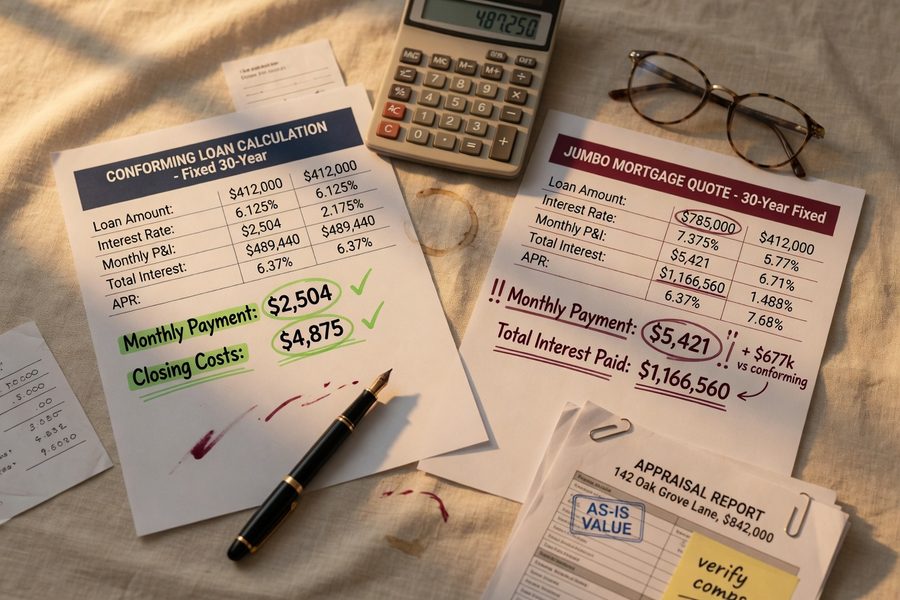
What the Arithmetic Actually Shows: The monthly payment difference between a jumbo loan without PMI and a conforming loan with PMI can be surprisingly small or even favor the jumbo. The real cost is the liquidity impact: the larger down payment and the 6–12 month reserve requirement on the jumbo side tie up substantially more cash at closing. A buyer who depletes savings to hit those thresholds and then faces an unexpected expense is in a worse position than one who held more cash and paid a slightly higher monthly amount.
Your Action Plan
-
Look up your county’s 2026 conforming loan limit
Use the FHFA’s 2026 conforming loan limit announcement or the Fannie Mae loan limit lookup tool to find the exact limit for your county. Do not assume the national baseline applies, high-cost area designations can give you significantly more room.
-
Calculate your required down payment for each scenario
Subtract the county conforming limit from your target purchase price. That result is the minimum down payment needed to stay conforming. Compare that to the minimum down payment for a jumbo loan (typically 10–20%), and identify which approach preserves more of your liquid savings after closing costs.
-
Pull your credit scores from all three bureaus
Get free reports from AnnualCreditReport.com, which provides one free report annually from Experian, TransUnion, and Equifax. If your score is below 700, focus on raising it before applying for a jumbo loan. If you are carrying significant revolving balances, addressing that first can meaningfully improve your profile, see our guide to prioritizing and negotiating credit card debt for specific strategies.
-
Calculate your debt-to-income ratio
Add up all monthly debt payments (credit cards, auto loans, student loans, any current mortgage) and divide by your gross monthly income. If the result plus your projected new housing payment exceeds 43%, you may face jumbo eligibility issues. At 45%, conforming loans become difficult as well. Reducing debt before applying is the most direct lever available.
-
Document your liquid reserves
Identify every account that qualifies as a liquid or near-liquid asset: checking, savings, money market, and vested retirement accounts (typically counted at 60–70% of face value). Confirm that you can meet the reserve requirement, 6–12 months of projected mortgage payments, after the down payment and closing costs are covered. If not, a conforming loan with a smaller down payment may be the more feasible path. For context on building savings while managing other financial pressures, our article on retirement savings priorities covers the trade-offs worth considering.
-
Get pre-approved by at least three lenders, including a jumbo specialist
For conforming loans, any major lender will do. For jumbo, seek out at least one portfolio lender (a bank or credit union that holds loans in-house) and one mortgage broker with documented jumbo lending relationships. The CFPB’s homeownership resource center provides a framework for comparing lender offers on equal terms.
-
Compare total cost of ownership, not just interest rates
Build a simple spreadsheet comparing monthly all-in costs (principal, interest, PMI if applicable, taxes, insurance) for each financing scenario at your target purchase price. Factor in the opportunity cost of a larger down payment: cash deployed at closing cannot earn returns elsewhere. The monthly payment difference often narrows significantly once PMI and rate differences are accounted for together.
-
Review prepayment terms before signing any jumbo commitment
Ask specifically whether the jumbo loan has a prepayment penalty and, if so, what the penalty period and amount are. Ask about the refinancing process and whether the bank’s portfolio standards could change. Because jumbo loans sit on the lender’s balance sheet, refinancing later requires the same manual underwriting process as the original loan. Make sure you understand what that means for your flexibility if rates drop in the next two to three years.
Frequently Asked Questions
What is the 2026 conforming loan limit?
The 2026 baseline conforming loan limit is $832,750 for one-unit properties in most U.S. counties, per the FHFA’s 2025 announcement. High-cost area counties carry a ceiling of $1,249,125. Limits are set annually based on changes in national home prices.
Is a jumbo loan harder to get than a conforming loan?
Yes, in most cases. Jumbo loans require higher credit scores (700 minimum versus 620 for conforming), stricter DTI ratios, larger down payments, and 6–12 months of cash reserves. The manual underwriting process also takes longer and leaves less room for compensating factors than the automated systems Fannie Mae and Freddie Mac use.
Do jumbo loans have higher interest rates?
Not always. Historically they ran 0.25–0.50 percentage points above conforming rates, but large portfolio lenders now often price jumbo loans competitively for well-qualified borrowers with strong credit. Rate comparisons should always account for PMI, which conforming loans often require below 20% down but jumbo loans often do not.
Can I avoid a jumbo loan by making a larger down payment?
Yes, if the purchase price allows it. On a $900,000 home in a standard-cost county, putting down $67,251 or more keeps the loan at or below $832,750, which is conforming territory. The trade-off is the liquidity cost of that additional cash at closing versus the flexibility of accepting jumbo terms with a smaller down payment.
How long does it take to close a jumbo loan?
Typically 45–60 days, compared to 30–45 days for conforming loans. The longer timeline reflects mandatory manual underwriting, additional document review, and the absence of automated approval systems. In competitive markets where sellers prefer quick closings, this difference can put jumbo buyers at a disadvantage.
What credit score do I need for a jumbo mortgage?
Most jumbo lenders require a minimum FICO Score of 700, with many preferring 720–740 for their best pricing tiers. Below 700, jumbo options become very limited. Borrowers in the 680–699 range will find conforming loans (where eligible) far more accessible, even if it requires a different purchase approach.
Are there jumbo loan options for self-employed borrowers?
Yes, but the documentation requirements are intensive. Lenders typically want two full years of personal and business tax returns, year-to-date profit and loss statements, and sometimes a CPA letter verifying income. Some portfolio lenders offer bank-statement-based jumbo programs that use 12–24 months of deposits rather than tax returns, at a somewhat higher rate. These programs exist specifically for borrowers whose tax returns understate their actual cash flow.
Our Methodology
This article evaluates conforming and jumbo mortgage products based on 2026 loan limit data from the Federal Housing Finance Agency, qualification standards drawn from Fannie Mae and Freddie Mac published guidelines, and CFPB consumer guidance. Qualification ranges (credit scores, DTI caps, reserve requirements, down payment minimums, and closing timelines) reflect typical market practice across a range of portfolio lenders, commercial banks, and mortgage brokers as of mid-2026. Because jumbo loan terms are not standardized, ranges rather than single figures are used throughout. Rate comparisons are presented qualitatively rather than with specific current rates, since jumbo and conforming rates change daily. Readers should obtain current quotes from multiple lenders before making financing decisions. This article does not constitute financial or mortgage advice. Specific dollar examples use arithmetic consistent with the FHFA-published 2026 baseline limit of $832,750.
Freddie Mac and Fannie Mae both publish their 2026 conforming loan limits in full detail. Freddie Mac’s 2026 limit announcement aligns with the FHFA baseline, loans above $832,750 in standard counties are classified as jumbo (non-conforming) and cannot be sold into the agency-backed secondary market.
U.S. home prices rose 3.26% between the third quarters of 2024 and 2025, the measurement the FHFA used to set the 2026 conforming loan limit of $832,750, a $26,250 increase from the 2025 cap of $806,500, per the FHFA’s official 2025 announcement.
If you are weighing a large home purchase alongside other major financial goals, the decision between a jumbo and conforming mortgage rarely exists in isolation. Income stability, existing debt, retirement savings trajectory, and your liquidity after closing all belong in the same conversation. For buyers still building their financial foundation, resources like our guide on starting to invest with no prior experience or understanding your overall credit counseling options can help frame how a mortgage fits into your broader plan. A jumbo vs conforming mortgage choice is a math problem with a human element, and the human element is what determines whether the right loan on paper is the right loan for you.
Sources
- Federal Housing Finance Agency, FHFA Announces Conforming Loan Limit Values for 2026
- Consumer Financial Protection Bureau, What Is a Jumbo Loan?
- Consumer Financial Protection Bureau, Conventional Loans and Conforming Loan Basics
- Fannie Mae, 2026 Conforming Loan Limits for Single-Family Loans
- Freddie Mac, Loan Limit Values for 2026
- Federal Housing Finance Agency, House Price Index Data
- Consumer Financial Protection Bureau, Loan Options: Conventional Loans
- Consumer Financial Protection Bureau, Understanding the Mortgage Closing Process
- Consumer Financial Protection Bureau, Explore Mortgage Rates Tool
- Federal Reserve, Selected Interest Rates (H.15 Statistical Release)
- Consumer Financial Protection Bureau, Comparing Loan Offers