
Fact-checked by the MyFinancial101 editorial team
Key Takeaways
- The average 30-year fixed mortgage rate sat at 6.49% as of early 2026, down from peaks above 7% in 2023-2024, creating a meaningful refi window for borrowers who bought at those highs.
- The Mortgage Bankers Association forecasts $737 billion in single-family refinance originations in 2026, a 9.2% jump from 2025’s $502 billion, reflecting how many borrowers now have rates worth replacing.
- A typical break-even period runs 24 to 36 months in 2026, so homeowners planning to stay at least 3 years are the clearest candidates for a refi that pays off.
- Only about 21% of mortgaged homeowners currently carry a rate of 6% or higher, meaning the majority still hold pandemic-era rates too low to benefit from refinancing today.
- Closing costs typically run 2% to 6% of the loan amount. On a $400,000 balance, that means $8,000 to $24,000 out of pocket before any savings begin accumulating.
- The 2026 conforming loan limit sits near $806,500 in most high-cost areas, giving some jumbo borrowers a targeted path to refinance into better conventional pricing with a modest principal paydown.
In This Guide
- Where Mortgage Rates Stand in Early 2026
- The Core Math: Running Your Break-Even Analysis
- Scenarios Where Refinancing Clearly Makes Sense
- When Waiting or Skipping Makes More Sense
- Hidden Factors That Change the Equation
- How to Get the Best Refi Deal Without Overpaying
- Choosing the Right Loan Type for Your Situation
- Credit Score and Equity: What Lenders Actually Require
- The Tax Angle and True Total Cost of Refinancing
Where Mortgage Rates Stand in Early 2026
The 30-year fixed mortgage rate averaged 6.49% in early February 2026, according to Freddie Mac’s Primary Mortgage Market Survey. That number is significant not because it is low by historical standards, but because it is measurably lower than the 7.5% to 8% range that trapped buyers in 2023 and much of 2024. For the cohort of homeowners who purchased in those years, the gap is now wide enough that mortgage refinancing 2026 deserves a serious look rather than a waiting game.
Forecasters are not predicting a dramatic collapse in rates. The Mortgage Bankers Association projects that rates will ease gradually through 2026, settling somewhere in the 5.9% to 6.4% range by year-end. That is meaningful movement, but not the kind of floor-level drop that makes everyone rush to refi. The practical implication: borrowers who act now at 6.49% and plan to refinance again later if rates drop another half-point will pay closing costs twice. The math rarely supports that approach.
Several forces are holding rates in this corridor. Energy price volatility tied to geopolitical uncertainty has kept inflation stickier than the Federal Reserve expected heading into 2026, which restrains how aggressively the Fed can ease. Trade policy uncertainty adds another variable. The result is a rate environment that is better than 2023 by a clear margin, but not the 3% to 4% window of 2020 and 2021 that many homeowners still dream about. Those rates are not coming back in any plausible near-term scenario.
Who Is Actually Positioned to Benefit
According to data from the Federal Housing Finance Agency reported by Johnson Financial Group, roughly 21% of mortgaged homeowners carry a rate of 6% or higher. That share is not enormous, but when applied against $13.19 trillion in outstanding U.S. mortgage debt, it represents a substantial pool of borrowers with genuine room to save. If you bought between mid-2022 and late 2024, there is a reasonable chance you are in that group.
The other 79% of borrowers, largely those who locked in sub-4% or sub-5% rates during the pandemic era, have little financial reason to refinance at current rates. Their monthly payments are already far below what the market offers today. For those homeowners, the calculus only changes if they have a pressing reason unrelated to rate, such as removing a co-borrower, tapping equity, or eliminating private mortgage insurance through a restructured loan.
The Mortgage Bankers Association forecasts $737 billion in single-family refinance originations in 2026, up from $502 billion in 2025. That 9.2% increase reflects the simple fact that enough borrowers now carry rates worth replacing.
What Gradual Rate Easing Means Practically
If rates do drift toward 5.9% by late 2026, borrowers who refinance now at 6.49% might find themselves wanting another refi in 12 months. Before acting on that impulse, run the numbers honestly. Closing costs on a $350,000 loan at 3% run $10,500. If your monthly savings from a 0.5% rate drop is $110, you need nearly eight years to recoup those costs. Doing that twice in two years is rarely smart money. The guidance from most financial professionals: refinance when today’s numbers make sense, not in anticipation of a rate that may or may not arrive.
The Core Math: Running Your Break-Even Analysis
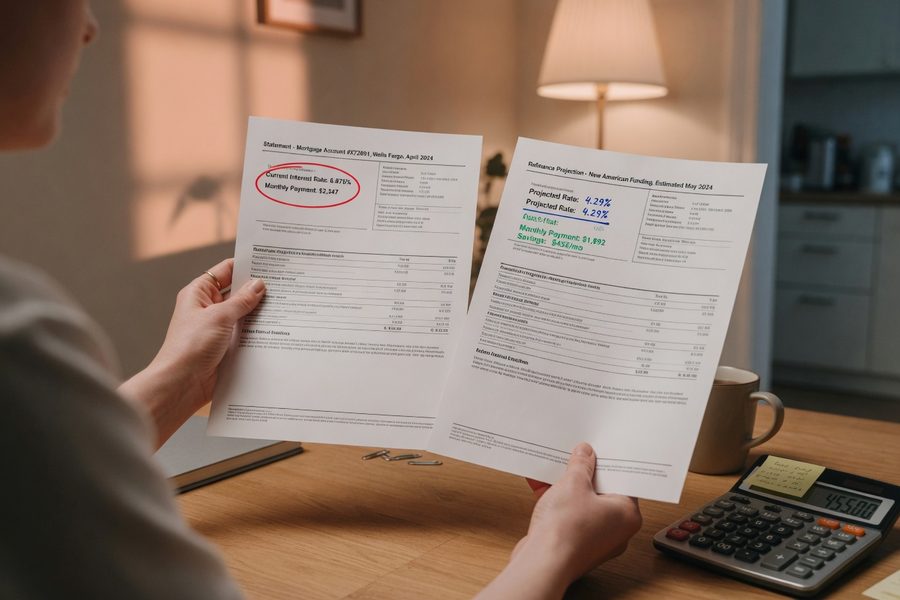
The break-even analysis is the single most important calculation in any refinancing decision. The concept is straightforward: divide your total closing costs by your monthly payment savings. The result tells you how many months you need to stay in the home before the refi pays for itself. Everything else, the rate forecasts, the lender pitches, the neighbor who “saved thousands,” is secondary until you have run this number for your specific loan.
Step-by-Step Calculation
Start with your current principal and interest (P&I) payment. Then calculate what that payment would be at the new rate on your remaining loan balance. The difference is your monthly savings. Next, get a realistic estimate of closing costs, typically 2% to 6% of the loan balance. Divide closing costs by monthly savings. That quotient, in months, is your break-even point.
Here is a worked example using real figures. A homeowner with a $400,000 remaining balance at 7.25% (a rate common in 2023) is considering refinancing to 6.49%. The P&I payment at 7.25% on a 30-year loan is roughly $2,729 per month. At 6.49% on the same balance and term, it drops to approximately $2,527. Monthly savings: $202. Closing costs at 3%: $12,000. Break-even: $12,000 / $202 = 59 months, or just under 5 years. That is on the longer end. If that borrower plans to sell in 4 years, the refi does not pay off.
Now take a borrower at 7.75% refinancing to 6.49%, saving $355 per month on the same $400,000 balance. Closing costs remain $12,000. Break-even: $12,000 / $355 = 34 months, about 2.8 years. That clears the typical 24-to-36-month benchmark comfortably and makes a strong case for moving forward. The rate difference matters enormously in this math. A 0.75% drop and a 1.25% drop produce very different timelines even on identical loan balances.
The average homeowner stays in their home for roughly 12 years, according to National Association of Realtors data. That tenure far exceeds the 24-to-36 month break-even most lenders use as a benchmark, meaning most long-term owners who refinance today will eventually recoup their costs and then some.
Why the 24-to-36 Month Benchmark Exists
Financial advisors and lenders land on two to three years as a working rule because it accounts for uncertainty without being so conservative that it paralyzes action. Life changes. Job relocations, family growth, and health situations shift housing plans. A break-even under 24 months gives meaningful cushion. Between 24 and 36 months is generally acceptable if your housing plans are reasonably stable. Beyond 36 months starts requiring more confidence in your long-term stay.
One caveat worth naming: the break-even calculation assumes you roll closing costs into the loan or pay them out of pocket. If you choose a no-cost refinance, where the lender covers fees in exchange for a slightly higher rate, your monthly savings are smaller but your break-even is essentially immediate. That trade-off can make sense for borrowers with shorter time horizons, but it costs more in total interest over time. Neither option is universally better; the right choice depends on how long you plan to stay and how rate-sensitive your budget is.
Scenarios Where Refinancing Clearly Makes Sense
Not every refinancing situation looks the same, and the math changes based on your original rate, current balance, credit profile, and plans. Several situations in early 2026 stand out as clear wins where the numbers consistently favor moving forward.
You Locked In Above 7% and Plan to Stay
This is the most straightforward case. If you purchased between mid-2022 and late 2024 at a rate above 7%, you are likely looking at $300 to $600 in monthly savings by refinancing to today’s rates, depending on your loan balance. On a $500,000 loan, dropping from 7.5% to 6.49% cuts your monthly P&I by roughly $375. Over 12 months, that is $4,500 in savings. At that pace, even $15,000 in closing costs is recovered in under four years, well within the typical homeowner’s tenure.
The case strengthens further if you plan to be in the home for five or more years. The long tail of compounded savings dwarfs the upfront cost. A $375 monthly savings over 7 years totals $31,500, against that same $15,000 in closing costs. This is where refinancing shifts from a close call to an obvious financial win.
“If you are one of the millions of homeowners who purchased at the high rates of the last few years, you will likely find 2026 an attractive window to refinance.”
Improved Credit Score or Equity Position
Rate is not the only variable a lender prices. Your credit score and loan-to-value ratio (LTV) affect the rate you are offered. A borrower who took out a loan two years ago with a 690 credit score and has since climbed to 760 may qualify for a rate 0.25% to 0.5% lower than the market average, even if rates themselves have not moved dramatically. Similarly, if home appreciation has pushed your LTV below 80%, you can eliminate private mortgage insurance (PMI) through a refi, often saving $100 to $300 per month on top of any rate reduction.
Switching from an ARM to a Fixed Rate
Homeowners with adjustable-rate mortgages (ARMs) that are approaching their adjustment dates face a specific kind of urgency. If your 5/1 or 7/1 ARM is set to reset in 2026 or 2027, converting to a fixed rate now locks in your payment and removes the risk of rate-triggered payment shock. Even if the new fixed rate is slightly higher than your current ARM floor, the certainty has real value for budget planning. Fannie Mae notes that switching from adjustable to fixed is one of the three primary reasons homeowners refinance, alongside lowering their rate and shortening their term.

When Waiting or Skipping Makes More Sense
Refinancing carries real costs, and those costs are not always worth paying. The scenarios where skipping or delaying is the smarter call deserve as much attention as the cases for moving forward.
If you plan to sell or move within the next two to three years, the math is almost always against refinancing. Closing costs front-load the expense, and the monthly savings simply do not accumulate fast enough to recover them before you hand over the keys. Similarly, if your current rate is already below 6% from a pandemic-era purchase, even a rate reduction of 0.5% is unlikely to cross the break-even threshold over a realistic remaining term. And if you are carrying a high balance in credit card debt at 20%-plus APRs, that debt may deserve your cash-flow attention before a mortgage refi does. Paying down high-interest debt often generates a better return on capital than shaving 0.75% off a mortgage rate.
Extending your loan term during a refi can dramatically increase total interest paid, even if your monthly payment drops. Refinancing a 25-year remaining term back to 30 years with a lower rate can still cost you $30,000 to $80,000 more in lifetime interest, depending on your balance. Always compare total interest paid, not just monthly payments.
Hidden Factors That Change the Equation
The rate and break-even analysis covers the basics, but 2026 has introduced some less-discussed variables that can meaningfully shift the calculation for specific borrowers.
The Conforming Loan Limit Opportunity for Jumbo Borrowers
The Federal Housing Finance Agency raised the conforming loan limit to $806,500 for most high-cost markets effective January 2026. This creates a targeted opportunity that most refinancing guides ignore. If you have a jumbo loan with a balance that sits just above the conforming threshold, paying it down to $806,500 or below could allow you to refinance into a conventional loan. Conventional loans typically carry better pricing and lower fees than jumbo products. A borrower with a $850,000 jumbo balance might find that putting $45,000 toward principal before refinancing saves them 0.25% to 0.5% on the new rate and reduces origination fees. The arithmetic only works if you have the liquid assets to make the paydown without depleting your emergency fund, but it is a concrete angle most articles on mortgage refinancing in 2026 simply do not mention.
Geopolitical Events and Rate Stability
Energy price spikes in late 2025, driven partly by supply disruptions in key export regions, pushed inflation metrics higher than the Fed’s projections. That dynamic is a key reason rates are sitting in the mid-6% range rather than the low-6% range many forecasters predicted a year ago. Borrowers waiting for rates to drop below 6% may be waiting longer than they expect. The market has already priced in a moderate easing path; an additional catalyst would require either a significant economic slowdown or a rapid resolution of geopolitical pressures. Neither is guaranteed.
Outstanding U.S. mortgage debt reached $13.19 trillion in early 2026, according to LendingTree’s analysis of Federal Reserve data. Even a modest average rate reduction across refinancing borrowers translates to billions in consumer savings annually.
Regional Variations in Achievable Rates
National averages are useful baselines but can be misleading for individual borrowers. Rates in competitive urban markets with many active lenders often run 0.1% to 0.25% below the national average, while rural borrowers with fewer local options may face pricing that is 0.25% higher. Credit tier differences compound this further. A borrower with a 760+ credit score may qualify for a rate 0.5% below what a 700-score borrower receives from the same lender. Running your refinancing decision against the national average without getting at least three personalized quotes can lead you to misjudge whether a refi actually pencils out for your specific situation.
How to Get the Best Refi Deal Without Overpaying
Getting the best rate is not just about timing the market. It is about preparing strategically and shopping aggressively. Most homeowners accept the first or second offer they receive, leaving meaningful money on the table.
Shop Multiple Lenders, Including Non-Banks
The Consumer Financial Protection Bureau consistently finds that borrowers who obtain at least three mortgage quotes save significantly compared to those who use only their current servicer. Your existing lender has no competitive pressure unless you are actively comparing alternatives. Credit unions, online lenders, mortgage brokers, and community banks often price differently from the big national banks. A mortgage broker shops your loan to multiple wholesale lenders simultaneously, which can be particularly effective for borrowers with complex situations. The rate differences among lenders for the same borrower on the same day regularly span 0.25% to 0.5%, which on a $400,000 loan over 30 years represents tens of thousands of dollars.
When shopping lenders, do all your rate inquiries within a 14-to-45-day window. Credit bureaus treat multiple mortgage inquiries within that window as a single hard pull, protecting your credit score while letting you compare offers honestly.
Understanding No-Cost vs. Lower-Rate Options
Lenders offer two broad structures: a lower rate with upfront closing costs, or a slightly higher rate with the fees rolled in or offset by lender credits. The right choice depends on how long you plan to stay. If your break-even on the low-rate option is 30 months and you are confident about staying 10 years, paying the closing costs upfront is mathematically superior. If you are less certain about your timeline, a no-cost refi at a modestly higher rate preserves flexibility without locking in a large upfront expense. Ask every lender to show you both options and run the comparison yourself using your specific monthly savings and cost figures.
Timing Applications Strategically
Mortgage rates respond to economic news in real time. A weaker-than-expected jobs report or a dovish Federal Reserve statement can push rates down 0.1% to 0.2% on the day of release. Borrowers who are ready to lock quickly, meaning their financial documentation is already assembled, can capture these brief dips. Conversely, mortgage demand spikes in spring (March through May) as purchase activity increases, which can push lender turnaround times longer and occasionally rates slightly higher. February and early fall are historically lower-volume periods where lenders are more competitive and processing faster.

Choosing the Right Loan Type for Your Situation
The rate you see advertised is almost always for a 30-year fixed conventional loan. But that is not the only option, and for some borrowers, it is not the best one.
15-Year vs. 30-Year Fixed
A 15-year fixed rate typically runs 0.5% to 0.75% below the 30-year rate, which translates to meaningful interest savings over the life of the loan. The trade-off is a substantially higher monthly payment. A $350,000 balance at 6.49% over 30 years carries a monthly P&I of about $2,212. At a 15-year rate of 5.75%, the monthly payment jumps to roughly $2,909, a $697 monthly increase. The total interest paid over the life of the loan drops from approximately $447,000 to $173,000, a $274,000 difference. That is a compelling number, but only if the higher monthly payment fits comfortably within your budget without crowding out retirement contributions or emergency savings.
FHA and VA Streamline Refis
FHA streamline refinancing and VA interest rate reduction refinance loans (IRRRLs) are low-documentation options available to borrowers already in those loan programs. They typically require no appraisal and reduced income verification. For eligible borrowers, these products can reduce closing costs and processing time significantly. Fannie Mae’s RefiNow program offers similar streamlined benefits for eligible borrowers with Fannie Mae-owned loans, potentially providing rate reductions with fewer hurdles than a standard conventional refi.
| Loan Type | Typical Rate Advantage | Key Requirement | Best For |
|---|---|---|---|
| 30-Year Fixed | Baseline | 620+ credit, 20% equity for no PMI | Most borrowers prioritizing payment stability |
| 15-Year Fixed | 0.5-0.75% lower | Higher monthly cash flow | Borrowers with financial cushion seeking equity acceleration |
| FHA Streamline | Market rate | Existing FHA loan, 6+ payments on time | FHA borrowers with limited documentation |
| VA IRRRL | Often 0.1-0.3% below conventional | Existing VA loan, veteran status | Veterans reducing rate with minimal paperwork |
| Fannie Mae RefiNow | Market rate, reduced costs | Fannie Mae-owned loan, income limits apply | Lower-income borrowers in Fannie-backed loans |
Credit Score and Equity: What Lenders Actually Require
You can have a perfect financial scenario on paper and still get denied or offered a rate far above the advertised headline. That happens when credit score and equity do not meet the thresholds lenders use to set pricing tiers.
Credit Score Tiers and Their Rate Impact
Most conventional lenders use FICO score tiers to set rate adjustments. The pricing differences between tiers are not trivial. Moving from a 699 to a 700 score can save 0.25% on rate. Moving from 720 to 760 often saves another 0.25% to 0.5%. On a $400,000 loan over 30 years, a 0.5% rate difference amounts to roughly $65,000 in total interest. If your score sits near a tier boundary, it is worth spending 60 to 90 days improving it before applying. Paying down revolving credit balances below 30% of the credit limit is typically the fastest lever, often moving scores 20 to 40 points within two billing cycles.
| Credit Score Range | Typical Rate Adjustment vs. Best Tier | Action to Improve |
|---|---|---|
| 760 and above | No adjustment (best pricing) | Maintain current habits |
| 740-759 | +0.125% to +0.25% | Reduce utilization to under 15% |
| 720-739 | +0.25% to +0.5% | Pay down balances, dispute errors |
| 700-719 | +0.5% to +0.75% | Consider delaying 60-90 days to improve |
| Below 700 | +0.75% or higher, or denial | Address derogatory marks, reduce debt |
Loan-to-Value and Why Equity Matters
LTV is the ratio of your loan balance to the appraised value of your home. Below 80% LTV, you avoid PMI entirely. Below 75%, some lenders offer marginally better pricing. The challenge in early 2026 is that home values have flattened or modestly declined in some markets after years of appreciation, which can push LTV higher than homeowners expect. Before applying, get a rough market value estimate from a real estate agent or appraisal data tool. If your LTV is above 80% and you have available savings, making a principal reduction payment before closing can eliminate PMI and improve your rate tier simultaneously. That two-for-one is worth the arithmetic. If you are carrying other high-interest obligations, the post on negotiating your credit card APR is worth reading alongside this one, since reducing revolving debt improves both your credit score and your monthly cash flow picture.
Cash-out refinancing can be tempting when you have built equity, but it resets your loan balance and often your loan term, sharply increasing total interest paid over time. Use cash-out refi only when the purpose of the funds justifies the cost, such as renovations that increase home value, not for discretionary spending.
The Tax Angle and True Total Cost of Refinancing
Refinancing has tax implications that are easy to overlook but relevant for homeowners who itemize deductions.
Mortgage Interest Deductibility
Under current IRS rules, mortgage interest is deductible on loan balances up to $750,000 for married couples filing jointly. If you refinance and increase your balance (through a cash-out refi), the additional interest on the new balance above what you originally borrowed may not be fully deductible. For borrowers who itemize, this limits the after-tax benefit of cash-out products. However, for standard rate-and-term refis, the interest deduction remains intact, and the lower rate means you pay less interest, which slightly reduces the deduction but increases net savings.
Closing Cost Deductibility
Points paid on a refinanced mortgage are generally not fully deductible in the year paid. Instead, they must be amortized over the life of the loan. This differs from purchase mortgage points, which are often immediately deductible. A borrower who pays $6,000 in points on a 30-year refi can deduct $200 per year, not $6,000 in year one. Knowing this matters when calculating the true after-tax break-even. It rarely changes the decision, but it does mean the tax benefit of a refi comes slowly, not as a lump sum.
For borrowers who are self-employed or have variable income, refinancing also affects cash flow planning and may interact with quarterly estimated tax obligations. If you are in that category, reviewing the refi with a tax professional before closing is time well spent. On a lighter note, freeing up $300 a month through a successful refi creates breathing room that can serve multiple financial goals simultaneously, whether that is prioritizing retirement savings over college funding or building a more resilient emergency fund.
| Closing Cost Type | Deductible? | When / How |
|---|---|---|
| Discount Points | Yes, partially | Amortized over loan term (not lump sum in year 1) |
| Origination Fees | Sometimes | If structured as points; check IRS Publication 936 |
| Appraisal Fee | No | Not deductible for primary residence refis |
| Title Insurance | No | Not deductible |
| Mortgage Interest Post-Close | Yes | Deductible annually if you itemize, on balances up to $750k |
If your tax refund is typically large, reviewing your withholding alongside a refi can be a useful double move. Lower mortgage interest from a refi may reduce your itemized deductions, potentially tipping you toward the standard deduction. That shift is not necessarily bad, but it is worth modeling before filing. The guide on free IRS tax help and overlooked credits covers resources that can help.
“It’s my advice that refinancing should be based on today’s reality versus tomorrow’s speculation.”
“If refinancing today creates meaningful savings, it’s the right time to begin making those savings now.”
A $500,000 loan refinanced from 7.5% to 6.49% saves approximately $375 per month in principal and interest. Over 36 months, that is $13,500 in savings. Typical 3% closing costs on that balance come to $15,000, putting the break-even at just under 40 months. At 5 years, net savings reach $7,500. At 10 years, they exceed $30,000.
Real-World Example: The 2023 Buyer Who Runs the Numbers in 2026
Consider an illustrative example: a homeowner in suburban Ohio who purchased in October 2023 with a $420,000 loan at 7.75%. Their monthly P&I payment was $3,002. By February 2026, their remaining balance has paid down to roughly $408,000, and they have accumulated modest equity from a small appreciation in local home values, pushing their LTV to 78%. Their credit score, initially 715 at purchase, has climbed to 748 after two and a half years of on-time payments and paying down a car loan.
They obtain quotes from three lenders and find offers ranging from 6.55% to 6.35%. After negotiation, they lock at 6.40% on a new 30-year term with $12,240 in closing costs (3% of $408,000). Their new monthly P&I: $2,548. Monthly savings: $454. Break-even: $12,240 / $454 = 27 months, well within the 24-to-36-month benchmark. They plan to stay in the home at least 10 more years.
The five-year savings picture: $454 x 60 months = $27,240 in gross savings, minus $12,240 in closing costs, for a net gain of $15,000 by month 60. Over 10 years, net savings reach roughly $42,240. Because their LTV dropped below 80%, they also eliminated $187 per month in PMI that had been baked into their original loan, bringing their total monthly improvement to $641.
The one honest concession in this scenario: by resetting to a 30-year term, this homeowner adds roughly 2.5 years of additional loan duration compared to staying on their original schedule. Over the full 30-year new term, total interest paid is higher than if they had kept the original loan even at the higher rate. The break-even and savings calculations only favor refinancing if they stay long enough to capture the monthly savings, which in this case they clearly intend to. Borrowers who cannot commit to that timeline should either choose a shorter loan term on the refi or skip it entirely.
Your Action Plan
-
Locate your current mortgage documents and confirm your exact rate, remaining balance, and loan type
You need three numbers to begin: your current interest rate (to the decimal), your remaining principal balance, and your loan type (conventional, FHA, VA, ARM). These are on your most recent mortgage statement or your original closing disclosure. Without them, any break-even calculation is a guess.
-
Calculate your preliminary break-even before contacting any lender
Estimate your potential new rate based on current averages for your credit tier. Calculate the difference in monthly P&I between your current rate and the projected new rate. Estimate closing costs at 3% of your remaining balance. Divide closing costs by monthly savings. If the result is under 36 months and you plan to stay longer than that, refinancing deserves serious pursuit.
-
Pull your credit report and score from all three bureaus
Use AnnualCreditReport.com to review your full credit file from Equifax, Experian, and TransUnion. Dispute any errors you find; even small inaccuracies can suppress your score and cost you a better rate tier. Check your score at each bureau, since lenders use the middle of three scores for pricing. If your score is within 10-15 points of a better pricing tier, consider delaying your application by 60 to 90 days to optimize.
-
Get your financial documentation in order before contacting lenders
Most refi applications require two years of W-2s or tax returns, two recent pay stubs, two months of bank statements, and your homeowner’s insurance declaration page. Having these documents ready in a digital folder before you begin shopping cuts processing time and signals to lenders that you are a serious, organized applicant, which occasionally results in better service and faster closing timelines.
-
Request loan estimates from at least three lenders within a 14-day window
The Loan Estimate form is standardized by federal law, making it the fairest way to compare offers side by side. Focus on Section A (origination charges), the interest rate, and the APR. The APR rolls fees into the rate and is the single most useful comparison metric across lenders. Do all your inquiries within two weeks so they count as one credit pull. Include at least one credit union and one online lender alongside your existing bank to ensure competitive range.
-
Evaluate whether to buy down the rate with points or accept no-cost terms
Ask each lender to show you three scenarios: their lowest rate with full closing costs, a mid-point rate with reduced costs, and a no-cost option with lender credits. For each scenario, calculate how many months to break even. Choose the structure that aligns with how long you plan to stay. Paying points for a lower rate only wins if you stay long enough to recoup them, typically five or more years.
-
Lock your rate at the right moment and understand the lock terms
Rate locks typically run 30 to 60 days. Locking too early adds cost if closing is delayed; locking too late risks a rate increase mid-process. Once your application is approved and you have chosen a lender, lock when you are confident about your closing timeline. Ask about float-down provisions: some lenders allow you to capture a rate decrease of 0.25% or more if rates drop during your lock period. That protection is worth asking about, even if it comes with a small fee.
-
Review the final Closing Disclosure carefully before signing
You receive the Closing Disclosure at least three business days before closing. Compare it line by line to your Loan Estimate. Fees should not have increased by more than the tolerances allowed under federal law (zero tolerance for origination fees, 10% tolerance for third-party services). If numbers have shifted, ask for an explanation in writing before proceeding. Once you sign, the terms are binding.
Frequently Asked Questions
How much lower does my rate need to be to make refinancing worth it?
There is no universal threshold, because the savings depend on your remaining loan balance and how long you plan to stay. On a large balance ($400,000 or more), a rate drop of even 0.5% can produce monthly savings of $100 to $175, which clears the break-even on closing costs in three to five years. On a smaller balance ($150,000), you may need a 1% or larger drop for the savings to offset fees in a reasonable timeframe. Run the actual arithmetic for your numbers rather than relying on a rule of thumb like “you need to save 1%.” The math tells the real story.
Will refinancing hurt my credit score?
A mortgage application triggers a hard inquiry, which can temporarily lower your score by five to ten points. That dip typically recovers within three to six months as the account ages. Importantly, shopping multiple lenders within a 14-to-45-day window counts as a single inquiry under most credit scoring models, so comparing offers does not multiply the damage. The long-term effect of a refi on credit is generally neutral to slightly positive, as it adds a new on-time payment history and may reduce your overall debt burden if you do not extend the term significantly.
Can I refinance if I have a second mortgage or home equity line of credit?
Yes, but it requires extra coordination. Your second mortgage or HELOC lender must agree to “subordinate” their lien to the new first mortgage, meaning they agree to remain in second position after the refi. Most lenders will subordinate if you are not taking cash out, though they may charge a subordination fee of $200 to $500. If you are doing a cash-out refi, the process is more complex, since the HELOC or second mortgage may need to be paid off as part of the transaction.
What is the difference between a rate-and-term refinance and a cash-out refinance?
A rate-and-term refinance replaces your existing mortgage with a new one at a different rate, different term, or both. Your loan balance stays approximately the same. A cash-out refinance replaces your mortgage with a larger loan, and you receive the difference in cash. Cash-out refis typically carry a slightly higher rate than rate-and-term products, require more equity, and reset your balance upward. They can be a cost-effective way to fund large expenses, but they increase your total debt and extend the time to payoff. Use them selectively and with a clear purpose for the funds.
How long does the refinancing process take?
Most conventional refinances close in 30 to 45 days from application. Streamlined products like FHA streamline or VA IRRRL can close in 20 to 30 days. Delays typically come from appraisal scheduling, title search issues, or incomplete documentation on the borrower’s end. Having your financial documents prepared before applying (see Action Plan step 4) meaningfully reduces your processing time. Applying in spring, when lender volume peaks, can add one to two weeks to the typical timeline.
Is refinancing a good idea if I am close to paying off my mortgage?
Generally, no. If you have five to seven years remaining on your loan, the interest portion of each payment is already small relative to principal. Refinancing into a new 30-year term dramatically increases the total interest paid over time, even at a lower rate. A 15-year refi might pencil out if you qualify for a significantly lower rate and the payment is manageable, but even then, the closing costs often erode the benefit when you are this close to payoff. Run the lifetime interest comparison, not just the monthly payment, before proceeding.
Are there programs specifically for lower-income borrowers who want to refinance?
Fannie Mae’s RefiNow program is designed for borrowers with Fannie Mae-owned loans who meet income thresholds, offering streamlined qualification and potential rate reductions with reduced documentation requirements. FHA streamline refinancing is available for existing FHA borrowers regardless of income and requires no appraisal. If you are weighing broader financial pressures alongside a potential refi, resources like the updated 2026 poverty guidelines and related benefit eligibility may be relevant to understanding what assistance you qualify for while you rebuild financial footing.
Sources
- Freddie Mac, Primary Mortgage Market Survey (PMMS)
- Mortgage Bankers Association, MBA Forecast: Total Single-Family Mortgage Originations to Increase 8 Percent to $2.2 Trillion in 2026
- Fannie Mae, Economic and Housing Outlook (March 2025)
- Johnson Financial Group, Mortgage Rates on the Decline: Should You Refinance in 2026?
- LendingTree, U.S. Mortgage Market Statistics
- Fannie Mae, Mortgage Refinance Overview
- Fannie Mae, Refinance Options Including RefiNow
- Consumer Financial Protection Bureau, What Is a Loan Estimate?
- Consumer Financial Protection Bureau, What Is a Closing Disclosure?
- IRS, Publication 936: Home Mortgage Interest Deduction
- Federal Housing Finance Agency, Conforming Loan Limit Values for 2026
- Federal Reserve, Selected Interest Rates (H.15 Release)