
Fact-checked by the MyFinancial101 editorial team
Quick Answer
For most single-income households, Ally Bank’s High-Yield Savings Account is the best place to build a six‑month emergency fund, it pays 4.35% APY with zero monthly fees. Marcus by Goldman Sachs works well if you never want to worry about a minimum balance, while Discover Online Savings shines if you already bank with Discover and want a single login.
How We Chose
We evaluated 12 FDIC-insured high-yield savings accounts open to individuals nationwide. Every account was scored on four criteria: annual percentage yield (APY), monthly maintenance fees, minimum opening deposit, and mobile experience. Data came directly from each bank’s public disclosures and was re‑checked the week of September 15, 2025. An account had to offer at least 4.00% APY with no monthly fee to make the cut, a floor that immediately eliminated accounts that nibble away at single‑income savings.
Most emergency‑fund advice assumes two incomes, which is a problem for the roughly 23 percent of married‑couple families where only one spouse is employed, according to the Bureau of Labor Statistics. When the entire household runs on a single paycheck, an unexpected layoff, a medical event, or an emergency home repair hits with outsized force. That’s why a single-income emergency fund needs to be bigger than the standard advice suggests, and why the account you put it in matters almost as much as the balance itself.
The decision came down to one overriding factor: real yield after fees. A 0.50% difference sounds tiny, but on a six‑month reserve of $15,000 it costs you $75 per year. Over the two or three years it takes to fill the fund, that’s real money a single‑income family cannot afford to leave on the table. Every account here beats inflation on idle cash while keeping the money fully accessible.
Key Takeaways
- Only 55 percent of adults had set aside money for three months of expenses in an emergency fund, according to the Federal Reserve’s 2025 report, and single-income households need a larger cushion than that baseline suggests.
- Just 55 percent of single parents reported saving for unexpected expenses, compared to nearly two-thirds of households overall, per the FDIC’s research on single-parent financial resilience.
- CIT Bank’s Savings Connect account posts 4.50% APY with no monthly fee, among the highest no-fee rates in this roundup.
- SoFi pays 4.60% APY on savings, but only when you set up qualifying direct deposit; without it, the rate drops sharply.
- A $0.50 APY gap on a $15,000 balance costs a saver about $75 a year, money that adds up over the two-to-three-year window it typically takes to fill a six-month fund.
- Roughly 23 percent of married-couple families rely on a single earner, according to BLS labor force data, a group with far less margin for error when an emergency hits.
| Account | Best For | APY (Sept 2025) |
|---|---|---|
| Ally Bank Online Savings | Overall value with everyday liquidity | 4.35% |
| Marcus by Goldman Sachs High Yield | Competitive rate with no minimums | See current rate |
| Discover Online Savings | All‑in‑one experience for existing customers | 4.30% |
| Capital One 360 Performance Savings | Physical branches + rare welcome bonus | See current rate |
| CIT Bank Savings Connect | No‑fee, highest APY of the field | 4.50% |
| SoFi Checking & Savings | Savers who can route direct deposit | 4.60% |
Ally Bank Online Savings, Best for overall value
Ally’s account hits the sweet spot for a single‑income emergency fund: a strong yield paired with bucket‑style savings tools that let you label goals like “six‑month reserve” and track progress visually.
Ally pays 4.35% APY with a $0 minimum to open, no monthly fee, and FDIC insurance up to $250,000 through Ally Bank.
- Best for earners who want to automate separate “buckets” within one account.
- Best for families who value a clean mobile interface and fast transfers.
- Best for beginners who need a gentle nudge with round‑up tools.
One limitation worth flagging: Ally reimburses only $10 in out‑of‑network ATM fees per statement cycle, so this account is not a checking replacement.
Real-World Example: The Bucket Strategy in Action
A single‑income family of four with $3,200 in essential monthly expenses opened an Ally account and immediately created three buckets: “Starter Fund,” “Three‑Month Cushion,” and “Six‑Month Goal.” The earner directed $50 per week automatically and threw in a $2,000 tax refund. After 12 months the account held $4,640, $140 of it pure interest, and the family had clear line‑of‑sight to the next milestone.
Marcus by Goldman Sachs High Yield Online Savings, Best for a strong rate with no strings
Marcus delivers a competitive APY with no minimum balance requirement, making it a simple choice for someone who wants a solid rate without any conditions attached.
Check Marcus’s current rate page for the latest APY; the account carries no monthly fee and is FDIC insured through Goldman Sachs Bank USA.
- Best for those who plan to deposit windfalls and let the cash compound untouched.
- Best for savers who hate fine print: no tiers, no introductory rates that expire.
The tradeoff here is access speed: Marcus does not offer an ATM card. You move money in and out via ACH, so a withdrawal typically takes one business day to land.
Real-World Example: Slow and Steady Acceleration
A solo‑earner parent with a fluctuating freelance income started a Marcus account with $300 and auto‑deposited 10% of every invoice payment. On a $45,000 annual take‑home, that averaged $375 per month. With interest compounding daily, the balance hit $4,800 after 12 months, nearly a full month of baseline expenses, without the earner ever feeling a pinch.
Discover Online Savings, Best for all‑in‑one convenience
If you already have a Discover credit card, keeping a cash‑back rewards checking account and a high‑yield savings account under one login is a genuine time‑saver for a household running on a single income.
Discover pays 4.30% APY with a $0 minimum, no monthly fee, and standard FDIC insurance.
- Best for people who value U.S.‑based customer service available 24/7.
- Best for those who want to link cash‑back checking to savings seamlessly.
This account’s yield trails the two leaders in this roundup, costing about $7.50 per year on a $15,000 balance. Small, but worth knowing before you commit.
Real-World Example: Rewards That Feed the Fund
A single‑income household switched their grocery and gas spending to a Discover Cashback Debit account. The 1% cash back averaged $22 per month. Paired with a $150 automated transfer, the joint Discover Online Savings account grew $1,164 in twelve months, with $48 of that coming from interest.
Capital One 360 Performance Savings, Best for branch access + a welcome bonus
Capital One is one of the few online‑first banks that also has physical locations scattered across the U.S., a perk that matters when you need to deposit cash quickly without waiting for an ACH pull.
Rates and bonus terms change frequently; check Capital One’s current offer page for the exact APY and minimum. The account carries no monthly fee and standard FDIC insurance, and occasional welcome bonuses of up to $200 appear with a qualifying deposit.
- Best for families who receive cash gifts or irregular cash income.
- Best for those who will chase a bonus to kick‑start the fund.
The catch is the base rate, which tends to run lower than the rest of this field. A $200 bonus can offset that gap for roughly three years on a $15,000 balance, but after that the lower rate starts to drag on your returns.
Real-World Example: Bonus‑Fueled Jumpstart
A single‑income earner opened a 360 Performance Savings account when Capital One offered a $200 bonus for a $10,000 deposit held 90 days. They transferred emergency cash from a low‑yield checking account, collected the bonus, then set up bi‑weekly transfers of $125. In year one the account earned $410 in interest plus the $200 bonus, effectively a 6.1% yield on the first year’s average balance.
CIT Bank Savings Connect, Best for no‑fee, highest APY
CIT Bank’s Savings Connect account posts the highest rate among competitors that impose zero monthly fees, making it a top choice for a single‑income emergency fund that must stretch every dollar.
CIT pays 4.50% APY with a $100 minimum to open, no monthly fee, and FDIC insurance through CIT Bank.
- Best for savers who prize yield above all else.
- Best for households that already have a separate checking account and just need a pure parking spot.
The $100 opening deposit is modest, but CIT’s mobile app trails Ally’s and Marcus’s in polish. If you check your balance daily, the experience may feel a step behind.
Real-World Example: Pure Yield on a Modest Balance
A recent graduate living on a single entry‑level salary of $38,000 opened a CIT Savings Connect account with $100 and committed $75 per bi‑weekly paycheck. She also routed a $900 tax refund there. After 12 months, the balance reached $2,960, with interest contributing $67, enough to cover one month’s car insurance premium.
SoFi Checking & Savings, Best for savers who can route direct deposit
SoFi pays a strong APY on linked savings, but only if you set up direct deposit. For a salaried earner, that’s a trivial hoop to jump through for the highest yield in this roundup.
SoFi’s savings account pays 4.60% APY on savings with qualifying direct deposit, has a $0 minimum, no monthly fee, and carries FDIC insurance up to $2 million through partner banks.
- Best for an earner on a stable, regular payroll who can split direct deposit between checking and savings.
- Best for those who will also use the checking account and its 0.50% APY on leftover cash.
Here’s the real risk: if direct deposit ever stops, the APY drops to 1.00% immediately, a brutal cut for an emergency fund. Make sure your employer’s payroll setup is dependable before you build your plan around this rate.
Real-World Example: Direct Deposit Unleashes Yield
A single‑income teacher routed $400 of each monthly paycheck to SoFi Savings. She also kept a $0‑fee checking buffer. After one year, the savings balance sat at $5,020, with $220 in interest, equivalent to an extra two weeks of take‑home pay, simply because she met the direct deposit requirement.
Ally Bank’s Online Savings account is our top overall pick because it pairs a competitive 4.35% APY with goal‑tracking buckets and zero fees, two features that keep a single‑income household on pace without requiring constant oversight.
How to Choose the Right Account for Your Single‑Income Emergency Fund
Start with a clean requirement: the money must be FDIC insured, free of monthly fees, and accessible in one business day or less. From there, pick the account that solves the problem you actually have, not the one with the highest number that comes with conditions you’ll forget.
Ask yourself three questions. Will direct deposit stay consistent? If yes, SoFi’s 4.60% is hard to beat. If your income wobbles, Marcus or CIT keep a strong rate regardless of payroll timing. Do you need a physical branch? Capital One 360 is your only option here with walk‑in locations. Will you actually use bucket tools? Ally adds a layer of psychological momentum that a plain interest rate can’t manufacture, and for a single‑income household, that momentum matters more than it sounds like it should.
One honest caveat before moving on: no savings account, however competitive, fixes a household that isn’t automating contributions or that keeps dipping into the fund for non‑emergencies. The account is the container. The habit is what actually builds the cushion.
Why Single‑Income Households Need a Bigger Cushion
The Federal Reserve’s latest survey found that only 55 percent of adults had set aside money for three months of expenses in an emergency fund, according to the Federal Reserve’s report on the economic well-being of U.S. households, and that’s across all household types. Shift to a single‑income family and the math gets scarier: lose that one job and income falls to zero overnight. There is no second stream to soften the landing.
Single parents face a version of this gap that’s already visible in the data. Just 55 percent of single parents reported saving for unexpected expenses or emergencies, compared to almost two-thirds of households overall, according to FDIC research on single-parent financial resilience. That gap is a direct result of running a household on one income with less room to absorb a shock.
Insurance deductibles also pack a heavier punch on a single income. A $2,500 health plan deductible might be manageable on two incomes; on one income it can consume an entire month’s discretionary cash. The general planning principle, tie your fund size to your deductibles and how stable your income is, points toward a target of six to twelve months of essential expenses for single‑earner households, not the standard three to six.
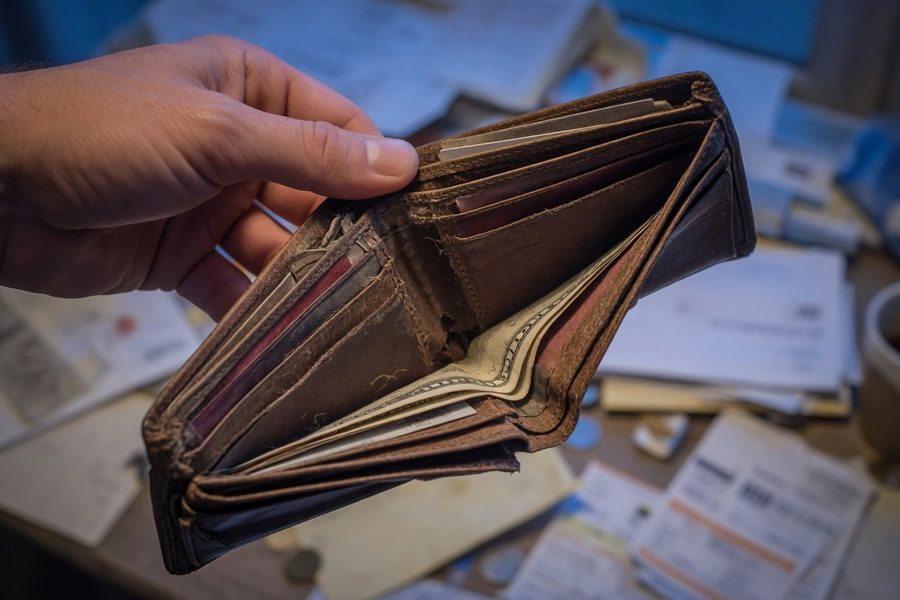
The biggest barrier, though, is psychological. Every dollar saved feels like a dollar stolen from today’s grocery budget, and no partner’s income provides a safety net. Recognizing that the target truly is bigger is the first step toward building it without guilt.
Calculate Your Six‑Month Target with Single‑Income Math
Stop using your gross income. The target is essential monthly expenses multiplied by six. Essentials are: housing, utilities, food, transportation, insurance premiums, minimum debt payments, and childcare, nothing else. Drop Netflix, restaurant spending, and the “miscellaneous” budget line. You can add them back after you have the core covered.
Take a real example: a single‑income family with a mortgage of $1,400, groceries of $600, utilities of $250, car insurance at $120, and a minimum credit card payment of $100. That’s $2,470 a month. Six months: $14,820. With just $200 available to save each month, reaching that target takes 74 months, more than six years. Few families are willing to wait that long, and that’s exactly why the strategy below focuses on acceleration rather than patience alone.
According to Bankrate’s annual emergency savings survey, a meaningful share of Americans have no emergency savings at all and most fall short of a full six-month cushion. A single‑income household can’t afford to sit in that gap for long. The math forces a pivot: you grow the deposit rate faster by combining automation, one-time windfalls, and slivers of new income.
Find Hidden Money in a Single‑Income Budget
Most single‑income budgets have at least $75 to $100 a month hiding in plain sight: recurring subscriptions, premium-brand grocery habits, or cell‑phone plans that haven’t been negotiated in two years. Pull three months of bank statements. Highlight anything you don’t remember buying. Cancel the lowest‑value item and redirect that exact dollar amount to the emergency fund the same day.
A tax refund, annual bonus, or gift check can shave months off the target. A $1,500 refund dropped straight into a CIT Savings Connect account earning 4.50% grows to roughly $1,567 in a year even if you never add another dime. Treating every windfall as non‑negotiable savings accelerates the finish line without touching your paycheck.

Automate and Prioritize Savings Without Derailing Your Only Income Stream
The single most reliable predictor of emergency-fund success is automation set on payday. Treat the transfer like the electric bill: it happens before you decide whether you can afford it. On a $50,000 single income, allocating even 4% of gross pay to an automatic deposit, roughly $77 per bi‑weekly check, builds a $2,000 starter fund in under a year. Once that starter fund exists, the same $77 adds nearly $2,000 annually toward the six‑month target.
Avoid the trap of waiting for “extra” money. On one income, extra money rarely appears without a deliberate cut or a side effort. The pay‑yourself‑first model works precisely because it removes the decision entirely. Link your checking account to a high‑yield account like Marcus and schedule the transfer for the morning pay arrives.
Add Income Strategically Without Burning Out the Sole Earner
The goal is not a second full‑time job. It’s a small, repeatable stream that adds $100 to $250 each month. A few hours of overtime, when offered, can fund an entire month’s contribution in one evening. For a non‑earning spouse, selling unused household goods on Facebook Marketplace or picking up micro‑freelancing tasks through platforms like Fiverr generates cash without adding child‑care costs. Seasonal work like tax preparation or tutoring also fits a single‑income calendar, especially when hourly jobs pay $19 or more.
The rule is simple: any side income goes directly to the emergency fund until the six‑month mark is hit. A consistent $150 monthly side gig, combined with a $200 automated transfer, triples the pace, turning a 74‑month timeline into roughly 25 months on the same $14,820 target.
Balance Emergency Savings With Debt Payoff on One Income
Don’t try to do both at full speed. The sequence: build a $1,000 to $1,500 starter fund first. That amount covers most single‑income emergencies, a car repair, a deductible, a short‑term medical expense, without forcing you back to a credit card. Once the starter fund is complete, shift focus to high‑interest debt, especially credit cards carrying 20% APR or higher. Tackling high‑interest credit card debt with a disciplined avalanche approach can free up $100 to $300 per month in interest savings, which then gets redirected straight into the larger emergency fund.
Pause the debt avalanche if a genuine emergency, job loss, major health event, drains the starter fund. Rebuild to $1,000 before resuming the debt snowball. This is a practical guardrail for a single‑income household where credit card debt is both a risk accelerator and an emergency itself. Some households also find success negotiating a lower APR, which reduces the payoff burden without sacrificing savings momentum.
Your Single‑Income Emergency Fund Action Plan
1. Lock in a specific target. Write down your essential monthly expenses, multiply by six, and put that number on a sticky note on the fridge. The example above landed at $14,820, yours will be different, but it must be concrete.
2. Open one of the high‑yield accounts above. Match the account to your actual behavior: SoFi if your paycheck is steady and direct-deposited, Marcus or CIT if you want a strong rate with no conditions, Ally if you’ll actually use the bucket tools, and Capital One if you need a branch nearby.
3. Automate the transfer for payday. Set it before you see the money hit checking, not after. A recurring $75 to $150 transfer is more powerful than an occasional $500 deposit you have to remember to make.
4. Redirect every windfall. Tax refunds, bonuses, cash gifts, and side-gig income go straight into the fund until you hit the six-month mark. Treat this as non-negotiable, not optional.
5. Reassess annually. Rates move, expenses change, and your target should be recalculated at least once a year, especially after a raise, a new dependent, or a change in insurance deductibles.
Frequently Asked Questions
How much should a single-income household keep in an emergency fund?
Aim for six to twelve months of essential expenses rather than the standard three to six months often recommended for dual-income households. The wider range accounts for higher insurance deductibles and the total loss of income if the sole earner loses their job.
What is the best savings account for an emergency fund in 2025?
There isn’t a single universal answer, it depends on your income pattern. Ally Bank offers strong overall value with goal-tracking tools, SoFi pays the highest rate in this roundup if you qualify for direct deposit, and Marcus or CIT work well if you want a competitive rate with no conditions attached.
Should I pay off debt or build an emergency fund first?
Build a starter fund of $1,000 to $1,500 first, then shift to paying off high-interest debt above 20% APR, then return to building the full six-month fund. Trying to do both at full speed on a single income usually stalls both goals.
How long does it take to save six months of expenses on one income?
On a modest $200 monthly contribution, a $14,820 target takes about 74 months, over six years. Adding a $150 monthly side income and a bigger automated transfer can cut that down to roughly 25 months.
Is a high-yield savings account safe for emergency money?
Yes, as long as the account is FDIC insured up to $250,000 per depositor, per bank. Every account in this roundup carries that protection, and some, like SoFi’s partner-bank structure, extend coverage even further.
Why do single-income households need a bigger emergency fund than dual-income households?
Because there’s no second paycheck to fall back on if the one earner loses their job or can’t work. Only 55 percent of single parents reported saving for unexpected expenses, compared to almost two-thirds of households overall, according to FDIC research, which reflects how much less margin these households have to begin with.
What counts as an “essential expense” when calculating my target?
Housing, utilities, food, transportation, insurance premiums, minimum debt payments, and childcare. Discretionary spending like streaming subscriptions, dining out, and hobby budgets should be excluded from the calculation, though you can add a buffer back in once the core target is met.
Does a savings account’s interest rate really matter that much?
Yes, over the two to three years it typically takes to fill a six-month fund. A 0.50 percentage point gap on a $15,000 balance costs about $75 a year, which adds up when compounded over the full savings timeline.
What if I can’t automate savings because my income is irregular?
Automate a percentage of each deposit rather than a fixed dollar amount, or set a rule that a set share of every invoice or side-gig payment goes straight to savings. Accounts like Marcus and CIT that don’t require direct deposit for their full rate work well for this kind of variable income.
Sources
- Federal Reserve: Economic Well-Being of U.S. Households in 2024
- FDIC: Single Parents’ Financial Resilience, Banking, and Mobile Technology
- Bureau of Labor Statistics: Both Spouses Employed in About Half of All Married-Couple Families
- Bankrate: Annual Emergency Savings Report
- Marcus by Goldman Sachs High Yield Savings
- Discover Online Savings Account
- Capital One 360 Performance Savings
- CIT Bank Savings Connect Account
- SoFi Checking and Savings
- FDIC: Deposit Insurance FAQs
- MyFinancial101: Credit Card Debt, How to Prioritize and Negotiate With Creditors
- MyFinancial101: Stop Overpaying, Negotiate Your Credit Card APR
- MyFinancial101: $19+ Hourly Jobs Hiring Now