Fact-checked by the MyFinancial101 editorial team
Key Takeaways
- A $2,500 purchase financed over 24 months at a typical BNPL extended-term APR of 37% costs roughly $1,074 in interest, about $402 more than the same balance on a 24% credit card.
- 63% of BNPL issuance in 2025 carried 0% APR, but that rate only holds if every payment arrives on schedule, one missed payment can trigger retroactive interest charges.
- The average BNPL loan size was $135 (inflation-adjusted) in 2023, making most BNPL use concentrated in small, short-term purchases rather than large financing decisions.
- CFPB research found BNPL borrowers are more likely to be highly indebted, carry revolving credit card balances, and have existing delinquencies compared to non-BNPL users.
- The CFPB issued a rule clarifying that BNPL lenders must provide dispute rights and refund protections similar to credit cards, a protection gap that previously disadvantaged BNPL users.
- Stacking three or more simultaneous BNPL plans across different providers creates opaque monthly obligations that do not appear on a single statement, increasing the risk of missed payments and overdraft fees.
In This Guide
- How BNPL and Credit Cards Actually Work Day-to-Day
- Short-Term Costs: When BNPL Delivers True 0% Financing
- Long-Term and Missed-Payment Scenarios: Where Costs Add Up Fast
- Rewards, Protections, and Hidden Value That Shifts the Math
- Credit Score Effects and Long-Term Borrowing Power
- Which Option Wins for Common Purchase Scenarios
- The Merchant Fee Factor Most Buyers Never See
- Total Cost Over 6–24 Months: A Quantitative Breakdown
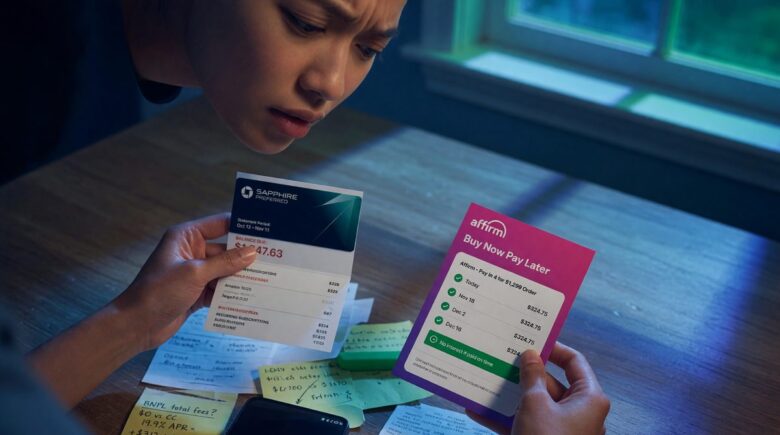
, the average APR on new credit card accounts sits near 22%, yet a growing share of American consumers are bypassing credit cards entirely for Buy Now, Pay Later services that advertise 0% interest. That zero sounds like an obvious win, until you read the fine print on what happens when the promotional window closes or a payment lands a day late. The buy now pay later vs credit card question is one where the correct answer depends almost entirely on your repayment behavior, not just the headline rate.
BNPL has grown fast. The CFPB’s market data shows it remains under 2% of total credit card purchase volume in the U.S., but usage is concentrated among consumers who already carry revolving card debt, suggesting the people most likely to choose BNPL are also the most exposed to its risks. Meanwhile, credit card charge-off rates hit 4.19% at U.S. commercial banks in Q4 2023, a signal that both products carry real default risk for stretched borrowers. Neither option is inherently safe, the cost difference is driven by how each product punishes a misstep.
This guide lays out the mechanics, the math, and the real-world scenarios where each option costs less. By the end, you will know exactly which choice saves money on a short-term purchase, which one wins on a 24-month financing plan, and where the conventional wisdom about “free BNPL” quietly falls apart.
How BNPL and Credit Cards Actually Work Day-to-Day
Most people assume BNPL and credit cards are just different wrappers around the same idea: borrow now, pay later. The operational difference is sharper than that. Pay-in-4 BNPL splits your purchase into four equal installments, typically due every two weeks, with no interest charged if you pay on time. The loan is closed-end, fixed amount, fixed schedule, done. A credit card is open-end revolving credit: you borrow up to a limit, carry a balance, pay interest on what remains, and can keep borrowing as you pay down.
Approval, Access, and Typical Purchase Sizes
BNPL approval is fast and often requires only a soft credit pull, which is part of its appeal for consumers with thin or damaged credit files. The average BNPL loan size was $135 (inflation-adjusted) in 2023, according to CFPB market data, this is grocery-run territory, not furniture financing. Credit cards require a formal application, a hard inquiry, and approval based on creditworthiness, but they offer higher limits, wider merchant acceptance, and rewards programs that BNPL products simply do not match.
Merchant acceptance is a practical constraint worth naming. Major BNPL providers like Affirm, Klarna, and Afterpay are integrated at thousands of retailers, but a credit card works nearly everywhere. If you are splitting costs on a category like dining or utilities, you are almost certainly using a card. For online retail, BNPL is increasingly the default option at checkout, which is exactly where impulse purchases happen.
BNPL providers earn primarily from merchant fees, which often exceed the interchange fees charged by credit card networks. That revenue model means the “free” financing for consumers is subsidized by retailers, and those higher merchant costs can filter into product prices for all buyers, BNPL user or not.
Extended-Term BNPL: A Different Beast
Pay-in-4 gets most of the headlines, but a growing segment of BNPL products now offer repayment terms of 6, 12, or 24 months. These longer-term plans frequently carry interest rates between 10% and 37% APR. Affirm, for example, publicly discloses APRs up to 36% on extended plans. This is the product category where the comparison to credit cards gets genuinely expensive, and where most surface-level “BNPL vs. credit card” coverage fails to go deep enough.
Short-Term Costs: When BNPL Delivers True 0% Financing
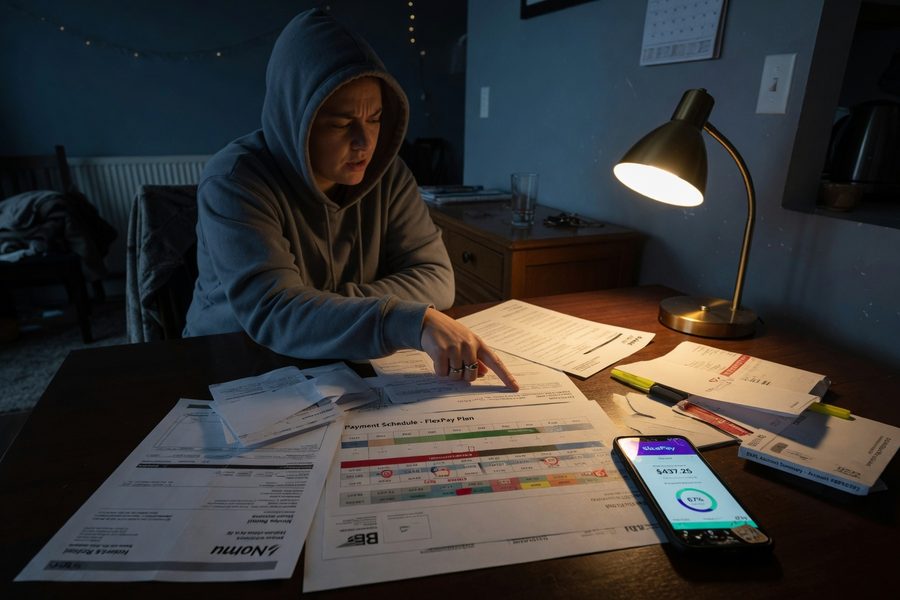
Here is where BNPL genuinely wins: a purchase you can pay off in six weeks or less, made with a provider offering a no-interest pay-in-4 plan, paid on schedule. The math is clean. You pay exactly the purchase price and nothing more. On a credit card, the equivalent scenario, paying the full balance before the statement due date, also costs $0 in interest. So for disciplined payers, both options are free on a short-term purchase.
The Grace Period Distinction
Credit cards come with a grace period, typically 21 to 25 days after the statement closes, during which no interest accrues on new purchases. Pay in full by that date and the effective APR is zero. BNPL pay-in-4 spreads payments over six weeks, which means you are cash-flow negative a bit longer, four smaller payments instead of one lump sum. For someone managing a tight monthly budget, those staggered payment dates can create timing pressure that a credit card’s single monthly due date does not.
63% of total BNPL issuance in 2025 carried 0% APR, according to Federal Reserve data. That means 37% of BNPL loans carried interest, a substantial minority that the product’s marketing rarely leads with.
Real-World Short-Term Comparison on a $500 Purchase
| Payment Method | Financing Cost | Total Paid | Condition |
|---|---|---|---|
| BNPL Pay-in-4 (0%) | $0 | $500.00 | All 4 payments on time |
| Credit Card (paid in full) | $0 | $500.00 | Balance cleared before due date |
| Credit Card (2% cash back) | $0 interest | $490.00 net | Reward applied, paid in full |
| BNPL Pay-in-4 (one late payment) | $7–$15 late fee | $507–$515 | One missed payment date |
The credit card with a 2% cash-back reward actually costs less net than either on-time scenario, a detail the BNPL promotional framing routinely ignores. This advantage only accrues if you pay in full. Carry that $500 for a single billing cycle at 22% APR and you owe roughly $9 in interest, which wipes out most of the cash-back benefit.
Long-Term and Missed-Payment Scenarios: Where Costs Add Up Fast
The moment a repayment extends past six weeks, the cost calculation shifts substantially. This is the scenario that accounts for most real consumer harm from both products, and where the data tells a stark story.
The $2,500 Calculation Nobody Shows You
Run the arithmetic on a $2,500 purchase financed over 24 months. At a 37% APR on an extended BNPL plan, total interest paid reaches approximately $1,074, bringing your total cost to about $3,574. On a credit card at 24% APR, already a high rate for someone with fair credit, the same balance over 24 months generates roughly $672 in interest, for a total of about $3,172. That is a $402 difference in favor of the credit card, on the exact same purchase price.
If your credit score qualifies you for a card at 20% APR, the interest drops to approximately $546, widening the gap to $528. For someone with good credit accessing a 0% intro APR card for 12–18 months, the saving against BNPL extended financing can exceed $800 on that single purchase.
Some BNPL providers charge deferred interest, not simple interest, on extended plans. If you carry any balance past the promotional period, you may owe interest on the original full purchase price, not just the remaining balance. This is the same structure as many store credit cards and can dramatically increase your actual cost.
Stacking BNPL Plans and the Visibility Problem
One angle that most comparisons skip entirely: what happens when a consumer runs three or four simultaneous BNPL plans from different providers. Each plan has its own biweekly payment schedule, its own late-fee structure, and its own app. There is no consolidated statement. A consumer with $135 per plan across four active BNPL accounts has roughly $540 in monthly BNPL obligations, but no single document shows that total. A credit card statement does. This opacity is not an accident; it is a structural feature of how BNPL is sold. When those staggered payment dates collide with a paycheck cycle, overdraft fees from the linked bank account add another layer of cost the promotional APR never captures.
CFPB research found that BNPL borrowers are significantly more likely to be highly indebted and to have existing delinquencies compared to non-BNPL users. That pattern suggests BNPL is being used as a last-resort financing tool by consumers already under financial pressure, which is precisely when payment timing failures are most likely.
Late Fees and Retroactive Interest
BNPL late fees vary by provider: Afterpay caps late fees at 25% of the order value, Klarna charges up to $7 per missed payment, and some extended-plan providers have no fee cap. A credit card’s late fee is federally limited to $30 for the first instance and $41 for subsequent instances ( regulations). On a $135 BNPL purchase, a 25% late fee adds $33.75, more than the credit card’s regulated maximum on a much smaller balance.
| Scenario | BNPL Cost | Credit Card Cost | Winner |
|---|---|---|---|
| $500, paid on time in 6 weeks | $0 | $0 (paid in full) | Tie |
| $500, one late payment | $7–$34 fee | $30 max late fee | Card (often) |
| $2,500 over 24 months, 37% BNPL / 24% card | ~$1,074 interest | ~$672 interest | Card by $402 |
| $2,500, 0% intro card for 18 months | ~$1,074 interest | $0 interest | Card by ~$1,074 |
| $135, pay-in-4, 0% on time | $0 | $0 (paid in full) | Tie |
Rewards, Protections, and Hidden Value That Shifts the Math
Here is the counterintuitive reality: for a responsible credit card user, the card is not just cheaper on long-term financing, it actually pays you to use it. Cash-back cards averaging 1.5–2% rewards on every purchase return real dollars. On $10,000 in annual spending, that is $150–$200 back. BNPL offers no equivalent. Flat-rate rewards cards through major issuers are straightforward, and travel cards can push effective return rates past 3% on certain categories.
Purchase Protections and Dispute Rights
Until recently, BNPL users who received a defective product or fell victim to fraud had no guaranteed path to a refund. That changed when the CFPB issued an interpretive rule clarifying that BNPL lenders meet the criteria for credit card providers under the Truth in Lending Act, requiring them to provide dispute rights and refund protections comparable to credit cards. This is a meaningful regulatory shift, but enforcement consistency across dozens of BNPL providers is still being established.
Credit cards have offered these protections for decades under the Fair Credit Billing Act. Many cards also provide extended warranty coverage, purchase protection against damage or theft for 90–120 days, and zero fraud liability. These benefits do not show up in an APR comparison but represent genuine financial value, especially on large purchases like electronics or appliances. If you are managing existing credit card debt, the rewards and protections still count, but they need to be weighed against the cost of any balance you carry.
Many travel and premium credit cards include trip cancellation insurance, rental car coverage, and price protection features worth hundreds of dollars annually, none of which are available through any major BNPL provider.
Zero Liability and Fraud Recovery
Federal Regulation E and card network zero-liability policies give credit card holders a clear and tested fraud recovery process. BNPL fraud recovery has historically been provider-dependent and slower. The new CFPB rule improves this, but if you make a large purchase and something goes wrong, a credit card’s dispute infrastructure is more mature. That matters most on the purchases where BNPL is increasingly competitive: electronics, furniture, and travel packages.
Credit Score Effects and Long-Term Borrowing Power
This is where the comparison gets complicated in ways most buyers do not anticipate. Credit cards report to all three major bureaus, Experian, Equifax, and TransUnion, every month. On-time payments build a payment history record. Your utilization ratio (balance divided by credit limit) appears on your report and affects your FICO score. A long-standing card account with low utilization is a positive signal to future lenders.
How BNPL Appears on Credit Reports
BNPL reporting has been inconsistent. Most pay-in-4 plans historically did not appear on credit reports at all, a feature some consumers found attractive. Post-2025, however, that is changing. Experian, Equifax, and TransUnion have all announced or implemented BNPL reporting frameworks, and several major providers now report payment data to at least one bureau. This means missed BNPL payments can now harm your credit score, while on-time payments may or may not help it, depending on how the bureau scores the data type.
The average default rate on BNPL loans for borrowers from 2019–2022 was 2%, according to CFPB data, lower than the 4.19% charge-off rate on credit cards at commercial banks in Q4 2023. The gap narrows significantly among lower-income users running multiple concurrent plans.
Multiple BNPL Accounts vs. One Consolidated Card Balance
A consumer with four active BNPL loans and no credit card history looks opaque to underwriters. The loans may not fully appear on their report, their total monthly obligation is invisible to lenders, and they have no revolving credit history to demonstrate responsible utilization management. When that person applies for a mortgage or auto loan, the underwriter cannot see the full picture. A single credit card account with a low balance and three years of on-time payments tells a much cleaner story. If managing credit card balances is an ongoing challenge, working with a credit counseling service can help you build that history more deliberately.
| Factor | Credit Card | BNPL Pay-in-4 | BNPL Extended-Term |
|---|---|---|---|
| Bureau Reporting | All 3 bureaus, monthly | Inconsistent, improving | Often reported |
| Credit History Building | Strong | Weak to moderate | Moderate |
| Utilization Impact | Yes (affects score) | Typically no | Sometimes |
| Hard Inquiry on Apply | Yes | Usually no (soft pull) | Sometimes hard pull |
| Missed Payment Consequence | Late fee + score hit | Late fee + possible score hit | Late fee + score hit |
Which Option Wins for Common Purchase Scenarios
Most buy now pay later vs credit card articles stop at general principles. Here is the scenario-level breakdown that actually changes decisions.
Small Purchase, Tight Budget, No Credit Card Access
For a $135 purchase by someone without a credit card or with a maxed-out card, BNPL pay-in-4 at 0% is a rational tool. The cost is zero if paid on time, no credit card interest compounds, and the fixed schedule can feel more manageable than an open revolving balance. The risk is real: one missed payment triggers fees, and stacking a second or third plan in the same period creates the visibility problem described earlier. Used as a single-plan, short-term tool for a planned purchase, BNPL is defensible here.
Large Purchase, Good Credit, Rewards Card Available
A consumer with good credit buying $1,500 in electronics should almost always use a rewards credit card paid in full within the billing cycle. The effective cost is negative after cash back, the purchase is protected by dispute rights and extended warranty, and the payment builds credit history. If paying in full is not possible, a 0% intro APR card for 12–18 months dominates extended BNPL by eliminating interest entirely during the promotional window. For consumers already managing high-rate credit card debt, adding a new purchase to the pile is different, but that is a balance management problem, not an argument for BNPL’s extended rates.
Lower Credit Score Users
BNPL is genuinely more accessible for consumers with fair or poor credit, since many plans use only a soft pull. A credit card for someone with a 580 FICO score might carry a 29–33% APR, higher than the average extended BNPL rate. In that narrow scenario, a short-term BNPL pay-in-4 plan at 0% beats a credit card on which the user carries a balance. The caveat: this only works if the BNPL plan is truly paid on time and the consumer does not stack multiple plans simultaneously.
The Merchant Fee Factor Most Buyers Never See
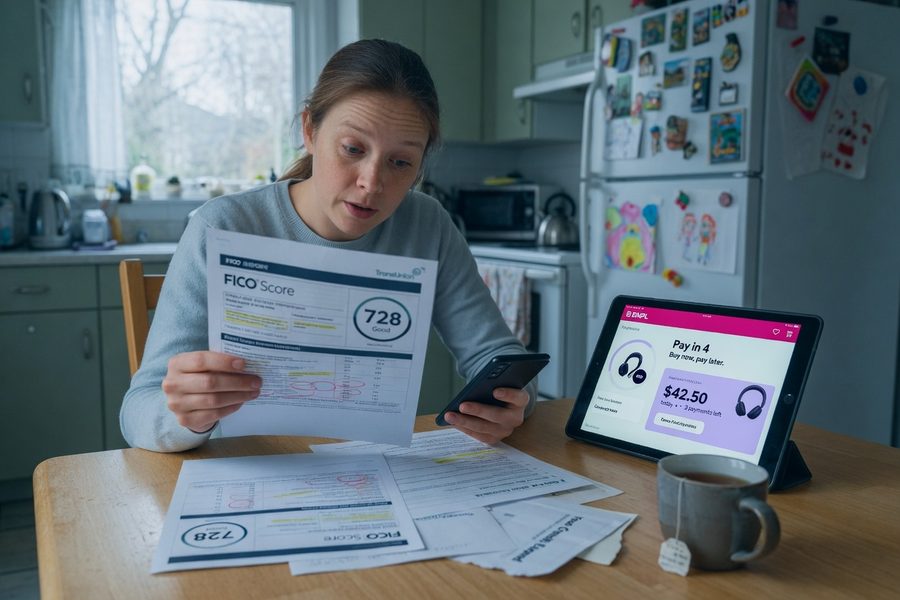
BNPL providers charge retailers merchant fees that frequently exceed the interchange fees credit card networks charge. Interchange on a standard consumer Visa or Mastercard runs roughly 1.5–2.2% of the transaction. BNPL merchant fees can run 2–8%, depending on the provider and plan type. Retailers absorb some of this cost as a customer acquisition tool, but a portion filters into product pricing for all buyers, BNPL user or not.
This means a consumer paying cash or using a debit card at a retailer with heavy BNPL integration is indirectly subsidizing the “free” financing others receive. It also means the true cost of BNPL financing is partially hidden in the retail price itself, making the 0% headline rate slightly less impressive than it appears.
Total Cost Over 6–24 Months: A Quantitative Breakdown
Pulling the data together into a single comparison makes the pattern clear. Over short timelines with disciplined repayment, the products are roughly equivalent, and BNPL has a slight accessibility edge. Over longer timelines or with any payment irregularity, the credit card wins on cost for most consumers with even moderate credit standing.
The Worked Example: $2,500 Over 24 Months
Take $2,500 financed over 24 months. At a 37% BNPL extended APR, the monthly payment on a standard amortizing loan is approximately $113.13, and total interest paid over 24 months reaches roughly $1,074, for a total repayment of $3,574. At a 24% credit card APR, paying the same amount monthly ($113.13), the interest paid drops to approximately $672, for a total of $3,172. The $402 difference is not speculative; it is arithmetic. Use a 0% intro credit card for 18 months and roll the remaining balance to a low-rate card, and the interest cost can be reduced to under $100 on that same purchase.
Before accepting an extended BNPL offer at checkout, check whether a 0% intro APR credit card offer is available to you. Issuers including Chase, Citi, and Discover regularly offer 15–21 month 0% periods on purchases. On a $1,000+ purchase, that is a savings of $200–$600 compared to a 37% BNPL plan over the same term.
Where the Data Points
| Timeline | Discipline Level | Lower Cost Option | Margin |
|---|---|---|---|
| 0–6 weeks | High (pays on time) | Tie (or card with rewards) | Card wins by 1–2% cash back |
| 6 weeks–6 months | High | Credit card (paid in full monthly) | Card wins by reward value |
| 6–24 months | Moderate | Credit card | Card wins by $200–$600+ |
| 6–24 months | Low (missed payments) | Credit card | Card wins; BNPL late fees compound |
| Any timeline | Any | 0% intro APR card (if eligible) | Card wins by full BNPL interest amount |
The honest caveat: this analysis assumes access to a competitive credit card rate. Consumers with credit scores below 620 may not qualify for the rates in these examples. For them, BNPL pay-in-4 on small, planned purchases remains a cost-effective bridge, provided they treat it as a short-term tool, not a permanent financing strategy. If building credit is the actual goal, a secured credit card with a low limit and full monthly payoff typically does more for long-term financial health than BNPL usage ever will. Resources on building financial fundamentals from zero can help frame where credit fits in a broader plan.
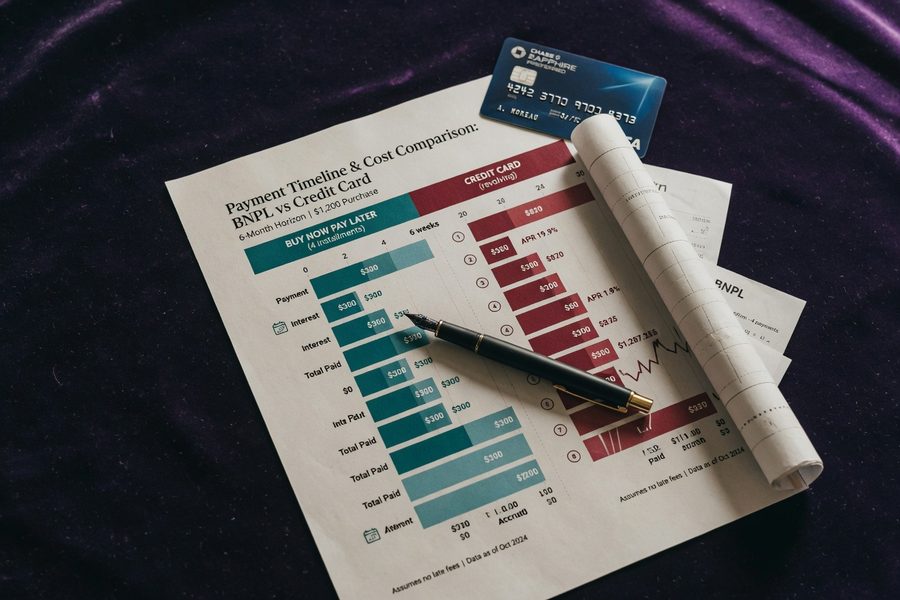
BNPL remains under 2% of total credit card purchase volume in the U.S., per CFPB market data, a reminder that despite the marketing noise, revolving credit cards still dominate consumer financing at scale.
Real-World Example: BNPL vs. Credit Card on a $1,200 Laptop Purchase
Consider an illustrative example: a consumer, call her Maria, purchases a $1,200 laptop through an online retailer in January 2026. At checkout, she is offered two options: a BNPL pay-in-4 plan at 0% interest, with four payments of $300 due every two weeks, or her 2% cash-back credit card, which she plans to pay in full by the February due date.
Maria chooses the BNPL plan, reasoning that spreading payments over six weeks feels easier on her budget. The first two payments clear without issue. The third payment, due six weeks after purchase, hits on a week when her rent clears the same day, and her checking account comes up $40 short. The payment fails, triggering a $15 late fee. She pays the remaining balance plus the fee the following day, but her bank also charges a $35 overdraft fee, a cost entirely outside the BNPL contract. Her total cost: $1,200 + $15 (BNPL late fee) + $35 (bank overdraft) = $1,250.
Had she used her credit card and paid in full, her total cost would have been $1,200, reduced by $24 in cash-back rewards, a net cost of $1,176. The difference between the two outcomes: $74. On a single laptop purchase. The timing collision between BNPL payment schedules and other monthly obligations is the exact behavioral pattern CFPB research identified as a recurring risk for BNPL users who are already financially stretched.
Now extend this: if Maria had chosen a 12-month extended BNPL plan at 29% APR instead of pay-in-4, her monthly payment would be approximately $116, and her total interest over the year would reach roughly $192, bringing total cost to $1,392. A credit card with a 0% intro APR for 12 months would have cost $0 in interest and returned $24 in rewards, a total cost of $1,176, a savings of $216 on the same purchase with the same repayment timeline.
Your Action Plan
-
Identify your actual repayment timeline before choosing a payment method
The single most important variable in the BNPL vs. credit card decision is not the headline rate, it is how long you will realistically take to pay. If the answer is six weeks or less, BNPL pay-in-4 at 0% and a credit card paid in full are equivalent. If the answer is longer than six weeks, do the math on what interest will actually cost before you commit.
-
Check your credit card’s 0% intro APR offers before accepting BNPL extended financing
If you need to finance a purchase over 6–24 months, log into your card issuer’s portal or check pre-approved offers before defaulting to the BNPL option at checkout. A 0% intro APR card eliminates interest entirely during the promotional period, often beating extended BNPL by several hundred dollars on purchases above $500.
-
Count your active BNPL plans before opening a new one
If you already have two or more active BNPL payment schedules running, do not open a third. The combined monthly obligation may not be visible on any single statement, but it is real. Write out every active BNPL payment schedule on a single sheet of paper, due dates, amounts, and providers, before deciding whether you can absorb another plan without a timing conflict.
-
Use a rewards credit card for purchases you can pay in full each month
On any purchase where you have the cash to pay in full by the due date, a rewards card dominates. You capture 1–2% cash back or equivalent on every dollar spent, with no interest. BNPL offers no equivalent. If you’re looking for ways to lower your credit card APR, doing so before you carry a balance is far more effective than trying to renegotiate after the fact.
-
Review BNPL terms for deferred interest clauses before signing
Some BNPL extended plans use deferred interest, not simple interest. Under deferred interest, if you carry any balance past the promotional end date, interest is charged retroactively on the original full purchase price. Read the loan agreement for the phrase “deferred interest” and ask the provider directly if you do not see it. Simple interest and deferred interest on a $1,500 purchase can differ by $200 or more.
-
Align BNPL payment dates with your paycheck schedule
If you use BNPL pay-in-4, confirm that each of the four payment dates falls within a day or two after your regular paycheck deposit. Most providers allow you to adjust the first payment date when you set up the plan. A payment due three days before your paycheck arrives is a setup for an overdraft fee that adds $30–$35 to a “free” financing arrangement.
-
Prioritize credit card payoff if you carry a balance and use BNPL simultaneously
Running BNPL plans while carrying a revolving credit card balance at 22%+ APR is the highest-cost configuration. The BNPL plan may be 0% short-term, but the unpaid credit card balance is compounding at a rate that erases any short-term BNPL benefit. Pay down the card first, then use BNPL only for purchases you can fully absorb.
-
Use BNPL strategically for planned, one-time purchases, not as a default checkout habit
BNPL is most defensible as a deliberate tool for a specific, budgeted purchase where the pay-in-4 schedule fits your cash flow. It becomes costly when used habitually at checkout across multiple retailers, because the cumulative obligation grows invisible. Treat it like a short-term personal loan, not a feature of the shopping experience, because financially, that is exactly what it is.
Frequently Asked Questions
Is BNPL ever actually cheaper than a credit card?
Yes, in one specific scenario: a pay-in-4 plan at 0% APR, paid on time, on a purchase the buyer could not otherwise make without carrying a high-interest credit card balance. In that case, BNPL avoids interest that a card would charge. For buyers who pay their credit card in full each month, BNPL is at best equal in cost and often worse, once rewards value is factored in.
What happens if I miss a BNPL payment?
The consequences depend on the provider. Most charge a late fee ranging from $7 to 25% of the order value. Some pause your account and prevent new purchases until the missed payment is resolved.–2026, missed payments on extended-term BNPL plans are increasingly reported to credit bureaus, which means a late payment can now appear on your credit report and lower your score, the same consequence as a missed credit card payment.
Do BNPL plans affect my credit score?
Increasingly, yes. Pay-in-4 plans have historically been the least likely to appear on credit reports, but bureau reporting for BNPL is expanding. Extended-term BNPL plans are more consistently reported. A missed payment on either type can now appear as a negative mark at one or more bureaus. On-time payments on pay-in-4 plans may not yet help your score, since scoring models are still catching up to the new BNPL data.
Which is better for building credit?
A credit card, clearly. A credit card with a low utilization ratio and a consistent on-time payment history builds credit score faster and more reliably than any BNPL product available today. BNPL’s inconsistent reporting means you may absorb the downside of missed payments without receiving full upside credit for on-time payments.
Can I use BNPL and a credit card for the same purchase?
Some BNPL providers allow you to fund the installment payments with a credit card, which creates a layered debt situation where BNPL acts as an intermediary. This can make sense if your card earns rewards on the transaction and you pay the card in full. It also adds complexity: you are now managing both a BNPL schedule and a credit card billing cycle. Do not use this approach while carrying a revolving credit card balance.
What is the real cost of BNPL when I look at it over a full year?
For a typical user running multiple small BNPL plans averaging $135 each, the annual cost depends almost entirely on whether payments are made on time. One late fee per plan per quarter, at $10 per incident, on three active plans adds $120 in fees annually, on top of any interest on extended plans. Add the potential for one overdraft event per quarter at $35 per incident, and the “free” financing can easily cost $250–$400 per year in ancillary fees alone.
Are credit cards safer than BNPL for large purchases?
For purchases above $500, credit cards offer more established legal protections under the Fair Credit Billing Act, including the right to dispute charges and withhold payment during a dispute. The CFPB’s 2024 rule extended similar protections to BNPL, but the enforcement infrastructure for BNPL dispute resolution is newer and less tested. For a $1,500+ purchase where product quality or delivery is uncertain, a credit card provides a more reliable dispute pathway.
Should I use BNPL if I have bad credit?
BNPL pay-in-4 is accessible with limited or poor credit, which is a real advantage for consumers who cannot qualify for a competitive credit card rate. Used carefully, one plan at a time, on a planned purchase, with payment dates aligned to your paycheck, it can serve as a short-term bridge. However, people with limited financial cushion are also most at risk from payment timing failures, overdrafts, and fee accumulation. A secured credit card with a $300–$500 limit and full monthly payoff is a better long-term credit-building tool, even if it takes a few months to obtain.
How do I compare the true cost of BNPL vs. a credit card offer I’ve received?
Take the purchase amount, the BNPL APR (or 0% if it is a pay-in-4 plan), and the repayment term, and calculate total interest paid using a standard loan amortization formula, or a free online calculator. Do the same for the credit card offer. Then subtract any cash-back or rewards value from the credit card total. The difference is your actual out-of-pocket cost gap. If the BNPL plan is a 0% pay-in-4 and you would pay the credit card in full, both are zero cost, but the card returns rewards. If you are comparing extended terms with stated APRs, the arithmetic almost always favors the card at typical credit card rates.
If you’re already managing financial stress, there are resources that can help beyond just choosing the right payment product. Programs covering utility assistance, food support, and income supplements are documented on MyFinancial101, including guidance on who qualifies for expanded assistance under 2026 poverty guidelines.
Sources
- Consumer Financial Protection Bureau, CFPB Takes Action to Ensure Consumers Can Dispute Charges and Obtain Refunds on Buy Now, Pay Later Loans
- Consumer Financial Protection Bureau, Consumer Use of Buy Now, Pay Later: Insights from the CFPB Making Ends Meet Survey
- Consumer Financial Protection Bureau, The Buy Now, Pay Later Market
- Federal Reserve Bank of Richmond, Economic Brief: Credit Card Charge-Off Rates, Q4 2023
- Consumer Financial Protection Bureau, BNPL Report 2025: Default Rates and Consumer Outcomes
- Board of Governors of the Federal Reserve System, Buy Now, Pay Later: Beyond Pay-in-4, A Comprehensive Product Overview (2026)
- Consumer Financial Protection Bureau, Buy Now, Pay Later Market Report, December 2025
- Federal Reserve, Consumer Credit Statistical Release (G.19): Credit Card Rates
- Consumer Financial Protection Bureau, Consumer Complaint Database: BNPL and Credit Card Complaints
- Federal Reserve Bank of New York, Research and Statistics: Consumer Credit Trends
- FICO, How Buy Now, Pay Later Accounts Are Scored