Fact-checked by the MyFinancial101 editorial team
Quick Answer
A CD ladder strategy staggers certificates of deposit across multiple maturity dates so one CD matures each year, giving you regular penalty-free access to your money while the rest earns higher long-term rates. A $10,000 five-rung ladder can generate roughly $2,200 in interest over five years, compared to about $500 in a typical savings account.
Most savers assume the safest move is to park cash in a single high-yield savings account and call it done. The CD ladder strategy challenges that assumption: by splitting your money across CDs with staggered maturities, you earn rates that top savings accounts consistently miss while keeping a portion of your principal accessible every year. The FDIC’s national average savings rate sits at just 0.38%, while the top one-year CD rates are pushing well above 4%.
The math matters, but so does the structure. This guide walks through exactly how to build a ladder, what the current rate environment means for which rungs to prioritize, what can go wrong, and how brokered CDs and platform tools change the equation in ways most guides overlook.
Key Takeaways
- The national average savings account rate is 0.38% APY, according to the FDIC’s rate data, making CD yields significantly more attractive for idle cash.
- A $10,000 five-year CD ladder can earn approximately $2,200 in total interest versus about $500 in a 1% savings account, per Bankrate’s CD ladder analysis.
- Choosing the wrong bank can cost 0.5 to 1.0 percentage points in yield, which translates to $250–$500 in lost interest on a $5,000 CD ladder over five years, according to Bankrate research.
- The national average one-year CD yield is 1.98% as of June 28, 2026, per Bankrate’s rate survey, though top online banks are offering multiples of that figure.
- FDIC insurance covers up to $250,000 per depositor per institution, meaning larger ladders spread across multiple banks must be structured carefully to stay fully protected under FDIC aggregation rules.
In This Guide
What Is a CD Ladder Strategy and Why Does It Matter in 2026?
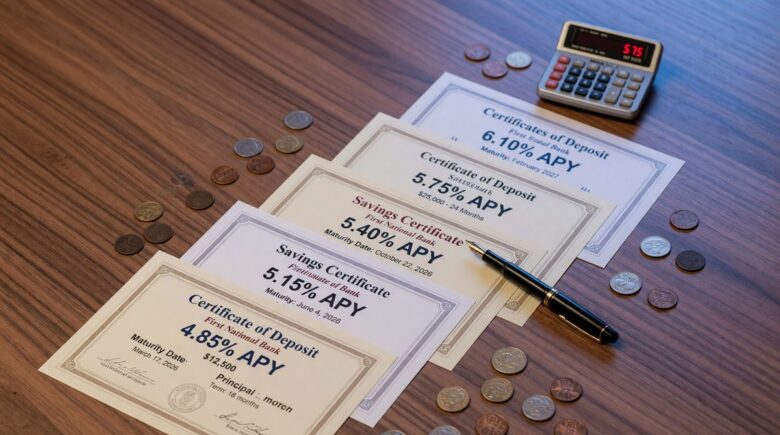
A CD ladder is a structured approach where you divide a lump sum into equal portions and invest each portion in a CD with a progressively longer maturity, typically one year, two years, three years, four years, and five years. When the shortest CD matures, you reinvest it into a new five-year CD at the top of the ladder, and the cycle repeats. The result is one maturity event per year, every year, after the initial setup period.
The core appeal is the trade-off it resolves. Locking all your money into a single five-year CD gives you the highest available rate but zero access to your principal for half a decade. Keeping everything in a savings account gives you access any day you want, but you surrender meaningful yield. A ladder captures most of the long-term rate while returning 20% of your principal annually as each rung matures.
Why June 2026 Changes the Calculus
The current rate environment makes this decision more nuanced than it was in, say, 2021. In June 2026, top-tier banks are offering approximately 4.30% on select 17-month CDs and roughly 4.20% on 5-year terms. That relatively flat yield curve means shorter and longer CDs are paying close to the same rate. In a normal steep yield curve, you would clearly sacrifice a lot of yield by staying short. Here, the penalty for staying short is small, which makes the liquidity argument for laddering even stronger: you give up very little yield to gain annual access points.
According to the Federal Reserve Bank of St. Louis (FRED), the national rate for a 12-month CD under $100,000 stood at 1.65% in June 2026, a reminder that the top advertised rates from online banks often run two to three times the national average. Shopping across institutions is not optional; it is the primary lever for maximizing a ladder’s return.
Savers who already carry high-interest balances elsewhere should note the priority order: eliminating expensive debt usually outperforms any CD yield. If that situation applies to you, our guide on prioritizing and negotiating credit card debt addresses that step first.
How to Build a CD Ladder: The Step-by-Step Process
Building the ladder requires four concrete decisions before you open a single account: total amount, number of rungs, term spacing, and which banks to use.
Step 1: Set Your Parameters
Most practitioners use 3 to 5 rungs spaced one year apart. Fewer rungs mean less frequent access; more rungs mean smaller individual deposits that may not qualify for top rates at some institutions. A five-rung structure is the most common starting point for savers with a three-to-five-year horizon who want annual liquidity.
Divide your total investment evenly. A $25,000 ladder split into five rungs gives you $5,000 in each CD. If your total exceeds $250,000, you must spread it across multiple institutions to stay within FDIC deposit insurance limits of $250,000 per depositor per institution per ownership category. Joint accounts get separate coverage, so a couple can hold up to $500,000 at a single bank and remain fully insured, a useful aggregation strategy for larger ladders.
Step 2: Shop Aggressively Across Institutions
The rate difference between banks is not trivial. Bankrate’s analysis shows that settling for a bank offering 0.5 to 1.0 percentage points below the top rate can cost $250 to $500 in interest on a $5,000 CD over five years. Online banks and credit unions consistently outpay traditional brick-and-mortar branches, and comparison tools make the process fast. Prioritize the best available rate for each specific term, not loyalty to a single institution.
One practical option worth knowing: brokered CDs, purchased through platforms like Fidelity, Vanguard, or Charles Schwab, allow you to build and manage an entire ladder inside a single brokerage account. Fidelity, for instance, offers a model CD ladder tool that automates the rung structure and flags maturing positions for reinvestment. The trade-off is that brokered CDs are sold on a secondary market if you need early exit, meaning you may receive less than face value if interest rates have risen since purchase. That is a meaningful difference from the bank CD model, where early withdrawal costs you a fixed penalty, typically two to six months of interest, but you never lose principal.
Step 3: Automate Reinvestment
The ladder’s power compounds only if you actually reinvest each maturing CD into a new long-term rung. Mark maturity dates on your calendar well in advance, because many banks roll matured CDs into a new CD at the current (often lower) rate automatically after a short grace period if you take no action. Set a reminder for the grace window, usually seven to ten days after maturity, and shop rates again before committing.

A Real-World Example Using June 2026 Rates
Numbers cut through abstraction faster than any explanation. Here is a five-rung ladder using $25,000 and rates available from competitive online banks in June 2026.
| Rung | Term | Deposit | Approx. APY | Interest Earned |
|---|---|---|---|---|
| 1 | 1 Year | $5,000 | 4.10% | $205 |
| 2 | 2 Years | $5,000 | 4.15% | $424 |
| 3 | 3 Years | $5,000 | 4.18% | $651 |
| 4 | 4 Years | $5,000 | 4.20% | $892 |
| 5 | 5 Years | $5,000 | 4.20% | $1,146 |
Total projected interest over the full ladder period: approximately $3,318 on a $25,000 investment. Compare that to keeping $25,000 in a savings account at the FDIC national average of 0.38% APY: over five years, that earns roughly $475. The ladder earns nearly seven times more, with one scheduled access point per year.
The Bankrate benchmark is consistent: on a scaled-down $10,000 ladder, the projected return over five years is approximately $2,200 versus roughly $500 in a 1% savings account. The arithmetic holds across scales. Note that CD interest is reported as ordinary income in the year it is received, not the year the CD matures, so expect an annual Form 1099-INT from each institution regardless of whether you touched the money.
Key Benefits and Realistic Drawbacks of CD Laddering
Reduced reinvestment risk is the ladder’s most underrated feature. Savers who locked into a single five-year CD in 2019 watched rates climb without being able to capture them. A ladder limits that exposure: because a rung matures annually, you are never more than 12 months from capturing a rising rate on at least a portion of your money.
Where the Strategy Falls Short
Early withdrawal penalties are the clearest downside. Most banks impose penalties equal to several months of interest, sometimes as much as 150 or 180 days on a five-year CD. That means a CD ladder is appropriate only for money you are genuinely certain you will not need before the scheduled maturity. Emergency funds belong in a liquid account, not a ladder. If you are still building that cash cushion, it may be worth reading about starting to invest from scratch to understand how to sequence these savings goals.
Inflation is a subtler risk. At today’s rates near 4%, the ladder clears most inflation benchmarks. But if inflation accelerates above that level and stays there, real purchasing power erodes on the locked rungs. Tax treatment compounds the drag: CD interest is taxed as ordinary federal income and, in most states, as ordinary state income as well, unlike U.S. Treasury interest which is exempt from state income tax. Savers in high-tax states, California, New York, New Jersey, should factor that difference into the effective yield comparison before choosing CDs over Treasuries of similar maturity.
Keep your emergency fund and your CD ladder in completely separate accounts. If an unexpected expense forces you to break a CD early, you forfeit months of interest and undermine the entire strategy. Fund your ladder only with money you have deliberately set aside beyond your liquid safety net.
CD Ladders vs. High-Yield Savings, Treasuries, and More
A high-yield savings account at a competitive online bank currently offers rates between 4.50% and 5.00% for some promotional periods, which can exceed a standard one-year CD. The critical difference: that savings rate is variable and can be cut with as little as 30 days’ notice. A CD locks your rate for the full term. If you expect rates to fall, the CD wins. If you expect rates to hold or rise, the savings account preserves optionality.
Treasuries and Brokered CDs
U.S. Treasury bills and notes are the most direct competitor. They offer comparable yields, full federal backing, and the state-tax exemption mentioned above. The ladder structure works equally well with Treasuries: a Treasury ladder using 1-, 2-, 3-, 4-, and 5-year notes functions identically to a CD ladder in terms of access and reinvestment logic. Treasury bills are also more liquid than bank CDs because they can be sold on the open market via TreasuryDirect or a brokerage without penalty (though price may differ from face value).
Brokered CDs through platforms like Fidelity occupy a middle ground: they are FDIC-insured if issued by an FDIC-member bank, but they trade on a secondary market. That secondary-market feature means you can exit before maturity without paying a fixed penalty; your sale price instead reflects current interest rates. If rates have risen since you bought, you will receive less than face value. If rates have fallen, you may receive a premium. That dynamic is absent in direct bank CDs, which is why brokered CDs suit investors who want flexibility and are comfortable with minor price risk, while direct bank CDs suit those who want a completely predictable payout.
The Wall Street Journal notes that laddering allows savers to capture today’s rates while maintaining flexibility for when rate conditions shift, a practical advantage in any rate environment where the direction of the next Fed move is uncertain.
The national average one-year CD yield is 1.98% APY as of June 28, 2026, according to Bankrate’s rate survey. Top online banks are paying more than double that figure, which means the single most impactful decision a saver makes is choosing the right institution, not the strategy itself.
For savers who are newer to structured investing and want broader context on how CDs fit within a personal finance plan, our overview of prioritizing retirement savings addresses how fixed-income tools like CD ladders can serve a specific role without crowding out long-term growth accounts. Similarly, if supplementing your savings with additional income is part of the plan, checking out hourly jobs hiring now in 2026 can accelerate how quickly you fund each rung.

FDIC insurance aggregates all deposits you hold at the same bank across all account types under the same ownership category. If you already have a checking and savings account at a bank totaling $200,000 and then open a $100,000 CD there, the excess $50,000 sits uninsured. Spreading a large ladder across three or more institutions eliminates that exposure entirely without sacrificing yield.
Those already managing tight monthly budgets while trying to save will find the cash-flow discipline required for a CD ladder especially relevant. Planning your discretionary spending carefully, the way our guide on how coupon stackers are beating inflation describes, can free up consistent deposits to fund each rung on schedule.
Frequently Asked Questions
How much money do I need to start a CD ladder?
There is no required minimum for the strategy itself, but individual CDs often have minimums of $500 to $1,000 per account at competitive online banks. A practical starting point is $5,000 total, split across five $1,000 rungs, which keeps each deposit above most minimums while demonstrating the full ladder structure.
What happens when a CD in my ladder matures?
Most banks apply an automatic rollover into a new CD of the same term at the current rate if you take no action within the grace period, which is typically seven to ten days. To maintain your ladder, you need to reinvest the maturing CD into the longest available term, usually a five-year CD, during that window. Missing the grace period often means accepting whatever rollover rate the bank posts automatically, which may be well below competitive rates.
Is a CD ladder safe?
Yes, within FDIC limits. According to the FDIC’s deposit insurance guidelines, each bank insures up to $250,000 per depositor per ownership category, so spreading a large ladder across multiple FDIC-member banks eliminates meaningful credit risk. The primary danger is not insolvency but early withdrawal penalties and the opportunity cost of locking into a rate that underperforms inflation.
Can I build a CD ladder inside a retirement account?
Yes, and doing so inside a Traditional IRA or Roth IRA defers or eliminates federal taxes on the interest earned each year, which is one of the most underused structural advantages of CD laddering. The same FDIC insurance rules apply, and required minimum distributions from a Traditional IRA must be factored into which rungs you choose to mature first after age 73.
Does laddering still make sense if the yield curve is flat?
In June 2026, the spread between one-year and five-year CD rates is narrow, roughly 10 basis points at many institutions. A flat curve reduces the yield sacrifice of staying short, which actually strengthens the liquidity case for laddering. You give up almost nothing in yield while gaining annual access to a portion of your principal, making the strategy more defensible in flat-curve environments than in steep ones.
Sources
- FDIC, National Rates and Rate Caps (June 2026)
- FDIC, Deposit Insurance Coverage Overview
- Bankrate, CD Ladder Guide and Interest Projections
- Bankrate, Historical CD Interest Rates and Current Rate Survey (June 2026)
- Federal Reserve Bank of St. Louis (FRED), 12-Month CD National Rate, June 2026
- The Wall Street Journal, CD Ladder Strategy: Expert Perspectives
- TreasuryDirect, Treasury Notes: Terms and Purchase Information
- Consumer Financial Protection Bureau (CFPB), What Is a Certificate of Deposit?