
Fact-checked by the MyFinancial101 editorial team
The Verdict
Cryptocurrency tax reporting is required any time you sell, trade, spend, or earn crypto, not just when you receive a 1099-DA. If you had zero taxable events and only held or transferred between your own wallets, you can answer “No” on Form 1040 and stop there. If you did anything else, you must report it, accurately, even if no tax form arrives.
The single factor that trips up most crypto investors is the belief that reporting only matters when a brokerage sends paperwork. It does not work that way. The IRS treats digital assets as property, which means every sale, swap, or spend is a taxable disposition under the same rules that govern stocks and real estate. For the 2025 tax year, the return due April 15, 2026, cryptocurrency tax reporting is more visible than ever, because regulated brokers are now issuing Form 1099-DA for gross proceeds for the first time.
That new form changes what the IRS already knows about your activity, raising the stakes for anyone who assumed crypto transactions were invisible. The gap between what brokers report and what you actually owe is your responsibility to close.
| Factor | Reasons to Report Fully and Proactively | Reasons Investors Delay or Underreport (and Why They Backfire) |
|---|---|---|
| IRS Visibility | Form 1099-DA now reports gross proceeds to the IRS directly from brokers for 2025 transactions | Assuming no 1099 means no IRS knowledge, exchanges share data under summons, too |
| Legal Obligation | Every disposition of crypto is a taxable event under IRS Notice 2014-21 regardless of amount | Waiting for “clarity”, the property treatment rules have been clear since 2014 |
| Loss Harvesting | No wash-sale rule applies to crypto, so losses can be harvested and immediately repurchased | Skipping tracking altogether forfeits deductible losses worth real dollars |
| Penalty Exposure | Good-faith relief exists for brokers in 2026, but individual taxpayers must still file accurately | Accuracy-related penalties run 20% of underpaid tax; fraud penalties reach 75% |
| Basis Tracking | Specific identification lets you choose which coins to sell and minimize gains legally | Defaulting to FIFO without a choice often produces the worst tax outcome |
| DeFi and NFTs | Proactive reporting of DeFi, staking, and NFT activity protects you if records are ever reviewed | DeFi transactions appear on no centralized 1099-DA, silence is not protection |
Key Takeaways
- Answer “Yes” to the digital asset question on Form 1040 if you sold, traded, spent, or received crypto at any point during 2025, even if the total was under $100.
- Short-term gains (assets held 12 months or less) are taxed as ordinary income, up to 37% for high earners; long-term gains on assets held longer qualify for 0%, 15%, or 20% rates.
- Staking rewards, mining income, airdrops, and hard fork proceeds are generally taxed as ordinary income at fair market value on the date received.
- Form 1099-DA covers gross proceeds from brokers for 2025 transactions, but cost basis reporting for pre-2026 acquisitions may be missing, you must supply it yourself using your own records.
- No wash-sale rule applies to crypto, so if you sold at a loss you can buy the same asset back the next day and still claim the deduction, a strategy unavailable for stocks.
- DeFi lending, liquidity provision, and NFT sales do not appear on any 1099-DA; you must track and report them using Form 8949 and Schedule D on your own.
- Transferring crypto between wallets you own is not a taxable event, but you must document the transfer so the cost basis travels with the coins.
What Counts as a Taxable Event?
Most crypto activity triggers a tax obligation. Selling Bitcoin for dollars, swapping Ethereum for Solana, buying a product with USDC, receiving staking rewards: all of these are reportable events. The common thread is that you either disposed of property at a gain or loss, or you received new property as income.
The IRS is explicit: anyone who sold crypto, received it as payment, or had other digital asset transactions must accurately report it on their tax return. That scope is wider than most people assume. A crypto-to-crypto trade is not a tax-free exchange under current law. It is a sale of the first asset at its current market value, followed by a purchase of the second. Two transactions, two potential gain or loss calculations, one trade.
Stablecoin transactions are a particular gray area that most top-line guides skip. Swapping USDT for USDC is technically a disposition of one property for another, though the gain is usually negligible given their pegged values. Some brokers apply de minimis aggregation rules to small stablecoin swaps, but that broker-level convenience does not flow automatically to you as a taxpayer. You still need to determine whether a reportable gain or loss occurred. If your stablecoin consistently maintained its peg and the gain rounds to zero, document that calculation; do not simply ignore the transaction.
What is NOT a taxable event is equally important to know: buying crypto with cash, holding it, and transferring it between wallets you own. Those actions are worth documenting carefully, but they do not trigger a current tax bill.

How the IRS Taxes Crypto Gains and Income
Holding period is the single variable that most determines your crypto tax bill. Assets held for 12 months or less before sale are short-term capital gains, taxed at your ordinary income rate, the same bracket that applies to your paycheck, up to 37% in 2025. Assets held longer than 12 months qualify for long-term capital gains rates of 0%, 15%, or 20%, depending on your total taxable income.
The IRS has been consistent on this since Notice 2014-21, which established that virtual currency is property for federal income tax purposes. That ruling has not changed, and subsequent guidance only reinforced it. The practical implication: if you can wait to cross the 12-month threshold before selling, the tax savings can be dramatic, a difference of potentially 22 or more percentage points on the same gain. Patience, in this case, has a measurable dollar value.
Income events work differently. Staking rewards, mining proceeds, airdrops from projects you participated in, and income from hard forks are generally treated as ordinary income at the fair market value of the coins on the day you received them. That value also becomes your cost basis for a future sale. So if you received 1 ETH worth $2,000 as a staking reward and later sold it for $2,800, you’d report $2,000 as ordinary income and $800 as a capital gain, two separate tax events from one coin.
One genuine advantage the tax code currently gives crypto investors: no wash-sale rule. Under IRS property treatment rules, you can sell Bitcoin at a loss on December 31 and buy it back on January 1 without losing the deduction, something that would be prohibited with stocks under Section 1091. That flexibility makes year-end loss harvesting a real planning tool, not just a theoretical one. Platforms such as Coinbase, Kraken, and Gemini have built gain/loss reporting features into their account dashboards precisely because this strategy is so commonly used near year-end.
Worth noting as a real limitation: crypto tax software, including tools offered through tax preparation firms like TurboTax and H&R Block, can automate much of the Form 8949 work, but none of it is reliable if your underlying transaction records are incomplete. Software accuracy depends entirely on the data you feed it. Investors who traded across multiple decentralized exchanges, moved assets through hardware wallets, or used DeFi protocols like Uniswap or Aave will almost certainly need to supplement automated imports with manual review.
Form 1099-DA: What Brokers Report in 2026 and What They Do Not
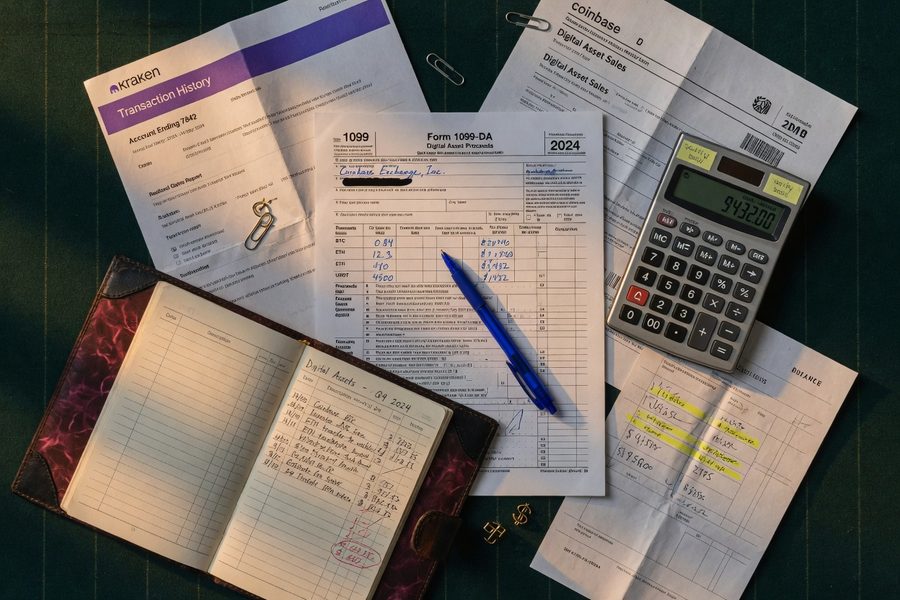
Form 1099-DA arrives for the first time in 2026, covering transactions from January 1, 2025 forward, but it reports gross proceeds only, not cost basis, for assets acquired before 2026. That gap is the most consequential reporting issue this filing season.
Centralized exchanges like Coinbase and Kraken that qualify as regulated brokers under the final Treasury regulations must send 1099-DA forms by February 17, 2026. The IRS has provided good-faith relief to brokers who make good-faith efforts to comply, meaning some forms may be incomplete or corrected late. That relief is for brokers, not for you. The IRS is clear that individual taxpayers remain fully responsible for accurate reporting regardless of what any 1099-DA shows or omits.
The practical problem: if you bought Bitcoin in 2023, transferred it to Coinbase in 2024, and sold it in 2025, the 1099-DA will show the proceeds but likely will not show your original cost basis. The exchange did not hold the asset when you acquired it. You must supply that basis yourself using your own purchase records, and you must reconcile any 1099-DA amounts against your actual transaction history before filing. A mismatch between what the IRS receives on the 1099-DA and what you report on Form 8949 is a fast path to a CP2000 notice.
Decentralized finance (DeFi) protocols are not covered by 1099-DA reporting at all under current rules. Those transactions happen without a centralized broker in the middle. That means if you provided liquidity on Uniswap, lent assets on Aave, or received rewards from a yield farming protocol, none of it will appear on any tax form from the platform. You are responsible for tracking and reporting every one of those events using your own records or crypto tax software that can read on-chain data.
The broader regulatory picture matters here too. The Treasury Department and the IRS issued final broker regulations in 2024 that brought centralized crypto exchanges within the same reporting framework that governs traditional securities brokers. The Securities and Exchange Commission (SEC) and the Commodity Futures Trading Commission (CFTC) have both weighed in on crypto classification in recent years, but for tax purposes, the IRS framework under Notice 2014-21 is what controls. Investors who hold crypto through retirement accounts at custodians like Fidelity or through crypto-adjacent products at firms like Grayscale face a separate set of tax treatment questions depending on account structure.
The IRS defines the term “digital asset” this way, drawn directly from its Frequently Asked Questions on Digital Asset Transactions: “any digital representation of value that is recorded on a cryptographically secured distributed ledger or similar technology and is not cash.” That definition is broad enough to cover Bitcoin, Ethereum, NFTs, and most tokens issued on networks like Solana or Polygon, which is exactly the IRS’s intent.
Who Should and Who Should Not Worry Most About Crypto Tax Reporting
Good candidates for close attention to crypto reporting
These investor profiles carry the highest risk of an IRS mismatch or missed obligation.
- Active traders who executed dozens of crypto-to-crypto swaps in 2025, each swap is a separate taxable event that must appear on Form 8949.
- DeFi users who provided liquidity, borrowed against crypto collateral, or received yield farming rewards, none of this appears on a centralized 1099-DA.
- Investors who transferred assets between wallets or exchanges before selling, cost basis may be missing from the 1099-DA and must be supplied manually.
- Anyone who received crypto as payment for services, staking rewards, or airdrop participation, this is ordinary income, taxed at your full marginal rate.
- NFT buyers and sellers, both the purchase and sale involve taxable events, and gains on NFTs may be taxed as collectibles at up to 28% for long-term holds.
Who should skip the stress (but not the checkbox)
Some investors genuinely have little to report, but they still must answer the Form 1040 digital asset question correctly.
- Long-term holders who bought crypto in 2025 and did nothing else, no taxable event occurred, and the Form 1040 answer is “No” for the activity question.
- Investors whose only 2025 activity was transferring crypto between their own wallets, transfers are not dispositions.
- Anyone whose total crypto gains for the year are below the standard deduction threshold and who had no offsetting losses to harvest, reporting is still required, but the tax owed may be zero.
Frequently Asked Questions
Do I have to report crypto if I didn’t sell anything?
If you only bought crypto or transferred it between your own wallets, no taxable event occurred and you can answer “No” to the digital asset question on Form 1040. Receiving staking rewards, airdrops, or any crypto as payment, even without selling, does trigger a reporting obligation as ordinary income.
Is crypto-to-crypto trading taxable?
Yes. Swapping one cryptocurrency for another is treated as a sale of the first asset at its current fair market value, followed by a purchase of the second. You must calculate and report the gain or loss on the disposed asset, even if no dollars ever changed hands.
What happens if my 1099-DA is wrong or missing my cost basis?
You are still required to report your transactions accurately, regardless of what the 1099-DA shows. Pull your original purchase records, calculate your actual cost basis, and reconcile the difference on Form 8949. Filing with numbers that simply match a flawed 1099-DA is not a safe harbor; accuracy is your responsibility.
Can I deduct crypto losses on my taxes?
Crypto losses are deductible against capital gains, and up to $3,000 of excess losses can offset ordinary income per year, with the remainder carried forward to future years. Unlike stocks, no wash-sale rule applies, so you can sell at a loss and repurchase the same asset immediately without losing the deduction.
Do stablecoin transactions need to be reported?
Technically yes, swapping one stablecoin for another is a property disposition. In practice, the gain or loss is usually negligible if the coins maintained their pegs, but you should calculate it and document your reasoning. Do not assume the transaction is invisible simply because the dollar amounts are small.
What forms do I use to report crypto activity?
Capital gains and losses go on Form 8949 and then summarize onto Schedule D of Form 1040. Ordinary income from staking, mining, or crypto received as payment goes on Schedule 1 (or Schedule C if you operate a crypto business). The digital asset question appears directly on the front page of Form 1040, and it must be answered before anything else.
If you are still getting comfortable with the mechanics of investing more broadly, our guide on how to start investing with zero experience covers foundational concepts that apply across asset classes. And if the risks unique to digital assets are still on your mind, the breakdown of cryptocurrency investment risks and benefits is worth a read before tax season wraps. For a broader look at the 2025 filing season and free filing resources, see our overview of what to do before tax season arrives. If you are managing other financial pressures alongside a crypto filing, understanding how to prioritize and negotiate credit card debt may help you allocate any refund effectively.
Sources
- Internal Revenue Service, Digital Assets Overview
- Internal Revenue Service, Taxpayers Need to Report Crypto and Other Digital Asset Transactions
- Internal Revenue Service, FAQs on Virtual Currency Transactions
- Internal Revenue Service, FAQs on Digital Asset Transactions
- Internal Revenue Service, Notice 2014-21: Virtual Currency Guidance
- Internal Revenue Service, About Form 8949, Sales and Other Dispositions of Capital Assets
- Internal Revenue Service, Tax Topic 409: Capital Gains and Losses