
Fact-checked by the MyFinancial101 editorial team
The IRS locks in your marital status on December 31 of the tax year, not the day you sign the final papers, not the day you move out, not the day a judge approves the settlement. That single rule drives an enormous number of tax mistakes for people going through divorce, and it shapes nearly every decision covered in this guide. Understanding divorce and taxes starts there: if your divorce was finalized on December 30, you were unmarried for the entire tax year. If it finalized on January 2, you were still married for all of the prior year, even if you hadn’t shared a home in months.
Divorce reshapes your tax life in ways that extend far beyond your filing status. The IRS Publication 504, updated for 2025, covers rules for alimony taxability, dependency claims, property transfers, and retirement account splits, each with its own deadlines and elections. The 2017 Tax Cuts and Jobs Act (TCJA) fundamentally rewrote alimony tax treatment for agreements signed after December 31, 2018, creating a two-tier system that still confuses both payers and recipients. Meanwhile, an estimated 50% of American marriages end in divorce, according to data tracked by the CDC’s National Center for Health Statistics, meaning millions of taxpayers face these questions each year, often without a clear roadmap.
This guide walks through every major tax consequence of divorce: how your filing status changes, why alimony rules depend on when you signed your agreement, who claims the children and the credits attached to them, how to fix your withholding immediately, what property transfers mean for future capital gains, and which state-level rules can still surprise you even when you’ve got the federal side right. By the end, you’ll know exactly what to address, in what order, and where the mistakes most often happen.
Key Takeaways
- Your marital status on December 31 determines your filing status for the entire tax year, a divorce finalized by year-end means you file as single or head of household for that full year.
- Alimony paid or received under agreements signed after December 31, 2018 is neither deductible by the payer nor includible in the recipient’s income under federal tax law, a permanent TCJA change with no scheduled sunset.
- Pre-2019 alimony agreements retain the old deduction/inclusion rules unless both parties sign a written modification explicitly electing to apply the new TCJA rules, a decision that cannot be undone.
- The custodial parent (the one with whom the child lived more nights during the year) has the default right to claim the child as a dependent; a non-custodial parent can claim only with a signed IRS Form 8332 release.
- Transfers of property between spouses incident to divorce are generally not taxable under IRC Section 1041, but the recipient inherits the transferor’s cost basis, which can create a significant capital gains bill years later when that asset is sold.
- A Qualified Domestic Relations Order (QDRO) allows the alternate payee to receive retirement funds without the 10% early-withdrawal penalty, but the window to avoid that penalty closes once the funds are rolled over into an IRA.
In This Guide
- Your Filing Status Changes the Day Your Divorce Is Final
- Alimony Rules Depend on When Your Agreement Was Signed
- Who Gets to Claim the Kids and the Bigger Tax Breaks
- Updating Withholding and Handling Estimated Taxes
- Property Division Usually Avoids Immediate Tax but Creates Future Bills
- State Taxes, Credits, and Overlooked Ripple Effects
- Joint Returns Filed During Marriage and Ongoing Liability
- Child Support Has Its Own Tax Rules
- Retirement Accounts and the QDRO Penalty Exception
- Planning Ahead to Minimize the Tax Cost of Divorce
Your Filing Status Changes the Day Your Divorce Is Final
Most people assume their filing status shifts gradually, that a year of separation means something to the IRS. It doesn’t. The IRS filing rules after divorce or separation are blunt: you are considered unmarried for the full tax year only if your divorce or legal separation decree is finalized on or before December 31 of that year. One day makes the difference between filing jointly with your ex-spouse and filing as a single taxpayer or head of household.
The December 31 Rule in Practice
This deadline creates a genuine planning opportunity. If your divorce will be finalized in late December or early January, the timing affects your entire return for that year. Filing jointly typically produces a lower combined tax bill for couples with unequal incomes, the so-called “marriage bonus”, but it also means you are jointly and severally liable for every dollar of tax owed on that return. Some divorcing couples choose to push finalization into the new year specifically to file one last joint return; others move it forward to separate their tax obligations as soon as possible.
Filing as head of household is the better outcome for most single parents, and it requires meeting three conditions: you must be unmarried (or treated as unmarried) on December 31, you must have paid more than half the cost of keeping up a home for the year, and a qualifying person (usually your child) must have lived in that home for more than half the year. The head-of-household rate is more favorable than the single rate, the 22% bracket, for example, begins at $47,150 for single filers but at $63,100 for head-of-household filers in 2024, per IRS Revenue Procedure 2023-34.
Legal Separation vs. Divorce for IRS Purposes
Legal separation under a formal court decree is treated the same as divorce for federal tax purposes, if you have a legal separation agreement recognized by your state, you are considered unmarried for that tax year. An informal separation, however, counts for nothing. The IRS makes clear in its guidance on marital status changes that taxpayers remain married for tax purposes until a final decree of divorce or separate maintenance is issued. Simply living apart, even for years, does not change your filing status.
There is one notable exception worth knowing: if you are still legally married but have been living apart from your spouse for the last six months of the year, you may qualify to file as head of household if you paid more than half the household costs and have a qualifying child. The IRS calls this the “considered unmarried” rule, it’s a limited workaround that applies only to the head-of-household question, not to other aspects of your return.
The standard deduction for head-of-household filers in 2024 is $21,900, nearly $8,000 more than the $14,600 single filer deduction. For a divorced parent who qualifies, that gap translates directly into lower taxable income.
Alimony Rules Depend on When Your Agreement Was Signed
The most misunderstood shift in divorce taxation came with the Tax Cuts and Jobs Act. Before 2019, alimony was a straightforward split: the payer deducted it above the line, reducing their adjusted gross income, and the recipient included it as taxable income. That system was repealed, permanently, for any divorce or separation instrument executed after December 31, 2018. No deduction for the payer, no taxable income for the recipient. It’s a clean cut for new agreements, but it creates a two-tier system that still trips people up six years later.
Pre-2019 vs. Post-2018 Agreements
If your agreement was signed on or before December 31, 2018, the old rules still apply. The payer deducts alimony on Schedule 1 of Form 1040 (line 19a), and the recipient reports it as ordinary income. The payer must provide the recipient’s Social Security number on the return, and the IRS cross-checks both returns. These agreements can remain under the old rules indefinitely, unless both parties execute a written modification that explicitly elects to have the post-2018 rules apply. Once that election is made, it cannot be reversed.
According to IRS Topic 452 on alimony payments, for alimony under a pre-2019 agreement to be deductible, it must meet specific requirements: the payments must be in cash (checks and direct deposits qualify; property transfers do not), the divorce instrument must not designate the payment as non-alimony, the parties must not be members of the same household when payments are made, and the payments must end at the recipient’s death. Payments that don’t meet all of these requirements are not deductible alimony, they’re either child support, a property settlement, or a non-deductible personal expense.
Modifying a Pre-2019 Agreement: What the IRS Actually Requires
This is one of the most overlooked pieces of the post-TCJA landscape. A payer under a pre-2019 agreement may want to convert to the new rules, eliminating their deduction in exchange for a potentially lower alimony obligation (since the recipient no longer pays tax on what they receive). Both parties must agree in writing, and the modification document must explicitly state that the TCJA alimony rules apply. There is no separate IRS form for this election, it’s handled through the modification language itself. The payer then stops claiming the deduction starting in the tax year the modification takes effect, and the recipient stops reporting the payments as income.
Modifying a pre-2019 alimony agreement to lower the payment amount, without explicitly electing the new TCJA rules in writing, does not switch the agreement to post-2018 treatment. The old rules remain in effect unless the modification language is specific. Get that language in writing, reviewed by a tax professional before signing.
State Alimony Tax Rules Don’t Follow Federal Law
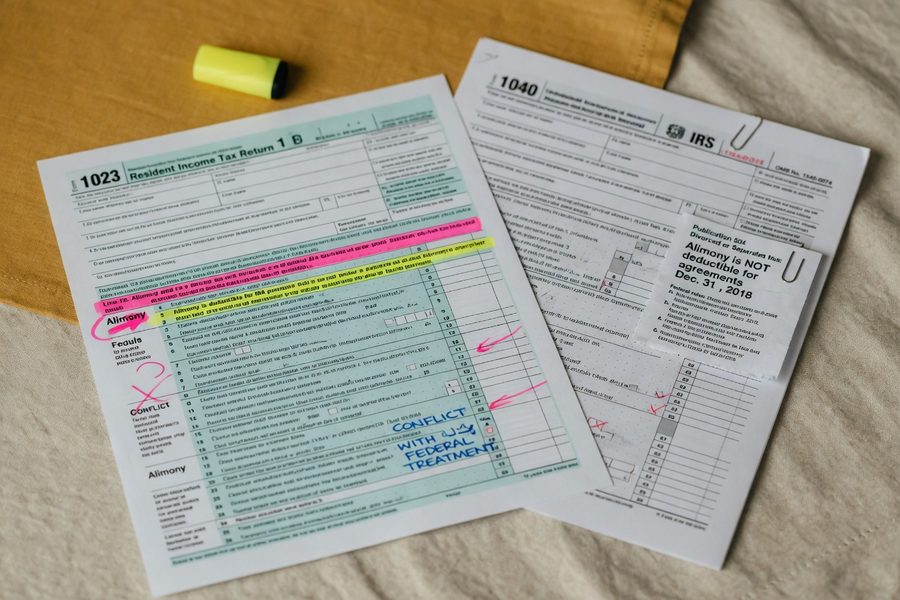
Several states have not conformed to the TCJA alimony changes and continue to require payers to deduct alimony and recipients to report it as income on state returns., states including New Jersey, Massachusetts, and California have their own treatment that may diverge from the federal rule. New Jersey, for instance, still treats alimony received as taxable income at the state level, even for post-2018 agreements, which means recipients in that state may need to make quarterly estimated state tax payments even though no federal estimated payments are required for that income. Always check your specific state’s conformity before assuming federal rules apply wholesale.
Who Gets to Claim the Kids and the Bigger Tax Breaks
There’s a widespread belief that claiming the children alternates automatically year-to-year in divorce agreements. Sometimes divorce decrees say exactly that. The IRS doesn’t care what your decree says, it has its own rules, and they override everything except a properly executed Form 8332.
The Custodial Parent Default Rule
Under federal tax law, as confirmed in IRS guidance on claiming children after divorce, the custodial parent, the one with whom the child lived for more nights during the calendar year, has the default right to claim the child as a qualifying child. This applies to the dependency exemption (now replaced by the Child Tax Credit mechanics), head-of-household filing status, the Earned Income Tax Credit, the Child and Dependent Care Credit, and the American Opportunity Credit. These benefits follow the custodial parent and cannot be split.
The Child Tax Credit, which provides up to $2,000 per qualifying child under age 17 in 2024 (with up to $1,700 refundable as the Additional Child Tax Credit), is one of the most valuable benefits tied to dependent status. For a parent with two children, claiming both is potentially worth $4,000 in tax credits, not deductions, actual credits that reduce your tax bill dollar for dollar.
Form 8332 and Non-Custodial Parent Claims
Form 8332 is the mechanism by which a custodial parent can release the dependency claim to the non-custodial parent. It can be executed for a single year, for specific future years listed on the form, or permanently. The non-custodial parent must attach the form (or a copy of the divorce decree meeting the equivalent requirements) to their return for any year they claim the child.
One point that rarely gets covered clearly: a Form 8332 release transfers only the right to claim the dependency exemption and the Child Tax Credit. It does not transfer head-of-household status, the Earned Income Tax Credit, or the Child and Dependent Care Credit, those stay with the custodial parent regardless of what the Form 8332 says. A non-custodial parent who claims the child via Form 8332 cannot use that child to qualify for head-of-household status. That’s a meaningful distinction when the non-custodial parent has a higher income and wants the filing status benefit.
Tie-Breaker Rules and Multiple Children
When parents share custody exactly equally (182.5 nights each), the IRS tie-breaker assigns the dependent to the parent with the higher adjusted gross income. In multiple-child situations, it’s possible, and often financially sensible, for each parent to claim different children, provided each child meets the custodial residency test with that parent. Divorce attorneys and CPAs sometimes negotiate arrangements where the custodial parent issues a Form 8332 for one child in exchange for other concessions. That’s a legitimate tax planning strategy, as long as the underlying residency test is genuinely met.
The Child Tax Credit provides up to $2,000 per qualifying child under age 17, with up to $1,700 refundable in 2024. For a divorced parent with three children, correctly claiming all three can mean up to $6,000 in credits, making dependent allocation one of the highest-value decisions in any divorce tax plan.
Updating Withholding and Handling Estimated Taxes
Your W-4 on file with your employer was probably filled out as a married person. After divorce, that withholding will almost certainly be wrong, usually not enough tax withheld for the newly single filer, sometimes too much for a high earner who no longer has a spouse’s income pushing them into higher brackets. Either way, submitting a new Form W-4 is urgent, not optional.
Why the Old W-4 Fails You
When you file as married, the withholding tables assume a certain income profile. Filing as single or head of household changes your bracket thresholds and your standard deduction, and if your employer’s system still calculates withholding using the married rate, you may end up owing a significant amount come April, plus potential underpayment penalties. The IRS recommends using its Tax Withholding Estimator immediately after any major life change, including divorce, to calculate the correct withholding allowance. Most people should do this within the first month after their divorce is finalized.
If you receive pre-2019 alimony, that income is fully taxable and your employer has no way to withhold tax on it. You’ll need to either increase your W-4 withholding at work to cover the alimony income, or make quarterly estimated payments using Form 1040-ES. Estimated payments are due four times per year: April 15, June 15, September 15, and January 15 of the following year. Miss them, and you’ll owe an underpayment penalty on top of the tax itself.
The Estimated Payment Trap for Alimony Recipients
Alimony recipients are particularly vulnerable to underpayment surprises in the first post-divorce tax year. If you received $24,000 in alimony during the year and had no other withholding adjustments, you could easily owe $3,500 to $5,000 or more in federal taxes when you file, depending on your bracket, plus state taxes in conforming states. The safe harbor rule provides some protection: if you pay at least 90% of the current year’s tax, or 100% of the prior year’s tax liability (110% if your AGI was over $150,000), you avoid the underpayment penalty even if you owe on April 15. That rule is worth understanding before the first estimated payment deadline passes.
If you receive alimony under a pre-2019 agreement, set aside approximately 22-24% of each payment in a separate savings account for federal taxes. If you live in a state that also taxes alimony, add your marginal state rate on top. This simple habit prevents the end-of-year shock that catches so many recipients off guard in their first post-divorce filing season. If you’re already managing tight finances post-divorce, our guide to free IRS tax help and credits families overlook covers no-cost assistance options.
Property Division Usually Avoids Immediate Tax but Creates Future Bills
One of the few genuinely taxpayer-friendly rules in divorce taxation is IRC Section 1041, which provides that transfers of property between spouses, or between ex-spouses, if the transfer is incident to divorce, are generally not taxable events. No gain or loss is recognized at the time of the transfer. The recipient spouse takes the property at the transferor’s original cost basis, as if the transferor had given it directly.
The Carryover Basis Problem
The catch is built into that last sentence. If your ex-spouse receives the investment account with a $50,000 cost basis and $120,000 current value, they receive it tax-free today, but when they sell it later, they owe capital gains tax on $70,000 of gain. The tax hasn’t been eliminated; it’s been deferred and transferred. This is particularly significant with appreciated investment accounts, rental properties, and stock options. In any property division negotiation, comparing the after-tax value of different assets, not just their face value, is essential. A house with $400,000 of built-in capital gain is materially less valuable than a cash account worth the same amount, even before accounting for exclusion rules.
Speaking of the house: for a primary residence sold within a divorce, the tax rules are more generous. Each spouse may qualify to exclude up to $250,000 of capital gain under IRC Section 121, even if only one spouse has lived in the home during the required two-of-five-year period, as long as the other spouse satisfies the ownership test. If you’ve built up significant equity, the timing and structure of the home sale can meaningfully affect how much of that gain is shielded. For many divorced homeowners, selling before the divorce is final, while both spouses can still claim the exclusion, produces the best tax outcome.
Selling a Marital Home: What the Numbers Look Like
Consider a home purchased for $200,000 that is now worth $700,000. If sold during the divorce with both spouses qualifying, up to $500,000 of gain can be excluded ($250,000 each). The $300,000 gain above that threshold would be taxable. If instead one spouse takes the house in the settlement and sells it five years later, only $250,000 of the gain is excluded, leaving $250,000 more potentially subject to long-term capital gains rates of 15% to 20%, plus the 3.8% net investment income tax if income exceeds $200,000 for single filers. The difference can easily exceed $37,500 in additional federal taxes from a single planning decision.
Under IRC Section 1041, transfers of property incident to divorce must generally occur within one year after the date the marriage ends, or within six years if made pursuant to the divorce agreement, to qualify for nonrecognition treatment. Transfers outside this window may be treated as taxable sales.

State Taxes, Credits, and Overlooked Ripple Effects
Federal rules get most of the attention, but state tax treatment can produce real surprises, especially for those receiving alimony or navigating Affordable Care Act (ACA) marketplace coverage after income changes.
State Alimony Conformity
states generally fall into three categories on alimony taxation. First, states that conform fully to current federal law, no deduction for payers, no inclusion for recipients. Second, states like California and New Jersey that maintained their own pre-TCJA rules, requiring recipients to report alimony as taxable income and allowing payers to deduct it, regardless of agreement date. Third, a smaller group of states that have mixed rules or have enacted partial conformity. If you live in a non-conforming state and receive post-2018 alimony, you may owe state income tax on payments that aren’t federally taxable, a fact that affects your estimated payment calculations significantly.
Marketplace Subsidies and Alimony’s Effect on MAGI
This is an angle few people think about until it’s too late. Under the ACA, eligibility for premium tax credits (marketplace subsidies) is based on your Modified Adjusted Gross Income (MAGI) relative to the federal poverty level. For 2025 coverage, premium tax credits phase out at 400% of the federal poverty level (with enhanced credits at some income ranges). If you receive alimony under a pre-2019 agreement, that income is included in your MAGI, and it could push you above a subsidy threshold, costing hundreds or thousands of dollars in monthly premiums. Recipients who transition from employer coverage to the marketplace after divorce should model their projected MAGI with and without alimony income before choosing a plan. Our overview of rising federal poverty guidelines in 2026 provides context on how thresholds are shifting.
Innocent Spouse Relief for Prior Joint Returns
If you filed joint returns during your marriage and the IRS later audits those returns, finding unreported income or improper deductions you didn’t know about, you may be held jointly and severally liable for the resulting tax, penalties, and interest. Innocent spouse relief, available under IRC Section 6015, can remove that liability if you can demonstrate you didn’t know (and had no reason to know) about the erroneous items on the return. The request is filed using Form 8857, and the IRS evaluates factors including your involvement in finances, your education level, and whether the error benefited you. Time limits apply: the request must generally be filed within two years of the IRS’s first collection activity against you related to the liability.
ACA premium tax credits can be worth anywhere from a few hundred dollars to over $10,000 per year for a qualifying individual, depending on income and plan selection. For a divorced parent with two children who drops from $85,000 to $55,000 in MAGI, the change in subsidy eligibility alone can offset a significant portion of other post-divorce expenses.
Joint Returns Filed During Marriage and Ongoing Liability
Many divorcing couples focus entirely on the current-year return and overlook the returns they filed together in prior years. Every joint return you signed makes you jointly and severally liable for the total tax due, meaning the IRS can collect 100% of any underpayment from either spouse, regardless of who earned the income or who caused the problem. That liability doesn’t dissolve when the marriage does.
Why the Year of Divorce Is Particularly Risky
In the year of divorce, if the divorce isn’t finalized by December 31, the couple may still choose to file jointly. Joint filing often produces the lowest combined tax bill when one spouse earns significantly more than the other, but it also means the lower-earning spouse signs off on the higher-earning spouse’s income, deductions, and credits. If the higher-earning spouse underreports income or improperly claims deductions, both spouses share the exposure. Before agreeing to file a joint return in the year of divorce, it’s worth requesting a complete review of both spouses’ income documentation, W-2s, 1099s, business income reports, and investment account statements.
For prior-year joint returns that may have been filed incorrectly, the statute of limitations for audit generally runs three years from the filing date, or six years if there is a substantial understatement of income (more than 25% of gross income omitted). There is no limitation period at all if a fraudulent return was filed. If you have any concern about returns your spouse filed while you were married, requesting copies from the IRS using Form 4506-T before finalizing your divorce is a sensible precaution. If managing debt from prior years is part of your post-divorce financial picture, the strategies in our guide to prioritizing and negotiating credit card debt may also apply.
What I see in practice: In my work with clients going through divorce, the prior-year return issue comes up far more often than people expect. I’ve seen spouses held liable for five-figure tax bills from returns they barely glanced at before signing. Reviewing the last three years of joint returns before the divorce is final costs a few hours and can save a great deal of grief.
Child Support Has Its Own Tax Rules
Child support is the simplest tax topic in divorce, not because the rules are complicated, but because they’re absolute. The IRS is unambiguous: child support is never deductible by the payer and never taxable to the recipient, regardless of when the agreement was signed, regardless of the amount, and regardless of anything your divorce decree says about it. This rule did not change under the TCJA, has no sunset date, and applies in every state.
The distinction between child support and alimony matters enormously under pre-2019 agreements, because any payment that doesn’t qualify as alimony loses the deduction. The IRS scrutinizes arrangements where alimony payments are scheduled to decrease or terminate at the same time a child reaches a milestone (like turning 18 or graduating high school). If payments are tied to a child-related event, the IRS may recharacterize those payments as non-deductible child support, a process called “front-loading” review. For anyone with a pre-2019 agreement that includes both alimony and child support components, the payment structure deserves careful review.
Retirement Accounts and the QDRO Penalty Exception
Splitting a 401(k), pension, or other employer-sponsored retirement plan in divorce requires a Qualified Domestic Relations Order (QDRO), a specific court order that instructs the plan administrator to transfer a portion of the account to the alternate payee (usually the non-employee spouse). Without a QDRO, any withdrawal from a retirement account to fund a divorce settlement is treated as a taxable distribution to the account holder, subject to both ordinary income tax and the 10% early-withdrawal penalty if the account holder is under age 59½.
The 10% Penalty Exception for QDRO Distributions
Here’s the detail that most coverage misses: the 10% early-withdrawal penalty exception available under a QDRO applies only to distributions made directly from the plan to the alternate payee. If the alternate payee takes the distribution in cash from the plan, they pay ordinary income tax on the amount but not the 10% penalty. If they roll the distribution over into their own IRA within 60 days, they defer the income tax as well, but they also permanently lose the penalty exception for that money. Any future early withdrawal from that IRA would be subject to the 10% penalty under standard IRA rules.
The timing decision at the QDRO distribution stage has lasting consequences. An alternate payee under age 59½ who needs liquidity in the near term may be better served by taking some distributions directly from the plan (penalty-free) and rolling the remainder to an IRA. That planning window closes once the funds are in the IRA. Plan administrators vary in how quickly they process QDROs, some take 30 days, others 90 days or more, so this decision needs to be made and documented before the QDRO is submitted.
| Distribution Method | Income Tax Owed | 10% Early Withdrawal Penalty | Best For |
|---|---|---|---|
| Direct QDRO distribution (cash) | Yes, ordinary income | No penalty | Alternate payees under 59½ needing cash now |
| QDRO rollover to IRA | Deferred until withdrawal | Standard IRA rules apply after rollover | Alternate payees who won’t need funds soon |
| No QDRO (direct withdrawal) | Yes, ordinary income | Yes, 10% if under 59½ | Never recommended; avoid this outcome |
IRAs, as opposed to employer plans like 401(k)s, are split differently. A transfer of IRA funds incident to divorce can be done by re-titling or transferring the account directly to the ex-spouse’s IRA under IRC Section 408(d)(6), which requires no QDRO. The transfer itself is not taxable, and standard IRA rules apply to the receiving spouse from that point forward. There is no penalty exception for direct IRA withdrawals under a divorce decree, that exception is specific to qualified employer plans under a QDRO.

Planning Ahead to Minimize the Tax Cost of Divorce
The best time to consider divorce tax strategy is during settlement negotiations, not on April 14. Several decisions made in the divorce agreement have permanent tax consequences, and many of those decisions look equivalent on paper while being materially different after taxes are applied.
Asset Allocation: After-Tax Value Comparisons
| Asset Type | Face Value | Estimated Built-In Tax Cost | Approximate After-Tax Value |
|---|---|---|---|
| Roth IRA ($100,000) | $100,000 | None (qualified withdrawals tax-free) | ~$100,000 |
| Traditional 401(k) ($100,000) | $100,000 | ~$22,000-$24,000 (assuming 22-24% bracket) | ~$76,000-$78,000 |
| Taxable account ($100,000, low basis) | $100,000 | ~$11,250-$15,000 (15-20% long-term cap gains on $75,000 gain) | ~$85,000-$89,000 |
| Cash ($100,000) | $100,000 | None | $100,000 |
Divorce is also a point at which reviewing your broader financial situation makes sense. If you’re rebuilding credit, managing debt, or reassessing retirement contributions post-divorce, our guide on why retirement savings should take priority is worth reading, particularly if a QDRO has reduced your retirement account balance significantly and you need a plan to rebuild.
Timing Considerations That Affect Your Tax Outcome
| Decision | Finalize Before Dec. 31 | Finalize After Jan. 1 |
|---|---|---|
| Filing status | Single or head of household | Married filing jointly or separately |
| Standard deduction (2024) | $14,600 (single) or $21,900 (HoH) | $29,200 (MFJ) or $14,600 (MFS) |
| Child Tax Credit claim | Custodial parent only | Determined by who claims dependent on MFJ return |
| Joint liability on current-year return | None if filing separately | Yes, if filing jointly |
Tax planning in divorce isn’t just about minimizing what you owe this year. Alimony structure, asset allocation, and retirement account treatment all have multi-year consequences. A settlement that looks even may create a $50,000 cumulative tax disparity over five years. For complex situations, multiple investment accounts, a business interest, stock options, or a pension, working with a CPA or tax attorney during settlement negotiations is one of the highest-return investments you can make. Credit counseling can also help if post-divorce finances feel overwhelming; our roundup of top credit counseling services covers reputable options.
Stock options and restricted stock units (RSUs) that were granted during the marriage but vest after the divorce may be subject to division as marital property in some states. The tax treatment at vesting depends on whose name the options are in, creating a potential mismatch between who owes the income tax and who receives the economic benefit under the divorce decree.
Real-World Example: Two Spouses, One Income, and a Tax Decision That Cost $14,000
Consider an illustrative example: a couple in their early 40s, married for 14 years, finalizes their divorce on January 3, 2025. The marriage produced one child, who lives primarily with the lower-earning spouse (adjusted gross income of $62,000). The higher-earning spouse earns $145,000. Their divorce decree was executed in December 2024, but the judge didn’t sign the final order until January 3, 2025.
Because the divorce was not final on December 31, 2024, both spouses are considered married for the full 2024 tax year. The higher-earning spouse’s attorney suggests filing married filing jointly to capture the marriage bonus, the combined 2024 MFJ tax on $207,000 of income is roughly $36,800. But the lower-earning spouse is concerned about joint liability. They choose to file married filing separately (MFS) instead. The MFS tax rate is harsher: the lower-earning spouse owes approximately $9,400 on $62,000 of income (compared to roughly $7,000 under a single or head-of-household return), and the higher-earning spouse owes roughly $30,200 on $145,000 of MFS income. Combined, the two MFS returns total approximately $39,600, about $2,800 more than MFJ, and the lower-earning spouse alone pays $2,400 more than they would have as head of household.
Now consider what happens with the alimony: the divorce decree, signed in December 2024 (pre-2025 for execution purposes but post-2018), provides for $1,500 per month in alimony. Because it was executed after December 31, 2018, the new TCJA rules apply, the payer gets no deduction, the recipient reports no taxable income. The lower-earning spouse’s MAGI stays at $62,000. They apply for ACA marketplace coverage after losing employer coverage through the divorce, and at $62,000 MAGI for a household of two (one dependent child), they qualify for a meaningful premium tax credit, reducing their monthly health insurance cost by approximately $380 per month, or $4,560 per year.
Had this person been receiving pre-2019 alimony of $18,000 per year, their MAGI would have been $80,000, pushing them above the threshold for the full credit and reducing the subsidy by over $3,000 annually. The interaction between alimony taxability and marketplace subsidies, invisible in most divorce planning conversations, produced a $14,000-plus cumulative difference over three years in this scenario. The lesson: tax year timing, alimony agreement date, and ACA eligibility are a connected system, not three separate boxes to check.
Your Action Plan
-
Confirm your divorce finalization date relative to December 31
Check the date on your final divorce decree. If it is before December 31, you file as single or head of household for that full tax year. If it falls after January 1, you are still married for tax purposes for the prior year and must choose between married filing jointly and married filing separately. This single date determines the starting point for everything else.
-
Identify whether you have a pre-2019 or post-2018 alimony agreement
Locate the execution date on your divorce or separation instrument. If it was signed on or before December 31, 2018, the old alimony rules apply, deductible for the payer, taxable to the recipient. If signed after that date, neither applies. If you’ve modified a pre-2019 agreement, check whether the modification explicitly elected the new rules. If it didn’t, the old rules still govern the original payment terms.
-
Submit a new Form W-4 to your employer immediately
Do not wait until the following tax season. Update your W-4 to reflect your new filing status and any change in dependents. If you receive taxable alimony and have no other income source to cover that tax obligation, either increase your withholding at work or set up quarterly estimated payments using Form 1040-ES. Use the IRS Tax Withholding Estimator to calculate the right amount.
-
Determine who claims the children and execute Form 8332 if needed
The custodial parent claims the children by default. If the divorce agreement grants the non-custodial parent the right to claim a child, that parent needs a signed Form 8332 attached to their return for each applicable year. Remember: the Form 8332 transfers the dependency exemption and Child Tax Credit only, it does not transfer head-of-household status or the Earned Income Tax Credit. Those stay with the custodial parent regardless.
-
Calculate the after-tax value of every asset in the division, not just face value
Before signing any settlement agreement, compare the after-tax value of each proposed asset. A $100,000 traditional 401(k) is worth roughly $76,000-$78,000 after income tax, not $100,000. A taxable investment account with low basis carries embedded capital gains tax. Cash and Roth accounts carry no embedded tax liability. Accepting a settlement that looks equal on paper but ignores basis and deferred taxes is one of the most common and expensive divorce financial mistakes.
-
Ensure any retirement account split uses a proper QDRO (for employer plans) or IRA transfer
For 401(k)s, 403(b)s, and pensions, a Qualified Domestic Relations Order is required. If you are the alternate payee and need liquidity, take a direct distribution from the plan rather than rolling it to an IRA, you’ll owe ordinary income tax on the amount, but not the 10% early-withdrawal penalty. If you roll it to an IRA first, that penalty exception is gone permanently. For IRA splits, no QDRO is needed; a direct transfer under IRC Section 408(d)(6) is the clean approach.
-
Review the last three years of joint returns and address any ongoing liability
Request copies of all joint returns using IRS Form 4506-T before your divorce is final. If you suspect inaccuracies, consider whether an amended return or innocent spouse relief (Form 8857) is appropriate. Understand that joint and several liability for those returns continues after divorce unless formal relief is granted. If your ex-spouse is later audited and owes additional tax, the IRS can come after you for the full amount absent a successful relief claim.
Frequently Asked Questions
Can I file jointly with my spouse in the year we separate, even if we haven’t divorced?
Yes, if you were still legally married on December 31 of the tax year, you generally have the option to file jointly or married filing separately. Separation, even a formal legal separation that doesn’t dissolve the marriage in your state, does not eliminate the joint filing option under federal law. Many couples in the year of separation still file jointly to minimize combined tax, though doing so means both spouses share liability for everything on that return. If there is distrust about the other spouse’s income reporting, married filing separately provides protection at the cost of higher tax rates.
Is the alimony I receive considered income for Social Security purposes?
No. Alimony payments, whether taxable under pre-2019 rules or not, do not count as earned income for Social Security benefit calculation purposes. They also do not count as earned income for purposes of contributing to an IRA, you generally need earned income (wages, self-employment income) to make an IRA contribution. However, if you receive taxable alimony under a pre-2019 agreement and have no other earned income, that alimony income does allow you to make an IRA contribution, because the IRS treats taxable alimony as compensation for IRA eligibility purposes under the pre-TCJA rules still governing those agreements.
What happens to the mortgage interest deduction if I keep the house after the divorce?
If you remain in the home and are legally obligated on the mortgage, you can deduct the mortgage interest you actually paid, subject to the standard itemized deduction rules. The current limit under the TCJA is interest on up to $750,000 of mortgage debt for loans originated after December 15, 2017. If your ex-spouse continues to make mortgage payments on a home you own (as part of a support arrangement), the deductibility depends on whether they are legally obligated on the loan, and whether those payments qualify as alimony or are treated as a property-related obligation.
Can the non-custodial parent claim head-of-household status if they have a Form 8332?
No. Head-of-household filing status requires that the qualifying person actually live in your home for more than half the year. A Form 8332 release transfers only the dependency exemption and Child Tax Credit, it does not affect the residency test required for head-of-household status. A non-custodial parent cannot use a child they claim via Form 8332 to qualify as head of household. That status remains exclusively with the parent in whose home the child actually lived.
Do I need a QDRO for an IRA, or just for a 401(k)?
No QDRO is needed for an IRA split. IRAs are divided under IRC Section 408(d)(6) through a direct transfer or re-titling to the receiving spouse’s IRA. The transfer must be pursuant to a divorce decree or separation agreement, and it must go directly to the receiving spouse’s IRA (not paid to the account holder first). The 10% early-withdrawal penalty exception that applies to QDRO distributions from employer plans does not exist for IRAs, standard IRA withdrawal rules apply to the receiving spouse from the point of transfer.
My divorce decree says we alternate claiming our daughter every other year. Is that enforceable with the IRS?
The divorce decree itself is not enforceable with the IRS, it’s a state court document, and the IRS applies federal tax law regardless of what it says. What makes the arrangement work is a properly executed Form 8332, signed by the custodial parent, for each specific year the non-custodial parent is meant to claim the child. Without Form 8332 attached to the non-custodial parent’s return, the IRS will default to the custodial parent. The decree creates a legal obligation between the spouses, but the Form 8332 is the mechanism the IRS actually recognizes.
Can I deduct attorney fees from my divorce on my tax return?
Generally, no. Under current law, personal legal fees, including those paid for a divorce, are not deductible. There is a limited exception for fees paid specifically to obtain taxable alimony under a pre-2019 agreement, or for tax advice related to the divorce. These narrower legal expenses may qualify as miscellaneous itemized deductions, but the TCJA suspended most miscellaneous itemized deductions through 2025. In practice, for most divorcing taxpayers in 2025, divorce attorney fees are a non-deductible personal expense. Consult a CPA if you paid significant fees with a mixed tax/non-tax purpose, as allocation may be possible in limited cases.
Sources
- IRS, Filing Taxes After Divorce or Separation
- IRS Publication 504, Divorced or Separated Individuals (2024)
- IRS Tax Topic 452, Alimony and Separate Maintenance
- IRS Newsroom, A Change in Marital Status Affects Tax Filing
- IRS Newsroom, Claiming a Child as a Dependent When Parents Are Divorced, Separated, or Live Apart
- IRS, Tax Withholding Estimator
- IRS, About Form 8332, Release/Revocation of Release of Claim to Exemption for Child by Custodial Parent
- IRS, Innocent Spouse Relief
- IRS Revenue Procedure 2023-34–2024 Inflation-Adjusted Tax Parameters
- Healthcare.gov, Modified Adjusted Gross Income (MAGI)
- IRS, About Form 8857, Request for Innocent Spouse Relief