Fact-checked by the MyFinancial101 editorial team
Quick Answer
The five most costly early 401k withdrawal mistakes are: ignoring the full tax bill beyond the 10% penalty, missing penalty exceptions you qualify for, cashing out during a job change instead of rolling over, underestimating the long-term opportunity cost, and skipping alternatives like 401k loans. A $25,000 withdrawal at age 40 can cost roughly $135,000 in lost retirement wealth.
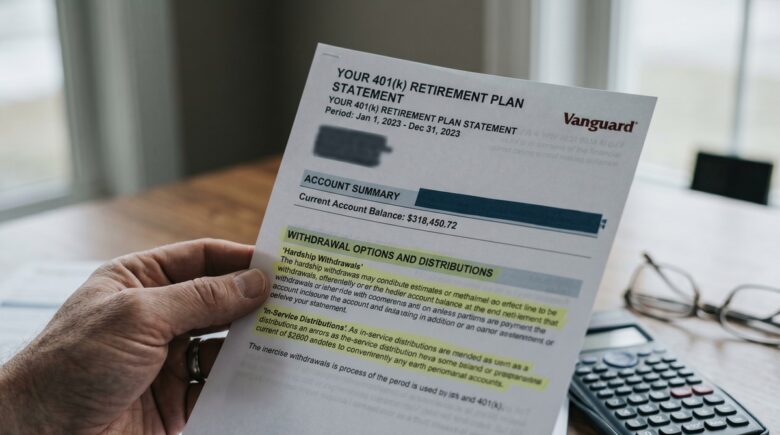
Early 401k withdrawal mistakes are not rare, they are becoming alarmingly routine. According to Vanguard’s How America Saves 2026 report, a record 6% of plan participants took a hardship withdrawal in 2025, the sixth consecutive annual increase and more than double the pre-pandemic rate. The median amount pulled out was just $1,900, enough to cover a month’s rent or a medical copay, but potentially enough to cost tens of thousands of dollars in long-term wealth.
Financial pressure makes early access tempting. But the mechanics of a 401k distribution are punishing in ways most people don’t fully grasp until the tax bill arrives.
Key Takeaways
- A record 6% of Vanguard plan participants took a hardship withdrawal in 2025, the sixth consecutive annual increase (CBS News / Vanguard 2026).
- A $50,000 early withdrawal can net as little as $33,000 after the 10% penalty, federal income tax, and state tax combined (IRS Topic No. 558).
- Roughly 41% of workers drain their 401k entirely when leaving an employer, treating a retirement account as a severance check (AARP research).
- The SECURE 2.0 Act (effective 2024) added a $1,000-per-year self-certified emergency penalty exception, though income tax is still owed on the distribution (IRS exceptions list).
- A $25,000 withdrawal at age 40 represents roughly $135,000 in lost retirement wealth at 7% annual growth over 25 years (401k Specialist Magazine).
- Average Vanguard account balances reached $167,970 at year-end 2025, a 13% gain from the prior year, making every early distribution more costly than it looks (401k Specialist Magazine).
Mistake #1: Only Counting the 10% Penalty
The 10% early withdrawal penalty gets all the attention, but it is often the smaller part of the real cost. Every dollar you pull from a traditional 401k before age 59½ is added to your ordinary taxable income for the year, which can push you into a higher federal bracket you weren’t expecting.
Consider a single filer earning $60,000 in wages who withdraws $50,000 from their 401k. Their taxable income jumps to $110,000, landing squarely in the 22% bracket for the portion above $47,150, and potentially spilling into the 24% bracket. Add the 10% penalty on the full $50,000, and the combined federal hit alone can exceed 30% before a single state dollar is counted. As IRS Topic No. 558 confirms, the additional 10% tax is applied to the gross distribution, not the amount received after withholding.
State taxes are the part almost nobody calculates in advance. Depending on where you live, state income tax on a retirement distribution ranges from 0% (states like Florida, Texas, and Nevada) to over 13% (California’s top marginal rate). For a $50,000 withdrawal, someone in a 5% state tax environment nets roughly $33,000 to $34,000 after federal tax, penalty, and state tax combined, well under two-thirds of the gross amount. That is not an exaggeration; that is the arithmetic.
Key Takeaway: A $50,000 early withdrawal can net as little as $33,000 after the 10% penalty, federal income tax, and state tax, meaning you forfeit more than a third of the gross amount before touching a dollar of it. IRS Topic No. 558 confirms the penalty applies to the full distribution.
Mistake #2: Not Knowing Which Exceptions Apply to You
Most people assume early access to a 401k always triggers the 10% penalty. That assumption leaves real money on the table. The IRS publishes a full list of statutory exceptions, and several are genuinely underused.
Exceptions worth knowing
Separating from your employer at age 55 or older (age 50 for qualified public safety employees) qualifies you for penalty-free distributions from that employer’s plan, no need to wait until 59½. Permanent disability, certain medical expenses exceeding 7.5% of adjusted gross income, and court-ordered QDRO distributions also avoid the penalty. Substantially Equal Periodic Payments (SEPP), sometimes called 72(t) distributions, let younger account holders take penalty-free withdrawals by committing to a fixed, IRS-approved payment schedule for at least five years or until age 59½, whichever comes later.
The SECURE 2.0 Act, effective beginning in 2024, added meaningful new exceptions. The most accessible: a penalty-free emergency withdrawal of up to $1,000 per year, self-certified, repayable over three years. A domestic abuse victim exception and a terminal illness exception also joined the list. These are real options that most early-withdrawal articles never mention.
One distinction matters more than any other and is almost never stated clearly: exceptions waive the 10% penalty only. Income tax is still owed on every dollar distributed from a pre-tax account, no matter which exception you qualify for. “Penalty-free” does not mean “tax-free.” Anyone who treats those two phrases as synonyms will be surprised at filing time.
Coordinating the tax and retirement planning sides of this decision matters significantly. A tax professional can identify which exception applies and model the income impact before a distribution is processed, while a financial advisor can assess whether the 401k should be touched at all. Treating these as separate conversations often leads to costly surprises.
Key Takeaway: The SECURE 2.0 Act (effective 2024) added a $1,000-per-year self-certified emergency exception to the 10% penalty, but income tax is still owed on that distribution. Check the full IRS exceptions list before assuming you have no penalty-free options.
Mistake #3: Cashing Out During a Job Change
Job changes are the single most common trigger for early 401k cash-outs, and the least emotionally defensible. Research cited by AARP suggests roughly 41% of workers drain their 401k balance entirely when leaving an employer, treating it as found money rather than a retirement asset. The account feels abstract; the cash feels real.
The mechanics make this worse than most people realize. When a plan issues a check directly to the participant (an indirect rollover), 20% is automatically withheld for federal taxes. To avoid that withholding becoming a permanent distribution, you must deposit the full original balance, including the withheld 20% from your own savings, into a new IRA or employer plan within 60 days. Miss the deadline or come up short on the 20%, and the shortfall is treated as a taxable distribution subject to both income tax and the 10% penalty.
“Using a 60-day rollover, also called an indirect rollover, is a huge mistake.”
A direct rollover eliminates that risk entirely. The check is made payable to the new plan or IRA custodian, never touching your hands, so no withholding applies and no deadline pressure exists. If you’re facing a financial squeeze during a job transition, it’s worth exploring short-term income options before tapping retirement savings. Pulling from a 401k to bridge a few weeks of unemployment is a very expensive solution to a temporary cash flow problem.
The compounding math is unsparing. A $20,000 balance rolled over and left to grow at 7% annually from age 40 becomes roughly $108,000 by age 65. Cashing it out at a combined effective rate of 30% to 35% nets around $13,000 to $14,000 after taxes and penalty. That gap is not hypothetical; it is the actuarial cost of a decision that takes about 10 minutes to make.
| Rollover Method | Withholding Applied | 60-Day Deadline | Penalty Risk |
|---|---|---|---|
| Direct Rollover | None | No deadline | None |
| Indirect Rollover | 20% withheld automatically | 60 days to redeposit full amount | High if deadline missed or funds short |
| Cash-Out (no rollover) | 20% withheld at distribution | N/A | 10% penalty + full income tax |
Key Takeaway: Indirect rollovers trigger automatic 20% federal withholding, you must replace that amount from personal savings within 60 days or it becomes a taxable distribution. A direct rollover avoids this entirely, as the U.S. Department of Labor’s EBSA guidance confirms.
Mistake #4: Ignoring What the Money Would Have Become
Framing matters enormously here. Most people evaluate an early withdrawal as “how much do I lose today”, the penalty, the taxes, the net check. The more accurate question is “how much does this cost me at age 65.”
A $25,000 withdrawal at age 40, assuming 7% annualized growth over 25 years, represents approximately $135,000 in lost future retirement wealth. That is not a choice between $25,000 now versus $25,000 later. It is a choice between $25,000 now and $135,000 at retirement, and that calculation does not even account for the taxes and penalty already paid on the distribution.
Withdrawing during a market downturn compounds the damage in a way that is rarely discussed. When you sell shares at a depressed price to fund a distribution, you permanently lock in those losses and forfeit the rebound. For someone with a volatile equity-heavy portfolio, the timing of a withdrawal can cost more than the penalty itself. This is worth considering carefully. Average Vanguard account balances reached $167,970 at year-end 2025, a 13% gain from the prior year. Withdrawing from a recently appreciated account during a correction locks in a double loss.
Alternatives worth exhausting first
A 401k loan, available in many plans for up to 50% of the vested balance or $50,000, whichever is less, lets you borrow and repay with interest back to yourself, with no penalty if repaid on schedule. The caveat: if you leave your job before repaying, the outstanding balance typically becomes due quickly, and any unpaid amount converts to a taxable distribution. If your job security is uncertain, a loan carries real risk. Similarly, the SECURE 2.0 Pension-Linked Emergency Savings Account (PLESA), a Roth-basis sidecar account capped at $2,500, withdrawable monthly without penalty, is an option many workers don’t even know to ask HR about. For anyone still carrying high-rate debt while considering a 401k withdrawal, reviewing your strategy for managing credit card balances first may reveal a less costly path.
If retirement savings feel inaccessible and cash is tight, understanding updated federal benefit thresholds for 2026 can clarify whether other forms of assistance are available before retirement funds become the last resort. And for workers who have already depleted savings and need to rebuild, a structured approach to starting over with investing can help restore momentum without repeating the same mistakes.
Key Takeaway: A $25,000 early withdrawal at age 40 costs roughly $135,000 in lost retirement wealth at a 7% growth rate over 25 years, not $25,000. A 401k loan or PLESA sidecar account may solve the same immediate problem without permanent compounding damage. As of year-end 2025, median Vanguard account balances stood at $44,115, real money worth protecting.
Frequently Asked Questions
Does “penalty-free” mean I won’t owe any taxes on my early 401k withdrawal?
No, and this is the most misunderstood point in early withdrawal planning. Penalty-free means the 10% additional tax is waived, but income tax is still owed on every pre-tax dollar distributed. A SECURE 2.0 emergency exception, for example, eliminates the penalty but leaves the withdrawal fully taxable as ordinary income in the year it is taken.
What is the actual cost of cashing out a $20,000 401k at age 40?
After a 10% penalty ($2,000), federal income tax at even a 22% rate ($4,400), and a modest 5% state tax ($1,000), you net roughly $12,600, about 63 cents on the dollar. Left invested at 7% annual growth, that same $20,000 would grow to approximately $108,000 by age 65. The real cost is not the $7,400 lost today; it is the $95,000 gap at retirement.
Can I put the money back after an early 401k withdrawal?
In limited cases, yes. An indirect rollover gives you 60 days to redeposit the full gross distribution (including any withheld amount) into an IRA or qualified plan. Miss the deadline and the full amount is treated as a permanent taxable distribution. SECURE 2.0 emergency withdrawals may also be repaid over three years to the same account.
Is a 401k loan ever a better option than a hardship withdrawal?
For most workers with stable employment, yes, a 401k loan avoids both the income tax hit and the 10% penalty, and the interest is repaid to your own account. The critical exception: if you might leave your employer before the loan is repaid, the outstanding balance can become immediately taxable. Unstable job situations make a loan riskier than it appears on paper.
Sources
- Internal Revenue Service, Topic No. 558: Additional Tax on Early Distributions from Retirement Plans
- Internal Revenue Service, Retirement Topics: Exceptions to Tax on Early Distributions
- U.S. Department of Labor, EBSA, Consumer Information on Retirement Plans
- CBS News, 401(k) Hardship Withdrawals Rise to Record High, Vanguard Report Finds (2026)
- 401k Specialist Magazine, How America Saves 2026: Record 401(k) Balances and Rising Hardship Withdrawals
- PSCA, 401(k) Balances and Hardship Withdrawals Both Increase in 2025 (Fidelity Data)
- Kiplinger, New Early Withdrawal Tax Rules (SECURE 2.0 and Vanguard Data)
- GoBankingRates, Financial Advisors on Mistakes to Avoid When Rolling Over Retirement Accounts