Fact-checked by the MyFinancial101 editorial team
Key Takeaways
- Only 27% of Americans have enough emergency savings to cover six months of expenses, according to Bankrate’s 2026 Annual Emergency Savings Report, making a fully funded reserve genuinely rare, not just difficult.
- On a $45,000 salary, take-home pay typically lands between $2,850 and $3,160 per month after federal taxes, FICA, and state withholding, depending on your state and filing status.
- A realistic 6-month emergency fund target for a single earner at this income level is $15,000–$18,000, based on essential monthly expenses rather than a multiple of gross pay.
- Saving $250–$350 per month gets you to a $15,000 goal in roughly 43–60 months; phased milestones of $1,000, then $3,000, then $6,000 keep progress visible and motivation intact.
- 24% of Americans have no emergency savings at all, per Bankrate 2026, meaning even a $500 starter fund puts you ahead of nearly one in four households.
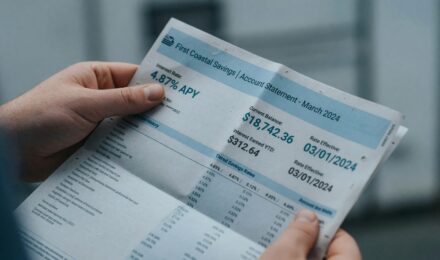
- High-yield savings accounts as of early 2026 still offer APYs in the 4.0%–4.5% range at leading online banks, meaning a $10,000 balance earns roughly $400–$450 per year in interest alone.
In This Guide
- Why a 6-Month Emergency Fund Is Especially Critical on $45,000
- Figuring Your Actual Take-Home Pay and Baseline Expenses
- Setting a Personalized 6-Month Target Amount
- Mapping a Realistic Savings Timeline Without Burnout
- Finding Extra Savings Room in a Tight Budget
- Automating Deposits and Building the Habit
- Maintaining the Fund and Knowing When to Use It
- Advanced Strategies to Accelerate Your Emergency Fund
According to Bankrate’s 2026 Annual Emergency Savings Report, 24% of Americans have no emergency savings at all, and only 27% have enough to cover six full months of expenses. For workers earning around $45,000 a year, those numbers carry extra weight: the margin between a manageable month and a financial crisis is narrow, and the path to build an emergency fund on this salary requires a different approach than generic advice written for higher earners. The conventional “save three to six months of expenses” directive is correct in principle, it just rarely comes with a plan suited to what $45k actually looks like on the ground in 2026.
The Federal Deposit Insurance Corporation recommends keeping at least six months of living expenses in a federally insured product, such as a savings account or CD, to withstand major income reductions or unexpected repairs. That guidance is sound. But the challenge is that six months of expenses for a single earner at $45,000 can easily represent 50% or more of total annual take-home pay, a psychological hurdle that causes many people to never start. Bankrate’s same 2026 report found that only 12% of earners below $40,000 grew their emergency savings in the past year, compared with 27% of those earning over $100,000. The barriers are real and measurably steeper at this income level.
This guide lays out a step-by-step method to build a six-month emergency fund on a $45,000 salary, with specific net-pay estimates, realistic monthly savings targets, phased milestones, and honest timelines that account for the slower progress most sources ignore. By the end, you will have a clear savings target, a monthly plan you can start this week, and a system for keeping the money intact once it is there.
Why a 6-Month Emergency Fund Is Especially Critical on $45,000
Fewer Safety Nets at Modest Income Levels
At $45,000 a year, the financial safety net is thinner than many people realize. Credit access is more limited: lower incomes correlate with lower credit limits and higher interest rates, so a job loss cannot be easily bridged with a 0% balance transfer card the way higher earners might manage. Liquid assets, savings, brokerage accounts, home equity, are typically smaller at this level too. When income stops, expenses do not, and the gap closes fast.
Job loss is not a rare event. The Bureau of Labor Statistics Job Openings and Labor Turnover Survey consistently shows that layoffs and discharges affect millions of workers each month. The median duration of unemployment as of late 2025 was approximately 10 weeks, roughly two and a half months, but that figure masks the longer searches many workers face, especially those in administrative, retail, or service roles that cluster around the $40,000–$50,000 income range.
Small Emergencies Hit Harder
A $1,200 car repair is a manageable inconvenience for a household earning $90,000. On a $45,000 salary, it can wipe out an entire month of discretionary income. The Federal Reserve Bank of St. Louis notes that experts recommend 3–6 months of essential expenses specifically to protect against large financial setbacks like job loss or major repairs, not because those events are catastrophic in isolation, but because without savings, even a mid-size shock forces people into high-interest debt that compounds the original problem.
63% of adults said they could cover a $400 emergency using cash or savings in the 2024 Survey of Household Economics and Decisionmaking, meaning 37% could not, and would need to borrow, sell something, or go without.
That 37% figure is not abstract. A single unexpected expense that goes on a credit card at 24% APR, carried for 12 months, costs an extra $288 in interest on top of the original $1,200. Over several such events, the interest alone can exceed what a small monthly savings habit would have cost to build protection in the first place. The math strongly favors building the fund even slowly.
Why Six Months, Not Three
Three months of savings is a reasonable first milestone, but the six-month standard exists for good reason. Healthcare disruptions, longer job searches in specialized fields, and the growing prevalence of contract or gig work (which offers no unemployment insurance) all argue for the longer cushion. On $45,000, where the margin for error is already thin, six months gives you genuine breathing room to find a comparable job rather than taking the first available one out of desperation. That distinction, job you chose versus job you had to take, has real, long-term wage consequences.
Figuring Your Actual Take-Home Pay and Baseline Expenses
Net Pay Reality on $45,000
Gross pay and take-home pay are very different numbers, and most savings advice glosses over the gap. At $45,000 annually, federal income tax for a single filer with the standard deduction runs approximately $3,700–$4,200, depending on any above-the-line deductions. FICA taxes (Social Security at 6.2% plus Medicare at 1.45%) add another $3,443. State income tax varies widely: Texas and Florida charge $0; California takes roughly $1,500–$1,800; New York another $2,000 or more. Adding a modest employer health insurance premium of $150–$200 per month, realistic monthly take-home pay lands in the range of $2,850–$3,160 for most single filers. Some states will push that figure below $2,800.
That range matters because every savings target in this article is anchored to take-home pay, not gross salary. Telling someone earning $45,000 to save “10% of income” implies $375 per month, before taxes are even out of the picture. The honest figure after taxes and common deductions is closer to $285–$316 per month at a 10% savings rate of net pay. Those numbers shape what is actually achievable.
If you contribute to a 401(k) or HSA through your employer, your taxable income, and therefore your take-home pay, shifts further. A 3% 401(k) contribution on $45,000 reduces your taxable income by $1,350, potentially saving $200+ in annual federal taxes while simultaneously building retirement savings.
Baseline Monthly Expenses for a Single Earner
The average U.S. household spends $6,545 per month according to the most recent Consumer Expenditure Survey data, but that average includes multi-person households with multiple incomes. For a single earner at $45,000, essential monthly costs look considerably leaner, though still tight against take-home pay.
| Expense Category | Low Estimate | Mid Estimate | High Estimate |
|---|---|---|---|
| Rent (1BR) | $950 | $1,250 | $1,600 |
| Utilities | $80 | $130 | $200 |
| Groceries | $250 | $350 | $450 |
| Transportation | $200 | $350 | $550 |
| Health Insurance | $0 (employer) | $150 | $300 |
| Phone | $40 | $65 | $90 |
| Debt Minimums | $0 | $150 | $400 |
| Total Essentials | $1,520 | $2,445 | $3,590 |
The mid-range total of roughly $2,445 in essential monthly expenses is a useful starting point for most single earners at this income level. In high-cost cities like San Francisco, Seattle, or Boston, rent alone can push that mid-range figure well past $3,000. In mid-size cities across the Midwest or Southeast, the low estimate is more achievable. Your actual number is what matters, and the exercise of writing it down is the first concrete step toward a savings plan that holds.

Setting a Personalized 6-Month Target Amount
Calculate Using Essentials, Not Gross Pay
The most practical way to set a six-month emergency fund target is to multiply your monthly essential expenses, the ones you genuinely cannot eliminate if income stops, by six. Generic advice to “save six months of salary” produces a $22,500 target for a $45,000 earner. That figure is not wrong, but it conflates gross pay with actual spending needs, and it can feel so large that people never start.
Using the mid-range expense estimate from the table above: $2,445 multiplied by six equals $14,670. Rounding up for small irregular expenses (a car insurance renewal, an annual subscription, a doctor’s copay), a target of $15,000–$18,000 is both defensible and more psychologically manageable than $22,500. The Consumer Financial Protection Bureau emphasizes that building an emergency fund starts with setting a clear goal, and a goal anchored to your actual expenses is more motivating than one derived from a rule of thumb that was never designed for your situation.
Variables That Shift the Target
Several factors push the target higher or lower. Dependents, a child, an elderly parent, a pet with chronic health needs, add to essential monthly costs and should be included in the base figure. High insurance deductibles (a $3,000 individual deductible is common in 2026 marketplace plans) argue for keeping the fund closer to the top of your range rather than the bottom. Conversely, if you have a strong support network, employer-provided short-term disability coverage, or very stable employment in a high-demand field, the lower end of your target range is more defensible.
Do not include discretionary spending, dining out, streaming services, gym memberships, in your emergency fund calculation. In a true emergency, those expenses stop. Inflating the target with non-essential costs makes an already ambitious goal feel impossible and delays getting started.
| Scenario | Monthly Essentials | 6-Month Target |
|---|---|---|
| Low cost-of-living city, no debt | $1,700 | $10,200 |
| Mid-size city, modest debt payments | $2,445 | $14,670 |
| High cost-of-living city, no debt | $3,000 | $18,000 |
| Any location, one dependent | $3,200 | $19,200 |
Mapping a Realistic Savings Timeline Without Burnout
What $200–$400 Per Month Actually Gets You
After essential expenses and a modest amount of discretionary spending, most single earners at $45,000 have somewhere between $200 and $500 per month that is theoretically available to save. In practice, that window narrows during high-expense months: car registration in January, higher utility bills in winter, a medical bill in spring. Planning for $250–$350 per month as a reliable savings rate is more honest than assuming $500 month after month.
The arithmetic is straightforward. Saving $300 per month toward a $15,000 target takes exactly 50 months, just over four years. At $250 per month, it takes 60 months, or five years. Neither timeline is exciting, but both are real, and both are far better than the alternative of carrying no savings. If a high-yield savings account earns 4.2% APY throughout that period, interest earned shortens the timeline by three to five months. That is not trivial, it is effectively free progress.
Saving $300/month in a 4.2% APY high-yield savings account reaches $15,000 in approximately 46 months instead of 50, the interest alone saves you roughly 4 months of contributions.
Phased Milestones That Keep Motivation Alive
A $15,000 goal with a four-year timeline is psychologically brutal if you measure progress only against the final number. Phased milestones break that problem. The first milestone is $1,000, a sum that already covers most single car repairs or a one-time medical copay. The second is $3,000, which starts to look like a real cushion. The third is one month of expenses (around $2,445 in the mid-range scenario), then three months, and finally six.
Each milestone deserves a moment of recognition, not a splurge but an honest acknowledgment that the progress is real. People who mark these smaller wins are meaningfully more likely to continue, according to behavioral finance research on goal framing. The milestone structure also matters practically: a $1,000 emergency fund already reduces the probability that a car problem sends you to a payday lender. Protection increases incrementally, not only after the full goal is reached.
Planning for Setbacks Without Abandoning the Plan
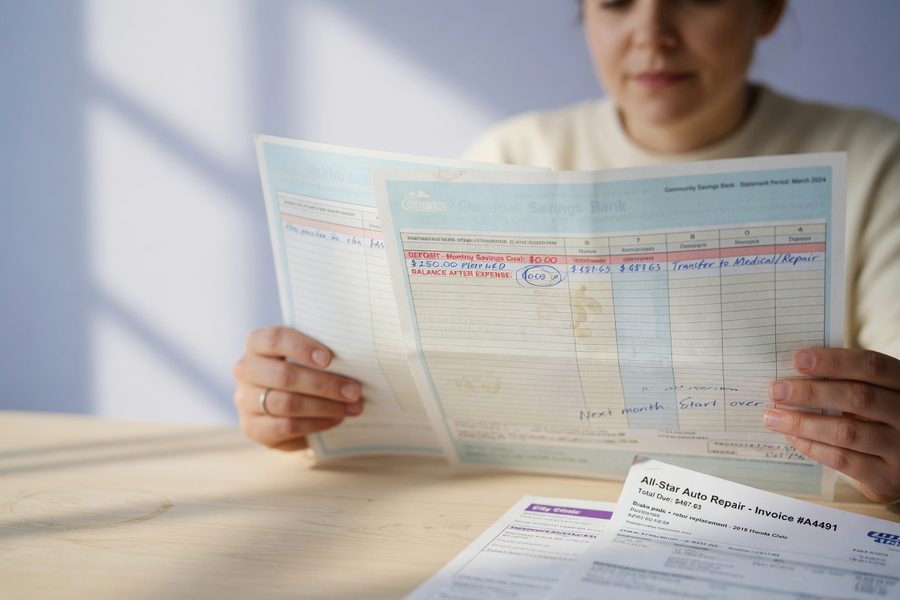
Some months will produce zero savings. A health expense, a car repair, a season of higher food costs, any of these can consume what would have gone into savings. The plan survives these months when the expectation of them is built in upfront. Rather than setting a monthly target and feeling like a failure when you miss it, set an annual target. $3,600 per year is $300 per month on average; if February and August produce nothing, that can be offset by stronger months in between. The annual framing is more forgiving and more accurate to how real life actually flows on this income.
Finding Extra Savings Room in a Tight Budget
Low-Effort Expense Reductions
Before looking for extra income, it is worth checking whether existing spending has any soft spots. Subscription audits consistently surface $30–$80 per month in forgotten or underused services. Grocery costs can drop 15–20% by shifting to store-brand equivalents on staples, not on everything, just on the items where quality differences are negligible. If you carry a balance on a credit card, the strategies covered in our guide on how to negotiate your credit card APR can reduce interest charges by $20–$60 per month, freeing that money for savings instead. None of these are dramatic cuts; the point is that $50–$100 per month found this way compounds meaningfully over a four-year savings horizon.
Utility costs are another lever. Programs through the Low Income Home Energy Assistance Program (LIHEAP) help eligible households reduce heating and cooling bills, and our coverage of how LIHEAP can help with rising utility costs details the eligibility rules and application process. At $45,000 annually, you may qualify depending on household size and state guidelines.
Direct your tax refund straight into your emergency fund before it lands in checking. The average federal refund in 2025 was approximately $3,100, a single transfer that covers more than 10 months of a $300/month savings target in one move. Set up the direct deposit to your savings account when you file.
Feasible Side Income at This Salary Level
A second income stream, even a modest one, can shorten the savings timeline substantially. The question is whether the side work is sustainable alongside a full-time job. Micro-freelancing, short, skill-based tasks completed online, has grown sharply in 2025–2026, and our reporting on the micro-freelancing surge covers platforms where $200–$500 per month in supplemental income is realistic for someone with administrative, writing, or data-entry skills. That additional $250 per month, directed entirely to savings, cuts the timeline to a $15,000 goal from 50 months to roughly 30, a full 20 months faster.
Seasonal work is another option worth considering. Our article on landing seasonal cash before rates affect your savings outlines specific roles that hire quickly and pay reasonably. The key is treating every dollar from a side job as earmarked for the emergency fund, not absorbed into general spending. Without that boundary, extra income tends to inflate lifestyle rather than accelerate the goal.
Using Windfalls Strategically
Windfalls, a work bonus, a tax refund, a cash gift, are the single fastest way to accelerate an emergency fund at this income level. The temptation to spend a windfall is real and understandable; after months of tight budgeting, a $1,500 bonus feels like permission to exhale. A middle path is to allocate 70%–80% of any windfall to savings and 20%–30% to something enjoyable. That split maintains motivation without sacrificing the bulk of the progress. A $1,500 bonus with 75% directed to savings adds $1,125 to the fund, nearly four months of contributions in a single event.
Automating Deposits and Building the Habit
Automation is the single most reliable behavioral tool available for building savings. The Consumer Financial Protection Bureau specifically recommends automatic transfers as a core strategy for building emergency fund contributions into a consistent habit, particularly for people with regular but limited income. Setting up a transfer of $250–$350 to a separate high-yield savings account on the day after each paycheck arrives means the decision is made once, not every payday.
The choice of account matters. A high-yield savings account at an online bank, earning 4.0%–4.5% APY as of early 2026, is meaningfully better than a standard savings account at a big bank paying 0.01%. On a $10,000 balance, the difference is $390–$440 per year in interest versus less than $2. That gap is not a trivial bonus, it is roughly one to two months of contributions at a $250/month savings rate. Keep the account at a different institution than your checking account. The slight friction of transferring money back creates a pause that helps distinguish true emergencies from impulse spending.
Many online banks let you nickname savings accounts, labeling yours “Emergency Fund Only” or “6-Month Goal” reinforces its purpose every time you log in. Small behavioral cues like this have been shown in research to reduce unplanned withdrawals.
Maintaining the Fund and Knowing When to Use It
What Qualifies as a True Emergency
The emergency fund has one job: to cover expenses that are necessary, unexpected, and urgent. A car repair that prevents you from getting to work qualifies. A home appliance failure qualifies. A job loss qualifies. A vacation sale, a flash furniture deal, or a credit card payoff that you planned three months ago does not. The boundary needs to be explicit and written down, because in the moment, many non-emergencies feel urgent.
A useful test: if you could have anticipated this expense with three months of notice, it was not an emergency, it was a planning failure. True emergencies are genuinely unpredictable. If spending from the fund feels questionable, it probably is. Keeping a one-sentence written rule in your budgeting app or on a note in your wallet adds a moment of friction that helps enforce the distinction.
Rebuilding After a Withdrawal
Using the fund does not mean failing at the plan, it means the plan worked. After a withdrawal, the priority is rebuilding to the previous level before redirecting money elsewhere. A practical approach: temporarily increase the automatic transfer by 20%–30% for three to six months after a withdrawal, then return to the standard rate once the balance is restored. If the withdrawal was large enough to take the fund below one month of expenses, rebuilding takes precedence over everything except employer-matched retirement contributions, which are essentially an immediate 50%–100% return on investment and should not be suspended.
Advanced Strategies to Accelerate Your Emergency Fund
Laddering with CDs for Better Returns
Once your emergency fund reaches $5,000 or more, a CD ladder can improve your yield without sacrificing too much liquidity. The structure: keep two to three months of expenses in a high-yield savings account for immediate access, and place the remaining three to four months in 3-month or 6-month CDs. As each CD matures, renew it at the current rate. In early 2026, 6-month CDs at FDIC-insured online banks are yielding 4.3%–4.7%, slightly above most high-yield savings accounts. The tradeoff is that money in a CD is less accessible during the term, which is exactly why maintaining a liquid portion is essential before using this strategy.
The FDIC insures deposits up to $250,000 per depositor per institution, so your emergency fund, regardless of which FDIC-insured bank holds it, is fully protected from bank failure up to that limit.
Coordinating Emergency Savings with Debt Payoff
Carrying high-interest credit card debt while building an emergency fund is one of the more difficult personal finance trade-offs, and honest advice acknowledges the tension. Mathematically, paying off a 24% APR card before saving in a 4.2% account looks obvious. Behaviorally, people who have no savings buffer tend to take on new debt when the next emergency arrives, erasing the payoff progress. The most defensible approach for most people at this income level: build a $1,000 starter emergency fund first, then aggressively pay down high-interest debt, then resume building the full six-month fund. Our detailed breakdown of how to prioritize and negotiate credit card debt is a useful companion resource at this stage.
| Strategy | Best For | Key Trade-Off |
|---|---|---|
| High-Yield Savings Only | Simplicity, full liquidity | Slightly lower yield than CDs |
| CD Ladder (3–6 month) | Funds over $5,000 | Less immediate access during term |
| Split: Savings + CD | Balanced approach after $5k | Requires managing two accounts |
| Pay Debt First, Then Save | High-interest card balances | No buffer if emergency occurs mid-payoff |
| Parallel Debt + Savings | Moderate-interest debt, $0 savings | Slower progress on both fronts |
Once the emergency fund is fully funded and high-interest debt is cleared, the next step is redirecting those monthly contributions toward retirement or investment accounts. Our primer on how to start investing with zero experience covers that transition for earners who are new to the markets.
Real-World Example: Building $15,000 on $45,000 in 48 Months
Consider an illustrative example: a 29-year-old single earner in Columbus, Ohio, earning $45,000 per year. After federal taxes, FICA, a $120/month employer health insurance premium, and Ohio state income tax (~$1,100 annually), take-home pay is approximately $2,960 per month. Monthly essential expenses, $1,050 rent for a one-bedroom apartment, $290 groceries, $310 car payment and insurance, $110 utilities, $55 phone, total $1,815. That leaves $1,145 per month of gross discretionary income before entertainment, dining, clothing, and savings.
After a realistic $400 per month for non-essential spending and $200 in minimum student loan payments, the available savings window is $545 per month. However, the earner decides to set $300 per month as the emergency fund contribution, a conservative target that leaves some buffer for variable months, and directs the remaining $245 toward the student loan to pay it off faster. The $300/month goes into a high-yield savings account earning 4.2% APY.
In month seven, an unexpected $900 car repair draws down the fund from $2,100 to $1,200. Rather than feeling defeated, the earner temporarily increases contributions to $375 per month for four months to rebuild. In month 12, a $2,800 tax refund (directed 80% to savings, 20% to a treat) adds $2,240 to the balance. At the 24-month mark, the fund sits at approximately $9,800, more than six months of minimum essential expenses, though short of the full $15,000 target. By month 42, with the interest compounding and one additional windfall (a $1,000 workplace bonus in year three), the fund reaches $15,200.
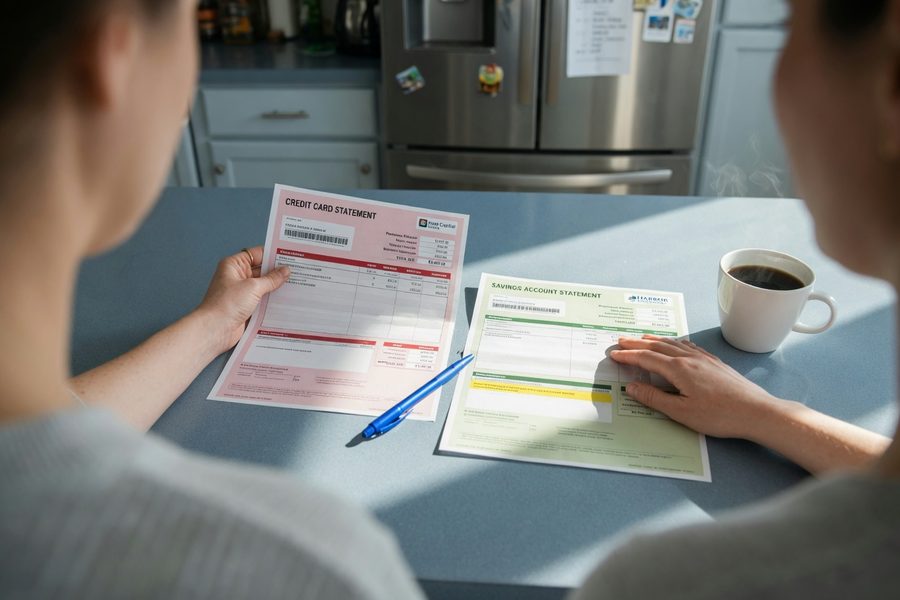
The before picture: zero savings, one car repair away from credit card debt. The after picture: $15,200 in a federally insured account, earning roughly $530 in annual interest, covering six months of essential expenses with no debt required. The timeline was 42 months, shorter than the 50-month base estimate because the tax refund and temporary contribution increase both mattered. The key decision was starting with a realistic number rather than a heroic one.
Your Action Plan
-
Calculate your actual take-home pay
Pull your last two pay stubs and find the net deposit amount, not the gross salary line. Multiply by 26 if you are paid biweekly, then divide by 12 for your monthly net. This is the number that governs every savings decision. If your take-home varies due to hourly work or gig income, average the last three months of deposits.
-
List your essential monthly expenses, only the ones that survive a crisis
Write down rent, utilities, minimum debt payments, groceries, transportation, and health insurance. Do not include restaurants, subscriptions, or entertainment, those stop in an emergency. Add the total. Multiply by six. That is your target.
-
Open a separate high-yield savings account this week
Choose an FDIC-insured online bank offering at least 4.0% APY. Keep it at a different institution than your checking account. Label the account clearly as your emergency fund. The setup takes about 15 minutes and the separation is the most important structural decision in this entire plan.
-
Set up an automatic transfer for the day after each payday
Start with an amount you are confident you can sustain, $200 to $300 is a reasonable range for most earners at this income level. The transfer should feel slightly uncomfortable but not crisis-inducing. You can adjust upward after two months if your cash flow allows. Automation removes the decision from willpower and makes the contribution reliable.
-
Audit subscriptions and one recurring bill this month
Identify and cancel any subscriptions unused in the past 60 days. Call one service provider, internet, insurance, or a streaming bundle, and ask for a lower rate or promotional pricing. Apply any savings found directly to increasing your automatic transfer. Even $30–$50 per month redirected this way adds $360–$600 to your emergency fund annually.
-
Commit your next tax refund to the emergency fund before it arrives
When you file your return, set the refund to deposit directly into your emergency savings account. Decide now, before the money exists, that 80% of the refund goes to savings. The average federal refund is approximately $3,100, which can represent 10 or more months of contributions in a single event. Making the decision in advance eliminates the temptation to spend it on arrival.
-
Set a three-month check-in and adjust the plan based on reality
After 90 days, review what actually happened: Did the automatic transfer clear every time? Were there months where you pulled money back out? Was the amount too aggressive or too conservative? Adjust the monthly contribution, the target, or the timeline based on the actual data from your own life, not a generic template. The plan that survives is the one calibrated to your real spending, not an ideal version of it.
Related reading: How a Single Parent in Ohio Built a 6.
Frequently Asked Questions
How long does it realistically take to build a 6-month emergency fund on a $45,000 salary?
For most single earners at this income level, the honest answer is three to five years when saving $250–$350 per month. That timeline shortens meaningfully with tax refunds, bonuses, or a modest side income directed to savings. A phased approach, reaching $1,000 first, then $3,000, then one full month of expenses, makes the longer timeline manageable by creating visible progress along the way. The four-to-five-year horizon is longer than most advice suggests, but it reflects what $45,000 take-home pay actually supports after essential expenses.
Should I pay off debt or build an emergency fund first?
Build a $1,000 starter fund before aggressively paying debt. Without any buffer, the next unexpected expense, a car repair, a medical bill, goes straight back onto the card you just paid down. Once you have $1,000 in savings, shift the majority of extra cash to high-interest debt (anything above 8%–10% APR), then return to building the full emergency fund. This sequence is not mathematically optimal, but it is behaviorally more durable for most people.
Where should I keep my emergency fund?
A high-yield savings account at an FDIC-insured online bank is the right default. As of early 2026, leading online banks are offering 4.0%–4.5% APY, meaningfully more than the national average savings rate of under 0.5% at large traditional banks. Once your fund exceeds $5,000, a partial CD ladder can improve yield slightly without eliminating access. Do not keep your emergency fund in a brokerage account or in investments that can lose value; the fund exists to be stable and available, not to grow aggressively.
What counts as an emergency when using the fund?
True emergencies are necessary, unexpected, and urgent, job loss, a car breakdown that prevents you from working, a medical expense not covered by insurance, or a critical home repair like a heating system failure. A vacation, a planned purchase you delayed, or paying off a credit card you accumulated over time do not qualify. The boundary can feel fuzzy in the moment, which is why writing down your personal rule in advance matters. If you have to debate whether something qualifies, it probably does not.
Is a 6-month emergency fund really necessary, or is 3 months enough?
Three months is a strong and defensible starting point, and it provides real protection against most single-event emergencies. Six months becomes more important if your income is irregular, you work in a field with longer job searches, you have dependents, or you carry high insurance deductibles. At $45,000, where the financial safety net is thinner, six months of savings reduces the risk that a setback forces you into long-term high-interest debt, which is the outcome the fund is designed to prevent.
Can I use a Roth IRA as an emergency fund?
Contributions (not earnings) to a Roth IRA can be withdrawn at any time without taxes or penalties, which makes this option technically available. The significant downside is that money removed from a Roth IRA loses future tax-free compounding forever, you cannot re-contribute beyond the annual limit. This strategy makes sense only as a last resort after a dedicated emergency fund is depleted. For most earners at $45,000, building a separate emergency savings account and keeping retirement contributions intact is the stronger long-term choice.
What if my income is irregular or I work gig jobs part of the year?
Irregular income makes emergency funds more important and harder to build simultaneously. The approach that works best: set your monthly savings target based on your lowest-income month rather than your average. In high-income months, direct the surplus to savings aggressively. In low-income months, maintain the minimum transfer even if it is only $50–$100. Building a separate tax reserve (typically 25%–30% of gross gig income) should run in parallel, since unexpected tax bills can otherwise drain the emergency fund. The instability of gig work is precisely why a robust savings cushion matters more, not less.
Does the emergency fund target change if I have children?
Yes, and the adjustment is significant. Each dependent adds $200–$600 per month in essential expenses, childcare, food, healthcare, and clothing, which directly increases the six-month target. A single parent with one child at $45,000 may need $18,000–$22,000 to cover true six-month expenses, not $15,000. The timeline extends accordingly, which makes starting earlier and using windfalls aggressively even more important.
Should I keep saving beyond six months?
Once the six-month fund is fully funded, additional savings should generally shift to other goals: paying down remaining debt, maximizing employer-matched retirement contributions, and eventually opening a brokerage account for longer-term investing. Keeping more than nine to twelve months in a savings account beyond the emergency fund earns lower returns than invested assets over long periods. At that stage, the emergency fund is “done” and the focus changes, our guide on how to start investing with zero experience covers the next step.
What is the biggest mistake people make when building an emergency fund?
Setting the monthly savings target too high, missing it for two or three months in a row, and concluding the plan does not work. The plan that saves $200 per month consistently for four years outperforms the plan that targets $600 per month but lasts eight months before collapsing under the pressure. Sustainability is more important than speed. Start with an amount that feels slightly low, prove the habit for three months, then increase. The psychology of small wins builds more durable savings behavior than aggressive targets that generate failure and abandonment.
Sources
- Bankrate, 2026 Annual Emergency Savings Report
- Consumer Financial Protection Bureau, An Essential Guide to Building an Emergency Fund
- Federal Deposit Insurance Corporation, Saving for the Unexpected and Your Future (2025)
- Federal Reserve Bank of St. Louis, When the Unexpected Happens: Be Ready with an Emergency Fund (2025)
- The Motley Fool, Average Monthly Expenses for U.S. Households
- U.S. Bureau of Labor Statistics, Job Openings and Labor Turnover Survey (JOLTS)
- U.S. Bureau of Labor Statistics, Consumer Expenditure Survey
- Internal Revenue Service, Tax Withholding Estimator
- U.S. Bureau of Labor Statistics, Employment Situation Summary (Unemployment Duration Data)