Fact-checked by the MyFinancial101 editorial team
Cash accounted for just 14% of all U.S. consumer payments by number in 2024, according to the Federal Reserve, yet the envelope budgeting method digital adaptation has never been more relevant. The system’s core logic, assigning every incoming dollar to a specific spending category before you spend a single cent, works whether the “envelopes” are made of paper or pixels. What has changed dramatically is that the average American now makes 48 payments a month, only about seven of them in cash. The mechanics of everyday spending have shifted; the psychology behind intentional allocation has not.
Overspending is not a discipline problem for most people, it is a visibility problem. 81% of U.S. consumers still made at least one cash payment in the past 30 days, down from 83% the prior year, meaning the slide away from cash is slow but steady. Meanwhile, mobile payments now average 11 transactions per month per person, surpassing cash. When spending is spread across debit cards, credit cards, mobile wallets, and subscription auto-charges, no single physical container signals “this category is empty.” That missing signal is exactly what the original envelope method provided, and it is precisely what digital tools now try to restore.
This guide walks through how the envelope method works, why physical cash no longer fits most budgets in 2026, and which digital apps and non-app alternatives most faithfully replicate the original system’s behavioral power. By the end, you will know which tool fits your income type and spending habits, what hidden costs and trade-offs to watch for, and how to set up a working digital envelope system from scratch.
Key Takeaways
- Cash now represents only 14% of U.S. consumer payments by number, making a purely physical envelope system impractical for most households in 2026.
- The average American makes 48 payments per month; only 7 are in cash, while 11 are via mobile phone, a near-reversal of spending habits from a decade ago.
- Goodbudget’s free tier caps users at 10 envelopes and 1 account; upgrading to Premium costs $10/month or $120/year, which may exceed the savings benefit for minimal-category budgeters.
- YNAB charges approximately $109/year, while Actual Budget offers a self-hosted, open-source option at $0 ongoing cost, the right choice depends entirely on how much you value automation vs. privacy.
- Multi-account “bucket” strategies at banks or credit unions can replicate envelope logic for free, though they require manual reconciliation and offer no real-time category dashboards.
- Gig and variable-income earners need envelope systems that support rolling unused funds forward month to month rather than resetting to zero, a feature that varies significantly across apps.
In This Guide
- What Is the Envelope Budgeting Method and Why It Still Matters
- The Challenges of Traditional Cash Envelopes in 2026
- How Digital Envelope Budgeting Replicates the Original System
- Top Apps Built for Digital Envelope Budgeting
- Step-by-Step Setup for a Digital Envelope System
- Non-App Alternatives That Achieve Similar Results
- Adapting Envelopes for Variable and Gig Income
- Making It Stick: Pitfalls and Long-Term Success
What Is the Envelope Budgeting Method and Why It Still Matters
Deceptively simple in design, envelope budgeting works like this: at the start of each pay period, you divide your take-home income into labeled envelopes, one for groceries, one for gas, one for dining out, and so on. When an envelope is empty, spending in that category stops until the next pay period. No overdraft. No borrowing from tomorrow. The rule is absolute, and that absoluteness is the entire point.
Assigning Every Dollar Before You Spend It
The method belongs to the broader family of zero-based budgeting, where income minus all assigned expenses equals zero. Nothing sits unallocated, because unallocated money tends to disappear into impulse purchases. Every dollar gets a job before the month begins. This approach forces you to make deliberate trade-offs at the planning stage, where thinking is calm, rather than at the point of sale, where emotion runs high.
Research on payment psychology consistently shows that spending cash feels more “real” than swiping a card; brain-imaging studies have documented greater activation in pain-related regions during cash transactions. The physical depletion of an envelope recreates that friction digitally by making the remaining balance visible and finite. That visibility is the behavioral engine driving any version of this system, paper or digital.
Why the Psychology Still Works Without Cash
The method’s endurance across economic eras comes from one insight: most overspending is not caused by greed but by a lack of real-time awareness. When you pay with a tap of your phone, there is no natural stopping signal. Digital envelopes restore that signal by displaying a declining balance tied to a specific category. Seeing “$23 left in dining” before agreeing to a $30 dinner reservation is functionally identical to reaching into a paper envelope and counting thin bills. The constraint is what changes behavior, not the medium.
The envelope method is widely credited to financial educator and radio host Dave Ramsey, who popularized it as a cornerstone of his “Baby Steps” debt-elimination plan starting in the 1990s. The underlying practice, however, dates back generations as a household cash management strategy long before personal finance became an industry.
One honest caveat: the method’s power is stronger when budgets are tight. High earners with large discretionary cushions often find the category-level granularity less behaviorally compelling, because the consequences of a near-empty envelope feel less acute. For households working to pay down debt or build an emergency fund, the constraint is at its most powerful. Those whose finances are already in solid shape may find a simpler tracking system serves just as well.
The Challenges of Traditional Cash Envelopes in 2026
Physical cash envelopes made perfect sense in an era when most routine purchases happened at brick-and-mortar stores. The economy of 2026 looks substantially different. 23% of U.S. consumer purchases and peer-to-peer payments were made remotely in 2024, and that share has only grown since. Online subscriptions, app-based food delivery, and digital bill pay cannot be paid with cash withdrawn from a labeled envelope. The system breaks down the moment a meaningful portion of spending exists outside the physical world.
Safety, Convenience, and Practical Friction
Keeping substantial amounts of cash at home also introduces risks that most financial advisors no longer recommend accepting without reason. Cash lost to theft, fire, or simple misplacement carries no FDIC protection and no fraud recourse. For a household budgeting $4,000 per month, maintaining even half that in categorized cash envelopes means holding $2,000 in unsecured notes. That is not a trade-off most families should make.
The inconvenience compounds for dual-income households or partners sharing a budget. Physical envelopes cannot be simultaneously accessed by two people in different locations. One partner withdraws cash at the ATM, the other needs groceries on the same afternoon, and the system either requires constant coordination or breaks down into informal workarounds that undermine the original structure entirely.
If you use physical cash envelopes and regularly “borrow” from one category to cover another, the system has already broken down. That pattern is the main reason people abandon the method entirely, when the fix is not more willpower but a better structure, which is exactly what digital alternatives provide.
Why People Love the Concept but Quit the Practice
The failure mode is predictable: someone enthusiastically sets up 12 labeled envelopes, withdraws $1,500 in cash on payday, and commits fully for about three weeks. Then an online purchase requires a card, a subscription auto-renews from a bank account, and the carefully allocated cash no longer reflects actual spending. The envelopes become fiction. Within two months, the system is abandoned, not because the concept failed but because the execution medium could not keep up with real spending patterns.
This is the gap that digital envelope tools are specifically designed to fill. The question is not whether to adopt the envelope concept, the evidence for its behavioral effectiveness is solid, but which digital implementation will hold up against the full complexity of modern household spending.
How Digital Envelope Budgeting Replicates the Original System
A digital envelope system replaces physical cash and paper folders with virtual categories that track allocated balances in real time. The rule remains identical: money assigned to “groceries” can only be spent on groceries, and when the balance hits zero, the envelope is empty. The difference is that transactions can flow in from card swipes, online purchases, and direct debits while the software categorizes and deducts them automatically or with one tap.
The Core Mechanics of Virtual Categories
Most digital envelope apps work in one of two modes. The first is bank-synced mode, where the app connects to your bank accounts via an API (often using services like Plaid or MX), imports transactions automatically, and prompts you to categorize each one. The second is manual-entry mode, where you record each transaction yourself, similar to a paper ledger. Both preserve the envelope constraint, a category cannot spend more than it contains, but they differ substantially in convenience, privacy exposure, and error risk.
Bank-synced apps are faster but require granting a third-party service read access to your financial accounts. Manual-entry apps offer greater privacy but demand daily or weekly attention to stay accurate. Neither is strictly better; the right choice depends on how much time you will realistically invest versus how comfortable you are sharing login credentials with a budgeting platform.
Key Differences from the Paper Version
Digital systems offer two advantages the paper method cannot match. First, error correction is nearly instant, a miscategorized transaction can be reassigned in seconds rather than requiring you to re-count and redistribute physical bills. Second, digital envelopes support rolling balances, meaning unspent funds in a category automatically carry forward to the next month rather than requiring you to physically re-stuff envelopes on payday. For irregular expenses like car repairs or medical copays, rolling balances are the feature that makes the system genuinely functional over time.
U.S. consumers made an average of 11 mobile payments per month in 2024, compared to just 7 cash payments. That gap means a purely cash-based envelope system now misses more than 36% of the average person’s monthly transactions before accounting for card purchases.
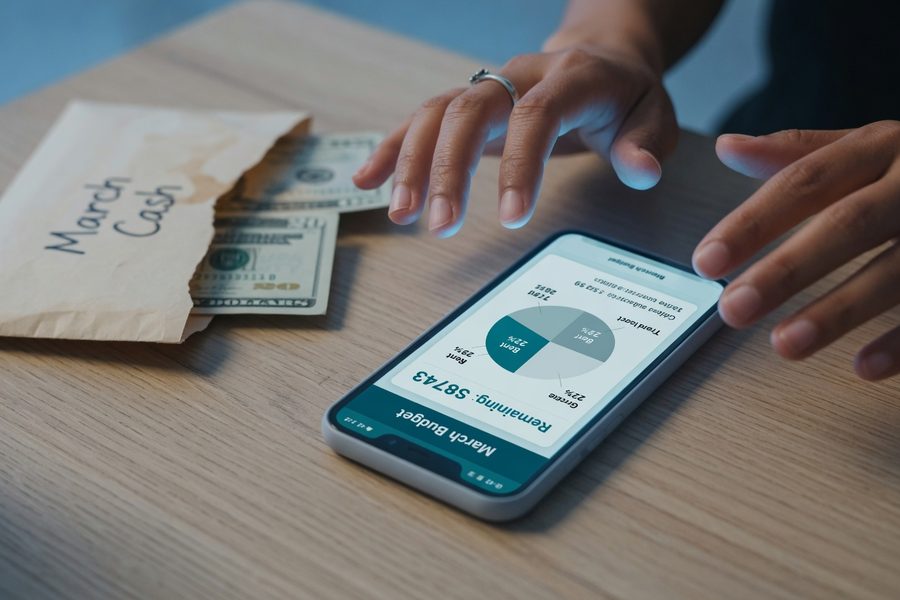
The honest trade-off is that digital systems require consistent data hygiene. A paper envelope gives you a binary signal: there are bills in here or there are not. A digital envelope can show a positive balance that is technically already spent if a pending transaction has not yet cleared or been manually entered. Staying current with transaction entry is the work the system requires of you. Skip it for two weeks and the balances become misleading.
Top Apps Built for Digital Envelope Budgeting
Several apps have built their entire product around the envelope concept, each with meaningfully different pricing models, feature sets, and target users. Choosing among them is mostly a question of how much automation you want, how much you value privacy, and how much you are willing to pay per year.
Goodbudget: Shared Households and Straightforward Envelopes
Goodbudget is one of the oldest dedicated envelope apps still active and is built specifically for couples and families who need to share a budget across devices. The free tier allows 10 envelopes and 1 linked account, a deliberate constraint that mirrors the original method’s simplicity. Premium costs $10 per month or $120 per year and removes all limits. Goodbudget does not sync directly with bank accounts; you enter transactions manually or import them via file. That keeps your bank credentials off their servers, which is a meaningful privacy advantage, though it requires consistent manual effort. For households with stable, salaried income and straightforward spending categories, Goodbudget’s free tier may be all that is needed.
YNAB, Actual Budget, and RealBudget
YNAB (You Need A Budget) is the best-known zero-based budgeting app in the U.S. market. It operates on the same “give every dollar a job” principle as envelope budgeting, though it uses the term “categories” rather than “envelopes.” YNAB connects to bank accounts automatically, supports real-time transaction imports, and offers substantial educational content. At approximately $109 per year, user-reported outcomes frequently cite meaningful savings improvements after consistent use, though the subscription cost means a user saving less than $100/year from the system is actually losing ground financially.
Actual Budget is the option most top-ranking articles on this topic miss entirely. It is open-source, self-hosted, and free to run on your own server or device. A hosted sync option with end-to-end encryption adds a modest optional fee, but the core software costs nothing and stores no data on a third-party server. For privacy-conscious users or those who want full data ownership, including the ability to export everything for tax or accounting purposes, Actual Budget is the strongest choice with the steepest learning curve.
RealBudget offers a one-time purchase model rather than an ongoing subscription, positioning itself as a lower total-cost-of-ownership alternative. It supports envelope categories with optional premium sync, making it appealing for users burned by YNAB’s price hike in recent years. The trade-off is a smaller development team, fewer integrations, and a less polished interface compared to YNAB or Goodbudget.
The Envelope app (a separate product from Goodbudget) integrates a checking account, FDIC-insured deposits, and a debit card directly into its envelope interface. Unlike every other app in this category, it eliminates the need for a separate bank connection because the bank account IS the app. It also offers a competitive APY on envelope balances, though rates fluctuate with the broader market.
| App | Pricing (April 2026) | Bank Sync | Data Privacy | Best For |
|---|---|---|---|---|
| Goodbudget | Free (10 envelopes) / $120/yr | No (manual entry) | High, no bank credentials shared | Couples, manual-entry preference |
| YNAB | ~$109/yr | Yes (Plaid) | Moderate, credentials with third party | Power users, automated tracking |
| Actual Budget | Free (self-hosted) / small sync fee | Optional | Highest, self-hosted option | Privacy-focused, tech-comfortable users |
| RealBudget | One-time purchase + optional premium | Optional | Moderate | Users avoiding subscriptions |
| Envelope App | Free (with built-in account) | Built-in, no external sync needed | High, single-app ecosystem | Those wanting banking + envelopes unified |
One comparison most reviews skip: export capabilities. If you use envelope spending data to categorize deductions at tax time or run a home-based business, the ability to export transaction history to CSV or spreadsheet format matters. YNAB and Actual Budget both support clean exports; some smaller apps do not, which can create headaches when switching platforms or producing records for accounting purposes.
Step-by-Step Setup for a Digital Envelope System
The setup phase is where most people either build something sustainable or create a system too complicated to maintain. Keep the initial envelope count low, eight to twelve categories is manageable; twenty is not. You can always add envelopes later; starting with too many is a common first-month failure.
Categorizing Income and Expenses
Start by listing your fixed monthly expenses: rent or mortgage, utilities, insurance premiums, loan payments. These become your first envelopes, fully funded each month at the same amount. Then list your variable expenses: groceries, gas, dining, personal care, entertainment. Review the last three months of bank and credit card statements to find your actual average spending in each category, not what you wish you spent. Most people discover their dining and grocery estimates are 20-30% below reality.
Fund fixed envelopes first each pay period. The remaining income goes to variable envelopes. If the math does not balance, meaning expenses exceed income after allocation, you have found the real problem the budget needs to solve, and you have found it before money has already left your account.
Handling Irregular Income and Rolling Categories
For households with predictable monthly income, funding envelopes on payday is straightforward. For irregular income, the better approach is to fund envelopes based on your lowest expected monthly income and treat any additional income as a windfall to allocate when it arrives. This conservative baseline prevents the scenario where you allocate an optimistic paycheck total and then come up short mid-month.
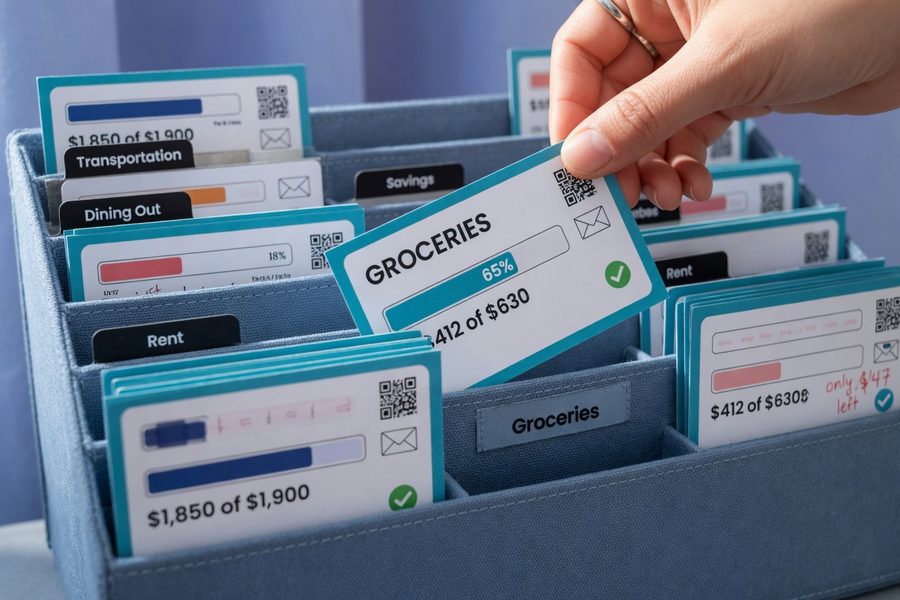
Certain categories benefit from rolling forward rather than resetting monthly. Car maintenance, medical copays, and annual expenses like homeowner’s insurance or holiday gifts should accumulate in a sinking fund envelope, a fixed monthly contribution that grows until the expense hits. A $1,200 annual car registration fee, for example, becomes a $100 monthly envelope contribution that feels manageable rather than a single-month emergency.
Set up sinking fund envelopes for every non-monthly expense you can predict. Review your last twelve months of statements for irregular but recurring costs, then divide each by 12 to find the monthly contribution. Most households find three to five such categories they had been treating as financial surprises.
Connecting Accounts or Using Built-In Banking
With a bank-synced app like YNAB, link your primary checking account and any credit cards you pay in full monthly. Credit cards used responsibly within the envelope framework can be treated as a payment instrument rather than a credit source, with the envelope balance decreasing at the point of purchase, not when the credit card bill arrives. The Envelope app eliminates this complexity by combining the checking account and envelope tracking in a single product, though it requires moving your day-to-day banking to a new institution, which is a meaningful commitment some users are not ready to make.
Non-App Alternatives That Achieve Similar Results
Dedicated apps are not the only path to digital envelope budgeting. Several lower-tech approaches replicate the method’s core logic without requiring a monthly subscription or a third-party data connection.
Multiple Bank Accounts as Envelopes
Many online banks and credit unions allow customers to open multiple savings sub-accounts at no cost, each of which can be named for a spending category. Ally Bank, Capital One 360, and several credit unions support this “bucket” structure natively. You fund each sub-account on payday and spend only from the designated account for each category. The behavioral friction of transferring money before spending adds a natural pause, similar to reaching into a labeled envelope. The main limitation is that this approach lacks a dashboard showing all category balances simultaneously, requiring manual tracking or a spreadsheet alongside it.
The math here is straightforward. A household that moves $400 per month to a “car maintenance” sub-account holds $2,400 after six months, precisely timed to absorb a set of tires or a brake job without affecting any other budget category. No app subscription required.
Spreadsheets and Manual Ledgers
A well-designed spreadsheet can replicate nearly every feature of a paid envelope app. Google Sheets and Excel both support the running balance logic that tracks category deductions in real time. Templates specifically designed for envelope budgeting are available through personal finance communities. The genuine downside of spreadsheets is that they are only as current as the last time you entered data, there is no automatic sync to pull in yesterday’s card transactions. For detail-oriented users who enjoy the process, this is not a problem. For busy households, the weekly data-entry requirement tends to erode over time.
| Alternative Method | Monthly Cost | Dashboard View | Automation | Privacy |
|---|---|---|---|---|
| Multiple bank accounts | $0 (most banks) | No | Partial (auto-transfer on payday) | High |
| Google Sheets template | $0 | Customizable | None | Highest |
| Excel workbook | $0 (if already subscribed) | Customizable | None | Highest |
| Credit card + manual reconcile | $0 (if paid in full) | No | Partial (statement imports) | Moderate |
Hybrid Credit Card Approaches
Some financially disciplined households use a hybrid model: they allocate spending categories in a spreadsheet or simple app, charge everything to a rewards credit card for the points, and pay the full balance monthly. The envelope logic lives in the tracking tool, not in the payment method. This approach works, and can net $300-$600 per year in travel or cash-back rewards on a typical household budget, but it requires absolute certainty about full monthly payoffs. Carrying a balance even once will erase months of rewards value. For households already managing credit card debt, this hybrid approach is not appropriate until balances are cleared.
Adapting Envelopes for Variable and Gig Income
Variable and gig income workers face a specific challenge that standard envelope guides rarely address adequately: the envelope system assumes you know how much money you are allocating before the month begins. When income varies by 30-50% from month to month, a fixed monthly allocation becomes a source of anxiety rather than control.
A two-tier system solves this practically. Tier one covers essential envelopes, housing, utilities, food, minimum debt payments, and is always funded first from whatever income arrives, regardless of amount. Tier two covers discretionary envelopes, dining, entertainment, clothing, and is funded proportionally with whatever income remains after essentials. In a strong-income month, discretionary envelopes fill generously. In a lean month, they receive a minimal allocation or nothing. This prevents the failure mode of over-allocating in an optimistic moment and then scrambling when income does not materialize. Exploring ways to grow gig income to stabilize your monthly budget often matters as much as the budgeting method itself.
Making It Stick: Pitfalls and Long-Term Success
The most common reason digital envelope systems fail is not overspending, it is under-maintenance. A system that requires daily attention will be abandoned by most users within 60 days. The solution is a weekly 10-minute budget review rather than real-time transaction checking. Once per week, reconcile any uncategorized transactions, check category balances, and make any needed transfers between envelopes. Monthly, review whether your allocations still reflect actual spending patterns; most households need to adjust at least two or three categories after the first few months of real data.
Avoiding the “Borrowing” Trap
Frequent transfers between envelopes, taking $50 from clothing to cover a restaurant overage, defeats the system’s core purpose. Occasional reallocation is normal and acceptable; structural over-borrowing means the category amounts are wrong, not that you lack discipline. Borrowing from the same envelope three months in a row is a signal that category is underfunded and needs a permanent adjustment. Treat it as a data point, not a moral failure.
One behavior change that separates long-term success from early abandonment: building a small buffer envelope of $50-$100 labeled something like “miscellaneous” or “budget flex.” Small unexpected expenses, a parking fee, a school fundraiser contribution, a last-minute household item, no longer require raiding other categories. The buffer absorbs the noise, which keeps the real category balances meaningful.
A household that reduces discretionary overspending by just $75 per month through envelope discipline saves $900 per year. Redirected to a high-yield savings account at 4.5% APY, that becomes approximately $936 after 12 months, a meaningful emergency fund start with no income increase required.
Envelope budgeting pairs particularly well with other spending-reduction habits. Combining it with coupon stacking strategies for groceries, for example, can make the grocery envelope last noticeably longer each month, freeing allocation room in other categories. Both methods reinforce each other because both require advance planning rather than reactive decision-making at the point of sale.
Quarterly Reviews and System Longevity
At the three-month mark, most envelope budgeters have enough real data to build a genuinely accurate spending picture. This is the right time for a full review: which envelopes consistently have leftover balances (probably over-allocated), which consistently run out early (under-allocated), and which categories you forgot to create. Annual expenses like holiday gifts, vehicle registration, or summer travel should be added as sinking fund envelopes at this stage if they were missed initially.
Long-term success also depends on connecting the system to a larger financial goal. A budget that feeds a specific savings target, an emergency fund, a debt paydown milestone, or a down payment, gives the daily friction a purpose. Without a clear destination, the system eventually feels like administrative overhead rather than progress. If retirement savings is your north star, understanding how to prioritize retirement over competing financial goals gives the envelope system a clear hierarchy to serve.
Users who connect envelope budgeting to a specific dollar-amount goal, rather than a vague desire to “spend less”, report higher rates of system adherence at the six-month mark, according to behavioral economics research on goal specificity and financial commitment. The number acts as an accountability anchor that abstract intentions cannot provide.
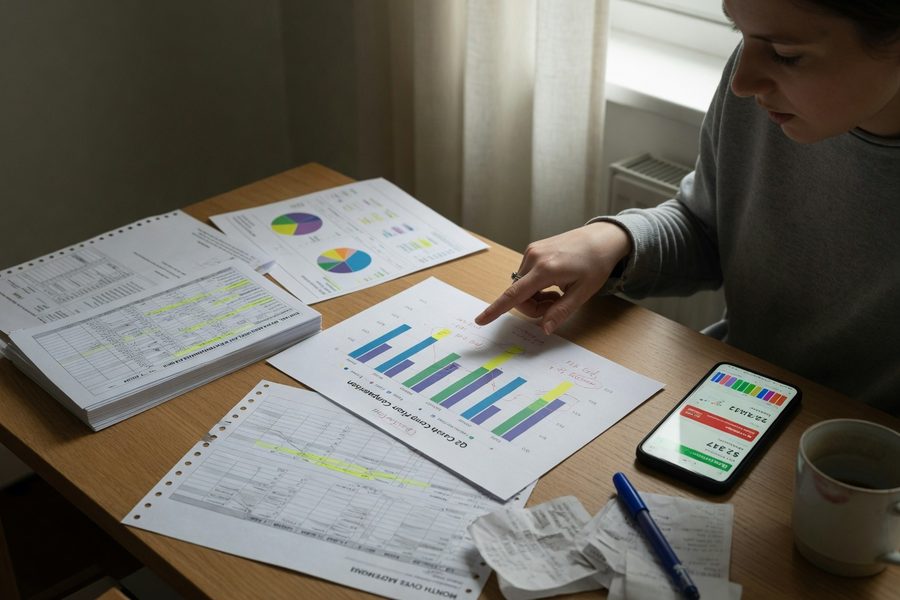
Schedule a recurring 15-minute calendar event on the first of each month to fund your envelopes and review last month’s actuals. Treating the budget review as a fixed appointment, not something you get around to eventually, is the single habit change most associated with long-term system adherence.
Real-World Example: From Cash Envelopes to a Digital System
Consider an illustrative example: a two-income household, combined take-home pay of $5,800 per month, that had used physical cash envelopes successfully for about four months. They were spending $1,100 on rent, $500 on groceries, $300 on gas, $250 on utilities, $400 on dining out, and roughly $800 on various irregular expenses. The system worked until one partner started ordering groceries online and the other began paying for work lunches with a corporate card they reimbursed monthly. The physical envelopes stopped reflecting real spending, and within six weeks the couple stopped maintaining them entirely.
They switched to Goodbudget’s free tier, which gave them 10 shared envelopes accessible from both phones. Rather than syncing bank accounts, they agreed on a daily “receipt entry” habit, 90 seconds each evening to log that day’s purchases. Fixed envelopes for rent, utilities, and insurance were funded automatically on payday via scheduled transfers. Variable envelopes for groceries, gas, dining, personal care, entertainment, and a miscellaneous buffer were funded manually each month. The system took about 45 minutes to set up and about 10 minutes per week to maintain thereafter.
At the three-month review, the data showed their dining envelope was consistently running out by the 20th of each month, suggesting they had allocated $400 to a category that actually required $520. Rather than a discipline problem, it was a measurement problem. They reduced the entertainment envelope by $80 and the personal care envelope by $40 to reallocate $120 to dining, a decision they made calmly with real data rather than in the moment of an overspend.
By month six, the household had accumulated $1,440 in a sinking fund envelope for annual car registration and insurance renewals, categories that had previously arrived as “surprises” each year. The switch from physical to digital envelopes did not change their income or their spending preferences; it restored the visibility the cash system had provided, in a format compatible with how they actually spent money in 2026. The annual cost to them: $0, on Goodbudget’s free tier.
Your Action Plan
-
Audit three months of actual spending
Pull bank and credit card statements for the past three months and categorize every transaction by type: housing, food, transportation, utilities, debt payments, entertainment, personal care, and miscellaneous. Calculate the monthly average for each. This data is the foundation of realistic envelope amounts, estimates without data almost always undercount variable categories by 20% or more.
-
Choose your tool based on privacy and automation preferences
For a free, privacy-first solution with shared access for two people, start with Goodbudget’s free tier. For full automation and comfort with bank sync, YNAB or a similar connected app fits better. Technically comfortable users who value data ownership above all will find Actual Budget’s self-hosted version costs nothing and keeps data entirely local. Do not over-engineer the choice, any system you will actually use consistently beats a perfect system you abandon in 60 days.
-
Build your initial envelope list (8-12 categories maximum)
Start with fewer envelopes than you think you need. Essential fixed expenses get their own envelopes. Variable spending categories should be broad at first, “food” rather than separate “groceries” and “dining” envelopes, and can be split later once you have two or three months of data. A simpler system gets maintained; a complex one gets abandoned.
-
Identify and create sinking fund envelopes
List every non-monthly expense you can predict from the past 12 months: car registration, insurance premiums, holiday gifts, annual software subscriptions, medical deductibles. Divide each by 12 and add that amount to the corresponding sinking fund envelope monthly. These are the categories most often treated as financial emergencies; converting them to planned monthly contributions is one of the highest-leverage changes in the entire system.
-
Fund envelopes on payday, fixed ones first
On every payday, allocate to fixed envelopes first: rent, utilities, insurance, minimum debt payments. Then allocate to variable envelopes with whatever remains. With variable income, fund only essential envelopes from the first income of the month and hold discretionary allocations until you know the month’s full income. Set up automatic transfers to savings or sinking fund sub-accounts where your bank supports it.
-
Schedule a weekly 10-minute review
Every week, reconcile any uncategorized transactions, check which envelopes are running low, and make intentional reallocation decisions if needed. This weekly habit is what separates households that maintain the system for years from those that abandon it after two months. Put it on your calendar as a recurring appointment and treat it as non-negotiable.
-
Conduct a full quarterly review and recalibrate
After three months, you have real data. Review every envelope: which had consistent surpluses, which ran short, which categories you forgot. Adjust amounts to reflect actual behavior rather than aspirational behavior. This quarterly calibration is when the system becomes genuinely accurate and behaviorally effective rather than just a rough approximation.
-
Connect the system to a specific financial goal
Define a concrete goal the envelope system serves: a $1,000 emergency fund by September, $3,600 in debt eliminated by year-end, or a down payment fund reaching $10,000. Attach a dollar amount and a date. This gives every budget decision a clear purpose and provides measurable progress that sustains motivation past the initial enthusiasm phase. If you are building toward long-term wealth, understanding how to start investing should be the next step once your envelope system is running smoothly and generating consistent monthly savings.
Related reading: refinance mortgage without new appraisal.
Frequently Asked Questions
Is the envelope budgeting method still effective without using physical cash?
Yes, and in many respects a digital implementation is more effective for modern spending patterns. The behavioral mechanism that makes the method work, a visible, finite balance for each spending category, is fully preserved in digital tools. Physical cash adds the friction of tangible depletion, but digital systems replace that with real-time balance displays that function similarly. What matters most is choosing a tool you will actually use consistently and maintaining it at least weekly.
What is the best free option for digital envelope budgeting?
For most households, Goodbudget’s free tier (10 envelopes, 1 account, manual entry) is the most accessible starting point. It does not require sharing bank credentials, works on both iOS and Android, and supports shared access for partners. For technically comfortable users who want full control and zero ongoing cost, Actual Budget’s self-hosted version is the strongest free option with no envelope or account limits.
How is the envelope method different from zero-based budgeting?
The two systems are closely related but not identical. Zero-based budgeting requires that income minus all allocated expenses equals zero, every dollar gets assigned somewhere, including savings and debt payments. The envelope method uses the same logic but adds the specific behavioral constraint that each category has a hard spending limit. YNAB, for example, uses zero-based language while building envelope-style category limits. In practice, most digital envelope apps are zero-based budgeting systems with a visual envelope metaphor layered on top.
Can I use credit cards with a digital envelope system?
You can, provided you pay the full balance monthly without exception. The envelope balance decreases when you charge a purchase, not when you pay the credit card bill. Apps like YNAB handle this with a dedicated credit card payment category that accumulates the amount owed as you spend. Carrying a revolving balance means credit cards do not fit cleanly into envelope logic, and the interest charges will undermine whatever budget discipline the system creates. Addressing existing card debt first is the cleaner approach, and understanding how to negotiate your credit card APR can reduce the cost of that paydown period.
How many envelopes should I start with?
Eight to twelve. New envelope budgeters consistently overestimate how many categories they need. Starting with broad categories, housing, food, transportation, utilities, debt, savings, entertainment, personal, and splitting them later when real data suggests a reason produces better results than beginning with 20 categories and spending more time on administration than on actual budgeting.
Is my bank account data safe with envelope budgeting apps?
This depends heavily on the app. Bank-synced apps like YNAB use aggregators such as Plaid or MX, which require read-only access to your accounts via a secure API. These services are widely used by major financial institutions and are not inherently unsafe, but they do involve sharing credentials with a third party. Manual-entry apps like Goodbudget never touch your bank login at all. Self-hosted options like Actual Budget store data only on your own device. The right trade-off between convenience and privacy is a personal decision that deserves more consideration than most app reviews give it.
How do I handle irregular or variable income with envelope budgeting?
Fund essential envelopes first from whatever income arrives, then allocate to discretionary categories with what remains. Base your essential envelope amounts on your lowest expected monthly income rather than an average or optimistic projection. In strong months, the surplus can be directed to savings envelopes, sinking funds, or debt paydown. This two-tier approach prevents the common failure mode of over-allocating in an optimistic month and scrambling when income comes in lower than expected. Variable-income earners in the gig economy often find that building a one-month income buffer, a cash flow reserve envelope, makes the entire system dramatically more stable.
What happens if I run out of money in an envelope mid-month?
You have two choices: stop spending in that category until the next funding date, or consciously transfer funds from another envelope and reduce that category’s remaining balance. The first option is the intended behavior, it is the friction the method is designed to create. The second is acceptable when genuinely necessary, but should be logged and reviewed at month-end. Repeated transfers from the same envelope are a signal worth acting on, not a normal maintenance routine.
Do envelope budgeting apps help with debt payoff?
They can, by making the minimum payment allocations visible and by building discipline around discretionary spending that frees up money for extra debt payments. The envelope method does not have a built-in debt payoff strategy, it is a spending-control and allocation tool. For households carrying high-interest debt, pairing the envelope system with an explicit debt payoff envelope (funded with any category surpluses) accelerates progress. For more structured guidance on the debt side, exploring credit counseling services alongside a budgeting system can provide both the structure and the accountability needed.
Is there a version of the envelope system that works for small businesses or freelancers?
The envelope concept adapts reasonably well to small business expense categories, marketing, supplies, contractor payments, taxes, but dedicated business bookkeeping software like Wave or QuickBooks handles the additional complexity of invoicing, tax reporting, and profit/loss tracking better than consumer envelope apps. For freelancers managing a personal budget alongside irregular business income, keeping the two systems separate and treating business income as a single deposit that feeds personal envelopes after taxes are set aside is the cleaner structure.
Sources
- Federal Reserve Financial Services, 2025 Findings from the Diary of Consumer Payment Choice
- Federal Reserve Bank of Atlanta, Survey and Diary of Consumer Payment Choice
- FDIC, Deposit Insurance Coverage Overview
- Goodbudget, Envelope Budgeting App (Official Site)
- YNAB, You Need A Budget (Official Site)
- Actual Budget, Open-Source Personal Finance (Official Site)
- Plaid, How Bank Data Aggregation Works for Consumers