Reviewed by the MyFinancial101 Editorial Team
Our Take
The envelope budgeting method is the single best starting system for impulse spenders and first-time budgeters who have tried apps and kept overspending anyway. The behavioral mechanism is real: physical cash creates friction that cards do not, and that friction is what makes the system work. The case against it is equally real: if you shop primarily online, travel frequently, or rely on credit card rewards with genuine payoff discipline, the digital envelope version (YNAB, Goodbudget, EveryDollar) delivers 80% of the benefit at half the inconvenience. Choose cash if you cheat; choose digital if you are honest with yourself.
Budgeting advice has never been more available, yet Bankrate’s 2025 emergency savings report found that 59% of Americans could not cover an unexpected $1,000 expense from savings. That gap between knowing what to do and actually doing it is exactly the problem the envelope budgeting method was designed to close, not by adding more information, but by changing the physical experience of spending money.
This guide is for anyone who has downloaded a budgeting app, stared at the charts, and still overspent on dining out by $200. What makes the envelope method work is also what makes it inconvenient, and understanding that tradeoff is what lets you adapt it to your actual life rather than abandon it by week three.
Key Takeaways
- Only 55% of U.S. adults had three months of emergency savings, down from a high of 59% in 2021, according to the Federal Reserve’s 2024 SHED report, a gap the envelope method directly targets by making savings a funded category, not an afterthought.
- Housing consumes 33% of average U.S. household spending, per Bureau of Labor Statistics data via WalletHub, fixed costs like rent go on autopay, not in envelopes; the envelope method works best on the variable 67%.
- 86% of Americans say they keep a monthly household budget in 2025, down from roughly 90% in 2024, according to Debt.com’s 2025 annual budgeting survey, but keeping a budget and sticking to one are different things entirely.
- Research from MIT and the University of Toronto shows people spend meaningfully more when paying by card than cash, with some studies finding the gap as large as 100% in certain spending categories, the behavioral engine the envelope system runs on, not folk wisdom.
- In our experience helping readers set up their first budget, the number-one failure point is not the method itself but funding too many envelope categories in month one. Starting with 3 to 5 envelopes dramatically improves the odds of reaching month two.
What Is the Envelope Budgeting Method, and Why Does It Actually Work?
The envelope budgeting method is a cash-based spending system where you divide your take-home income into labeled envelopes, one per spending category, and stop spending in that category when the envelope is empty. No app, no accounting degree, no retroactive guilt about last Tuesday’s takeout order.
The psychological edge over tracking apps is the key distinction that most beginner guides skip over entirely. Apps like Mint, Personal Capital, or even the budgeting tools built into Chase Online Banking show you where your money went after the fact. The envelope method forces you to allocate money before you spend it. That shift from reactive to proactive is the whole game.
The behavioral mechanism behind this is well-documented. Research cited by MIT’s Sloan School and University of Toronto academics consistently shows that paying with physical cash triggers a measurable “pain of payment” that cards simply do not produce. When you hand over a $50 bill for groceries, your brain registers a loss in a way that tapping a card at checkout does not. That friction is not a bug in the system. It is the system.
What I see in practice: Readers who switch from apps to cash envelopes almost always report the same thing in the first week: they were genuinely surprised by how fast a grocery envelope empties. Not because they changed their spending, but because they finally felt it in a way that a notification on their phone never produced.
The enduring appeal of the method comes down to a simple principle that Ramsey Solutions has long described as the heart of the system: telling your money where to go before the month begins, so you are not left wondering where it went once it is gone. That forward allocation logic is what separates the envelope method from passive expense tracking.
One honest clarification that most beginner guides miss: you do not need to run every dollar through a physical envelope. Fixed expenses like rent, insurance, and loan payments belong on autopay, not stuffed in paper. The envelope method earns its full benefit on variable, discretionary spending: groceries, dining, gas, entertainment, personal care. That is where the overspending actually lives for most households.
Cash Envelopes vs. Digital Envelopes: Which Version Should You Actually Use?
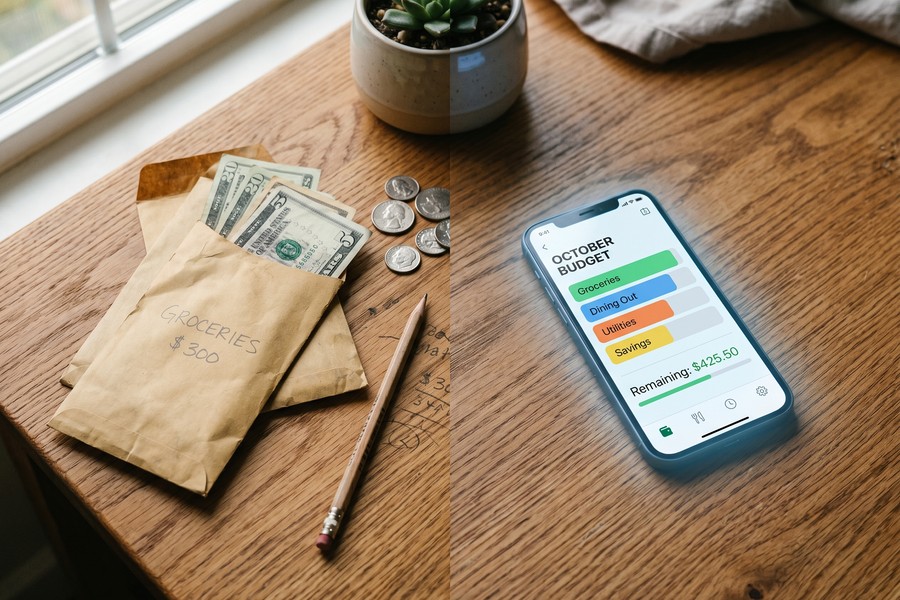
Use physical cash envelopes if you are an impulse spender or have failed at budgeting apps before. Use a digital envelope app if your spending is primarily online or you travel frequently and carrying cash is genuinely impractical. Use a hybrid approach, autopay for fixed bills and cash envelopes for discretionary variable spending, if you want the behavioral benefits without the full inconvenience.
Those are the three real formats. Here is what the comparison actually looks like:
| Format | Best For | Pain of Payment Effect | Effort Level |
|---|---|---|---|
| Physical Cash Envelopes | Impulse spenders, first-time budgeters | High, cash loss is viscerally felt | High: ATM trips, counting change, no online use |
| Digital Envelope App (YNAB, Goodbudget, EveryDollar) | Online shoppers, frequent travelers | Low to moderate, depends on self-discipline | Moderate: setup time, no cash handling |
| Hybrid (autopay fixed, cash for variable) | Most practical starting point for beginners | Moderate to high, cash used where it counts most | Moderate: fewer envelopes, fewer ATM trips |
What you actually lose when going fully digital is worth naming directly. Prudential’s financial education resources note that digital variations preserve the allocation logic but the tactile experience is different. That difference matters more for some people than others. Digital envelope users need to compensate with a strict rule: the card balance tied to any envelope category gets paid in full, monthly, without exception. Without that discipline, the system becomes a more elaborate version of the same app you were already ignoring.
The TikTok-era resurgence of “cash stuffing,” essentially the envelope method rebranded for a new generation, reflects something real. Younger, digitally-native budgeters are choosing analog tools deliberately, not because they lack access to apps like SoFi’s budgeting features or Experian’s spending insights, but because the physical act of handling cash provides something screens do not. If you find yourself in that camp, lean into it. The method works precisely because it is slightly inconvenient.
How to Set Up Your First Month of Envelope Budgeting
Start with your net take-home pay, separate your fixed and variable expenses, and fund no more than five envelopes in month one. Over-engineering this on day one is the fastest way to quit by day ten.
The Exact Setup Sequence
Step one: calculate your actual monthly take-home pay after taxes, not your gross salary. This is the only number that matters for envelope funding. Step two: list your fixed expenses, rent or mortgage, car payment, insurance premiums, subscription services, minimum loan payments, and put those on autopay. They do not get envelopes because they do not vary month to month and there is no behavioral spending decision to make.
Step three: identify your variable spending categories and pull three to six months of actual bank or card statements to see what you have genuinely been spending. Guessing your grocery spend will produce a wrong number; your statements will not lie. Step four: create envelopes only for those variable categories, withdraw the cash, and label each envelope. The InCharge Debt Solutions envelope budget guide recommends starting simple: groceries, dining out, gas, personal care, and entertainment cover the majority of discretionary overspending for most households.
When reviewing your statements, pay attention to your debt-to-income ratio (DTI) as well. If minimum payments on credit cards or personal loans are consuming more than 15% of your take-home pay, the envelope method alone will not fix the underlying math. That is a separate problem requiring a separate solution.
The Bi-Weekly Paycheck Problem (and How to Solve It)
Most guides assume a single monthly paycheck. If you are paid bi-weekly or semi-monthly, the mechanics shift. The practical approach: divide each envelope’s monthly allocation in half and fund it from each paycheck rather than attempting to fund all envelopes at once on paycheck one. For a $400 monthly grocery envelope, that means withdrawing $200 on the 1st and $200 on the 15th. This prevents the common trap of spending the full envelope in the first two weeks and scrambling for the last ten days of the month.
One category mainstream guides consistently ignore is monthly subscriptions. Streaming services, gym memberships, and software subscriptions are neither classic fixed bills nor cash-envelope variable expenses; they are automatic charges that vary in emotional category from month to month. The cleanest solution: treat subscriptions as a fixed expense line item (they go on autopay and do not get a physical envelope), but review them quarterly as part of your budget audit. If you are carrying subscriptions you forgot you had, our piece on what your library gives free offers some practical alternatives worth checking before auto-renewing.
Where this gets tricky: The most common month-one mistake we see is trying to fund twelve different envelope categories simultaneously. The system feels bureaucratic, the withdrawal amounts are odd, and people give up. Three envelopes that you actually maintain will beat twelve that you abandon by the second week every single time.
What to Do When an Envelope Runs Out Before the Month Ends
Running out of an envelope early, especially in month one, is normal and genuinely useful information. It tells you exactly where your actual spending diverges from your plan. Treat it as data, not failure.
When an envelope empties before the month ends, you have three legitimate options. First, stop spending in that category until the month resets. This is the strictest version and the most effective for impulse spenders. Second, borrow from a lower-priority envelope (entertainment before groceries, not the other way around) and track the transfer honestly. Third, tap a small pre-funded miscellaneous envelope, typically $50 to $100 per month, designed specifically for this purpose.
Draw a hard line on raiding essential envelopes. Pulling from groceries or gas to cover dining out is a signal the category allocations are wrong, not that the method is failing. Capital One’s budgeting resources describe this diagnostic quality as one of the method’s core strengths: the envelope makes visible, immediately and concretely, exactly which categories are under-funded relative to actual behavior.
If the dining-out envelope is consistently empty by the 20th of every month, one of two things is true: the amount you allocated is genuinely too low given your lifestyle, or the behavior needs to change. The envelope is not causing the problem. It is just making the problem impossible to ignore. That visibility, uncomfortable as it feels in month one, is exactly what most tracking apps fail to deliver.
How to Make Envelope Budgeting Work With Irregular or Variable Income
Budget from your lowest expected monthly income, not your average. Then use an income holding account to smooth out the variation so your envelope fills stay consistent regardless of when client payments arrive.
The Baseline Income Strategy
For freelancers, gig workers, and anyone with variable earnings, identify the lowest monthly income you realistically expect across the year. Fund your envelopes based on that floor amount. Essential expenses are always covered, and you are never counting on a good month to make rent. When a higher-earning month arrives, the surplus goes to an emergency fund or a buffer envelope first, before anything discretionary gets a top-up.
The FDIC recommends that any cash you designate for savings be moved promptly into an insured deposit account rather than held at home. A physical savings envelope sitting in a desk drawer earns zero interest and carries real risk if the cash is lost, stolen, or destroyed. Move savings allocations into a high-yield savings account, where FDIC insurance protects balances up to $250,000 per depositor, as soon as they are set aside.
If you are looking for ways to increase your baseline income, our coverage of jobs paying $19 or more per hour in 2026 is worth a read alongside your budget setup.
The Income Holding Account Concept
This is the strategy that most competing guides omit entirely. Deposit all income into a dedicated holding account rather than your spending account. Then pay yourself a fixed “salary” amount each month from that holding account into your operating account, regardless of what came in that month. Your envelope fills stay consistent. The holding account absorbs the timing variation so your budget does not have to.
The Consumer Financial Protection Bureau’s budgeting guidance emphasizes that consistent tracking and forward allocation are the two behaviors most correlated with people successfully sticking to a budget, which is precisely what the holding account approach enables for variable earners. The CFPB also notes that budgeters who review their spending at least monthly are significantly more likely to meet their savings targets than those who check in less frequently.
One thing to resist: redoing the entire budget every time a paycheck arrives. Review and adjust allocations once at month-end, after you can see the full picture. Mid-month budget revisions almost always lead to overspending disguised as replanning.

Where This Recommendation Falls Short
The envelope budgeting method is not for everyone, and pretending otherwise would be dishonest.
The strongest case against it starts with the practical reality of modern spending. A significant and growing share of daily transactions, fuel at the pump, online grocery orders, streaming services, e-commerce purchases, cannot be completed with physical cash. For households where the majority of variable spending happens online or through automatic charges, a pure cash envelope system is not just inconvenient. It is operationally unworkable.
The drawback is not just logistical. Carrying meaningful amounts of cash introduces real risk. Cash lost to theft, a fire, or simply misplaced at home is gone with no recourse: no fraud protection, no purchase dispute process, none of the consumer protections that come with a debit or credit card issued by Chase, SoFi, or any FDIC-insured institution. Savings allocations kept in a physical envelope are particularly vulnerable; that cash earns zero interest and sits exposed. Any money you are designating as savings should be transferred immediately to a high-yield savings account. Keeping a $300 savings envelope in your desk drawer for three months instead is a small but genuine cost that adds up over time.
The catch for credit card reward earners is real, too. Someone who legitimately pays their full balance every month, earns 2% cash back on all purchases, and has never once carried a balance will give up measurable value by switching to cash. For that person, a digital envelope app with strict payoff discipline is the smarter choice, and recommending cash envelopes to them would be wrong. The annual percentage rate (APR) on most rewards cards runs between 20% and 28%, so that 2% cash-back advantage evaporates instantly the moment a balance carries. Know which category you are actually in before deciding.
There is also the matter of effort. The envelope method requires consistent manual action: ATM trips, counting change, re-stuffing envelopes at the start of each month. For people who find that friction more annoying than motivating, and some genuinely do, the friction that is supposed to slow spending instead becomes the reason they abandon the system entirely. Self-knowledge matters here more than any rule.
One factor that rarely comes up: the envelope method has no direct effect on your FICO Score. Paying down credit card balances, keeping your credit utilization ratio below 30%, and making on-time payments are what move that number. If improving your credit profile is a goal alongside building a spending habit, those two tracks require separate attention. Experian’s consumer education resources are a reasonable starting point for understanding what actually drives credit score changes.
Finally, the envelope method handles variable discretionary spending well. It adds essentially no value to fixed expenses. If your budget problem is primarily a fixed-expense problem (rent that is too high relative to income, a car payment that is underwater), no amount of grocery-envelope discipline will solve it. The envelope method is a behavioral spending tool, not a financial planning tool. For the underlying math, pairing it with help from a nonprofit credit counselor makes sense for anyone with significant debt alongside a spending habit problem. Our guide to top credit counseling services covers the vetted options.
How We Sourced This
This article draws on verified data from the Federal Reserve Board of Governors’ 2024 Survey of Household Economics and Decisionmaking (SHED, published May 2025), Bankrate’s 2025 Emergency Savings Report, Debt.com’s 2025 Annual Budgeting Survey, and Bureau of Labor Statistics consumer expenditure data as aggregated by WalletHub. Behavioral research citations reference academic work from MIT Sloan and University of Toronto studies on the “pain of payment” and cashless spending effects, which are among the most replicated findings in consumer behavior literature. Institutional guidance was drawn from the Consumer Financial Protection Bureau, Prudential Financial, Capital One, InCharge Debt Solutions (an NFCC-accredited nonprofit), and Ramsey Solutions, each accessed in May 2026. No statistics were invented or extrapolated; figures not available from the verified source list were either cited to named third-party sources or expressed qualitatively.
Frequently Asked Questions
How much cash should I put in each envelope?
Base each envelope amount on three to six months of your actual past spending in that category, not a guess. Pull your bank or credit card statements and calculate your real average. Then, in month one, reduce each discretionary category by roughly 10% to create a small cushion without setting an impossible target.
Can I use the envelope budgeting method without cash?
Yes. Digital envelope apps like YNAB, Goodbudget, and EveryDollar replicate the allocation-first logic of the method without requiring physical cash. You lose some of the behavioral friction that makes cash effective, but you gain the ability to use the system for online purchases and card transactions. Digital works well for disciplined spenders; cash works better for impulse spenders.
What happens if I need to spend money in a category that has no envelope?
Create a miscellaneous envelope funded at $50 to $100 per month specifically for unplanned but legitimate expenses. If you find yourself relying on it constantly, that is a signal to add a dedicated category next month. The miscellaneous envelope is a safety valve, not a slush fund for categories you know you need.
Does the envelope method work for paying off debt?
Yes, and it pairs well with a debt payoff strategy. Create a dedicated “debt payoff” envelope and treat it like any other non-negotiable spending category. The method is particularly effective at freeing up cash from discretionary overspending and redirecting it toward debt. Our breakdown of how to prioritize and negotiate credit card debt covers the payoff sequencing side of that equation.
How do I handle online purchases with the envelope method?
The cleanest approach for online-heavy spenders is the hybrid model: use a dedicated debit card only for the spending categories that go online, track the balance manually against your envelope amount, and treat it as empty when the envelope amount is spent. Never top up the card until the following month’s envelope is funded. Subscriptions should be tracked as fixed-expense autopay items, reviewed quarterly rather than managed as envelopes.
What do I do with money left over in an envelope at the end of the month?
Use surplus in this order of priority: top up your emergency fund first, then accelerate any debt payoff, then roll over to next month’s same category, then direct to a specific savings goal. Do not treat leftover cash as free money to spend outside the budget. A consistent surplus in a particular category is also a signal that the allocation is too high and could be redirected to a higher-priority goal.
How long does it take for the envelope method to work?
Most people see meaningful behavioral change by the end of month two, once the initial category amounts have been corrected based on real month-one data. Month one is almost always imperfect. Think of it as a diagnostic run rather than a success-or-failure test. A 90-day commitment is the minimum useful trial period; three months is enough to reveal your real spending patterns and let you refine the system into something sustainable. If you are also working on building income alongside cutting spending, our overview of the micro-freelancing surge covers accessible ways to add cash flow while the budget resets.
Sources
- Federal Reserve Board of Governors, Report on the Economic Well-Being of U.S. Households in 2024 (SHED): Savings and Investments
- CBS News, Bankrate Emergency Savings Report 2025: 59% of Americans Can’t Cover a $1,000 Expense
- Debt.com, 2025 Annual Budgeting Survey: Best Way to Budget
- WalletHub, Budgeting Statistics (Bureau of Labor Statistics Consumer Expenditure Data)
- Consumer Financial Protection Bureau, How to Create a Budget and Stick With It
- Prudential Financial, Budgeting Envelope Method
- InCharge Debt Solutions, Envelope Budget System: How It Works
- Capital One, What Is the Envelope Budget System?
- Ramsey Solutions, The Cash Envelope System Explained