
Fact-checked by the MyFinancial101 editorial team
Verdict at a Glance
For a first‑time buyer with a credit score below 660, the FHA loan is the stronger choice, it accepts scores down to 580 with just 3.5% down and carries a lower monthly insurance premium at low scores. Choose a conventional loan instead if your score clears 660 and you can put down at least 5%, because private mortgage insurance cancels once you reach 20% equity, saving tens of thousands over the life of the loan.
The “FHA vs conventional loan first time buyer low credit” question isn’t about which loan is better in the abstract, it’s about which loan actually opens the door at your credit score. An FHA loan insures the lender against loss, which lets it approve buyers with scores as low as 500, while a conventional loan typically requires a 620 score and punishes lower scores with much higher private mortgage insurance. In fiscal year 2024, over 82% of FHA forward purchase endorsements, more than 498,000 mortgages, went to first‑time homebuyers, making the program the dominant on‑ramp for this group.
The single factor that swings the choice most is your middle credit score. Pull a tri‑merge report from all three bureaus, and the middle of those three numbers will decide not just which loan you can get, but what you’ll pay for years afterward. If that number lands under 620, conventional is unlikely even with recent program changes; above 660, the math starts to tilt away from FHA. Every 20‑point band reshapes both the qualification odds and the long‑term cost.
| Attribute | FHA Loan | Conventional Loan |
|---|---|---|
| Minimum credit score | 580 for 3.5% down; 500–579 at 10% down | 620 typical; as low as 600 with compensating factors on HomeReady/Home Possible |
| Down payment | 3.5% (with 580+), 10% (500–579) | 3% (HomeReady/Home Possible); 5% standard |
| Upfront mortgage insurance | 1.75% of loan amount rolled into the loan | None |
| Annual insurance premium | 0.55% of loan balance (typical); lasts life of loan unless 10%+ down | PMI typically 0.58%–1.86% of loan amount, based on credit score; cancels at 20% equity |
| Maximum DTI | Up to 57% with strong compensating factors | Typically 45%; 50% possible but harder to get |
| Waiting period after Chapter 7 bankruptcy | 2 years | 4 years |
| Appraisal requirements | Strict, HUD Minimum Property Standards; safety/repair issues must be fixed | Standard appraisal; fewer required repairs |
| Gift funds allowed | Yes, with documentation | Yes, with documentation |
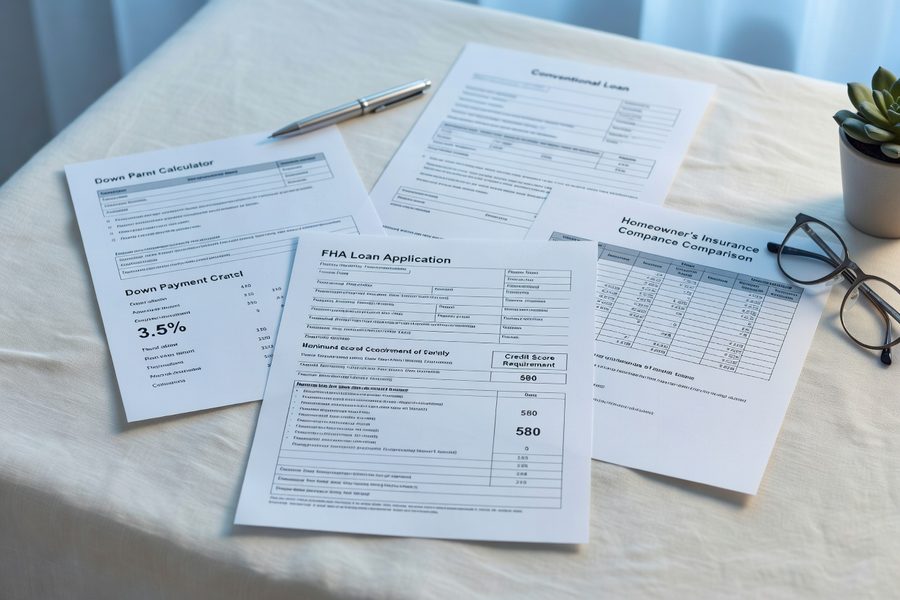
FHA vs Conventional Loan First Time Buyer Low Credit: The Score That Separates the Two
For anyone with a credit score below 620, the FHA loan is almost always the only realistic option. FHA’s baseline is 580 for a 3.5% down payment, and it will even go down to 500 if you bring 10% to the table, though every lender adds its own overlay, and many won’t touch scores below 620 without strong compensating factors. On the conventional side, Fannie Mae’s removal of the hard 620 floor for certain programs in late 2025 opens the door for borrowers in the 600–619 range, but those approvals remain exceptions, not the norm.
“If you have a lower credit score, try first to get over 580, which is the bare minimum for an FHA loan,” notes Aaron Brown, Loan Officer at New American Funding. Even that threshold can feel out of reach, but the difference between 578 and 582 can determine the size of the down payment you need and the lender’s willingness to look at your file at all. The middle score on your tri‑merge credit report is the one that counts, and if you or a co‑borrower has a lower middle score, the loan is priced to that weaker number.
In fiscal year 2025, the share of first‑time homebuyers among FHA’s forward purchase endorsements climbed to more than 83%, confirming that the program remains the primary tool for buyers who haven’t built a premium credit file yet. And FHA served a broad cross‑section: 31.66% of FHA’s forward mortgages in fiscal year 2024 went to borrowers who self‑identified as people of color.
How Much Cash Will You Really Need at the Closing Table?
FHA’s 3.5% down payment sounds small, but closing costs push the upfront cash higher; conventional loans can actually go as low as 3% through Fannie Mae HomeReady and Freddie Mac Home Possible, making the down payment gap nearly invisible, provided your credit score qualifies. On a $300,000 home, 3% down is $9,000, while FHA’s 3.5% is $10,500. Add the FHA upfront mortgage insurance premium of 1.75% (rolled into the loan, but still a cost) and closing costs of roughly 2%–5%, and the total cash‑to‑close on FHA can be surprisingly close to what a conventional buyer puts down.
The bigger wildcard is where the money comes from. Both loan types accept gift funds, but if you’re tapping an IRA or using a state‑sponsored down payment assistance program, FHA’s rules tend to be more forgiving. Many first‑time buyer programs pair better with FHA because of its lower credit floor, and some will even let you finance the upfront mortgage insurance into the loan while using a standalone grant toward the down payment. Before you apply, focusing on debt reduction can make a difference, negotiating a lower APR on your credit cards can free up cash that directly adds to your down payment reserve.

The Mortgage Insurance Trap, and When FHA’s Lower Premiums Actually Win
FHA charges an upfront MIP of 1.75% and an annual premium of 0.55% of the loan balance that, for a borrower putting down less than 10%, stays for the life of the loan. Conventional PMI, on the other hand, cancels automatically once your equity hits 20%. But for a low‑credit buyer, PMI can cost far more per month than FHA’s MIP, sometimes triple, because conventional insurers price the risk aggressively at scores below 660. On a $280,000 home with 3.5% down at a credit score of 600, FHA’s annual MIP works out to roughly $126 per month, while conventional PMI for the same property with 3% down at 600 might run close to $290 per month.
Over five years, the math hands the advantage to FHA: cumulative insurance costs total about $7,560 for FHA versus roughly $17,400 for conventional, even after accounting for FHA’s upfront premium. But the pendulum swings if you hold the loan for the long term. Once the conventional buyer reaches 20% equity, typically around year 10 with normal appreciation and amortization, the PMI drops off, while the FHA borrower continues paying MIP every year. The break‑even point where the cumulative lower FHA premium no longer offsets its lifetime MIP sits somewhere between years 10 and 14, depending on interest rates and home price growth. If you expect to refinance or move before year 10, FHA’s cheaper insurance can’t be ignored; if you plan to stay decades, conventional becomes the better value, but only if you can qualify.
Bankruptcy, Foreclosure, and Other Credit Scars That Change the Equation
FHA’s waiting periods after a serious credit event are dramatically shorter than conventional’s, a 2‑year wait after a Chapter 7 bankruptcy discharge versus 4 years, and 3 years after a foreclosure versus 7 years. For a first‑time buyer with a major derogatory mark but otherwise stable finances, FHA is not just the cheaper route, it’s often the only route until those waiting periods lapse.
When High Debt and Low Credit Collide: DTI, Reserves, and Manual Underwriting
FHA wins decisively on debt‑to‑income flexibility. With compensating factors, such as documented rent payment history, a steady job for at least two years, and at least two months of cash reserves, FHA can approve a DTI as high as 57%. Conventional lenders, by contrast, rarely stretch beyond 45% and demand strong credit scores to go even that high. If you carry student loan debt or an auto loan that pushes your back‑end ratio above 45%, FHA’s willingness to look at the full picture becomes the deciding factor.
Amber Ernst, Loan Officer at New American Funding, says, “Work with a lender that offers manual underwriting. Many don’t. Lower scores often require a bit more digging.” Manual underwriting lets a human weigh compensating factors, a rental payment record that’s spotless for 24 months, a healthy savings account, or overtime income that automated systems might discount, and can salvage an FHA application when the credit score alone would reject it. Working with a reputable credit counseling service before you apply can also help correct errors that artificially suppress your score, giving you a stronger starting point for either loan type.
FHA’s serious delinquency rate stood at 4.15%, more than double conventional’s, which is why lenders overlay tougher rules of their own, but also why the program tolerates riskier files.
When the FHA Loan Is the Better Choice
FHA leads whenever a credit score, a high debt load, or a recent derogatory event would shut down a conventional application. It’s the smarter choice when:
- Your middle credit score is below 660, and especially below 620, conventional PMI at those scores erases any cancellation advantage.
- You can only afford a 3.5% down payment and don’t have access to a conventional 3% program because of income or score limits.
- Your DTI sits between 45% and 57% and you have compensating factors like 6+ months of reserves or a perfect rent payment history.
- You’ve been through a Chapter 7 bankruptcy discharged less than 4 years ago, or a foreclosure less than 7 years ago.
- You expect to sell or refinance within 10–12 years, long before FHA’s lifetime MIP becomes a heavier burden than conventional PMI cancellation.
When a Conventional Loan Is the Better Choice
Conventional wins when a stronger credit profile makes private mortgage insurance cheap and cancelable, and when the property or market conditions favor a standard appraisal. Pick conventional when:
- Your credit score exceeds 660 and you can put down at least 5%, PMI premiums at that level will be competitive and eventually disappear.
- You’re buying in a high‑cost county where the conventional conforming limit of $832,750 (or up to $1,249,125) far outstrips the local FHA ceiling, saving you from a jumbo loan.
- You’re bidding on a home in a competitive market where sellers view FHA inspections as a risk; a conventional offer with a pre‑approval can edge out FHA buyers.
- The property is older or has minor condition issues, conventional appraisals are less likely to flag cosmetic problems that HUD standards might require fixing.
- You plan to own the home for 12+ years and want to shed mortgage insurance permanently without refinancing.
| Criterion | FHA Loan | Conventional Loan |
|---|---|---|
| Credit score flexibility | 5 / 5 | 3 / 5 |
| Down payment minimum | 4 / 5 | 5 / 5 (as low as 3%) |
| Mortgage insurance short‑term cost | 5 / 5 | 2 / 5 (high PMI at low scores) |
| Mortgage insurance cancelability | 2 / 5 | 5 / 5 |
| DTI flexibility | 5 / 5 | 3 / 5 |
| Appraisal/property standards | 3 / 5 | 5 / 5 |
| Overall accessibility for low‑credit first‑time buyers | Winner |
If you have a lower credit score, try first to get over 580, which is the bare minimum for an FHA loan.

Frequently Asked Questions
What credit score do I need for an FHA loan in 2026?
The official FHA floor is 580 for a 3.5% down payment; between 500 and 579 you need 10% down. Most lenders, however, impose overlays that require at least 620 unless you have compensating factors like hefty reserves or manual underwriting.
Can I get a conventional loan with a 600 credit score?
It’s possible, especially through Fannie Mae HomeReady or Freddie Mac Home Possible, which no longer enforce a hard 620 floor on all applications. But at 600 you’ll face higher PMI rates, often above