Fact-checked by the MyFinancial101 editorial team
Quick Answer
Grocery store overspending is not a willpower problem, it is an engineering problem. Stores use layout design, eye-level product placement, oversized carts, and sensory cues to drive unplanned purchases. To fight back, build a meal-based list before you shop, set a firm dollar budget, stick to the store perimeter, and consider curbside pickup or discount grocers. Most households can cut $50–$150 per month with consistent habits.
Most people leave the grocery store having spent more than they planned. That is not an accident. Grocery store overspending is a predictable outcome of store design, layouts engineered at every turn to maximize the number of products you see, touch, and drop into your cart before reaching the register. According to Food Marketing Institute (FMI) 2024 data, the average supermarket carries 31,795 items across a 42,453 square-foot floor plan, and shoppers spend an average of $45.70 per transaction. Every inch of that floor plan is working against your budget.
The problem is sharper now than it was five years ago. Food-at-home inflation has remained stubbornly elevated into 2026, running above 3% on a sustained basis since the pandemic era. That means every unplanned item added to your cart costs more than it once did, and the layout tricks that encouraged impulse buying in cheaper times carry a higher price tag today. The average American household spends somewhere between $500 and $800 per month on groceries, with unplanned purchases easily adding hundreds of dollars annually.
This guide is for anyone who wants to understand exactly how stores are designed to extract more money from you, and how to build habits that counter those tactics trip by trip. You do not need perfect discipline. You need a better system.
Key Takeaways
- The average supermarket carries 31,795 items across 42,453 square feet, according to FMI’s 2024 industry data, every item placed with margin in mind.
- In-store grocery shoppers spent an average of 23.4 minutes per trip in 2024, according to JLL’s Grocery Tracker, enough time to encounter thousands of strategically positioned products.
- Store brands cost 15–25% less than name brands with comparable quality in many categories, according to Consumer Reports, making brand loyalty one of the costliest habits in the grocery aisle.
- Grocery store foot traffic reached nearly 17.2 billion visits in 2024, per JLL citing Placer.ai data, making grocery retail one of the highest-traffic consumer environments in the country.
- Households that switch staples to discount grocers like Aldi or warehouse clubs can cut per-unit costs by 20–40% on core items, a meaningful buffer against sustained food inflation.
- Building a list and sticking to it before entering the store is among the highest-leverage single habits, USDA’s Nutrition.gov confirms that planning ahead helps shoppers save money and choose healthier options simultaneously.
In This Guide
- Step 1: Why Grocery Stores Engineer Your Path to Spend More
- Step 2: The Specific Tricks That Quietly Inflate Your Bill
- Step 3: How Much Grocery Overspending Actually Costs You
- Step 4: Build a Bulletproof Shopping List Before You Leave Home
- Step 5: Navigate the Store Without Falling for the Traps
- Step 6: Smart Alternatives That Cut Overspending at the Source
- Step 7: Track Results and Adjust for Long-Term Control
- Frequently Asked Questions
Step 1: Why Grocery Stores Engineer Your Path to Spend More
Here is what most budget advice misses: the grocery store is not neutral ground. It is a precision-engineered retail environment, designed by category managers, behavioral scientists, and retail architects whose sole metric is dollars per square foot. According to FMI’s 2024 data, supermarkets generate $18.55 in weekly sales per square foot of selling area. That number does not happen by accident.
The Layout Psychology Behind Every Aisle
Produce appears at the entrance of almost every major grocery chain. That placement is deliberate: filling your cart with fresh vegetables early creates a “health halo” that makes shoppers feel virtuous enough to indulge later. Essentials like dairy, eggs, and meat are positioned at the back of the store, forcing a longer walk through thousands of impulse products to reach what you actually came for. The path from entrance to eggs is not a convenience, it is exposure time.
Right-hand dominance also shapes how stores are built. Studies on shopper behavior consistently show that 70–90% of shoppers drift right and scan products on their right side first. Stores exploit this by placing higher-margin items on the right side of aisle displays and at the end of aisles (called end caps), where dwell time is highest. You are not browsing, you are being guided.
What to Watch Out For
The maze-like design of many traditional supermarkets is intentional. Fewer straight sight lines mean more time spent navigating, more products in your field of vision, and more opportunities to pick up something unplanned. Discount grocers like Aldi use a radically different model: smaller footprints, fewer SKUs, and a linear layout. That design difference is a core reason shoppers tend to leave discount stores closer to their original budget.
Grocery store foot traffic reached nearly 17.2 billion visits in 2024, according to JLL citing Placer.ai. With the average shopper spending $45.70 per transaction, even a 10% reduction in unplanned purchases across the country adds up to billions in reclaimed household dollars.
Step 2: The Specific Tricks That Quietly Inflate Your Bill
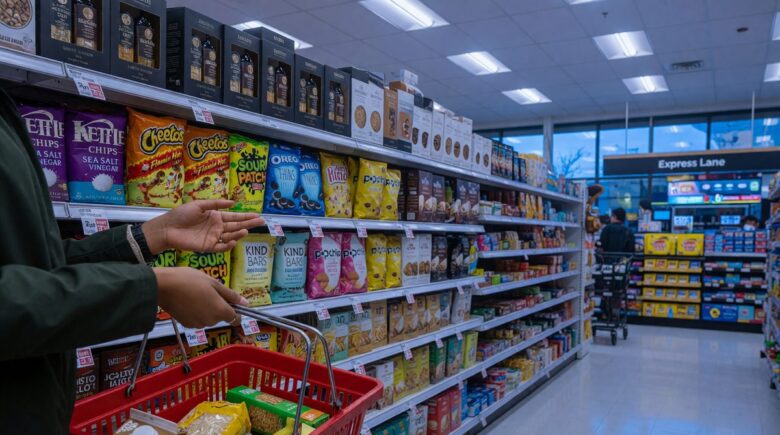
Eye-level placement is the most valuable real estate in retail, and grocery stores charge brands a premium to be there. What sits at eye level is almost never the best value, it is the highest-margin product the store or brand could negotiate into that spot. Budget and store-brand alternatives are almost always on the bottom shelf, below knee height, where most shoppers never look.
Cart Size, Aromas, and Fake Sales
Oversized carts are a studied tactic. Research on shopping cart psychology consistently shows that shoppers fill a larger cart to a similar visual “fullness” as a smaller one, meaning a bigger cart prompts more buying to avoid the sensation of an empty basket. Bakeries are placed near entrances or high-traffic zones because freshly baked bread aromas trigger hunger responses and purchase intent, even in shoppers who had no intention of buying baked goods.
Checkout lane temptations are the final funnel. Low-cost, high-margin items, candy, magazines, gum, energy drinks, are stacked at register queues where you have nothing to do but wait and look. And “sale” signage deserves scrutiny: bold red tags reading “3 for $5” are often no cheaper per unit than the regular price. The number anchors you into buying three when you needed one. With food-at-home prices still elevated in 2026, that kind of anchoring costs more than it did three years ago.
What to Watch Out For
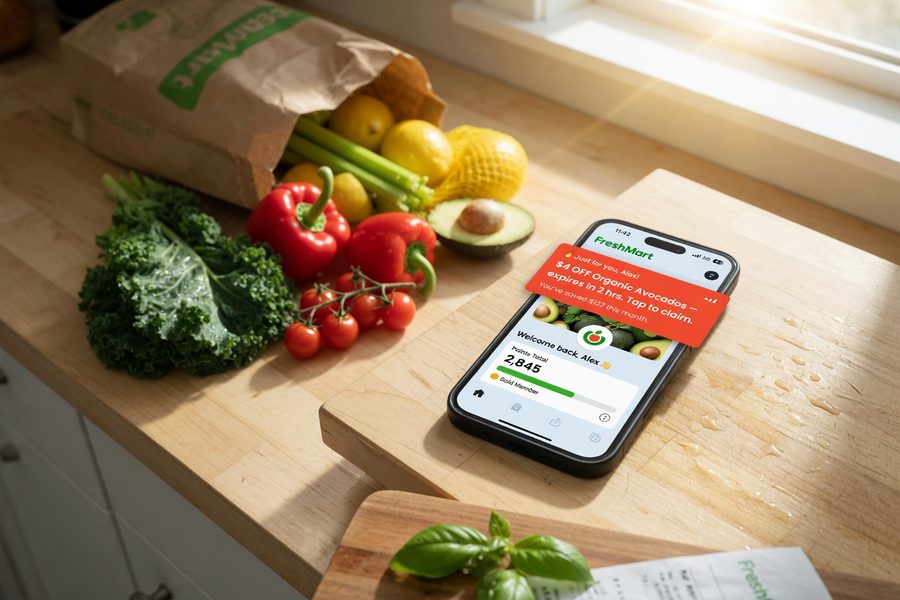
Loyalty apps have added a new layer to these tactics. Push notifications and personalized digital deals from apps like Kroger’s loyalty program or Safeway’s Just for U are trained on your purchase history to surface items you are likely to buy, including upgrades and add-ons you were not looking for. A coupon for a product you would not have bought otherwise is not savings; it is a discounted impulse purchase. For more on stacking real savings versus chasing deals, see how coupon stackers are beating inflation with a more disciplined approach.
“Buy one, get one” and multi-unit pricing deals often require you to buy more than you need to realize the savings. Always calculate the per-unit price before loading extras into your cart. If you would not have bought the second item at full price, you have not saved anything.
Step 3: How Much Grocery Overspending Actually Costs You
Small overages compound fast. Consider a household that spends $600 per month on groceries but consistently adds $50 in unplanned purchases per trip on two weekly visits. That is $100 per month, or $1,200 per year, spent on items that were not part of the plan. Against a sustained food inflation rate above 3%, that unplanned spending grows in real cost every year.
The USDA publishes monthly food plan benchmarks by household size. For a family of four on the “moderate-cost plan,” the 2024 target was approximately $1,200–$1,300 per month. Many households in that bracket routinely exceed that figure not because of genuine need, but because of the accumulated effect of layout tactics, impulse additions, and brand-name loyalty. Cutting even 10% through deliberate habits is worth $1,440 annually. That is a real number, enough to meaningfully contribute to an emergency fund or reduce credit card debt that is crushing household budgets across income levels.
Store brands cost 15–25% less than name brands with comparable quality in many categories, according to Consumer Reports. On a $600 monthly grocery budget, switching half your name-brand purchases to store equivalents could save $45–$75 per month, or up to $900 per year.
Step 4: Build a Bulletproof Shopping List Before You Leave Home
A shopping list is the single highest-leverage tool against grocery store overspending. Not because it requires discipline, but because it shifts decision-making from inside the store to outside it. USDA’s Nutrition.gov states directly: “Making a plan before heading to the store can help you get organized, save money, and choose healthy options.” That applies whether you are feeding one person or a family of five.
How to Do This
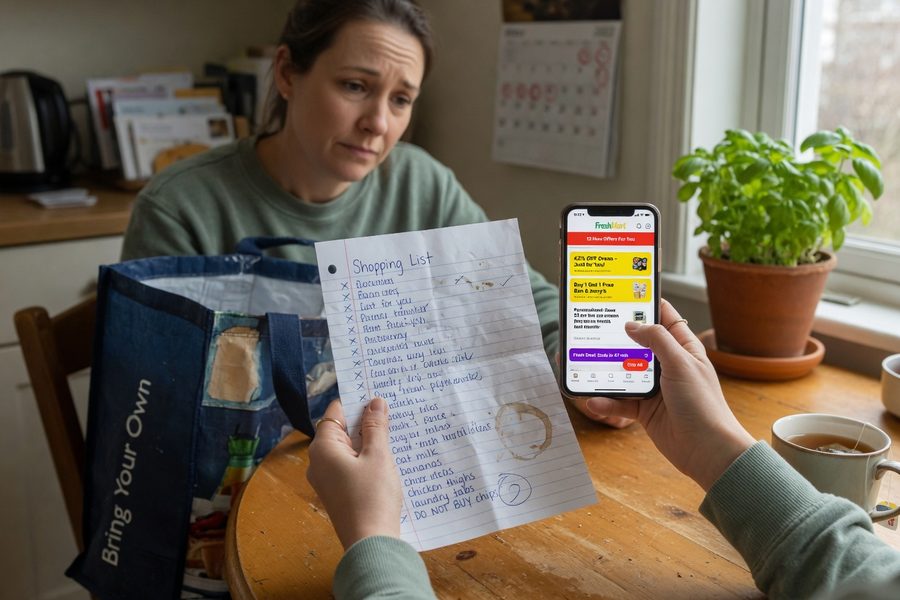
Start by auditing what you already have. Check your pantry, fridge, and freezer before writing a single item down, buying a second jar of pasta sauce because you forgot you already had one is a quiet but common drain. Then plan meals for the week based on what is already in the house plus what you need to add. Cross-reference that plan with your store’s weekly circular or digital app (most major chains post sales online) to build around discounts rather than paying full price for everything.
Write your list organized by store section: produce, protein, dairy, dry goods, frozen. Moving through sections in order reduces backtracking and limits the wandering that stores count on. Set a dollar budget before you go, not after. Tools like the USDA’s food cost guidelines can help you calibrate a realistic weekly target by household size.
What to Watch Out For
Store apps offer genuine digital coupons but are also designed to surface personalized promotions for items not on your list. Clip only the coupons for items you had already planned to buy. Opening the app inside the store is a higher-risk behavior than reviewing it at home; the in-store environment is designed to amplify every suggested purchase. For households looking to cut spending across the board, it is also worth exploring whether SNAP benefits or other food assistance programs could offset grocery costs during tighter months.
Organize your shopping list by aisle or store zone, not by category. A list that mirrors your store’s physical layout lets you move through once without doubling back, and doubling back is exactly when unplanned items end up in the cart.
Step 5: Navigate the Store Without Falling for the Traps
Sticking to the store’s perimeter handles most grocery runs. The outer ring of a traditional supermarket is where produce, meat, dairy, and bakery live, the whole foods that make up the bulk of most healthy shopping lists. The center aisles house processed foods, snacks, and high-margin packaged goods. If your list does not require center-aisle items, skip them entirely.
How to Do This
Shopping with cash or a pre-loaded debit card set to your exact budget is one of the most effective behavioral constraints available. When the money runs out, the trip ends. That friction is the point. In-store grocery shoppers spent an average of 23.4 minutes per trip in 2024, according to JLL, enough exposure time for dozens of unplanned decisions. Entering with a tight list and a firm cash limit compresses that decision space.
Timing also matters. Shopping during peak hours, weekend afternoons, weekday evenings, means more in-store promotions running, more product samples, and more sensory stimulation designed to slow you down. Midweek mornings tend to be quieter, faster, and lower-pressure. Never shop hungry; that is not a cliché but a physiologically real problem. Hunger reliably increases purchase volume and shifts buying toward higher-calorie, higher-margin foods.
What to Watch Out For
Accepting every free sample is a minor but consistent drain. Samples exist because they work, tasting a product increases purchase probability significantly. Declining politely costs nothing. The same logic applies to promotional end caps: items stacked at the end of an aisle look like deals because of their placement and volume, not because of their price. Check the shelf tag before assuming.
| Shopping Approach | Avg. Unplanned Spend Risk | Best For | Key Trade-Off |
|---|---|---|---|
| In-Store with List + Cash | Low ($5–$15/trip) | Budget-focused shoppers who want full product control | Requires time and planning; cash can be inconvenient |
| Curbside Pickup (Online Order) | Very Low ($0–$5/trip) | Anyone who consistently overspends in-store | Pickup fees at some chains; can’t evaluate produce quality |
| Discount Grocer (Aldi, Lidl) | Low ($5–$10/trip) | Shoppers seeking lower per-unit prices on staples | Limited brand selection; no loyalty programs |
| Warehouse Club (Costco, Sam’s) | Medium ($15–$40/trip) | Families buying non-perishable staples in bulk | Annual membership fee; bulk sizes not suited for singles |
| In-Store, No List | High ($20–$60/trip) | No scenario where this is optimal | Full exposure to every layout tactic described above |
Step 6: Smart Alternatives That Cut Overspending at the Source
The most reliable way to avoid traditional supermarket manipulation is to shop somewhere designed differently. Discount grocers like Aldi and Lidl use a stripped-down model: fewer SKUs (typically 1,800–2,000 items versus the 31,795 in a conventional supermarket), minimal end-cap promotions, and a mostly private-label product mix. The result is a store environment that is substantially harder to overspend in, not because shoppers have more willpower, but because the architecture offers fewer opportunities to stray. Switching staples like canned goods, frozen vegetables, dairy, and dry pasta to Aldi can reduce per-unit costs by 20–40% compared to conventional chain pricing.
Curbside Pickup and Bulk Buying
Online ordering with curbside pickup is the sharpest structural defense against in-store overspending. You are not in the building. No aromas, no samples, no end caps, no checkout candy. Most major chains, Kroger, Walmart Grocery, Target, Whole Foods via Amazon, offer this service, some for free with a minimum order. The trade-off is real: you cannot evaluate produce freshness directly, and you lose the ability to substitute on the spot if something is out of stock. That is a genuine convenience cost, worth acknowledging rather than dismissing.
Bulk buying non-perishables at warehouse clubs like Costco or Sam’s Club works best for households with consistent consumption patterns and storage space. The math is favorable on staples: cooking oils, canned goods, paper products, and frozen proteins are reliably cheaper per unit. The risk is buying bulk quantities of items you use slowly, which can lead to waste that erodes the savings. For households exploring ways to stretch food dollars alongside other budget strategies, reviewing seasonal food choices that keep grocery bills in check can complement a bulk-buying approach year-round.
Making a plan before heading to the store can help you get organized, save money, and choose healthy options.
Step 7: Track Results and Adjust for Long-Term Control
Tracking is what separates a one-week experiment from a permanent habit. You do not need an app or spreadsheet system, a simple note on your phone logging planned budget versus actual receipt total after every trip is enough. Over four to six weeks, a clear pattern emerges: which store, which day, and which list format produces the most consistent results.
How to Do This
Review your monthly grocery total against the USDA’s food plan benchmarks for your household size. If you are consistently 20% over the moderate-cost target, that gap is worth diagnosing. Look at your receipts for non-list items, they tell you exactly which layout zones are getting to you. Checkout candy? Bakery items? End-cap specials? Each pattern points to a specific counter-tactic. Adjust one variable at a time: try curbside pickup for a month, or switch one weekly trip to Aldi, and measure the actual dollar difference. If grocery overspending has already contributed to revolving credit card balances, addressing that debt directly is the logical next step, see how to prioritize and negotiate credit card debt once you have freed up monthly cash flow.
What to Watch Out For
Be honest about convenience trade-offs. Some people genuinely save time and reduce decision fatigue by shopping at a full-service supermarket even if it costs slightly more. Others do better splitting trips between a discount grocer for staples and a conventional store for specialty items. Neither approach is wrong; the goal is a system you will actually maintain rather than an ideal you abandon after three weeks.
Set a monthly grocery budget as a fixed line in your household budget, not a rough target, but a firm number you track the same way you track rent or utilities. Treating food spend as variable and approximate is how it quietly grows. Treating it as a category with a ceiling creates the accountability loop that makes other tactics stick.
Frequently Asked Questions
Why do grocery stores put produce at the entrance instead of in the middle?
Produce is placed at the entrance to create a “health halo” effect: loading your cart with fresh vegetables early makes you feel good about your choices, which research shows makes shoppers more willing to splurge on less-healthy, higher-margin items later in the trip. It is a behavioral priming tactic, not a convenience decision.
How much money does the average person waste on impulse grocery buys per year?
Estimates vary, but a household spending $600 per month with just $25 in unplanned purchases per weekly trip is overspending by $1,300 per year. At $50 per unplanned trip, that figure doubles to over $2,600 annually, real money that could otherwise go toward savings or debt reduction.
Does shopping at Aldi actually save money compared to a regular supermarket?
Yes, consistently. Aldi’s private-label model and limited SKU count (roughly 1,800–2,000 items versus over 31,000 at a conventional chain) allow it to price staples at 20–40% below traditional supermarket rates on comparable products. The trade-off is a narrower selection and no name-brand options for most categories.
Is curbside grocery pickup actually cheaper than shopping in-store?
On the total transaction, yes, for most shoppers. Removing in-store exposure eliminates the unplanned purchases that inflate the average bill. Some chains charge a pickup fee of $1.99–$4.99 per order, but that cost is typically far smaller than the impulse spending it prevents. Walmart Grocery and Kroger offer free pickup above minimum order thresholds.
Should I bring cash or use a card when grocery shopping to stay on budget?
Cash creates harder spending limits: when it runs out, the trip ends. Cards allow overspending without immediate friction. If you have a consistent problem with in-store overspending, cash or a prepaid debit card loaded to your exact budget is the more effective behavioral constraint, at least until list-discipline becomes automatic.
What is the best way to use grocery store loyalty apps without getting upsold?
Review the app at home before your trip, clip only coupons for items already on your list, then close the app before entering the store. Push notifications and in-app “personalized deals” are designed around your purchase history to surface items you are likely to buy, including things not on your list. Engaging with the app inside the store is high-risk behavior in a high-stimulation environment.
Do bigger shopping carts really make me spend more?
Yes. Research on cart psychology shows that shoppers fill larger carts to a similar visual fullness as smaller ones, which means a bigger cart prompts more buying to avoid the feeling of an empty basket. Reaching for a smaller hand basket or a compact cart when your list is short is a concrete tactic, not a trivial one.
How do grocery store tactics affect single-person households differently than families?
Single-person shoppers face a different version of the same problem: bulk sizing and multi-unit deals (two-for-one, buy three) push quantities that exceed what one person uses before expiration, leading to waste that negates the apparent savings. Family households are more vulnerable to cart-volume effects and checkout temptations multiplied across more people in the store at once. The core counter-tactics are the same, but single shoppers should be especially skeptical of multi-unit pricing.
How do I know if my grocery spending is actually too high?
Compare your monthly total against the USDA’s official food plan cost benchmarks, which are published by household size and age group. If you are consistently exceeding the moderate-cost plan by 15% or more, that gap is worth examining. Pull three months of receipts and sort line items into “was on list” versus “was not on list”, that audit alone usually identifies where the overage is coming from.
Sources
- Food Marketing Institute (FMI), Food Industry Facts 2024
- JLL, Grocery Tracker 2024 (citing Placer.ai)
- USDA Nutrition.gov, Nutrition on a Budget
- Consumer Reports, Store Brands vs. Name Brands Quality Comparison
- MyFinancial101, How Coupon Stackers Are Beating Inflation
- MyFinancial101, SNAP Benefits at Risk as Federal Budget Standoffs Continue
- MyFinancial101, The Winter Foods Keeping Grocery Bills Under Control