
Fact-checked by the MyFinancial101 editorial team
Quick Answer
The most common index fund mistakes beginners make are over-concentrating in mega-cap stocks, chasing the cheapest fund without checking overlap, ignoring international exposure, panic-selling during downturns, and misplacing funds in the wrong account type. In 2024, the average equity investor earned 16.54% while the S&P 500 returned 25.02%, an 848-basis-point gap driven almost entirely by these avoidable errors.
Most beginners assume index funds are foolproof. Buy a broad market ETF, leave it alone, retire wealthy, that’s the pitch. And it’s mostly right. But even passive investors make costly mistakes, and the evidence is stark: according to DALBAR’s 2025 Investor Behavior Report, the average equity fund investor earned just 16.54% in 2024 while the S&P 500 returned 25.02%. That’s not a stock-picking problem. That’s a behavior and structure problem, the exact territory where index fund mistakes beginners make live.
The timing of this matters. As of early 2026, the S&P 500 is more concentrated in a handful of technology giants than at almost any point in its history. Standard “passive” index funds now carry active-level concentration risk without most investors realizing it. Meanwhile, tax rules haven’t changed, but the opportunity cost of ignoring them has grown as account balances rise.
This guide is written for anyone who has opened or is about to open a brokerage account and wants to invest in index funds the right way from the start. Follow these six steps and you’ll sidestep the structural and behavioral traps that quietly erode returns for millions of otherwise disciplined investors.
Key Takeaways
- The average equity fund investor earned 9.24% annualized over the 20 years ending in 2024, measurably below what a simple buy-and-hold strategy would have returned, according to Wintrust Wealth Management citing DALBAR’s 2024 QAIB data.
- The average dollar invested in U.S. mutual funds and ETFs earned just 7% annualized over the 10 years ended December 2024, per Morningstar’s 2025 Mind the Gap study.
- More than 90% of actively managed large-cap funds underperform their benchmark index over 15 years, according to S&P Dow Jones Indices’ SPIVA reports, yet passive investors still leave substantial returns on the table through behavioral errors.
- Expense ratios above 0.20% to 0.40% compound into meaningful opportunity cost over decades; the difference between a 0.03% and a 0.50% expense ratio on a $50,000 portfolio held for 30 years exceeds $60,000 in foregone growth.
- The U.S. Securities and Exchange Commission warns that index funds with seemingly similar benchmarks can deliver very different returns and may underperform their stated index due to fees and taxes.
- Holding both VTI and VOO simultaneously creates near-total overlap: both track the broad U.S. market, meaning the “diversification” is largely illusory and the investor is effectively paying two sets of costs for one exposure.
In This Guide
- Step 1: Understand Why Index Funds Still Trip Up Beginners
- Step 2: Avoid Over-Concentrating in Mega-Cap Stocks
- Step 3: Stop Chasing the Lowest Expense Ratio Without Checking Holdings
- Step 4: Add International Exposure to Beat Home-Country Bias
- Step 5: Stay Invested During Volatility Instead of Panic-Selling
- Step 6: Place Your Funds in the Right Accounts for Tax Efficiency
- Frequently Asked Questions
Step 1: Understand Why Index Funds Still Trip Up Beginners
Index funds are not self-managing. That’s the counterintuitive part. The fund rebalances mechanically, but the investor still makes decisions, and those decisions determine a large share of actual returns.
The Behavior Gap Is Real
The core problem is that passive investing eliminates stock-picking risk without eliminating behavioral risk. An investor who buys a Vanguard S&P 500 fund and sells it during a 20% drawdown has made an active decision with passive tools. According to Morningstar’s 2025 Mind the Gap report, the average dollar invested in U.S. mutual funds and ETFs earned only 7% annualized over the 10 years ended December 2024, a meaningful gap below what simply holding the funds would have generated.
The same behavioral biases that cause people to chase hot stocks cause them to over-buy index funds at market peaks and sell at troughs. Recency bias, loss aversion, overconfidence, none of these disappear because you switched to a passive vehicle.
What to Watch Out For
New investors often conflate “passive strategy” with “no decisions required.” In practice, you still choose which index, which account type, how to handle dividends, and when to rebalance. Getting any of those wrong is the beginning of common index fund mistakes beginners should know before their first purchase. If you’re just getting started, the guide on how to start investing with zero experience covers the foundational decisions worth making deliberately.
The average equity fund investor earned 9.24% annualized over the 20 years ending in 2024, a compounding gap that represents hundreds of thousands of dollars in lost wealth over a full career, per DALBAR’s 2024 QAIB data.
Step 2: Avoid Over-Concentrating in Mega-Cap Stocks
Buying the S&P 500 feels like buying 500 companies. As of early 2026, it’s closer to buying a leveraged bet on roughly seven of them.
The “Magnificent 7”, Apple, Microsoft, Nvidia, Amazon, Alphabet, Meta, and Tesla, make up roughly 30% to 35% of the S&P 500 by market capitalization. Market-cap weighting means the larger a company grows, the more of your index fund it occupies. A beginner who buys VOO or SPY believing they’re broadly diversified across the U.S. economy is, structurally, heavily exposed to a single sector’s valuations. The SEC’s investor guidance explicitly notes that index funds with seemingly similar benchmarks can deliver very different returns and can underperform their index due to fees and taxes, concentration is one of the mechanisms behind that divergence.
How to Do This
The fix is not to avoid S&P 500 funds entirely. It’s to understand what you own. Consider pairing a cap-weighted S&P 500 fund with an equal-weight version like the Invesco S&P 500 Equal Weight ETF (RSP), which gives each of the 500 companies a roughly equal share. Alternatively, a total international fund like Vanguard’s VXUS or iShares’ IXUS adds exposure to thousands of non-U.S. companies that have no overlap with domestic tech concentration.
What to Watch Out For
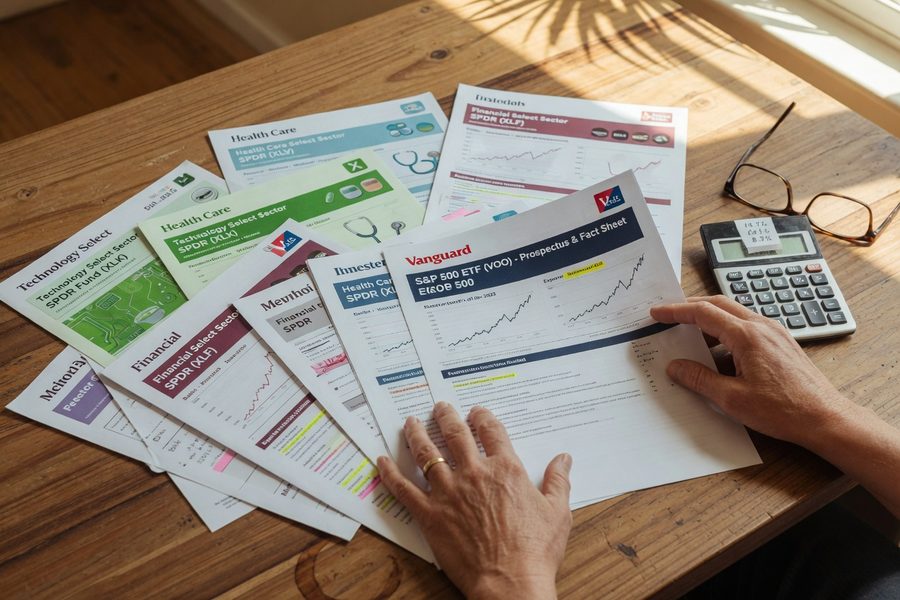
Sector ETFs marketed as “diversification” often compound the problem rather than solving it. Adding a technology sector fund on top of an S&P 500 fund increases your Magnificent 7 exposure further. Check the top-10 holdings of any new fund before buying; if you already own most of them, you’re not diversifying.
Market-cap weighting is not neutral. It systematically overweights whatever has already risen in price. Buying “the market” today means buying the assets the market has already bid up the most, a structural tilt worth understanding before committing.
Step 3: Stop Chasing the Lowest Expense Ratio Without Checking Holdings
Expense ratios matter enormously over time. But the hunt for the absolute lowest fee has led many beginners into a second mistake: assembling a portfolio of multiple cheap ETFs that all hold the same stocks.
The Overlap Problem
Consider a beginner who holds VTI (Vanguard Total Stock Market ETF, 0.03% expense ratio), VOO (Vanguard S&P 500 ETF, 0.03%), and QQQ (Invesco Nasdaq-100, 0.20%). All three are low cost by most standards. But approximately 83% of VTI’s holdings are also in VOO, and QQQ’s top holdings are nearly identical to both. The investor has paid three sets of transaction costs and created a portfolio that is essentially a single concentrated bet on large-cap U.S. technology, dressed up as diversification.
FINRA’s investor guidance on ETFs specifically warns investors to “be aware of potential overlaps in holdings or exposures when using multiple ETFs or index products for diversification.” That warning exists precisely because this pattern is common.
How to Do This
Use free tools like ETF Research Center’s fund overlap tool or Morningstar’s portfolio X-ray before buying a second or third fund. A simple two-fund portfolio, one U.S. total market fund and one total international fund, eliminates almost all meaningful overlap at the lowest possible cost. Vanguard, Fidelity, and iShares all offer this combination with expense ratios at or below 0.10%.
What to Watch Out For
The “more funds equals more diversification” assumption is one of the most persistent index fund mistakes beginners make. Real diversification comes from holding different asset classes or geographies, not from holding five ETFs that all track variations of the same index.
According to FINRA, actively managed products often carry higher expense ratios than comparable index-tracking products, “which has the potential to eat into returns over time.” Even a difference of 0.50% annually compounds into a significant drag over a 30-year horizon.
Here’s a concrete example. A $50,000 portfolio growing at 8% annually for 30 years reaches approximately $503,000 with a 0.03% expense ratio (net 7.97%). The same portfolio with a 0.53% expense ratio (net 7.47%) grows to roughly $443,000. That’s a $60,000 difference, generated purely by the fee gap, with no difference in behavior or market timing.
| ETF Combination | Overlap Estimate | Blended Expense Ratio | True Diversification |
|---|---|---|---|
| VTI + VXUS | ~0% (U.S. vs. international) | ~0.05% | High, 14,000+ global securities |
| VTI + VOO | ~83% (near-total duplication) | 0.03% | Low, effectively one U.S. large-cap bet |
| VTI + VOO + QQQ | ~85%+ across all three | ~0.08% | Very low, magnifies tech concentration |
| SPY + Sector ETFs (3-5) | Varies, 40–90% per sector | 0.15–0.40% | Low to moderate, depends on sectors chosen |
| VTI + BND + VXUS | <5% between asset classes | ~0.06% | Very high, stocks, bonds, international coverage |
Step 4: Add International Exposure to Beat Home-Country Bias
Home-country bias is the tendency to overweight domestic stocks simply because they feel familiar. For U.S. investors, this usually means an all-S&P-500 portfolio with zero non-U.S. exposure, a choice that quietly cost returns in 2025 as international equities outperformed U.S. markets for stretches of the year.
Why International Exposure Matters Now
U.S. stocks currently trade at elevated valuations by most historical measures. Several market analysts, including research from Lyn Alden’s investment strategy work, project mid-single-digit or lower long-term U.S. equity returns from current price levels. Non-U.S. markets, Europe, emerging Asia, Japan, trade at significantly lower cyclically adjusted price-to-earnings ratios. That doesn’t guarantee outperformance, but it does mean the risk-reward case for holding some international exposure is stronger than it was a decade ago when U.S. valuations were lower.
Morningstar’s analysis noted that ignoring non-U.S. stocks was a meaningful error in 2025, as international funds delivered stronger calendar-year returns than the S&P 500 for significant portions of the year. A total-world fund like VT (Vanguard Total World Stock ETF, 0.07% expense ratio) captures both U.S. and non-U.S. markets in a single holding, automatically maintaining global market-weight allocation without any manual rebalancing.
How to Do This
A straightforward target for most new investors: allocate somewhere between 20% and 40% of equity exposure to non-U.S. stocks. The exact figure is less important than the decision to include some. VXUS, IXUS, and Fidelity’s FZILX (0% expense ratio) are all credible options. Adding even a modest international sleeve meaningfully reduces the portfolio’s sensitivity to U.S. market cycles.
What to Watch Out For
Currency risk and geopolitical volatility are real features of international investing, not marketing disclaimers. Emerging market funds carry additional volatility. For beginners who want simplicity, a developed-market international fund (which excludes emerging markets) is a reasonable starting point before adding any emerging-market exposure.
One fund solves this entirely. Vanguard’s VT holds over 9,000 stocks across 47 countries at a 0.07% expense ratio. For a beginner who wants global diversification without making any allocation decision between U.S. and international, it’s the simplest possible solution.

Step 5: Stay Invested During Volatility Instead of Panic-Selling
The single largest source of the gap between index fund returns and investor returns is selling at the wrong time. This is documented, quantified, and widely understood, and beginners still do it at scale every market cycle.
Why Panic Selling Destroys Returns
According to DALBAR’s 2025 report, the average equity fund investor earned 16.54% in 2024 versus the S&P 500’s 25.02% return, an underperformance of 848 basis points in a single year. Much of that gap traces to investors who exited positions during early-year volatility and missed subsequent rallies. Missing just the 10 best trading days in any given decade typically cuts total returns by more than half.
Index funds don’t protect you from your own decisions. A drawdown of 30% on a broad index ETF feels exactly as uncomfortable as a 30% loss on a single stock. The difference is that the index is virtually certain to recover; an individual stock may not. Knowing that intellectually and feeling it during a portfolio drop are different experiences.
How to Do This
Two concrete practices prevent panic selling. First, automate contributions through dollar-cost averaging: set a fixed monthly purchase that executes regardless of market conditions. Automation removes the decision point. Second, set a rebalancing schedule, once or twice per year, so portfolio adjustments are calendar-driven, not emotion-driven. Both Fidelity and Vanguard allow automatic investment schedules at no additional cost. Managing high-interest credit card debt before investing is worth doing first, since carrying expensive debt while watching a volatile portfolio can amplify the psychological pressure to sell.
What to Watch Out For
Checking your portfolio daily is not a neutral act. Research in behavioral finance consistently shows that more frequent monitoring leads to more emotional decisions. For most index fund investors, a quarterly or semi-annual review is sufficient. Daily portfolio-watching during a downturn is one of the clearest predictors of premature selling.
In 2024, the S&P 500 returned 25.02%. The average equity fund investor returned 16.54%, an 848-basis-point gap driven primarily by behavioral decisions, not fund selection, per DALBAR’s 2025 Investor Behavior Report.
Step 6: Place Your Funds in the Right Accounts for Tax Efficiency
Most beginners focus entirely on which index funds to buy and almost never on where to hold them. Account placement is the least exciting part of index fund investing, and one of the most financially consequential.
How to Do This
The core principle is straightforward: put tax-inefficient assets in tax-advantaged accounts (401(k)s, IRAs) and keep tax-efficient assets in taxable brokerage accounts. Broad U.S. total market index funds like VTI are highly tax-efficient because they generate minimal capital gains distributions. Bond funds and REITs generate frequent ordinary income and belong in a Roth IRA or traditional 401(k) where that income isn’t taxed annually.
In a taxable account, tax-loss harvesting adds a meaningful layer of efficiency. When a broad index ETF drops in value, selling it and immediately buying a similar-but-not-identical fund (for example, swapping VTI for Schwab’s SCHB) harvests a tax loss while maintaining market exposure. The IRS wash-sale rule prohibits repurchasing the same security within 30 days, but moving between funds that track similar indices typically satisfies the requirement. Over a decade, systematic tax-loss harvesting in a taxable account can add 0.5% to 1.5% in after-tax annual return according to Vanguard’s own research. If tax season strategy is already on your radar, the guide on free IRS tax help and overlooked credits is worth reading alongside this one.
What to Watch Out For
A common mistake: holding a high-dividend international fund in a taxable account. Foreign dividends are taxed as ordinary income in most cases, and the foreign tax credit is limited. Placing international funds inside a Roth IRA also forfeits the foreign tax credit entirely, since there’s no tax liability to offset. For most investors, international equity funds belong in a taxable account or traditional IRA to preserve that credit. These nuances are where a fee-only financial planner earns their fee.
If you can only prioritize one tax-efficiency move, max your Roth IRA before adding to a taxable brokerage account. For 2026, the Roth IRA contribution limit is $7,000 (or $8,000 if you’re 50 or older). Decades of tax-free compounding on index fund returns is one of the most valuable advantages available to retail investors.
Retirement accounts deserve a standalone look. The article on why saving for retirement should come before college savings explains the sequencing logic that underpins proper account prioritization.
The SEC’s Guide to Mutual Funds makes a point worth internalizing: index-based funds with seemingly similar benchmarks can actually be quite different and can deliver very different returns, and they may have less flexibility than non-index funds to react to price declines, meaning they can underperform their stated index due to fees and taxes. That last point applies directly to account placement. A fund held in the wrong account type will generate tax drag that eats into returns regardless of how well the underlying index performs.
Frequently Asked Questions
How do I know if my index fund is too concentrated in tech stocks?
Check the fund’s top-10 holdings and sector allocation, which every fund publishes on its fact sheet or issuer website. If technology represents more than 30% of the fund’s total weight, you have meaningful tech concentration. As of early 2026, standard S&P 500 index funds hold roughly 30–35% in the information technology sector alone, making this a real concern for investors who assume broad diversification.
Is it a mistake to only hold one index fund like VTI?
Holding only VTI is not a mistake, it’s a defensible and simple strategy for many investors. VTI covers roughly 3,500 U.S. companies across all market caps. The limitation is U.S.-only exposure: you own none of the roughly 60% of global stock market capitalization that sits outside the United States. Adding a single international fund like VXUS corrects that without adding meaningful complexity.
Should I dollar-cost average into index funds or invest a lump sum?
Lump-sum investing outperforms dollar-cost averaging roughly two-thirds of the time when a large sum is available upfront, because markets tend to rise over time and waiting costs you market exposure. Dollar-cost averaging is consistently the better psychological choice for investors who might panic-sell a large position during an early drawdown. For most beginners without a large lump sum, regular monthly contributions are both practical and effective.
What expense ratio is too high for an index fund?
Any expense ratio above 0.20% for a broad U.S. or international index fund is worth questioning. Vanguard, Fidelity, and Schwab all offer total market and S&P 500 index funds at 0.03% to 0.10%. An expense ratio of 0.50% or higher competes with actively managed fund pricing and is difficult to justify for a product that simply tracks an index. The compounding cost over 30 years on a meaningful balance easily exceeds $50,000 to $60,000.
Can I hold both VTI and VOO in the same portfolio?
Technically yes, but it provides almost no diversification benefit. VTI and VOO overlap by approximately 83% in holdings, since VOO tracks the S&P 500 (large caps) and VTI includes those same companies plus mid- and small-caps. If you want broader U.S. market coverage, simply holding VTI alone achieves that more efficiently than holding both. Pairing VTI with an international fund like VXUS is a far more meaningful diversification decision.
How often should I rebalance my index fund portfolio?
Once or twice per year is sufficient for most investors, or when any asset class drifts more than 5 percentage points from its target allocation. More frequent rebalancing in a taxable account generates unnecessary capital gains. In a tax-advantaged account like a Roth IRA or 401(k), rebalancing is free of immediate tax consequences, so you can rebalance whenever drift is meaningful without worrying about the tax bill.
Do index funds still make sense if U.S. stock valuations are high?
Yes, but the case for including international index funds alongside U.S. ones is stronger now than it was a decade ago. Several research frameworks project mid-single-digit annualized returns from U.S. equities over the next decade given current valuations. That doesn’t mean avoiding U.S. stocks; it means not concentrating exclusively in them. A globally diversified index portfolio captures whichever markets perform best over your investing horizon.
What is tax-loss harvesting and should beginners do it?
Tax-loss harvesting means selling an investment that has declined in value to realize a tax loss, then immediately buying a similar fund to maintain your market exposure. The realized loss offsets capital gains elsewhere in your portfolio, reducing your tax bill. It’s most relevant for investors with taxable brokerage accounts and balances large enough that the tax savings justify the administrative effort. Beginners just starting out with a Roth IRA or 401(k) don’t need to think about this until they have a meaningful taxable account.
How do I avoid the wash-sale rule when tax-loss harvesting index funds?
The IRS wash-sale rule disallows a tax loss if you repurchase the “same or substantially identical” security within 30 days before or after the sale. When tax-loss harvesting with index ETFs, swap into a fund that tracks a different index but covers a similar market segment: for example, sell VTI (tracks CRSP U.S. Total Market Index) and buy SCHB (tracks Dow Jones U.S. Broad Stock Market Index). Both hold thousands of U.S. stocks but track different benchmarks, generally satisfying the wash-sale distinction. Always confirm with a tax professional for your specific situation.
Are index funds safe during a market crash?
Index funds will fall as much as the market they track, there is no downside protection built in. During the 2020 COVID crash, the S&P 500 dropped approximately 34% in five weeks. A total market index fund dropped by a similar amount. The difference from individual stocks is that recovery is historically reliable for broad index funds: the S&P 500 had fully recovered within about five months. Individual stocks have no such guarantee. Index funds reduce the risk of permanent capital loss; they do not reduce short-term volatility.
Sources
- DALBAR, Investors Missed the Best of 2024’s Market Gains: Latest DALBAR Investor Behavior Report
- Morningstar, Fund Investors Who Kept It Simple Captured More Return (Mind the Gap 2025)
- Wintrust Wealth Management, The Risks of DIY Investing (citing DALBAR 2024 QAIB)
- U.S. Securities and Exchange Commission, SEC Guide to Mutual Funds
- FINRA, Exchange-Traded Funds and Products: Investor Guidance
- Internal Revenue Service, Publication 550: Investment Income and Expenses (Wash-Sale Rules)