Fact-checked by the MyFinancial101 editorial team
The Verdict
Store brands are usually the better savings tool if you spend at least $200 per month on groceries and shop consistently at one or two stores. Grocery loyalty programs savings are real but conditional: they pay off most when you actively clip digital coupons and buy fuel. Skip the loyalty app hustle if you shop infrequently or at multiple chains.
Most shoppers assume loyalty programs are the smarter play because they feel personalized and modern. The data disagrees. Food costs are 26% higher than pre-pandemic levels, and the single factor that moves the needle most on a grocery bill is not which app you download. It is whether you routinely buy the store-label version of a product instead of the national brand. That one habit shift, applied across a full cart, consistently outperforms passive loyalty point accumulation.
Grocery loyalty programs savings are real, but they come with strings attached that retailers rarely advertise. Understanding those strings is what separates a strategy that actually cuts your bill from one that mostly cuts your privacy.
| Factor | Reasons to Lean on Loyalty Programs | Reasons to Lean on Store Brands |
|---|---|---|
| Upfront cost | Free to join at Kroger, Albertsons, Safeway, and most major chains | Zero cost; no signup, no app required |
| Average savings rate | Kroger claims an average of $576/year per member via coupons and fuel points | Consumer Reports documents 15–25% less than name brands per item |
| Effort required | High: digital coupon clipping, app management, and tracking point expiration | Low: choose the store-label product at the shelf, done |
| Consistency of savings | Variable; deals rotate weekly and may push items you would not otherwise buy | Consistent across categories; savings apply every trip |
| Privacy trade-off | Retailers monetize your purchase data; Kroger earned significant revenue from data sales in 2024 | None; no data collection tied to store-brand purchases |
| Best for | High-volume shoppers who buy fuel and branded items regularly at one chain | Any shopper willing to switch product labels across pantry staples |
| Overspending risk | Moderate to high; promoted deals encourage buying items not on the list | Low; the savings are on items you already planned to buy |
| Point expiration | Real risk; industry data shows roughly 26% of loyalty points go unspent or expired | No points to expire; savings are immediate at checkout |
Key Takeaways
- Your monthly grocery spend is at least $200, making the percentage savings from store brands meaningful in dollar terms.
- You shop primarily at one or two chains where loyalty rewards can accumulate without expiring.
- You are willing to switch at least half your pantry staples, pasta, canned goods, dairy, cleaning products, to store-label versions.
- You regularly buy fuel, since fuel-point programs at Kroger and Albertsons can add $10–$30 in monthly savings for drivers.
- You are not already overspending on promoted loyalty items that offset your earned discounts.
- You can track whether your actual receipt total is falling, not just your theoretical points balance.
- Your household size is two or more people; the store-brand savings gap widens significantly at four or more people.
What Do Grocery Loyalty Programs Actually Deliver?
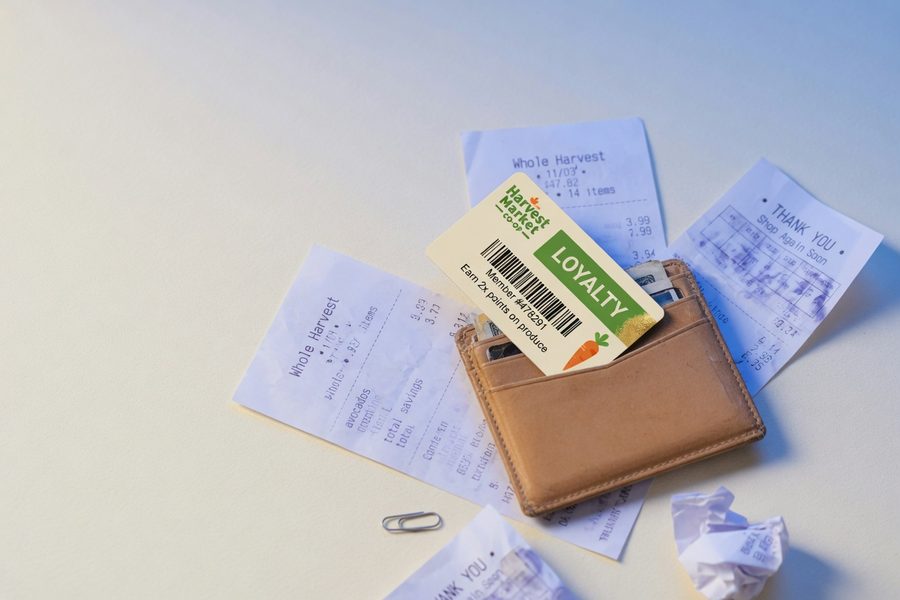
The headline number from Kroger, $576 per member per year, is real, but it requires active participation that most enrolled members never reach. Eagle Eye’s 2025 consumer survey found that 44% of North American shoppers are increasingly turning to loyalty programs to save on groceries. That is a large share. What it does not reveal is how many of those shoppers actually redeem their rewards before they expire.
The expiration problem is significant. Industry research from Antavo estimates that roughly 26% of loyalty points go unspent or expire annually, representing up to $10 billion in unredeemed U.S. consumer value each year. A program that saves you $576 in theory but lets a quarter of your points lapse is actually saving you closer to $427, if you are tracking carefully. Most people are not.
There is also a data-monetization angle that most comparisons skip entirely. Kroger generates substantial revenue from selling aggregated shopper purchase data to consumer packaged goods companies and advertisers. The Federal Trade Commission (FTC) has scrutinized retail data practices broadly, and while loyalty program data sharing is legal, the discounts you receive are partly funded by the commercial value of your purchasing behavior rather than by Kroger absorbing margin cuts. Whether that trade-off bothers you is a personal call, but it is worth knowing the economics before calling a loyalty program “free savings.”
The Quiet Power of Store Brands
Store brands consistently outperform loyalty programs on one metric that matters most: reliability. The savings show up every single trip, on every qualifying item, with no app, no coupon clip, and no expiration date to manage.
Consumer Reports’ 2026 pricing analysis found that store brands cost 15–25% less than comparable national-brand products. The Private Label Manufacturers Association (PLMA) estimates that U.S. consumers collectively save $35–$40 billion per year by choosing store labels over national equivalents. For a family of four that switches most of its pantry staples, that can translate to roughly $5,000 in annual savings, an outcome no loyalty card tier comes close to matching.
The quality objection is real but narrower than it used to be. Store brands have improved substantially over the past decade, and independent taste tests, including repeated Consumer Reports panels, find that generics match or outperform name brands in most commodity categories: canned vegetables, pasta, rice, dairy, frozen vegetables, and cleaning supplies. Categories where name brands still hold a meaningful edge are narrower, certain condiments, specialty baked goods, and brand-specific formulations like some over-the-counter medications. If you are ready to get serious about beating inflation at the register, store brands are the most reliable tool on the shelf.
One honest caveat: store brands vary considerably in quality across retail chains. Costco’s Kirkland Signature line and Trader Joe’s private labels are widely regarded as strong, while some discount-chain generics fall short on taste or consistency. Switching everything at once can lead to buyer’s remorse. A gradual category-by-category approach, starting with pantry staples where quality differences are minimal, tends to stick better than an all-at-once overhaul.
Head-to-Head Savings Math: Running the Real Numbers
Here is a worked example. Take a household spending $500 per month on groceries, roughly consistent with USDA moderate-cost plan estimates for a family of three or four in 2026.
Applying a conservative 15% store-brand discount across 70% of that cart (the portion where generics are genuinely comparable) yields: $500 × 0.70 × 0.15 = $52.50 saved per month, or $630 per year. Bump that store-brand discount to the high end of Consumer Reports’ range, 25%, and the same math produces $87.50 per month, or $1,050 per year. No app. No clipping. No expiration dates.
Now compare that to Kroger’s claimed loyalty savings of $576 per year. That figure assumes consistent engagement with digital coupons, fuel point redemption, and weekly deal tracking. After accounting for the roughly 26% point breakage rate, realistic annual loyalty savings for an average participant drop to approximately $427. Store brands, even at the conservative end, match or beat that number with far less effort.
For single shoppers spending around $200 per month, the gap narrows but does not close. Store brands still save roughly $252–$420 per year on the same math, while loyalty programs at lower spend volumes generate fewer rewards and fewer fuel-point opportunities. The math favors store brands at nearly every volume level.
Hidden Costs Most Shoppers Miss
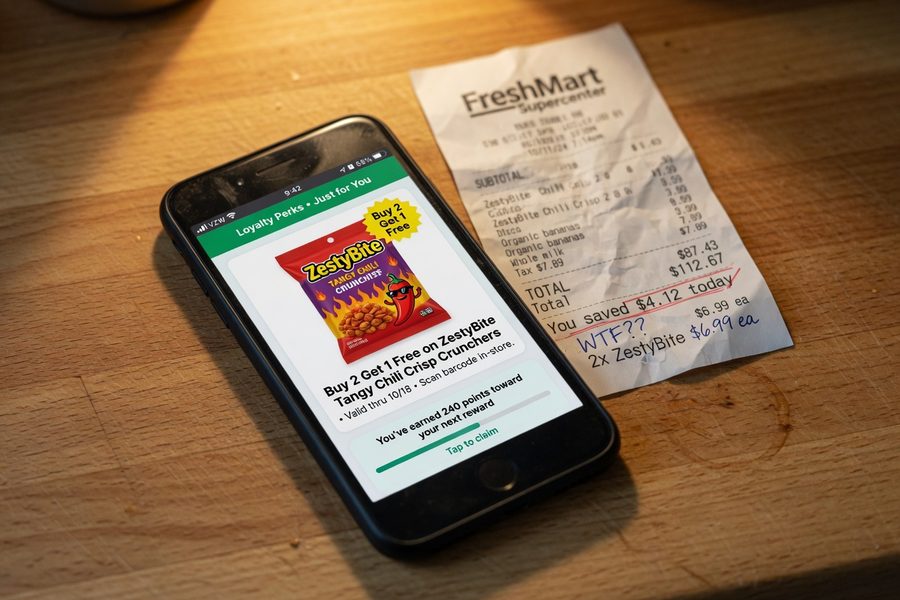
Loyalty programs have a subtle but real overspending problem. When a retailer’s app pushes a “buy two, get one free” deal on a brand you would not normally buy, you spend money you had not planned to spend. The promoted discount is real; the net savings to your budget may not be. This is a structural feature of loyalty program design, not a bug. Grocers profit when promotions drive basket size up, not just when they drive you to the store.
There is also the time cost. Clipping digital coupons, navigating apps, tracking expiration windows, and cross-referencing your list against weekly deals takes meaningful effort. If you value your time at even a modest $15 per hour and spend 20 minutes per week managing a loyalty program, that is roughly $260 per year in time cost, which erodes the net savings advantage significantly.
The same Eagle Eye survey noted that 73% of North American consumers say value is the top factor when choosing a grocery brand, and 53% use coupons to offset higher costs. Both figures suggest shoppers are looking for savings, but “looking” and “finding” are not the same thing when program mechanics work against casual participants.
The broader inflation context matters here too. The Bureau of Labor Statistics (BLS) Consumer Price Index tracks food-at-home costs as a distinct category, and that data shows grocery inflation has outpaced overall CPI in several recent periods. Against that backdrop, passive loyalty point accumulation is a thin defense. The Federal Reserve’s own household survey data consistently shows food spending as one of the largest variable cost categories for American families, which is precisely why a structural savings habit like store-brand switching carries more weight than an opt-in discount program.
Families watching every dollar should also consider pairing grocery savings with other household strategies. If food-assistance programs like SNAP are part of your budget, store brands stretch those benefits further without requiring loyalty program enrollment. The USDA Food and Nutrition Service, which administers SNAP, confirms that store-brand items are fully eligible under the program, meaning the savings stack directly on top of benefit dollars.
Who Should and Who Should Not
Good candidates for prioritizing store brands
Most shoppers will see a faster, more reliable payoff from store brands than from loyalty programs.
- Families of three or more who spend at least $400 per month on groceries and buy staple categories weekly, the savings compound fast.
- Budget-focused shoppers who dislike managing apps, tracking coupons, or worrying about expiration windows.
- Anyone who shops across multiple chains, including Walmart, Target, Costco, and Aldi, and cannot concentrate spending at one loyalty retailer.
- Shoppers who are already buying seasonal produce and staples strategically and want to add a consistent savings layer on top.
Who should lean on loyalty programs
Loyalty programs are worth the effort in a few specific situations.
- High-volume shoppers who spend $600 or more per month consistently at a single chain like Kroger or Albertsons, the accumulation math improves significantly.
- Drivers who fill up frequently at a chain-affiliated gas station; fuel points alone can add $10–$30 in monthly value.
- Shoppers who buy primarily branded specialty items or dietary-specific products that have no viable store-brand equivalent.
- Anyone already comfortable with digital coupon apps who engages weekly, the savings are real for this group, just not automatic.
It is also worth noting that some financial institutions have begun folding grocery rewards into broader cash-back structures. Chase Freedom and similar credit cards from issuers tracked by the Consumer Financial Protection Bureau (CFPB) sometimes offer rotating grocery-category cash back. Stacking a cash-back card with store-brand purchases is one of the few scenarios where two savings mechanisms genuinely compound rather than overlap. Just be certain the card is paid in full monthly; carrying a balance at a high APR erases any grocery savings quickly.
Frequently Asked Questions
Are grocery loyalty programs actually worth it?
For active, high-volume shoppers at a single chain, yes. Kroger’s free Plus program claims an average savings of $576 per year, but only members who consistently clip digital coupons and redeem fuel points approach that figure. Casual members who sign up and forget it typically save far less after accounting for unspent points.
Do store brands really save you money compared to name brands?
Consistently, yes. Consumer Reports’ 2026 analysis found store brands cost 15–25% less than comparable national brands. On a $500 monthly grocery budget where generics cover 70% of purchases, that gap translates to $630–$1,050 in annual savings with no app or coupon management required.
Can you stack loyalty program discounts with store brand savings?
You can, but the opportunity is smaller than it sounds. Loyalty digital coupons are almost always tied to national brands, not store-label products. Stacking works best when you use loyalty fuel points for gas while choosing store brands for the groceries themselves, two separate savings streams rather than one compounding system.
What happens to grocery loyalty points you do not use?
They expire. Industry data estimates roughly 26% of loyalty points go unspent or lapse annually, representing up to $10 billion in lost U.S. consumer value each year. If you enroll in a program, set a calendar reminder to check your balance every 60 days.
Is Walmart+ worth it for grocery savings?
Walmart+ costs $98 per year and includes free grocery delivery, fuel discounts, and member pricing on select items. It makes financial sense if you order grocery delivery at least twice a month and would otherwise pay delivery fees; the math does not work for in-store-only shoppers who get comparable value from Walmart’s everyday low prices and its store brand Great Value without the subscription.
Which grocery stores have the best loyalty programs in 2026?
Kroger’s free Plus Card and Albertsons for U shoppers consistently rank highest for active participants who buy fuel. For paid tiers, Walmart+ delivers the clearest value for delivery-dependent households. The “best” program is the one at the chain where you already concentrate your spending. Spreading loyalty across three different apps dilutes the benefit of all of them.
Sources
- Consumer Reports via KCRA, Grocery Budget Strategy and Store Brand Savings (2026)
- Eagle Eye, Canada and United States Grocery Loyalty Snapshot (2025)
- Food Marketing Institute (FMI), Supermarket Facts and Industry Data
- Private Label Manufacturers Association (PLMA), Store Brand Sales and Consumer Savings Data
- U.S. Bureau of Labor Statistics, Consumer Price Index: Food at Home
- USDA Center for Nutrition Policy and Promotion, Monthly Cost of Food Reports
- USDA Food and Nutrition Service, Supplemental Nutrition Assistance Program (SNAP)
- Federal Trade Commission (FTC), Consumer Data and Retail Privacy Oversight
- Consumer Financial Protection Bureau (CFPB), Credit Card Rewards and Consumer Protection
- Federal Reserve, Report on the Economic Well-Being of U.S. Households
- USDA Economic Research Service, Food Prices and Consumer Spending
- Consumer Reports, How to Save Money on Groceries and Store Brand Guidance
- Antavo, Global Loyalty Program Statistics and Point Breakage Research
- Kroger, Kroger Plus Card and Fuel Points Program Details
- IRS, Tax Treatment of Rebates and Reward Programs (Topic 452)