
Fact-checked by the MyFinancial101 editorial team
Quick Answer
Managing finances as a couple with a large income gap works best when you split shared expenses proportionally by take-home pay rather than 50/50. Start by calculating each partner’s share of combined net income, apply that ratio to joint bills, and maintain individual discretionary accounts. Most couples can set up a working system in 2-4 weeks with one or two honest conversations and a shared spreadsheet.
Effective money management for couples with an income gap starts with one shift in thinking: fairness means equal sacrifice, not equal dollars. When one partner earns $90,000 and the other earns $35,000, splitting rent evenly does not feel fair, and the math backs that up. According to the Institute for Family Studies, 63% of recently married young-adult women were outearned by their husbands in 2023, which means unequal-income households are genuinely the norm. The right framework for money management in income-gap couples is proportional contribution, each partner covers a share of joint costs that reflects their share of the household’s total income.
Wage inequality between spouses has become more visible as more households have one partner earning significantly more than the other. The U.S. Bureau of Labor Statistics reported in 2024 that only 49.6% of married-couple families had both spouses employed, while 23.4% had only one spouse working, a setup that creates the steepest possible income gap. Even in dual-income households, the spread between salaries is often wide enough that a rigid 50/50 approach quietly erodes goodwill over time.
This guide is for couples at any stage, newly partnered, recently married, or years in, who are trying to build a money system that does not breed resentment. By the end, you will have a clear process for choosing a financial structure, calculating proportional contributions, setting shared goals, and protecting both partners’ long-term financial health.
Key Takeaways
- 63% of recently married young-adult women were outearned by their husbands in 2023, according to the Institute for Family Studies, confirming that unequal-income couples are the majority, not an edge case.
- 77% of married couples held at least one joint financial account in 2023, per the U.S. Census Bureau, but owning a joint account and having a fair contribution system are two different things.
- A proportional split, where each partner covers the same percentage of their income, not the same dollar amount, is the method most consistently recommended by financial planners to reduce resentment in income-gap households.
- Filing taxes jointly often produces a marriage bonus when there is a large income difference, but that benefit accrues more to the higher earner unless the couple redistributes it intentionally.
- Maintaining separate discretionary accounts alongside a shared joint account gives both partners spending autonomy and is consistently linked to greater perceived fairness in the relationship.
- Couples should schedule formal money check-ins at least twice a year, and immediately after any major income change, to keep the system calibrated and prevent silent resentment from building.
In This Guide
- Step 1: Understand the Emotional Reality Before Touching the Numbers
- Step 2: Choose a Money System That Actually Feels Fair
- Step 3: How Do You Calculate Proportional Contributions Without Getting Lost in the Math?
- Step 4: Build a Joint Budget and Align on Shared Goals
- Step 5: How Should Couples Handle Major Career or Life Changes When Incomes Are Unequal?
- Step 6: Long-Term Planning, Retirement, Taxes, and Safety Nets
- Step 7: How Often Should Couples Revisit Their Financial Agreement?
- Frequently Asked Questions
Step 1: Understand the Emotional Reality Before Touching the Numbers
No spreadsheet survives a conversation that has not yet dealt with the feelings underneath it. Income gaps carry emotional weight that goes far beyond who pays for dinner, and ignoring that weight is the most reliable way to guarantee the numbers conversation will fail.
How the Income Gap Feels to Each Partner
The lower earner often internalizes the gap as a reflection of personal worth rather than market circumstance. This shows up as reluctance to spend on themselves, overcompensating with domestic labor, or avoiding money conversations entirely because they feel like negotiating from a position of weakness. None of those responses are irrational, they are predictable outcomes of a system where financial contribution is still widely treated as a proxy for value in a relationship.
The higher earner faces a different but equally real pressure. They may feel constrained in their spending because every purchase is visible to a partner who earns less. They may quietly resent footing a larger share of shared costs, even if they agreed to it, if the arrangement was never named out loud. Unspoken resentment on either side tends to surface during arguments about something unrelated to money.
What to Watch Out For
The most common trap is confusing equality with fairness. Splitting costs 50/50 feels procedurally neutral, but it is not. A $2,000 monthly rent payment represents 6.9% of gross monthly income for someone earning $350,000 a year and 34% for someone earning $70,000. That is not equal sacrifice, it is a significant structural disadvantage for the lower earner, one that compounds over time into reduced savings, less retirement security, and less personal financial resilience.
Start the money conversation by naming the gap directly and framing it as a practical problem to solve together, not a score to keep. Many couples find it useful to separate the first conversation, “how do we feel about this?”, from the second one, “what system do we use?” Doing both at once usually means the logistics get muddled with emotion, and neither conversation goes well.
According to the U.S. Census Bureau, 23% of married couples had no joint bank accounts at all in 2023. Some of those couples have a deliberate, working system, but for many, the absence of shared accounts reflects avoidance rather than a plan.
Step 2: Choose a Money System That Actually Feels Fair
Three basic models exist for how couples manage money: fully combined accounts, fully separate accounts, or a hybrid system. For income-gap couples specifically, the hybrid model, one shared account for joint expenses, individual accounts for personal spending, has the most consistent track record for preserving both partnership and autonomy.
Fully combined finances work well when both partners have similar earnings, similar spending habits, and high mutual trust. When the income gap is large, combining everything can quietly shift financial power to the higher earner, because their income disproportionately “fills” the shared pot and their preferences tend to shape how it gets spent. Fully separate finances, on the other hand, require meticulous negotiation of every shared expense and often become unwieldy as a household’s financial life grows more complex. The hybrid model threads this needle: joint expenses come from a shared account, each person contributes to that account proportionally, and whatever remains in each person’s individual account is genuinely theirs to spend without justification. Pre-relationship wealth or family assets held by one partner are an important complication, if one person brought significant inherited money into the relationship, a clear written agreement about whether that asset belongs to both or to the individual protects everyone, and is worth addressing before it becomes a point of contention.
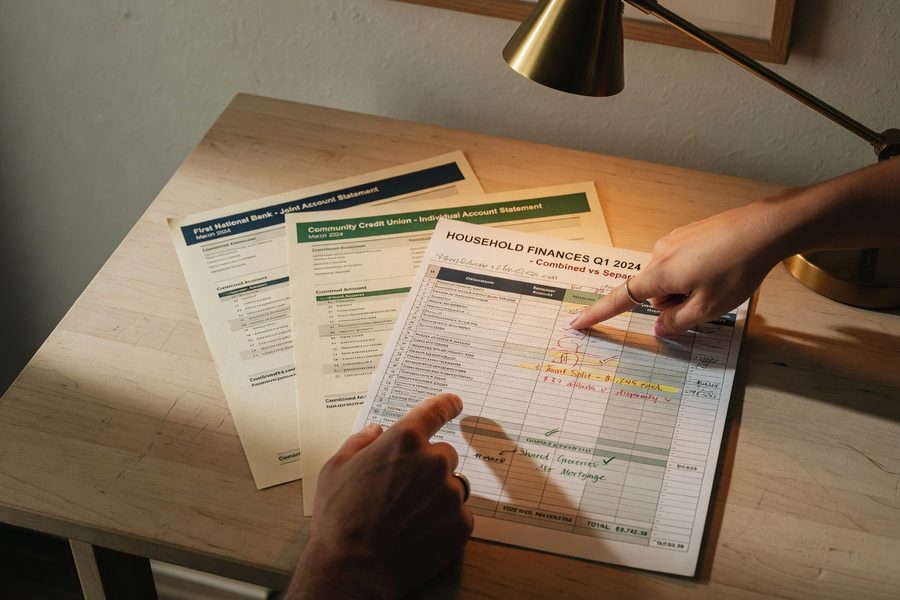
When one partner carries student loan debt or a damaged credit history from before the relationship, keep those liabilities in individual accounts rather than absorbing them into joint finances. Contributing toward a partner’s debt payments is a generous choice, but it should be a named decision, not an assumed one, to avoid the power imbalance that comes from one person feeling financially beholden to the other.
Step 3: How Do You Calculate Proportional Contributions Without Getting Lost in the Math?
Proportional contribution is simpler to calculate than most couples expect. Take each partner’s monthly take-home pay, add them together, then divide each person’s income by the combined total. The resulting percentages are your contribution ratios, applied to every shared expense.
How to Do This
Here is a concrete example. Partner A takes home $4,500/month; Partner B takes home $1,750/month. Combined take-home is $6,250/month. Partner A’s share: $4,500 ÷ $6,250 = 72%. Partner B’s share: $1,750 ÷ $6,250 = 28%. If their joint monthly expenses total $3,200 (rent, utilities, groceries, shared subscriptions), Partner A contributes $2,304 and Partner B contributes $896. Both partners have paid exactly 25.6% of their take-home pay toward shared life, equal sacrifice, not equal dollars. Over a year, that difference amounts to Partner A paying $17,088 versus Partner B paying $6,912 in joint costs, which accurately reflects what each person can absorb without straining their individual finances.
The same logic applies when one partner has variable income, freelancers, commission earners, or seasonal workers should use a three-month rolling average of take-home pay, updated each quarter. This prevents a windfall month from permanently inflating their contribution and a slow month from creating a real cash shortfall.
What to Watch Out For
Decide upfront what counts as a “joint” expense versus a personal one. Housing, utilities, shared groceries, and household supplies are almost always joint. Gym memberships, hobbies, clothing, and individual subscriptions are typically personal. Children’s costs, pet costs, and vacations require a direct conversation, there is no universal rule, only what both partners agree is fair. If the higher earner wants to spend on experiences or lifestyle upgrades that the lower earner cannot proportionally afford, the options are: the higher earner covers the full cost as a gift, the couple agrees to skip it, or they negotiate a different split for discretionary shared spending.
32% of recently married young-adult women earned more than their husbands in 2023, according to the Institute for Family Studies, up from earlier decades, which means the higher-earner in an income-gap couple is increasingly likely to be female. The proportional system works identically regardless of which partner earns more.
| System | How It Works | Best For | Main Risk for Income-Gap Couples |
|---|---|---|---|
| 50/50 Split | Each partner pays exactly half of every joint expense | Partners with nearly equal incomes (within ~15%) | Lower earner spends a much higher percentage of their income; savings gap widens over time |
| Proportional Split | Each partner pays a percentage matching their share of combined income | Couples with any meaningful income gap | Requires agreement on what counts as “joint”; needs updating after income changes |
| All-In Pooling | All income goes into one account; all spending comes from it | Couples with high mutual trust and similar spending values | Higher earner may feel disproportionate control; lower earner may feel lack of autonomy |
| Hybrid (Recommended) | Proportional contributions to a joint account; remainder stays in individual accounts | Most income-gap couples, especially with different spending styles | Requires initial setup and quarterly recalibration; more accounts to manage |
| Fully Separate | Each person pays certain bills; no shared accounts | Early relationships, couples with complex individual finances | Becomes cumbersome; no natural mechanism for shared goals like saving for a home |
Step 4: Build a Joint Budget and Align on Shared Goals
A working proportional system is only as good as the budget it feeds. Once contribution ratios are set, the next job is agreeing on what the joint account actually covers and building shared savings toward goals that matter to both partners, even when their earning power differs sharply.
How to Do This
List every recurring shared expense and assign each a monthly cost. Separate those into non-negotiable fixed costs (rent, insurance, loan payments) and variable joint costs (groceries, utilities, shared entertainment). Total them, and that number becomes the floor for your joint account monthly target. Build in a joint emergency fund contribution on top of that, a common starting point is $200-$500/month until you reach three to six months of combined shared expenses. Tools like YNAB (You Need a Budget), Honeydue, or a shared Google Sheets template make real-time tracking accessible without requiring both partners to be equally enthusiastic about spreadsheets.
For shared financial goals, a home purchase, a travel fund, early retirement, assign each goal a specific monthly savings amount and treat it like a fixed expense in the joint account. This matters for income-gap couples because the higher earner may naturally default to a savings rate the lower earner genuinely cannot match. Set goal timelines based on what both partners can actually contribute, not what the higher earner could accomplish alone. That constraint is frustrating sometimes, but it keeps both partners genuinely invested in the outcome.
What to Watch Out For
Lifestyle creep is the quiet threat here. When the higher earner gets a raise, there is a natural pull to upgrade shared spending, a nicer apartment, more frequent restaurants, a more expensive vacation. If that upgrade happens without a proportional recalculation of contributions, the lower earner’s burden increases without their income increasing. Every time household spending rises, run the proportional math again. If the new split is genuinely unaffordable for the lower earner, the upgrade should either wait or be funded differently.
Couples navigating a tight budget on the lower-earner’s side may also find value in strategies from our guide on how to prioritize and negotiate credit card debt, particularly if individual consumer debt is affecting one partner’s ability to contribute to shared goals.
Give each partner a personal “no-questions-asked” discretionary allowance within their individual account. This is not a luxury, it is structural. When both partners know they have money that is genuinely theirs to spend without justification, the joint budget becomes less fraught and less likely to become a site of petty conflict.

Step 5: How Should Couples Handle Major Career or Life Changes When Incomes Are Unequal?
Career changes, parental leave, a return to school, or one partner reducing hours to care for a family member are all decisions that can shift an already unequal income equation dramatically. These transitions are also exactly where couples most need a clear, pre-agreed framework, because making major financial decisions under emotional pressure without one tends to produce regret on both sides.
How to Do This
When one partner is considering a career downgrade or a leave of absence, the household needs a specific short-term financial plan before the decision is finalized. That plan should answer four questions: What is the projected monthly income shortfall during the transition? Which joint expenses will be reduced or eliminated? How will the higher earner’s increased contribution be recognized, and compensated for, eventually? And what is the exit plan if the transition takes longer than expected? This is not pessimism; it is the kind of scenario-planning that protects both partners from a conversation that turns into blame when money gets tight.
Protecting the lower earner’s long-term earning potential is a genuine financial priority, not just a fairness concern. A partner who reduces work to manage a household or care for children often pays a lasting penalty in Social Security benefits, 401(k) balances, and career earnings capacity. Naming this explicitly, and building a plan around it, matters. That might mean the household prioritizes contributions to the lower earner’s IRA during a transition period, or that both partners agree in writing to revisit earnings parity once circumstances allow. If the lower earner is looking to rebuild or increase their income, resources like jobs currently hiring at $19 or more per hour can be a practical starting point.
What to Watch Out For
The most common mistake here is treating a temporary income adjustment as permanent in the financial system. If one partner takes a year off, the joint contribution ratios should be recalculated for that period, not left at pre-transition levels where the lower-earning partner is now either contributing from savings or going into debt. Explicit, time-bounded agreements prevent the temporary from silently becoming permanent.
Step 6: Long-Term Planning, Retirement, Taxes, and Safety Nets
Long-term financial planning is where income-gap couples face some of their most consequential decisions, and where the stakes of getting the structure wrong are highest, because the effects compound over decades.
How to Do This
On retirement savings: the higher earner’s 401(k) capacity is larger in absolute terms, but the lower earner’s retirement security is often more fragile. Prioritize maxing out the lower earner’s Roth IRA ($7,000 annual limit for 2025, or $8,000 if age 50 or older) before directing additional dollars to the higher earner’s accounts. A Roth IRA is particularly valuable for the lower earner because contributions are made with after-tax dollars at a lower marginal rate, and growth is tax-free. If the lower earner has no earned income (as in a single-income household), a spousal IRA allows contributions based on the working spouse’s earnings, a mechanism that many couples overlook entirely. For couples just getting started with investing, a primer on how to begin investing with no prior experience covers the foundational steps without assuming prior knowledge.
On taxes: filing jointly almost always benefits couples with a significant income difference because the combined income may fall into lower marginal brackets than either partner would face individually. This is the marriage bonus, and it is real, but note that the benefit flows disproportionately to the higher earner’s tax liability. One straightforward way to redistribute that benefit is to funnel a portion of the tax savings directly into the lower earner’s retirement account or emergency fund. On emergency savings: the lower earner should have an individual emergency fund sized to three months of their personal expenses, separate from any joint emergency fund. This is not about distrust; it is about ensuring both partners retain independent financial resilience in any scenario.
What to Watch Out For
One caveat worth naming: in some high-income combinations, the marriage penalty applies instead of a bonus, typically when both partners earn high incomes that push combined income into the top brackets. For most income-gap couples, where one partner earns significantly less, this is not the concern, but if your combined household income exceeds $550,000, consult a CPA before assuming joint filing is optimal. If you carry significant consumer debt at the household level, addressing that debt may improve long-term financial outcomes more than marginal retirement contributions, our overview of top credit counseling services can help if debt management feels overwhelming.
A lower-earning or non-earning spouse who does not maintain retirement savings in their own name is financially vulnerable in the event of divorce or the death of a spouse. Social Security spousal benefits are meaningful, but they do not replace individual retirement savings. Make this a household priority, not an afterthought.

Step 7: How Often Should Couples Revisit Their Financial Agreement?
A proportional system that worked when you set it up can become outdated quietly, through raises, job changes, new expenses, children, or shifting financial goals. Revisiting your agreement regularly is not a sign that the original plan failed; it is the mechanism that keeps it working.
How to Do This
Schedule a formal money check-in at least twice a year, many couples tie these to January (after year-end financial statements arrive) and July (mid-year adjustment). Set aside ninety minutes, bring current income figures and a summary of actual joint spending from the prior period, and recalculate the contribution ratios from scratch. Even if nothing has changed, the act of looking at the numbers together maintains transparency and prevents either partner from operating on assumptions that have drifted from reality.
Trigger reviews immediately, outside the scheduled cadence, after any of these events: a raise or promotion for either partner, a job loss, the start or end of parental leave, a significant change in shared expenses (like buying a home or paying off a debt), or a shift in one partner’s student loan or other debt payments. The list of triggers sounds long, but each one genuinely changes the math enough to warrant recalibration.
What to Watch Out For
When adjustments feel like corrections or punishments, “you got a raise, so now you have to pay more”, resentment builds even in couples with good intentions. Frame recalibrations as the system working as designed: the goal was always for both partners to contribute proportionally, and the contribution numbers simply update to reflect current reality. If these conversations consistently turn contentious, that is usually a signal that the emotional groundwork from Step 1 needs revisiting, and sometimes a session with a financial therapist or couples counselor is the most efficient tool available. The American Association for Marriage and Family Therapy maintains a therapist directory at AAMFT.org if that resource would be useful.
End every money check-in with something forward-looking: a shared goal you are making progress on, a trip you are saving toward, or a milestone you just hit. It keeps the conversation from feeling like a performance review and reinforces that the system exists to serve the partnership, not to track contributions like a ledger.
Related reading: Pro Techniques for Managing Windfall Money Without Overspending in High.
Frequently Asked Questions
Is a 50/50 bill split ever fair when one partner earns much more?
A strict 50/50 split is fair only when both partners earn within roughly 10-15% of each other. When the gap is larger, equal dollar amounts mean the lower earner is sacrificing a much higher percentage of their income, which erodes their savings, retirement security, and financial independence over time. A proportional split, each partner pays the same percentage of their take-home income, produces genuinely equal sacrifice and is the approach most financial planners recommend for income-gap couples.
What if my partner refuses to talk about the income gap or gets defensive about money?
Defensiveness around money almost always signals an emotional concern underneath, shame, fear of judgment, or anxiety about dependency, rather than a practical disagreement about numbers. Separate the feelings conversation from the numbers conversation: first agree that the goal is a system that feels fair to both partners, without assigning blame for who earns what. If repeated attempts produce consistent conflict, a financial therapist (rather than a financial planner) is the right tool; they are trained to mediate the relational dynamics that make money conversations shut down.
How should we handle one partner’s student loan debt when setting up joint finances?
Student loans that existed before the relationship are generally the individual’s responsibility and should stay in that person’s individual account system. Absorbing them into joint finances without an explicit, named agreement creates a power imbalance, because the debt-holding partner may feel indebted beyond the financial obligation. If the higher earner wants to help, structure it as a named, voluntary contribution rather than an assumed joint cost, and document the understanding in writing.
Should we file taxes jointly or separately when there’s a big income difference?
Filing jointly almost always produces better tax outcomes when one partner earns significantly more than the other, because the lower combined marginal rates create what the IRS calls a “marriage bonus.” The exception applies in specific situations: very high combined income (above roughly $550,000), when one partner has significant medical expenses that are only deductible above a threshold of adjusted gross income, or when one partner has income-driven student loan repayment calculations that are hurt by combined income. Run both scenarios with a CPA or use the IRS comparison tool before defaulting to either option.
How do we save for retirement fairly when our incomes are so different?
Prioritize the lower earner’s retirement accounts first, specifically a Roth IRA, which allows up to $7,000 in contributions per year ($8,000 if age 50+) and grows tax-free at the lower partner’s current marginal rate. If the lower earner has no earned income, a spousal IRA allows contributions based on the working partner’s income. After individual accounts are funded, direct additional dollars to the higher earner’s 401(k), particularly if an employer match is available. This sequence gives the lower earner greater long-term financial resilience while maximizing household tax efficiency.
What happens to our proportional system if one of us loses a job or takes parental leave?
Recalculate contribution ratios immediately based on the new income figures, do not leave the system at pre-transition levels and expect the lower-income partner to absorb a shortfall. If one partner’s income drops to zero, a temporary single-earner arrangement may mean the employed partner covers all joint expenses; the household should also draw on its emergency fund rather than the non-earning partner taking on debt. Agree upfront on a timeline and a trigger for returning to proportional splits, this prevents a temporary arrangement from silently becoming permanent.
How do we handle big purchases when only the higher earner can realistically afford them?
Name the options directly rather than letting the higher earner silently cover the cost and build resentment. The three functional choices are: the higher earner pays in full as a gift (no expectation of reimbursement), the couple delays the purchase until joint savings can cover it proportionally, or the couple uses the proportional ratio to split the cost with both partners contributing what they can afford. Which option is right depends on the purchase, the relationship stage, and both partners’ comfort with financial imbalance on one-time items. Large purchases, vacations, appliances, a car, should be decided together before money is spent.
Can we use the proportional system even if one of us earns commission or has irregular income?
Yes, with one adjustment: use a three-month rolling average of net income to set the contribution ratio, and update it quarterly rather than annually. This smooths out windfall months and slow months without requiring constant recalculation. Budget the joint account based on the lower end of the variable earner’s expected income range so that a slow month does not create a cash shortfall, and treat any above-average months as an opportunity to build the joint emergency fund.
When should an income-gap couple bring in a financial advisor?
Bring in a fee-only financial planner (look for CFP credentials through the CFP Board’s directory) when you are making decisions with long-term consequences: buying a home, changing tax filing strategy, setting up retirement accounts across multiple employers, or planning for one partner to exit the workforce for an extended period. A one-time planning session, typically costing $200-$500 for a flat-fee advisor, is often enough to clarify the most consequential questions. Do not wait until a dispute arises, the best time to bring in a neutral expert is before one side feels the current system is unfair.
Sources
- U.S. Census Bureau, Married but Separate: Joint and Individual Account Ownership Among Married Couples
- U.S. Bureau of Labor Statistics, Both Spouses Employed in About Half of All Married-Couple Families
- Institute for Family Studies, Women Still Marry Up, But the Income Gap Is Narrowing
- IRS, Roth IRAs: Contribution Limits and Eligibility Rules
- Federal Reserve, Survey of Consumer Finances 2023
- Consumer Financial Protection Bureau, Managing Money as a Couple
- National Bureau of Economic Research, Intrahousehold Inequality and Decision-Making in Couples