
Fact-checked by the MyFinancial101 editorial team
Quick Answer
A money market account is a federally insured deposit account that pays higher interest than a standard savings account while giving you check-writing or debit card access. Top accounts in early 2026 pay 3.80–4.00% APY versus a national average of roughly 0.45–0.61%. To open one, compare rates and minimum-balance requirements, gather your ID and funding source, and apply online or at a branch in under 15 minutes.
A money market account (MMA) is one of the most practical tools in personal finance for anyone who wants their cash to earn a meaningful return without locking it away., the top-yielding accounts at online banks and credit unions advertise 3.80–4.00% APY, a spread that dwarfs the FDIC-reported national average of roughly 0.45–0.61% for money market deposit accounts. That gap translates to real money: on a $10,000 balance, the difference between a 0.50% account and a 3.90% account is about $340 in interest over one year. This money market account guide walks you through every decision you need to make before opening one.
The timing matters. Core deposits at U.S. commercial banks, including money market accounts, grew at a 4% rate through the first three quarters of 2025, according to the Federal Reserve Bank of St. Louis, reflecting how many households redirected cash into higher-yield accounts as interest rates stayed elevated. At the same time, only 55% of U.S. adults had set aside three months of expenses in an emergency fund in 2024, per the Federal Reserve’s household survey. That gap between what people earn on savings and what they could earn is exactly the problem this guide is designed to solve.
Whether you are building an emergency fund, saving for a large near-term purchase, or simply tired of watching your cash underperform, this guide covers everything from account mechanics and insurance rules to rate-shopping tactics and the fine print that most institutions bury. By the end, you will know whether an MMA fits your situation, and how to open the right one if it does.
Key Takeaways
- Top money market accounts pay 3.80–4.00% APY in early 2026, compared to a national average of 0.45–0.61%, a difference that can add hundreds of dollars annually on a mid-five-figure balance.
- Money market deposit accounts are federally insured up to $250,000 per depositor per ownership category at FDIC-insured banks and NCUA-insured credit unions, according to FDIC deposit insurance guidelines.
- Unlike CDs, MMAs have no fixed term or early-withdrawal penalty, but rates are variable and can drop within weeks of a Federal Reserve policy change.
- Most accounts still limit certain electronic transfers and check/debit transactions per statement cycle; exceeding those limits can trigger fees or account conversion, even after Regulation D was relaxed.
- Many accounts waive their monthly maintenance fee only if you maintain a required daily minimum balance; falling below it can trigger fees that wipe out two to four weeks of interest on a low-balance account.
- Only 55% of U.S. adults had a three-month emergency fund in 2024, per the Federal Reserve’s 2025 household survey, an MMA is one of the most accessible ways to build one while keeping funds liquid.
In This Guide
- Step 1: What Exactly Is a Money Market Account?
- Step 2: How Money Market Accounts Compare to Your Other Options
- Step 3: What Rates Can You Realistically Expect Right Now?
- Step 4: The Real Pros and Cons Before You Commit
- Step 5: Key Features and Fine Print That Affect Everyday Use
- Step 6: How to Choose and Open the Right Account for You
- Frequently Asked Questions
Step 1: What Exactly Is a Money Market Account?
A money market account is a federally insured deposit account that earns variable interest, typically at a higher rate than a standard savings account, while also offering limited check-writing or debit card access. The Consumer Financial Protection Bureau describes it as a type of account offered by banks and credit unions that is insured by the FDIC or NCUA, tends to pay higher interest rates than other savings accounts, but usually limits the number of transactions by check, debit card, or electronic transfer. That hybrid nature, savings-account yield with checking-account convenience, is what makes MMAs worth understanding.
How the Interest Works
Banks and credit unions that offer MMAs use your deposits as part of their lending and investment activities, then pay you a share of that return as interest. Rates are variable, meaning the institution can adjust them at any time based on the federal funds rate and competitive pressure. Most accounts compound interest daily and credit it monthly. That compounding structure means your balance grows slightly faster than a simple annual rate implies, though the difference is modest at the APY levels available today.
One distinction worth making clearly: a money market deposit account (MMDA) is not the same as a money market mutual fund. The FDIC notes that money market mutual funds are not FDIC-insured, unlike deposit accounts held at insured banks. Money market funds are investment products sold by brokerages and fund companies; they carry credit and liquidity risk that federally insured deposit accounts do not. The terms sound similar, but the risk profiles are entirely different.
Federal Insurance and What It Covers
At FDIC-insured banks, your money market deposit account is automatically covered up to $250,000 per depositor per ownership category, per the FDIC’s deposit insurance guidelines. At federally insured credit unions, the NCUA provides equivalent share insurance coverage up to the same limits. Joint accounts, retirement accounts, and single-owner accounts each count as separate ownership categories, which means a household can insure well over $250,000 in deposits across different account types at a single institution.
Money market mutual funds, sold by brokerages like Fidelity and Vanguard, are not FDIC-insured. If you are holding cash in a brokerage “money market” position, that money is not protected the same way a bank deposit account is. Confirm whether your account is a deposit account or a fund before assuming it carries federal insurance.
Step 2: How Money Market Accounts Compare to Your Other Options
Money market accounts occupy a specific niche between savings accounts and checking accounts, offering better yields than most savings products while keeping your money more accessible than a CD. Understanding where they fit helps you decide whether one belongs in your financial setup or whether a different account type serves you better.
The comparison table below lays out the key differences across the four main account types most people consider when parking cash.
| Account Type | Typical APY (Jan 2026) | Access / Liquidity | Minimum Balance | FDIC/NCUA Insured |
|---|---|---|---|---|
| Money Market Account | 0.45–4.00% | Check, debit, transfer; limited transactions/cycle | $0–$25,000 depending on institution | Yes, up to $250,000 |
| High-Yield Savings Account | 0.50–4.50% | Electronic transfer only; no checks or debit | $0–$500 at most online banks | Yes, up to $250,000 |
| Traditional Checking Account | 0.00–0.10% | Unlimited transactions; debit, check, ATM | $0–$1,500 | Yes, up to $250,000 |
| 12-Month CD | 3.50–4.75% | None until maturity; early withdrawal penalty applies | $500–$10,000 typically | Yes, up to $250,000 |
The clearest case for choosing an MMA over a high-yield savings account is access. If you want to write a check from your emergency fund without a same-day transfer or face the possibility of needing debit card access, an MMA gives you that. High-yield savings accounts, by contrast, typically allow only electronic transfers, which can take one to three business days to clear. For money you might need in a hurry, that lag matters.
If you already carry high-interest credit card balances, the priority order is clear: pay those down before chasing MMA yields. A 4.00% APY return is effectively canceled out if you are simultaneously paying 20%+ on revolving credit card debt. Check out this guide on how to prioritize and negotiate credit card debt before redirecting cash into savings accounts.
Step 3: What Rates Can You Realistically Expect Right Now?
The gap between what the best accounts pay and what most banks advertise is wide enough to matter. Top online banks and credit unions advertise MMA rates of 3.80–4.00% APY in early 2026, while the FDIC-reported national average for money market deposit accounts sits at roughly 0.45–0.61%. On a $15,000 balance, that spread means approximately $507 versus $68 in annual interest, a difference of about $439 per year, or $36.60 per month.
Tiered Rate Structures
Most high-yield MMAs use tiered interest rates: the highest rate applies only above a minimum threshold, often $10,000 or $25,000. Below that threshold, a lower rate applies. Read the rate schedule carefully before assuming the advertised APY applies to your opening deposit. Some institutions advertise a top-tier rate that only kicks in above $100,000, which is effectively marketing copy for most households.
How Rate Trends Affect Your Yield
MMA rates are variable and track the federal funds rate with a short lag. The post-2024 rate-cut cycle has brought yields down from the 5.00%+ peaks seen in mid-2023, and MMA rates have generally fallen faster than CD rates in this environment because MMAs have no fixed term. If the Federal Reserve holds rates steady or cuts further in 2026, expect MMA yields to follow. A short-term CD may lock in today’s rate for six to twelve months, whereas an MMA yield could slip within a single billing cycle after a Fed announcement. That is a genuine trade-off, not a marketing footnote.
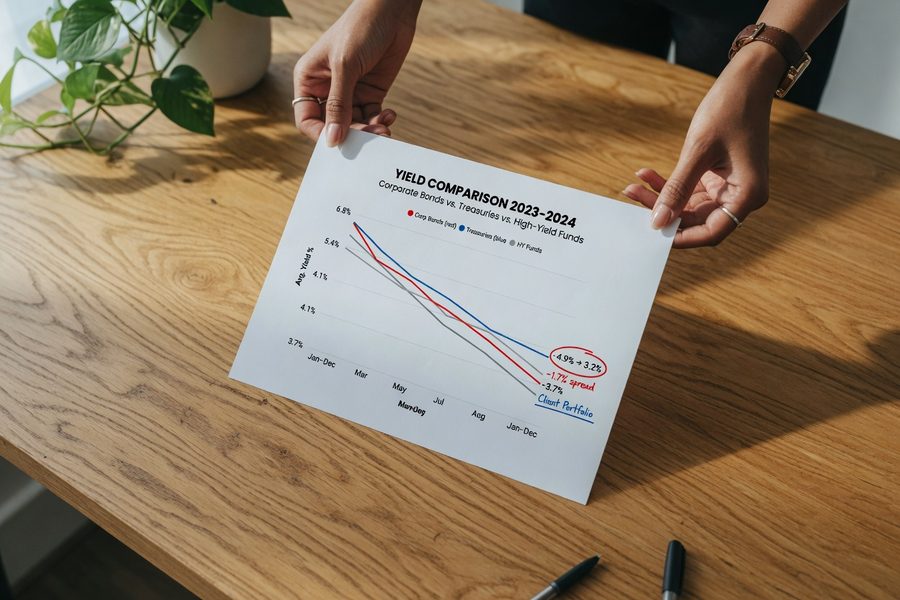
Core deposits at U.S. commercial banks, a category that includes money market deposit accounts, grew at a 4% rate through the first three quarters of 2025, according to the Federal Reserve Bank of St. Louis. That growth reflects households actively shifting cash toward higher-yield deposit products.
Step 4: The Real Pros and Cons Before You Commit
Money market accounts are genuinely useful for a specific range of financial situations, but they are not the right answer for everyone or every dollar. The honest version of this analysis requires naming both sides clearly.
What Works in Their Favor
The main advantages are safety, yield, and flexibility. Deposits are federally insured. Rates at competitive institutions significantly exceed what traditional savings or checking accounts pay. And unlike a CD, there is no penalty for withdrawing your money before a set date. For an emergency fund or a savings goal with a timeline under two years, that combination is hard to beat. If you are building the kind of cash cushion described in our article on savings priorities and long-term financial goals, an MMA can serve as a productive holding place while you direct primary contributions elsewhere.
The Honest Limitations
MMAs are not for long-term wealth building. A 4.00% APY, while solid by deposit account standards, is below the long-term average return of a diversified stock portfolio. Anyone investing with a horizon of five years or more is likely better served by brokerage accounts or retirement vehicles. For guidance on moving from savings into actual investing, the beginner’s guide to investing with zero experience walks through the transition clearly.
The other real limitation is fee exposure. Many accounts charge a monthly maintenance fee of $10–$25 that is waived only if you maintain a required minimum daily balance. If your balance dips, due to a car repair, a medical bill, or even an automatic transfer you forgot, the fee can wipe out weeks of earned interest. On a $1,000 balance earning 4.00% APY (about $3.33/month), a $12 monthly fee turns a gain into a $8.67 monthly loss. That math gets worse the lower the balance.
Automatic bill-pay and recurring transfers are a common trigger for unexpected minimum-balance violations. If you set up automatic payments from your MMA and a large withdrawal hits on the same day your balance is near the minimum, you may trigger a fee that month. Consider using a dedicated checking account for automatic payments and keeping your MMA balance strictly above its required threshold.
Step 5: Key Features and Fine Print That Affect Everyday Use
The advertised rate is only part of the story. The practical experience of using an MMA daily depends on a set of features, and restrictions, that most account holders discover only after opening.
Transaction Limits: Still Real, Still Relevant
Even though the Federal Reserve removed the mandatory six-transfer limit under Regulation D in 2020, most banks and credit unions have retained their own internal limits on electronic transfers, checks, and debit transactions from MMA accounts, typically six per statement cycle. Exceeding those limits can trigger per-transaction fees (often $10–$15 each), a temporary account freeze, or conversion of the account to a non-interest-bearing checking account. In practice, institutions vary in how consistently they enforce these limits, but assuming your bank will look the other way is a costly assumption. Read the account agreement to confirm what applies to your specific account.
Check-Writing, Debit Cards, and ATM Access
Not all MMAs offer the same access features. Some accounts include both a debit card and a checkbook; others provide only one or neither. Online-only institutions, which often carry the highest rates, sometimes restrict access to ACH transfers alone, with no physical check or debit card option. If check-writing or in-person cash access matters to you, confirm those features are included before applying, they are worth trading a few basis points for if your situation requires them.
One area where traditional banks hold a genuine edge over online-only MMAs is dispute resolution and customer service. If a transaction is posted in error or your account is flagged for fraud, reaching a human at a brick-and-mortar institution is typically faster and less frustrating than navigating an online bank’s support queue. That convenience gap is real, even if it does not show up in a rate comparison table.
Joint Accounts, Beneficiaries, and Estate Planning
MMAs can be opened as joint accounts, and doing so doubles the effective FDIC coverage at a single institution to $500,000 for that account type. You can also designate payable-on-death (POD) beneficiaries, which allows the account to transfer outside of probate. Each named beneficiary in a POD arrangement is treated as a separate ownership category by the FDIC, extending coverage further. This is a feature that very few comparisons mention, but it has meaningful implications for households with larger balances or anyone doing basic estate planning.

Step 6: How to Choose and Open the Right Account for You
Choosing the right MMA comes down to four variables: rate, minimum balance requirement, fee structure, and access features. Work through them in that order, and most candidates will eliminate themselves.
Shopping and Comparison Checklist
Start by filtering for accounts with no monthly fee or a fee that is realistically waivable given your expected balance. Then compare the actual rate you will earn at your deposit amount, not the top-tier advertised rate. A few specific questions to answer before applying:
- What is the minimum opening deposit?
- What daily balance is required to waive the monthly fee?
- Is the advertised APY available at my expected balance, or only above a higher threshold?
- Are check-writing and debit card access included?
- How many transactions per cycle are permitted before fees apply?
- Is this a promotional rate that expires, or the ongoing standard rate?
Documents and Application Process
Opening an MMA, whether online or at a branch, requires a government-issued photo ID (driver’s license or passport), your Social Security number, and a funding source (routing and account number for an ACH transfer, or a check for in-branch applications). Online applications typically take 10–15 minutes and fund within one to three business days via ACH. Branch applications can fund same-day with a check or cash deposit.
Red Flags During Shopping
Be cautious of any MMA advertising a rate significantly above the market (above 5.00% APY as of early 2026) without a clear explanation of conditions. Promotional rates that drop sharply after 90 days, accounts with no published fee schedule, and institutions that cannot quickly confirm their FDIC or NCUA status online are all reasons to keep looking. Confirm insurance status directly at FDIC.gov or NCUA.gov before funding any account.
If you are also considering putting some savings to work more actively, understanding the risk spectrum helps. Our overview of cryptocurrency investment risks and benefits illustrates why federally insured deposit accounts occupy a fundamentally different risk category from speculative assets.
If you are building an emergency fund from scratch, consider opening the MMA with a direct deposit split. Many employers allow you to direct a fixed dollar amount to a second account each pay period. Even $100 per paycheck routed directly into an MMA compounds quietly without requiring active transfers. If boosting income is part of your savings plan, check the current list of $19+ hourly jobs hiring now for ways to accelerate your deposit rate.

Frequently Asked Questions
What is the difference between a money market account and a money market fund?
A money market account is a federally insured deposit account held at a bank or credit union, covered by the FDIC or NCUA up to $250,000. A money market fund is an investment product sold by brokerage firms; it carries no federal deposit insurance and can, in rare cases, lose value. The FDIC explicitly distinguishes these two products, noting that money market mutual funds are not insured deposits. If safety is your priority, the distinction matters enormously.
How much money do I need to open a money market account?
Minimums vary significantly. Some online banks offer MMAs with a $0 minimum opening deposit; traditional banks and credit unions more commonly require $500 to $2,500 to open, and some premium accounts require $10,000 or more to earn the advertised rate. The opening minimum and the ongoing minimum balance to avoid fees are often different numbers, always check both before applying.
Is my money safe in a money market account if a bank fails?
Yes, up to the applicable limit. Money market deposit accounts are protected by FDIC deposit insurance up to $250,000 per depositor per ownership category at insured banks, and by equivalent NCUA share insurance at federally insured credit unions. No depositor has lost insured funds in an FDIC-insured bank failure. Balances above the coverage limit are at risk, which is why joint accounts and POD beneficiary designations can extend effective coverage for larger balances.
Can I use a money market account as my main checking account?
Technically possible, but generally inadvisable. MMAs typically limit certain electronic transfers and check/debit transactions to a set number per statement cycle, and exceeding that cap can trigger fees or account conversion. For regular bill pay, payroll deposits, and daily spending, a dedicated checking account is more practical. The better use case for an MMA is as a higher-yield holding account for your emergency fund or near-term savings goal, separate from your primary transactional account.
What happens if the Fed cuts rates, will my MMA rate drop?
Almost certainly, yes. MMA rates are variable and typically follow the federal funds rate with a short lag, sometimes within weeks of a Fed announcement. This is the most important trade-off versus a fixed-rate CD. If you want to lock in today’s yield for a defined period, a six- or twelve-month CD is more appropriate, though it sacrifices liquidity. If you value access over yield stability, the MMA is still the right choice, with the understanding that the rate you earn today may not be the rate you earn six months from now.
Are there limits on how many times I can withdraw from a money market account?
Most banks and credit unions still impose their own limits on certain withdrawals and transfers from MMAs, typically six per statement cycle for electronic transfers, checks, and debit card transactions, even though the Federal Reserve removed the regulatory requirement under Regulation D in 2020. Exceeding those limits can result in per-transaction fees, a temporary hold on transactions, or conversion of the account to a checking account that earns little or no interest. ATM cash withdrawals and in-person teller transactions are usually excluded from the count, but confirm this with your specific institution.
Should I put my emergency fund in a money market account or a high-yield savings account?
Either can work well, and the right choice depends on how you expect to access the money. If you want the ability to write a check or use a debit card directly from the account in an emergency, an MMA is the better fit. If you are comfortable with a two- to three-day ACH transfer when needed, a high-yield savings account often carries comparable or slightly higher rates with lower minimum-balance requirements. For most people building their first emergency fund, the access features of an MMA provide genuine peace of mind worth a few basis points of rate difference.
Do I pay taxes on money market account interest?
Yes. Interest earned in an MMA is taxable as ordinary income in the year it is credited, at your federal and applicable state income tax rate. Your bank or credit union will issue a Form 1099-INT if you earn $10 or more in interest during the calendar year. There is no special tax treatment for MMA interest, it is treated the same as interest from a savings account or CD. If you are approaching a major tax filing and want to understand credits you may be missing, our guide on free IRS tax help and overlooked credits is worth reviewing.
What is the best way to use a money market account alongside other savings goals?
Use your MMA as the holding account for your liquid emergency fund, typically three to six months of essential expenses, and for any savings goal with a target date under two years. For longer-term goals, the opportunity cost of keeping money in a deposit account instead of a diversified investment portfolio becomes meaningful over time. A common approach is to keep your emergency reserve in the MMA, CD-ladder the next tier of near-term savings for slightly higher fixed yields, and direct anything beyond that toward tax-advantaged retirement accounts. The MMA is the foundation, not the whole structure.
Sources
- Consumer Financial Protection Bureau, What Is a Money Market Account?
- Federal Deposit Insurance Corporation, Deposit Accounts Consumer Resource
- Federal Deposit Insurance Corporation, Understanding Deposit Insurance
- Federal Deposit Insurance Corporation, Money Market Deposit Accounts vs. Money Market Mutual Funds
- National Credit Union Administration, Share Insurance Coverage
- Board of Governors of the Federal Reserve System, Economic Well-Being of U.S. Households in 2024: Savings and Investments
- Federal Reserve Bank of St. Louis, Banking Analytics: Core Deposit Growth Accelerated in 2025
- Federal Deposit Insurance Corporation, Deposit Insurance Overview