
Fact-checked by the MyFinancial101 editorial team
Quick Answer
Buying mortgage points means paying upfront cash at closing to permanently lower your interest rate, typically 0.125%–0.375% per point depending on the lender. One point costs 1% of the loan amount. To decide if it is worth it, calculate your break-even period (point cost divided by monthly savings), confirm you will stay past that date, and always request a zero-point quote first to establish a true baseline.
Buying mortgage points is a concrete, calculable decision, not a gut call. You pay a lump sum at closing in exchange for a permanently lower interest rate, and the math either works in your favor or it does not. At April 2026 rates of approximately 6.37% on a 30-year fixed loan, one discount point on a $400,000 purchase costs $4,000 and buys roughly 0.25% off your rate, saving about $60 per month and producing a raw break-even of around 5.6 years. Whether that trade makes sense for your situation is a different question entirely, and one this guide will answer with specifics.
The stakes are higher right now than they have been in years. A CFPB data spotlight on discount point trends found that the share of homebuyers paying discount points roughly doubled from 2021 to 2023 as rates climbed. Many of those buyers did not fully understand what they were purchasing. With several economists forecasting 30-year fixed rates falling to the 5.50%–6.00% range by late 2026, the refinancing question now sits at the center of every points decision, because points you cannot keep long enough to recoup are simply money left on the lender’s table.
This guide is for anyone preparing to buy or refinance a home in 2026 who wants a clear framework for evaluating discount points before they sign a Loan Estimate. By the end, you will know exactly how to calculate your break-even, when the math clearly works, when it clearly does not, and which alternatives, including seller-paid buydowns, often deliver a better outcome with less risk.
Key Takeaways
- One mortgage point costs 1% of the loan amount and typically reduces your rate by 0.125%–0.375% depending on the lender, the rate reduction is not standardized, which is why shopping multiple lenders matters. (CFPB guidance on discount points)
- The share of homebuyers paying discount points roughly doubled from 2021 to 2023, with the sharpest increases among FHA borrowers, according to CFPB HMDA research.
- Discount points paid on a primary home purchase are generally fully deductible in the year paid for itemizers, but points on a refinance must be deducted ratably over the life of the loan, per IRS Topic No. 504.
- Total points and fees on Qualified Mortgage loans cannot exceed 3% of the loan amount, establishing a regulatory ceiling under Fannie Mae’s Selling Guide eligibility rules.
- For buyers putting down less than 20%, redirecting $4,000 from a point purchase into a larger down payment can eliminate or reduce PMI costs of 0.5%–1.5% annually, often a better per-dollar return with no break-even timeline required.
- A seller-paid 2-1 temporary buydown costs the buyer nothing upfront and, if the buyer refinances before year three, any unused escrow funds are returned, making it a structurally lower-risk alternative in a falling-rate environment.
In This Guide
- Step 1: What Are Mortgage Points and What Do They Actually Do?
- Step 2: How Does the Rate-Reduction Math Actually Work?
- Step 3: How Do I Calculate My Break-Even on Buying Points?
- Step 4: When Is Buying Mortgage Points Worth It, and When Is It Clearly Not?
- Step 5: Permanent Buydown vs. Temporary Buydown, Which Fits 2026?
- Step 6: How Do I Use the Seller-Paid Points Strategy Most Buyers Miss?
- Step 7: Are Mortgage Points Tax Deductible, and How Should I Shop for Them?
- Frequently Asked Questions
Step 1: What Are Mortgage Points and What Do They Actually Do?
Mortgage discount points are prepaid interest. You pay a lump sum at closing to reduce the interest rate on your loan for its entire remaining term. One point equals 1% of the loan amount: on a $400,000 mortgage, one point costs $4,000. This payment does not reduce your loan balance, does not count toward your down payment, and does not build equity. It exclusively buys a lower rate.
Discount Points vs. Origination Points
The most costly confusion in the mortgage process is treating discount points and origination points as the same thing. They are not. Discount points are optional; you choose to pay them in exchange for a rate reduction. Origination points are lender fees for processing the loan. They compensate the lender and do not lower your rate at all. Both appear on your Loan Estimate, sometimes in the same line items in Section A, which is exactly why borrowers conflate them.
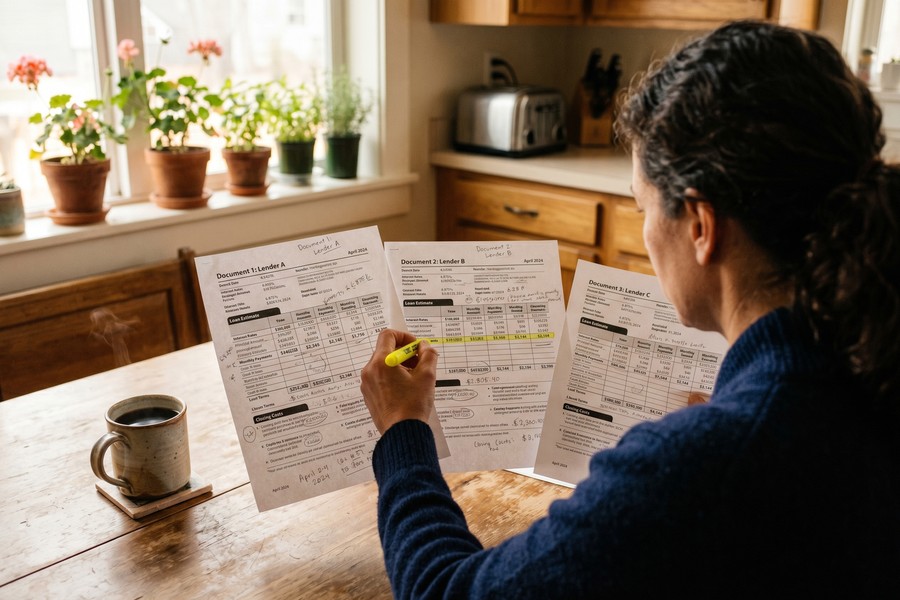
Before you can evaluate whether buying points makes sense, you must confirm from your lender in writing that any points listed on your Loan Estimate are discount points that reduce your rate, not origination fees dressed in similar language. The CFPB’s guidance on discount points and lender credits is explicit: points lower your interest rate in exchange for paying more at closing, and any points that do not reduce your rate are simply fees.
Lender Credits: The Mirror Image
Lender credits are the opposite of discount points. You accept a higher interest rate in exchange for receiving a cash credit that reduces your closing costs. If points are “negative credits,” then credits are “negative points.” This matters because the decision is not binary. The full range runs from paying multiple points for the lowest possible rate to accepting lender credits for a higher rate with minimal out-of-pocket costs at closing. Your best position on that spectrum depends entirely on your time horizon and cash position.
Points are classified as prepaid interest by the IRS, not as a loan fee or down payment contribution. This distinction matters for tax purposes: points paid on a home purchase may be deductible in full the year you pay them, while most other closing costs are not deductible at all, per IRS Publication 936.
Step 2: How Does the Rate-Reduction Math Actually Work?
The rate reduction you get per point is not a fixed industry standard. It varies from lender to lender, and that variability is one of the most important facts about buying mortgage points that most competing guides never address. Depending on the lender’s pricing model and current market conditions, one point might buy you anywhere from 0.125% to 0.375% off your rate. Assuming 0.25% per point is common, but it can be badly wrong.
How to Do This
Start with a concrete example using April 2026 numbers. On a $400,000 30-year fixed loan at a baseline rate of 6.37%, one discount point costs $4,000. If that point buys 0.25% off the rate, your new rate is 6.12%. The principal and interest payment drops from approximately $2,494 to $2,434, saving about $60 per month. At that pace, you recoup $4,000 in roughly 67 months, or about 5.6 years.
Now consider what happens when a different lender offers only 0.125% per point. Your payment drops by roughly $30 per month, and break-even stretches to about 11 years, nearly double. A third lender offering 0.375% per point cuts break-even to around 3.5 years. You paid the same $4,000 each time. The rate reduction you received determines whether that was a reasonable trade or a poor one, and the only way to find out is to request quotes from multiple lenders at the same point purchase level and compare them side by side on the Loan Estimate.
What to Watch Out For
Diminishing returns are real. Buying a second or third point often delivers a smaller rate reduction per point than the first, because lenders price the steepest discounts on the first point. By the time you are considering three or more points, the incremental rate benefit per dollar spent is typically weaker, which pushes break-even further out. Most experienced mortgage professionals will tell you the value curve bends sharply after two points.

Some lenders advertise low rates that are only available with discount points already baked into the pricing, without making that clear upfront. Any points listed in Section A of your Loan Estimate must, by law, reduce your interest rate. If a lender cannot confirm this in writing, request a zero-point quote and compare it to the advertised rate before proceeding.
Step 3: How Do I Calculate My Break-Even on Buying Points?
The break-even calculation for buying mortgage points is straightforward: divide the total cost of the points by the monthly payment savings. The result is the number of months you must keep the loan before the points pay for themselves. If you sell or refinance before that date, you lose the unrecouped portion of the points cost with no recovery option.
How to Do This
The formula is: Cost of Points / Monthly Payment Savings = Break-Even Months.
Scenario A, the case where it makes sense: You are buying a $500,000 home, putting down 20%, and financing $400,000 on a 30-year fixed loan. You plan to stay at least 10 years and have strong reason to believe you will not refinance. At 6.37%, you pay one point ($4,000) for a 0.30% rate reduction to 6.07%. Monthly payment drops by approximately $73. Break-even: 4,000 / 73 = 54.8 months, or about 4.6 years. With a 10-year horizon, you are well past break-even and the points save you meaningful money.
Scenario B, the case where it does not make sense: You are buying a starter home with a $250,000 loan and expect to upsize in five years. You pay one point ($2,500) for a 0.20% rate reduction, saving $29 per month. Break-even: 2,500 / 29 = 86 months, or about 7.2 years. You plan to move in five years. You will never reach break-even, and you have already spent $2,500 with nothing to show for it.
The Refinancing Wildcard
The break-even formula assumes you keep the loan untouched. In April 2026, with multiple economists projecting 30-year fixed rates dropping to the 5.50%–6.00% range by year end, a meaningful share of buyers who purchase points today will refinance within 18 to 24 months. That is well before any break-even calculation clears. If you refinance at 5.75% in 18 months, any unrecouped points cost, which could be $3,500 or more out of the original $4,000, is simply gone. The points did not transfer to the new loan.
The Opportunity Cost the Formula Ignores
The standard break-even calculation treats the points cost as money that either gets recouped through interest savings or gets lost. But that cash has an alternative use. At an assumed 7% annual return in a broad index fund, $4,000 invested today grows to approximately $5,600 over 5.6 years, the same timeline as the raw break-even on one point. Points only “win” the comparison if you stay well past break-even and forgo other investment opportunities.
For buyers putting down less than 20% on a conventional loan, there is an even more direct alternative. PMI typically costs 0.5%–1.5% of the loan amount annually. Redirecting the points cash toward a larger down payment can, in some cases, push the loan-to-value below 80% and eliminate PMI entirely. That is a guaranteed annual cost reduction with no break-even requirement and an immediate equity benefit, frequently a better per-dollar outcome than discount points. If your situation involves PMI, run both calculations before making any decision about buying points. You can also review how to stop overpaying on high-cost financial products for related principles that apply here.
According to the CFPB’s data spotlight on discount points, borrowers only benefit from paying discount points if they keep the mortgage past the break-even period, and that discount points are less useful for cash-strapped borrowers or those who expect to move or refinance soon.
| Scenario | Loan Amount | Rate Reduction per Point | Monthly Savings | Break-Even | 10-Year Verdict |
|---|---|---|---|---|---|
| Long-term buyer, strong lender pricing | $400,000 | 0.375% | $89/mo | ~45 months (3.7 yrs) | Buy points, clear win |
| Long-term buyer, average lender pricing | $400,000 | 0.25% | $60/mo | ~67 months (5.6 yrs) | Buy points, marginal win |
| 5-year mover, average lender pricing | $400,000 | 0.25% | $60/mo | ~67 months (5.6 yrs) | Do NOT buy, never reaches break-even |
| Likely refinancer, low lender pricing | $400,000 | 0.125% | $30/mo | ~133 months (11 yrs) | Do NOT buy, break-even unreachable |
| PMI elimination alternative | $400,000 at 19% down | N/A | PMI savings ~$167/mo | Immediate (no break-even) | Redirect cash to down payment instead |
Step 4: When Is Buying Mortgage Points Worth It, and When Is It Clearly Not?
Buying mortgage points makes financial sense in a specific, narrow set of circumstances. Outside those circumstances, the same cash almost always has a better use. The honest answer is that for most buyers in April 2026, with refinancing odds elevated by a forecast rate decline, the case for paying permanent discount points is weaker than it has been at any point in the past three years.
The Concrete “Yes” Profile
Points are worth considering when all of these conditions are true: you are buying with a fixed-rate loan on a home you expect to own for at least seven to ten years, your cash reserves are fully intact after the down payment and points cost (meaning emergency fund untouched), you are highly confident you will not refinance before break-even, and you have shopped enough lenders to confirm the rate reduction per point is at or above 0.25%. In this profile, the math is clear and the downside is limited.
The Concrete “No” Profile
Points are almost certainly the wrong choice when any of the following apply. You are buying a starter home or plan to upsize within five years. You are cash-constrained at closing, because points should never come at the expense of your emergency fund or a down payment large enough to avoid PMI. You are taking an adjustable-rate mortgage, because the rate discount only applies during the fixed introductory period, not after the rate adjusts. You expect to refinance within 18 to 24 months, which in the current April 2026 rate environment is a reasonable expectation for a large share of buyers.
A Consumer Protection Issue Worth Naming
The CFPB’s research on discount point trends found that a disproportionately high share of FHA borrowers with sub-640 credit scores were buying discount points, a pattern consistent with lenders steering borrowers toward points to reduce the debt-to-income ratio enough to qualify for the loan. If a lender is suggesting points as part of the qualification strategy rather than as an option you independently evaluated, that is a flag worth examining. Points are a financial tool you should choose after running the numbers, not a lender-driven workaround to clear approval thresholds.
The same CFPB research noted that in volatile rate environments, lenders were at times not offering an undiscounted rate to applicants at all, effectively making points a hidden default rather than a transparent option. This makes comparison shopping not just helpful but necessary. Understanding how to manage other forms of high-cost financial obligation, such as negotiating credit card debt effectively, uses the same principle: know the baseline before agreeing to any terms.

Before agreeing to any points, ask your loan officer for three quotes on the same loan: one at zero points, one at one point, and one at two points. Compare both the rate reduction and the break-even on each. This takes less than 24 hours to obtain and is the only reliable way to evaluate whether the points on offer represent genuine value or inflated pricing.
Step 5: Permanent Buydown vs. Temporary Buydown, Which Fits 2026?
Permanent discount points and temporary buydowns are both called “buydowns,” but they serve entirely different purposes and carry different risk profiles. Conflating them is one of the most common mistakes buyers make when entering negotiations in 2026’s softening market.
How to Do This
A permanent buydown is what most of this guide covers: you pay points at closing to reduce your interest rate for the full loan term. The rate reduction never expires. You are the one who typically pays for it, and you need to stay well past break-even to realize the benefit.
A temporary buydown, the most common structure being the 2-1 buydown, works differently. Your payment is calculated as if your rate were 2% lower in year one and 1% lower in year two. In year three and beyond, the rate resets to the full note rate on your loan. The seller or builder typically funds this by depositing cash into an escrow account at closing. For a $400,000 loan at 6.37%, a 2-1 buydown brings your effective rate to 4.37% in year one and 5.37% in year two, before returning to 6.37% in year three. The buyer pays nothing extra for this; the seller’s concession funds the escrow.
Why the 2-1 Buydown Fits 2026
The 2-1 buydown has become a dominant negotiating tool in 2026 because sellers in a softening market prefer offering concessions to cutting the purchase price, which would negatively comp nearby properties. Buyers get their largest payment relief in years one and two, when budgets are typically tightest. And here is the detail that almost no competing guide explains: if rates drop as forecast and the buyer refinances in year one or two, any unspent funds sitting in the buydown escrow account are returned to the buyer or applied to the loan balance. The downside is limited; the buyer bears no unrecoverable cost.
What to Watch Out For
The 2-1 buydown’s honest risk is straightforward. If rates do not fall and the buyer does not refinance before year three, the payment jumps sharply back to the full note rate. On a $400,000 loan, that jump from the year-two effective rate back to 6.37% adds roughly $200 per month to the payment. That is a real budget shock if the buyer planned on rates declining and they did not. The 2-1 buydown is a bet on rate movement, structured with the buyer’s interests in mind, but not a free lunch.
Step 6: How Do I Use the Seller-Paid Points Strategy Most Buyers Miss?
In a buyer’s market, sellers can fund discount points or temporary buydowns as a concession. For the buyer, seller-paid points are far more attractive than buyer-paid points because the buyer assumes no out-of-pocket cost while still receiving the rate reduction benefit.
How to Do This
Here is the negotiation math that most buyers never run. Suppose a seller offers either a $10,000 price reduction or a $10,000 seller concession directed toward a rate buydown. The price reduction saves you $10,000 minus what you borrowed against it: on a $400,000 loan at 6.37%, a $10,000 price reduction lowers your payment by about $62 per month. By contrast, $10,000 applied as two and a half discount points (assuming a 0.25% rate reduction per point) cuts your rate by 0.625%, saving approximately $150 per month. Over ten years, the buydown approach saves roughly $18,000 more in payments than the price cut, while the seller nets the same amount either way.
The seller avoids reducing the sale price, which protects comparable home values in the neighborhood. The buyer gets a lower rate without touching their cash reserves. Both parties can structure this as a win when seller concession limits allow it.
Loan-Type Concession Limits You Must Know
Seller concessions are capped by loan type, and exceeding them can kill a deal or require restructuring. For FHA loans, sellers can contribute up to 6% of the purchase price in concessions. For conventional loans, the limit ranges from 3% to 9% of the purchase price depending on down payment size: 3% for down payments under 10%, up to 9% for down payments of 25% or more. For VA loans, sellers can cover standard closing costs without a firm percentage cap, though a 4% limit applies to certain non-standard items. Know your loan type’s ceiling before you negotiate, because a seller concession that exceeds the limit simply cannot be applied to your transaction.
When making an offer, ask your real estate agent to explicitly frame seller-paid points or a 2-1 buydown as a concession alternative to a price reduction. Most listing agents will present this to sellers as a comparable net outcome for them, and many sellers prefer it because it does not publicly reduce the recorded sale price.
Step 7: Are Mortgage Points Tax Deductible, and How Should I Shop for Them?
Discount points paid on a primary home purchase are generally fully deductible in the year you pay them, provided you itemize deductions. The elevated standard deduction introduced by the Tax Cuts and Jobs Act of 2017 means fewer borrowers itemize than in prior decades, which reduces or eliminates this tax benefit for many households.
How the IRS Treats Points
According to IRS Topic No. 504, discount points on a home purchase qualify as deductible prepaid interest if the cash-method conditions are met: the loan is secured by your main home, paying points is an established practice in your area, and the points are computed as a percentage of the loan principal. The deduction is taken in the year of closing. Points paid on a refinance, or on a second home, do not qualify for the same immediate deduction. Instead, they must be deducted ratably over the life of the loan, per IRS Publication 936.
This creates a meaningful difference in after-tax break-even between purchase and refinance scenarios. On a purchase, the full deduction accelerates the effective cost recovery into year one, shortening the true after-tax break-even. On a refinance, you recover about 1/30th of the deduction annually on a 30-year loan, barely material. If you do not itemize at all, neither scenario provides a tax benefit, and the raw break-even calculation stands unchanged.
How to Shop for Points Correctly
Request a zero-point Loan Estimate from every lender you contact. This is your baseline. Then ask for the same loan with one point and with two points, and compare the rate reduction offered per point across lenders. Because the rate reduction per point varies from 0.125% to 0.375% across the market on the same day for the same loan profile, the only way to judge whether a lender’s points are priced fairly is to see the full rate-point schedule and compare it against at least two competitors.
Check the Loan Estimate carefully. Any discount points must appear in Section A (“Origination Charges”) and must be paired with a corresponding rate reduction. If a lender’s points appear to be fees without a rate benefit, ask for written confirmation of the rate each point is purchasing. If the answer is unclear, that is reason enough to walk away and request quotes elsewhere. Managing your overall cost of borrowing is part of a broader financial picture; understanding your investment alternatives for any upfront cash is equally worth doing before committing to points.
The Fannie Mae Selling Guide caps total points and fees on Qualified Mortgage loans at 3% of the loan amount. If you are being asked to pay more than this, the loan may not conform to standard guidelines, and you should verify whether the fees are legitimate before proceeding.
For buyers managing broader financial priorities, the same discipline applied to mortgage decisions, understanding what you are paying, who benefits, and what the alternatives cost, applies to other major expenses as well. If you are budgeting around a home purchase and managing multiple financial obligations, resources on prioritizing long-term savings goals can help you frame the opportunity cost question more clearly.
Frequently Asked Questions
How many mortgage points should I buy on a 30-year fixed loan?
For most buyers, buying one to two discount points is the reasonable upper limit, and only if your break-even falls comfortably inside your expected ownership period with a margin of at least two to three years. Beyond two points, diminishing returns typically kick in: each additional point buys a smaller rate reduction than the one before it, pushing break-even further out. Always request quotes at zero, one, and two points and calculate the break-even at each level before deciding.
Should I buy points if I might refinance in the next two years?
No. If there is a meaningful chance you will refinance within two to three years, buying discount points is almost certainly a losing trade. At April 2026 rates with multiple economists forecasting a decline to the 5.50%–6.00% range by year-end, many buyers will likely refinance well before a 5- to 7-year break-even clears. Any unrecouped points cost is permanently lost when you refinance, because points do not transfer to the new loan. The CFPB advises that buyers evaluate points across multiple time horizons, including the realistic refinancing scenario.
What is the difference between buying points and a 2-1 buydown?
Buying discount points permanently reduces your interest rate for the entire loan term; you typically pay for it yourself at closing. A 2-1 buydown temporarily reduces your payment in years one and two only, then resets to the full note rate in year three; it is usually funded by the seller or builder as a concession, costing the buyer nothing out of pocket. The 2-1 buydown is generally the better choice in a softening market where seller concessions are available and where buyers expect to refinance before the reset.
Can the seller pay for mortgage points on my behalf?
Yes, and this is one of the most underused strategies in a buyer’s market. Sellers can fund discount points or a temporary buydown as a closing cost concession, subject to loan-type limits: up to 6% of purchase price on FHA loans, 3%–9% on conventional loans depending on down payment size, and no firm percentage cap on standard VA closing costs. Seller-paid points deliver the same rate benefit to the buyer with zero out-of-pocket cost, making them structurally superior to buyer-paid points in any scenario where seller concessions are negotiable.
Are mortgage discount points tax deductible in 2026?
Discount points paid on a primary home purchase are generally fully deductible in the year paid for borrowers who itemize deductions, per IRS Topic No. 504. Points on a refinance must instead be deducted ratably over the life of the loan. However, the elevated standard deduction, $30,000 for married filing jointly in 2026, means many households do not itemize, eliminating the tax benefit entirely. If you do not itemize, the points deduction does not factor into your break-even calculation.
Should I use the money for mortgage points or to eliminate PMI?
If you are putting down less than 20% on a conventional loan, eliminating PMI by redirecting points cash to a larger down payment is often the better financial choice. PMI costs 0.5%–1.5% of the loan amount annually; on a $400,000 loan, that is $2,000–$6,000 per year. Eliminating it produces an immediate, guaranteed annual savings with no break-even period and an equity benefit. By contrast, discount points require you to stay past break-even, which may be five years or more. Run both scenarios with your specific numbers before committing to either.
How do I know if a lender is giving me a fair price on discount points?
Request a Loan Estimate at zero points from at least three lenders, then ask each for the same loan at one and two points. Compare how much rate reduction each lender offers per point, a fair range is 0.125%–0.375%, with 0.25% being common. A lender offering only 0.125% per point is delivering half the value of one offering 0.375%, at the same cost to you. The rate reduction per point varies significantly across lenders on the same day for the same loan profile, and the only protection is side-by-side comparison on standardized Loan Estimates.
What happens to unused 2-1 buydown escrow funds if I refinance early?
If you refinance before the 2-1 buydown escrow is fully used, the remaining funds are returned to you or applied to your loan balance. They are not forfeited to the lender or seller. This is a material upside that makes the seller-paid 2-1 buydown strategy particularly attractive in a falling-rate environment: the buyer gets maximum payment relief in the early years, and if rates drop and refinancing follows, the unused escrow comes back. The downside is primarily limited to the rate-reset risk if refinancing does not occur before year three.
Is buying mortgage points worth it on an ARM loan?
Generally, no. On an adjustable-rate mortgage, the discount rate applies only during the fixed introductory period, typically five or seven years. Once the rate adjusts, the original points purchase has no effect on your payment. Given that ARMs are already priced lower than fixed-rate loans in most market conditions, and that the rate will change regardless of what you paid at closing, buying points on an ARM is rarely cost-effective and can result in a break-even that you never reach.
For broader context on managing financial decisions when income or budget flexibility is a factor, reviewing current affordability thresholds and income benchmarks in 2026 can help frame whether points make sense given your specific financial position.
Sources
- Consumer Financial Protection Bureau, How should I use lender credits and points (discount points)?
- Consumer Financial Protection Bureau, Data Spotlight: Trends in Discount Points Amid Rising Interest Rates
- Internal Revenue Service, Tax Topic No. 504: Home Mortgage Points
- Internal Revenue Service, Publication 936: Home Mortgage Interest Deduction
- Fannie Mae Selling Guide, B2-1.5-02: Loan Eligibility and Points and Fees Limits
- American Banker, CFPB Eyes Growing Use of Mortgage Rate Buydowns
- Federal Reserve, Selected Interest Rates (H.15), Historical Mortgage Rate Data
- U.S. Department of Veterans Affairs, VA Home Loan Closing Costs and Seller Concessions
- Consumer Financial Protection Bureau, Understanding Your Loan Estimate