
Fact-checked by the MyFinancial101 editorial team
Quick Answer
Most W-2 remote employees cannot claim remote worker tax deductions on federal returns in 2026, the suspension of unreimbursed employee expenses is now permanent. Self-employed and 1099 contractors can deduct home office costs, internet, equipment, and more. The simplified home office method caps at $1,500 per year. New Schedule 1-A deductions for overtime pay and vehicle loan interest are available to W-2 workers regardless of employment type.
Remote worker tax deductions depend almost entirely on how you’re paid. If you receive a W-2, the Tax Cuts and Jobs Act eliminated your ability to deduct unreimbursed employee business expenses starting in 2018, and the One Big Beautiful Bill Act (OBBBA) made that suspension permanent, so there’s no sunset to wait for. Self-employed workers and 1099 contractors still have access to a meaningful set of deductions, including the home office, internet, and equipment write-offs that W-2 employees lost.
The stakes are real. With the 2026 standard deduction set at $16,100 for single filers and $32,200 for joint filers according to IRS guidance, most remote workers won’t itemize at all. But several above-the-line and Schedule 1-A deductions introduced in 2025 and 2026 can reduce taxable income even without itemizing, and most remote workers haven’t heard of them yet.
This guide covers who qualifies, what’s deductible, what’s permanently off the table, and how the 2026 tax law changes affect your bottom line. Whether you’re a full-time freelancer, a hybrid employee, or a salaried remote worker, you’ll leave with a clear picture of what you can actually claim.
Key Takeaways
- W-2 employees cannot deduct home office or unreimbursed work expenses on federal returns, the OBBBA made this suspension permanent, confirmed by the IRS.
- The simplified home office method allows $5 per square foot of dedicated workspace, up to a $1,500 annual cap, available only to self-employed filers per IRS Publication 587.
- New Schedule 1-A deductions allow up to $12,500 single / $25,000 joint for qualified overtime pay, taken below the line even if you claim the standard deduction.
- The SALT cap increased to $40,000 for tax years 2025 through 2029 under the OBBBA, which changes the math on itemizing for homeowners in high-tax states like California and New York.
- Self-employed remote workers must pass both the exclusive use and regular use tests before claiming any home office deduction, per IRS Publication 587.
- Remote employees working across state lines face potential double taxation if their employer’s home state applies a “convenience of the employer” test, New York and Pennsylvania are the primary examples.
In This Guide
- Who Can Claim Remote Worker Tax Deductions in 2026?
- How Does the Home Office Deduction Actually Work?
- Common Expenses Self-Employed Remote Workers Can Deduct
- What Remote Workers Cannot Claim on Federal Taxes
- New 2026 Deductions That Can Benefit Remote Workers
- How to Document Deductions and Stay IRS-Compliant
- State Tax Rules and Multi-State Remote Work Risks
- Frequently Asked Questions
Step 1: Who Can Claim Remote Worker Tax Deductions in 2026?
Employment status is the single factor that determines your federal deduction eligibility. Self-employed individuals, sole proprietors, and 1099 independent contractors retain access to home office deductions, business expense write-offs, and other self-employment deductions. W-2 employees, regardless of whether they work from a kitchen table or a converted garage, are permanently blocked from claiming those same expenses on their federal return.
The W-2 Wall
The IRS states plainly that employees are not eligible to claim the home office deduction. Before 2018, W-2 workers could deduct unreimbursed employee expenses as a miscellaneous itemized deduction. The Tax Cuts and Jobs Act suspended that category entirely, and the OBBBA locked it in permanently. There’s no scheduled expiration date to plan around.
There are narrow exceptions. Armed forces reservists, qualified performing artists, and fee-basis state or local government officials can still deduct certain unreimbursed employee expenses on Schedule 1, Line 12. These categories are specific, if your situation doesn’t match one of those three exactly, the exception does not apply.
Self-Employed and 1099 Workers
If you operate as a freelancer, independent contractor, or sole proprietor, your deductions flow through Schedule C. You can deduct ordinary and necessary business expenses including home office costs, internet, equipment, and professional services. Partnerships and S-corp shareholders who work from home may also qualify under rules outlined in IRS Tax Topic 509, though the mechanics differ from a straight Schedule C.
Being labeled a “remote worker” by your employer does not change your tax classification. If your employer withholds payroll taxes and issues a W-2, you are an employee for federal tax purposes, no deductions for home office or unreimbursed expenses, regardless of your job title or work arrangement.
Step 2: How Does the Home Office Deduction Actually Work?
The home office deduction is available only to self-employed filers, and it requires passing two tests before any calculation begins: the exclusive use test and the regular use test. Meeting only one of them doesn’t cut it.
The Exclusive and Regular Use Tests
The space must be used regularly and exclusively for business. A desk in a bedroom you also sleep in fails the exclusive use test, even if you work there 40 hours a week. A separate room used only for client calls, design work, or product fulfillment typically qualifies. The IRS Publication 587 explains the eligibility rules in detail and covers edge cases like daycare providers and storage spaces that follow slightly different rules.
Your home office must also be your principal place of business, or a place where you regularly meet clients, or a separate structure used exclusively for business. If you rent a coworking space as your primary office and occasionally work from home, the home space likely won’t qualify.
Simplified Method vs. Actual Expense Method
Once you establish eligibility, two calculation methods are available. The simplified method provides a standard deduction of $5 per square foot, up to a maximum of 300 square feet, capping your deduction at $1,500 per year. According to the IRS simplified option page, this approach reduces recordkeeping significantly because you don’t need to track actual home expenses or calculate depreciation.
The actual expense method calculates your deduction as a percentage of total home costs, divide your office square footage by your home’s total square footage, then apply that percentage to deductible home expenses including rent, utilities, mortgage interest, and homeowner’s insurance. For a 150 sq ft office in a 1,500 sq ft home, that’s a 10% allocation. If your annual rent is $24,000, the actual expense method yields a $2,400 deduction versus $750 under the simplified method for the same space. The actual method requires detailed recordkeeping and allows depreciation deductions, which can create a taxable recapture event when you sell the home.
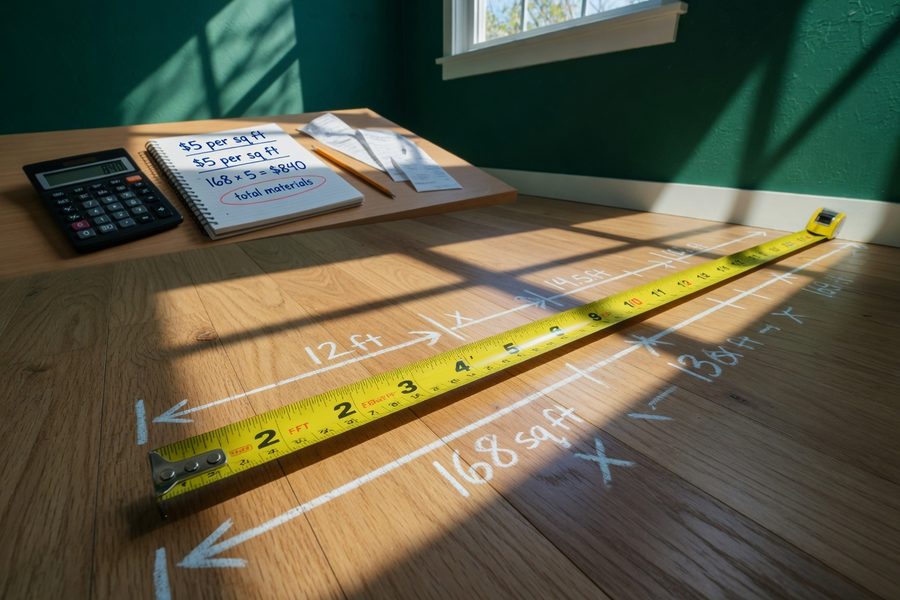
Run both calculations before choosing. In high-rent cities, the actual expense method often yields a substantially larger deduction, but you’ll need 12 months of utility bills, a lease or mortgage statement, and a floor plan showing exact square footage. If your home is modest and your business income fluctuates, the simplified method’s predictability may be worth the smaller deduction.
Step 3: Common Expenses Self-Employed Remote Workers Can Deduct
Beyond the home office, self-employed remote workers have a broader set of ordinary business expenses they can write off on Schedule C, provided those expenses are directly tied to business activity.
Internet service is one of the most commonly claimed deductions. You can deduct the business-use percentage of your monthly bill, if 70% of your internet usage is for work, 70% of the annual cost is deductible. The same logic applies to a phone bill shared between personal and professional use. Deducting 100% of a residential internet plan is aggressive and difficult to defend in an audit unless you have a separate business line. Equipment purchased exclusively for work, a monitor, keyboard, external drive, or webcam, is fully deductible in the year of purchase under Section 179 expensing. Software subscriptions, cloud storage, project management tools, and professional association dues also qualify as ordinary and necessary business expenses. Mileage driven for business purposes (meeting a client, picking up supplies) can be deducted at the standard IRS mileage rate for the year. Commuting to a regular work location is not deductible, but travel to a client site from your home office typically is, since a qualifying home office establishes your principal place of business. If your work involves side income or micro-freelancing gigs, the same Schedule C rules apply to those earnings too.
Self-employed remote workers can also deduct the employer-equivalent portion of self-employment tax, half of what you owe, as an above-the-line deduction on Schedule 1. This reduces your adjusted gross income without requiring itemization, and it’s one of the most overlooked deductions available to freelancers and contractors.
Step 4: What Remote Workers Cannot Claim on Federal Taxes
The list of deductions that are permanently off-limits for W-2 employees is longer than most people expect, and more permanent than the news coverage suggested during the TCJA debates.
The Permanent Suspension of Employee Business Expenses
Home office costs, unreimbursed work supplies, professional dues, and job-related education that doesn’t qualify for other credits, all of these were once deductible as miscellaneous itemized expenses subject to a 2% AGI floor. The OBBBA eliminated any future reinstatement. If your employer requires you to buy your own headset, standing desk, or ergonomic chair and doesn’t reimburse you, that cost is simply gone from a federal deduction standpoint. The IRS confirms that employees cannot claim the home office deduction under any circumstances outside the three narrow occupational exceptions noted earlier.
Personal Commuting and Mixed-Use Spaces
Driving to a coworking space you rent or to your company’s physical office is commuting, not a business travel deduction. A home office that doubles as a guest room, TV room, or kids’ homework station fails the exclusive use test and generates zero deductible square footage. Items your employer reimbursed you for cannot be deducted again personally; that would constitute double-dipping.
The Better Path for W-2 Employees: Accountable Plans
If you’re a W-2 remote worker with legitimate unreimbursed expenses, the right move isn’t a personal deduction, it’s an employer accountable plan. Under an accountable plan, your employer reimburses business expenses tax-free (no payroll tax, no income tax) as long as you document the expense, substantiate the business purpose, and return any excess. This arrangement benefits both parties: you get full reimbursement rather than a partial deduction at your marginal rate, and your employer gets a business expense deduction for the reimbursement. Push your HR department on this before assuming you’re out of options.

| Expense Type | W-2 Employee | Self-Employed / 1099 |
|---|---|---|
| Home Office (dedicated room) | Not deductible (federal) | Deductible, simplified ($1,500 max) or actual % |
| Internet (business %) | Not deductible | Deductible, prorated business-use % |
| Work Equipment / Tech | Not deductible | Fully deductible via Section 179 |
| Cell Phone (business %) | Not deductible | Deductible, prorated business-use % |
| Professional Development | Not deductible (unless meets education credit criteria) | Deductible as ordinary business expense |
| Business Travel (non-commute) | Not deductible | Deductible at IRS mileage rate |
| Employer-Reimbursed Expenses | Tax-free under accountable plan | N/A, cannot deduct reimbursed amounts |
If you’re a W-2 remote worker whose company doesn’t have an accountable plan in place, bring a written proposal to your manager or HR. Outline common remote work expenses, internet stipends, equipment, phone allowances, and note that IRS accountable plan rules make reimbursements tax-free for both parties. Many smaller employers simply haven’t formalized the process; a brief conversation can change your annual tax outcome.
Step 5: New 2026 Deductions That Can Benefit Remote Workers
The OBBBA introduced several deductions in 2025 that are now in full effect for 2026 returns, and some of them apply to W-2 employees, filling a gap left by the permanent loss of employee business expense deductions.
Schedule 1-A: Overtime Pay and Tips Deduction
Qualified overtime pay is now deductible as a below-the-line item on Schedule 1-A, up to $12,500 for single filers and $25,000 for married filing jointly. This deduction phases out at higher income levels, but it is available regardless of whether you take the standard deduction or itemize. For remote workers in hourly roles or salaried positions with overtime provisions, this is a meaningful new reduction in taxable income. The overtime deduction requires that the pay qualify under the Fair Labor Standards Act definition of overtime, not just any extra hours or bonus pay.
Vehicle Loan Interest Deduction
Interest on loans for new U.S.-assembled vehicles originated after 2024 is now deductible up to $10,000 per year on Schedule 1-A. This is a personal deduction, not limited to business use, and applies whether you’re a W-2 employee or self-employed. Remote workers who commute occasionally or use their vehicle for business errands may find this stacks usefully with other deductions.
SALT Cap Increase: New Math for Homeowning Remote Workers
The state and local tax (SALT) deduction cap rose from $10,000 to $40,000 (or $20,000 for married filing separately) for tax years 2025 through 2029. This change phases out for taxpayers with modified AGI above $500,000. For remote workers who own homes in high-tax states like California, New York, or New Jersey, this is a significant shift. Many of these filers previously couldn’t justify itemizing because the $10,000 SALT cap made their total itemized deductions fall short of the standard deduction. At $40,000, that calculation changes, especially when SALT deductions are combined with mortgage interest. It’s worth revisiting your itemization strategy with a tax professional if you own in a high-tax state and haven’t done so since the OBBBA passed.
Step 6: How to Document Deductions and Stay IRS-Compliant
A legitimate deduction you can’t document is a deduction you’ll lose in an audit. The IRS expects contemporaneous records, meaning documentation created at the time of the expense, not reconstructed later.
What to Keep and How
For the home office deduction, maintain a floor plan or sketched diagram showing the office dimensions, copies of your lease or mortgage statements, and 12 months of utility bills. For equipment and software, keep receipts and note the business purpose in writing at the time of purchase. For internet and phone, save monthly statements and document your method for calculating the business-use percentage. A simple spreadsheet noting the date, amount, vendor, and business purpose for each expense is sufficient for most Schedule C filers. Cloud storage with a dedicated folder for tax documents, organized by tax year, makes retrieval straightforward if the IRS ever requests substantiation.
Audit Red Flags for Remote Workers
Deducting 100% of a residential internet or phone bill draws scrutiny. So does a home office deduction in a year when your Schedule C shows a loss, while legally possible in some cases, the IRS watches for the pattern of repeated losses combined with home office claims. Unusually large home office square footage relative to home size, or a deduction for a space that appears to serve multiple household functions, are also common review triggers. The IRS Publication 587 guidance walks through the specific rules that examiners check first.
The IRS simplified home office method caps at $1,500 per year ($5 per sq ft x 300 sq ft maximum). That’s a fixed ceiling, no depreciation, no utility allocation, no recapture risk when you sell. For many freelancers with modest spaces, it’s the most defensible calculation available.
Step 7: State Tax Rules and Multi-State Remote Work Risks
Federal rules set the floor, but state tax treatment for remote workers varies dramatically, and in some states, working from home can trigger tax obligations in states where you’ve never set foot.
The “Convenience of the Employer” Test
New York and Pennsylvania apply a rule called the convenience of the employer test. Under this doctrine, if you work remotely for a New York employer primarily for your own convenience (rather than a business necessity of the employer), New York taxes your income as if you worked in New York, regardless of where you actually performed the work. A remote worker living in Florida who works for a Manhattan company and whose employer has not formally designated their home as a required work location may owe New York state income tax on their entire salary. This is not hypothetical; it’s enforced and litigated regularly. If your employer is based in New York or Pennsylvania and you work remotely from another state, this test warrants a direct conversation with a tax professional who handles multi-state returns.
Double Taxation and Residency Rules
Most states offer a resident credit for taxes paid to another state, which prevents true double taxation in most cases. But the credit process isn’t automatic, it requires filing returns in both states and applying the credit correctly. States without income tax (like Florida, Texas, or Nevada) don’t have a reciprocal agreement to simplify things; you may still owe tax to your employer’s state depending on that state’s sourcing rules. Remote workers who moved during the tax year face a particularly complex situation: partial-year residency in two states, with income allocated between them. If any of this applies to your situation, the preparation steps you take before tax season can significantly reduce errors and penalties.
State Deduction Rules That Differ From Federal
Some states never adopted the TCJA suspension of employee business expenses. California, for example, still allows W-2 employees to deduct unreimbursed employee expenses on the state return, subject to a 2% AGI floor. This means a California-based remote employee who can’t deduct a thing on their federal return may still recover some of those costs at the state level. Check your state’s conformity to federal tax law, it’s one of the most overlooked opportunities in the entire remote work tax picture.
If you relocated to a new state for remote work and didn’t update your employer’s payroll records, you may have had the wrong state’s taxes withheld all year. This doesn’t mean you owe nothing to your new home state, it means you’ll likely owe a balance due there and need to claim a credit for taxes paid to the wrong state. Catch this before filing, not after.
Frequently Asked Questions
Can I deduct my home office if I’m a W-2 employee working remotely full time?
No. W-2 employees cannot claim the home office deduction on their federal return under current law. The OBBBA made the TCJA suspension of unreimbursed employee expenses permanent, with no scheduled expiration. The only exceptions are armed forces reservists, qualified performing artists, and fee-basis government officials. If your employer doesn’t reimburse your home office costs, ask about setting up an accountable plan, that’s the only path to recovering those expenses tax-free.
What’s the difference between the simplified and actual expense method for the home office deduction?
The simplified method gives you $5 per square foot of exclusive-use workspace, capped at 300 sq ft for a maximum deduction of $1,500. The actual expense method calculates the business percentage of your total home costs, rent, utilities, insurance, and depreciation, which can produce a larger deduction but requires more detailed records and creates depreciation recapture when you sell your home. Run both calculations before choosing; in high-rent areas, the actual method often wins by a significant margin.
Can I deduct my internet bill if I work from home?
Self-employed workers can deduct the portion of their internet bill attributable to business use. If 60% of your usage is for work, 60% of the annual cost is deductible on Schedule C. W-2 employees cannot deduct any portion of their residential internet bill on a federal return. Claiming 100% of a residential internet line as a business expense, even for the self-employed, is difficult to sustain in an audit without a separate dedicated business line.
How does the new $40,000 SALT cap affect remote workers who own homes?
The SALT cap increase from $10,000 to $40,000 (for tax years 2025–2029, phasing out above $500k MAGI) makes itemizing worthwhile for far more homeowners in high-tax states. A California homeowner paying $18,000 in state income tax and $12,000 in property taxes, $30,000 total, previously capped at $10,000 under SALT limits. Under the new cap, the full $30,000 is deductible. Combined with mortgage interest, many of these filers can now exceed the 2026 standard deduction of $32,200 for joint filers and benefit from itemizing for the first time since 2017.
What is an accountable plan and how does it help remote employees?
An accountable plan is an employer reimbursement arrangement that meets IRS rules: expenses must have a business connection, employees must substantiate them with documentation, and any excess must be returned. Reimbursements made under a qualifying accountable plan are excluded from the employee’s income entirely, no payroll tax, no federal income tax. This is categorically better than a personal deduction, which would only reduce income at your marginal rate and isn’t available to most W-2 workers anyway. Employers who reimburse without a formal accountable plan risk treating those payments as taxable wages.
I’m a freelancer. Can I deduct equipment I bought for remote work even if I use it occasionally for personal tasks?
You can deduct the business-use percentage of mixed-use equipment. A laptop used 80% for client work and 20% for personal browsing yields an 80% deduction. Section 179 expensing allows you to deduct the full business-use portion in the year of purchase rather than depreciating it over several years. Keep a log or written estimate of your usage breakdown, if the IRS questions the allocation, you’ll need to show your calculation method. Items used exclusively for personal tasks are not deductible at all.
Do I owe taxes in my employer’s state if I work remotely from a different state?
Possibly. States like New York and Pennsylvania apply a “convenience of the employer” test that taxes remote employees on income earned for employers based in those states, even if the work was physically performed elsewhere. If your employer is headquartered in New York and your remote arrangement isn’t formally designated as a business necessity, New York may claim the right to tax your wages. Most states offer a resident credit to offset double taxation, but filing in two states and applying credits correctly requires careful attention. Consult a CPA who handles multi-state returns if this applies to you.
Can I deduct health insurance premiums as a remote worker?
Self-employed workers can deduct 100% of health insurance premiums paid for themselves and their dependents as an above-the-line deduction on Schedule 1, no itemizing required. This applies as long as you weren’t eligible to participate in an employer-subsidized health plan through a spouse’s employer. W-2 employees who pay premiums through payroll typically receive that benefit pre-tax already, through a Section 125 cafeteria plan, so there’s no additional personal deduction available. If you’re managing freelance income alongside employment income and want to understand how these deductions interact with your broader tax picture, reviewing your overall financial priorities can help frame the right approach.
Sources
- IRS, How Small Business Owners Can Deduct Their Home Office From Their Taxes
- IRS, Simplified Option for Home Office Deduction
- IRS, Tax Topic 509: Business Use of Home
- IRS Publication 587, Business Use of Your Home (2025 Returns)
- IRS, About Publication 587, Business Use of Your Home
- IRS, Tax Topic 455: Moving Expenses (reference for multi-state context)
- IRS, Self-Employment Tax (Social Security and Medicare Taxes)
- Pennsylvania Department of Revenue, Personal Income Tax Forms and Information