Fact-checked by the MyFinancial101 editorial team
Quick Answer
A side hustle triggers self-employment tax of 15.3% on net profit, on top of your regular income tax bracket, the moment net earnings hit $400. You must report all income, pay quarterly estimated taxes, and file Schedule C, regardless of whether you receive a 1099 form.
Side hustle taxes follow a different set of rules than W-2 employment, and most first-timers discover this the hard way. According to the IRS’s self-employment tax guidance, any net profit of $400 or more from independent work creates a filing requirement and triggers a 15.3% self-employment tax that W-2 workers simply do not face directly. Per Bankrate’s 2025 Side Hustle Survey, 27% of U.S. adults reported running at least one side hustle, and most of them are operating with an incomplete picture of what they owe.
The income itself is only part of the equation. Quarterly deadlines, new 1099 reporting thresholds, and overlooked deductions that reduce both income and self-employment tax simultaneously make this a genuinely different tax situation, not just a bigger number on the same form.
Key Takeaways
- Self-employment tax runs at 15.3% of net profit the moment earnings clear $400, before a single dollar of income tax is applied, per IRS SE tax rules.
- 27% of U.S. adults reported running at least one side hustle in 2025, according to Bankrate’s Side Hustle Survey, with most unaware of their full tax obligation.
- Side hustlers who expect to owe $1,000 or more for the year must make quarterly estimated payments or face IRS underpayment penalties, per IRS Gig Economy Tax Center guidance.
- Schedule C deductions reduce both the 15.3% self-employment tax and ordinary income tax simultaneously, per IRS Publication 334.
- The QBI deduction under Section 199A, made permanent in 2025, allows sole proprietors to deduct up to 20% of net business income, a benefit unavailable to W-2 employees, per IRS filing guidance.
- The 1099-K reporting threshold drops to $600 for 2026 income, and several states already enforce that level, per IRS Gig Economy Tax Center.
The Self-Employment Tax Nobody Warned You About
A side hustler earning $10,000 in net profit owes roughly $1,530 in self-employment tax before a single dollar of income tax is calculated. That is the blunt starting point. W-2 employees pay only 7.65% because their employer covers the other half of Social Security and Medicare. As a self-employed person, you are both the employee and the employer, so you carry the full load.
The IRS confirms the SE tax rate breaks down as 12.4% for Social Security (applied up to the wage base) and 2.9% for Medicare with no income cap. That 15.3% stacks on top of your ordinary income tax rate. It does not replace it.
There is a partial offset. The IRS allows self-employed individuals to deduct half of the SE tax paid as an above-the-line deduction on Form 1040, which reduces adjusted gross income before income tax is calculated. On a $10,000 net profit, that deduction is roughly $765. Meaningful, but not a reversal of the core cost.
One detail most articles soft-pedal: a profitable side hustle can push your combined income into a higher federal bracket. A single filer in the 22% bracket who adds $15,000 in net side hustle income pays an additional $2,295 in income tax plus approximately $2,295 in SE tax (after the 50% deduction), roughly 30 cents on every marginal dollar, before any deductions. That is the honest number to plan around, not the headline rate alone.
Key Takeaway: Self-employment tax runs at 15.3% of net side hustle profit and hits before income tax is applied, per IRS SE tax rules. Deducting half of SE tax from adjusted gross income reduces, but does not eliminate, the added burden.
Quarterly Estimated Taxes: The Calendar That Catches People Off Guard
No employer withholds taxes from side hustle income, which means the IRS requires you to pay as you go, quarterly. If you expect to owe $1,000 or more for the year, you must make estimated payments or face underpayment penalties.
For 2026, those deadlines fall on April 15, June 15, September 15, and January 15, 2027. Missing them does not just mean a penalty at year-end. The IRS calculates interest on the underpaid amount from the date each quarterly payment was due.
Two Calculation Methods
The prior-year safe harbor method is the simpler route: pay 100% of last year’s total tax liability across four equal installments (110% if your prior-year adjusted gross income exceeded $150,000). This protects you from underpayment penalties even if your current-year income jumps significantly. The current-year estimation method is more precise but requires projecting actual income and expenses each quarter, useful when side hustle income is declining or irregular.
The W-4 Workaround Worth Knowing
If you hold a full-time W-2 job alongside your side hustle, you can adjust your withholding at your primary employer instead of filing quarterly Form 1040-ES separately. On the 2026 Form W-4, Step 4(b) lets you enter a flat extra-withholding dollar amount per paycheck. Calculate your estimated annual SE tax and income tax on side hustle income, divide by the number of remaining paychecks in the year, and enter that figure. The result is the same: tax paid on time, with less administrative overhead. This approach breaks down if your side hustle income is large enough to exceed what your W-2 withholding can reasonably cover, or if you have no primary employer. For those cases, 1040-ES filings are unavoidable.
If you are also exploring ways to expand your income streams, our overview of $19+ hourly jobs hiring in early 2026 covers roles that may generate W-2 income instead of self-employment income, a meaningful structural difference for tax purposes.
Key Takeaway: Side hustlers who expect to owe $1,000 or more must make quarterly estimated payments to avoid IRS penalties, per IRS Gig Economy Tax Center guidance. Adjusting W-4 withholding at a primary job is a legitimate, and often overlooked, alternative to filing quarterly 1040-ES forms.
Deductions That Actually Move the Needle, and Why They Work Twice
Schedule C deductions do something most articles understate: they reduce both income tax and self-employment tax simultaneously. Because SE tax is calculated on net profit, every legitimate deduction lowers the base that the 15.3% rate applies to, not just your income tax liability.
The high-impact deductions for most side hustlers are home office (up to $1,500 using the simplified method in 2026, based on $5 per square foot up to 300 square feet), business mileage at $0.70 per mile, the business-use percentage of phone and internet costs, equipment under Section 179 expensing, and self-employed health insurance premiums, deductible at 100% of the premium paid.
Recordkeeping That Survives an Audit
According to IRS Publication 334, sole proprietors must demonstrate that expenses were both ordinary and necessary for the business. Commingling personal and business funds makes that proof nearly impossible and is a specific audit signal, not a theoretical risk. A separate business checking account, a mileage log updated in real time, and receipts organized by category and date are the minimum viable documentation set.
The QBI Deduction: A Structural Advantage W-2 Employees Cannot Access
Sole proprietors filing Schedule C may deduct up to 20% of net qualified business income under Section 199A, the Qualified Business Income deduction. The One Big Beautiful Bill signed in July 2025 made this deduction permanent, with phase-out beginning at $403,500 of taxable income for married filers. A side hustler with $40,000 in net business income could deduct up to $8,000 from taxable income through QBI alone, a benefit that has no equivalent for W-2 employees. Even after accounting for the SE tax cost, this deduction can make self-employment tax-advantaged in ways the headline rate does not suggest.
For context on how the overall tax picture for independent earners has shifted in recent years, our article on tax season preparation covers timing and documentation habits that apply equally to side hustlers.
Key Takeaway: Schedule C deductions reduce both the 15.3% self-employment tax and ordinary income tax, per IRS Publication 334. The permanent QBI deduction under Section 199A, up to 20% of net business income, is a structural advantage unavailable to W-2 employees.
| Tax Item | W-2 Employee | Side Hustler (Schedule C) |
|---|---|---|
| SE Tax Rate | 7.65% (employer pays other half) | 15.3% (full amount, self-paid) |
| Tax Withholding | Automatic via payroll | None, quarterly payments required |
| Filing Threshold | Standard deduction-based | $400 net profit triggers SE tax |
| QBI Deduction | Not available | Up to 20% of net business income |
| SE Tax Deduction | Not applicable | Deduct 50% of SE tax from AGI |
| Retirement Options | Employer 401(k), IRA | SEP-IRA up to $72,000 or Solo 401(k) |
| Home Office Deduction | Not available (post-2017) | Up to $1,500 simplified method (2026) |
Side Hustle Taxes and the 1099 Reporting Rules Most People Misread
Receiving fewer 1099 forms does not reduce your reporting obligation by a single dollar. That is the rule most people get wrong.
The IRS Gig Economy Tax Center is explicit: all side hustle income must be reported regardless of whether a Form 1099-NEC, 1099-K, or 1099-MISC was issued. Cash payments, Venmo transfers below any platform threshold, and barter income are all taxable. The 1099 is an information return for the IRS. Your obligation exists independently of it.
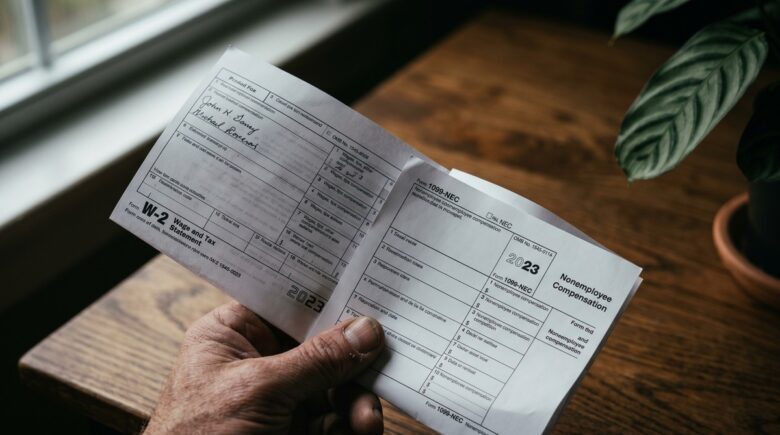
Three overlapping forms are now in play simultaneously. Form 1099-NEC covers direct payments from clients for services of $600 or more. Form 1099-K from payment platforms like PayPal, Stripe, or Venmo has had its threshold change four times in four years, from $20,000 to $5,000 to $2,500 to now $600 for 2026 income, under the One Big Beautiful Bill. Form 1099-MISC applies to miscellaneous compensation in certain categories.
The directional truth about 1099-K is worth stating plainly: the IRS has been systematically closing the reporting gap, not opening it. The trajectory toward $600 is the policy intent, and assuming you are under the radar on platform payments is an increasingly unreliable position.
State-level thresholds add another layer. Several states, including Maryland, Massachusetts, Vermont, and Virginia, already enforce 1099-K reporting at $600 or lower, independent of whatever the federal threshold is in a given year. Online sellers and gig workers who assume state compliance mirrors federal compliance face a live gap.
The growth of micro-freelancing platforms has accelerated exactly this problem: more workers, more payment platforms, more overlapping 1099 obligations from multiple sources simultaneously.
Bankrate’s 2025 data shows the average side hustler earns $885 per month, against a median of just $200. That gap reflects enormous income disparity within the category. Someone at the median may never receive a 1099 and still owes SE tax the moment net profit clears $400.
Key Takeaway: All side hustle income is reportable regardless of 1099 receipt, per IRS Gig Economy Tax Center rules. The 1099-K threshold drops to $600 for 2026 income, and several states already enforce that level, making platform payment reporting a compliance issue for most active sellers.
Frequently Asked Questions
Do I have to report side hustle income if I didn’t get a 1099?
Yes, every dollar of net self-employment income above $400 must be reported to the IRS, regardless of whether any 1099 form arrives. The IRS Gig Economy Tax Center is explicit that cash payments, peer-to-peer transfers, and barter income are all taxable. The 1099 is a tool the IRS uses to cross-check. Your obligation exists independently of it.
How much should I set aside from each side hustle payment for taxes?
A 25–30% set-aside from each payment is the standard working rule for most side hustlers in the 22% federal bracket once SE tax and state income tax are factored in. Set it aside immediately in a dedicated savings account, not a general checking account, so it is never accidentally spent before a quarterly deadline. The exact percentage shifts depending on your total income, deductions, and state tax rate.
Can a side hustle loss lower my regular W-2 income taxes?
It can, under specific conditions. If a side hustle generates a net loss on Schedule C and the IRS classifies it as a legitimate business (not a hobby), that loss can offset W-2 income and reduce overall taxable income. The hobby-loss rule under IRC Section 183 is the critical distinction: a business that shows profit in at least 3 of the last 5 years generally passes the test, though the IRS evaluates multiple factors. This is one of the genuinely underreported tax benefits of self-employment.
What is the difference between a SEP-IRA and a Solo 401(k) for side hustle income?
Both allow contributions up to $72,000 in 2026, but the Solo 401(k) reaches that ceiling at lower income levels because it includes an employee-deferral component in addition to employer contributions. The less-discussed tradeoff: SEP-IRA contributions (as employer contributions) reduce net self-employment income and therefore reduce your Qualified Business Income deduction under Section 199A, while Solo 401(k) employee deferrals do not reduce QBI in the same way, meaning the Solo 401(k) can preserve more of your Section 199A deduction. For side hustlers who also contribute to a W-2 employer’s 401(k), total employee deferrals across both plans cannot exceed $23,500 in 2026. If simplicity matters more than optimization, the SEP-IRA is easier to open and administer.
Sources
- Internal Revenue Service, Self-Employment Tax (Social Security and Medicare Taxes)
- Internal Revenue Service, Self-Employed Individuals Tax Center
- Internal Revenue Service, Gig Economy Tax Center
- Internal Revenue Service, Publication 334, Tax Guide for Small Business
- Internal Revenue Service, Filing Tips and Updates for Gig Economy Workers
- Internal Revenue Service, Topic No. 554, Self-Employment Tax
- Bankrate, 2025 Side Hustle Survey
- GoBankingRates, How a Side Hustle Can Backfire on Your Taxes