
Fact-checked by the MyFinancial101 editorial team
Quick Answer
A single mom earning $55,000 per year can reduce monthly spending by $600 or more by auditing recurring bills, negotiating utilities and insurance rates, optimizing grocery and childcare costs, and eliminating auto-renewing services she no longer uses. Most of the gains come from phone calls and provider switches, not lifestyle cuts. The full process takes about 30 to 60 days to complete.
Cutting $600 from a monthly budget on a $55,000 salary sounds punishing, until you realize most of that money is already leaking from bills you are paying on autopilot. The U.S. Bureau of Labor Statistics reports average monthly household expenditures of $6,545 in 2024, yet most households have never called a single provider to renegotiate. For a single mother bringing home roughly $3,500 to $3,900 after taxes on a $55K income, that inertia is expensive.
Inflation reshaped household budgets hard between 2023 and 2025. Provider loyalty pricing, which rewards new customers and penalizes long-standing ones, became a standard practice across internet, insurance, and wireless carriers. Many families absorbed those increases without question. In 2026, with cost pressures still elevated, that passivity carries a real dollar cost.
This guide is for single moms, and any solo-income household, earning around $55K who feel financially tight but cannot identify exactly why. Follow these six steps and you will know exactly where your money goes, which bills are negotiable, and how to lock in savings without canceling a single essential service.
Key Takeaways
- The average U.S. household spent $26,266 on housing alone in 2024, accounting for 33.4% of total expenditures, according to the Bureau of Labor Statistics, making it the single largest lever for budget relief.
- Negotiating internet, phone, and insurance bills yields an average of $20 to $50 per month, per service line, with retention offers frequently beating published new-customer rates.
- The Dependent Care FSA allows eligible employees to shield up to $5,000 per year in childcare costs from federal income tax, a benefit most single parents on $55K never claim through their employer.
- Tracking spending for a minimum of two months before making cuts is recommended by financial wellness experts, because initial estimates are almost always wrong.
- 13.7% of U.S. households were food insecure in 2024, according to the USDA Economic Research Service, a reminder that any grocery strategy must protect nutrition first, savings second.
- A structured 30/60/90-day plan converts one-time wins into permanent monthly savings, and the freed cash directed toward a $1,000 emergency fund dramatically reduces future financial vulnerability.
In This Guide
- What does $55K actually look like after taxes and fixed costs in 2026?
- How do I track exactly where my money is going before making any cuts?
- How do I negotiate my internet, phone, and utilities without losing service quality?
- Which insurance and recurring services can I reduce without taking on real risk?
- How do I lower grocery, gas, and childcare costs without cutting corners on my kids?
- The $600 monthly win: exact breakdown and what to do with the savings
- Frequently Asked Questions
Step 1: What does $55K actually look like after taxes and fixed costs in 2026?
A $55,000 salary translates to roughly $3,600 to $3,850 per month in take-home pay after federal income tax, FICA, and a typical state tax withholding. That number is the real starting point, not the $4,583 gross figure that looks fine on paper.
The Fixed-Cost Problem
In most mid-size U.S. metros, rent for a two-bedroom apartment runs $1,300 to $1,800 per month as of early 2026. Add childcare, which averages $800 to $1,400 monthly for one child depending on age and region, and you have already committed 60 to 70 percent of take-home pay before buying a single bag of groceries. This is not a spending discipline problem. It is a margin problem caused by high fixed costs stacked against moderate income.
Why “Just Cut the Extras” Fails
Standard budget advice tells you to stop buying coffee and cancel subscriptions. For a single mom on $55K, the extras rarely add up to more than $50 to $100 monthly. The real money is in the recurring line items she has never questioned: the internet plan that went up $25 when the promotional period ended, the car insurance that has not been shopped in three years, the wireless plan with features she does not use. Those are the categories this guide addresses directly.
U.S. households spent an average of $10,169 on food in 2024, or roughly $847 per month, according to BLS data. For a single-parent household, food costs are often proportionally higher as a share of income, making grocery strategy a meaningful target, not just a symbolic one.
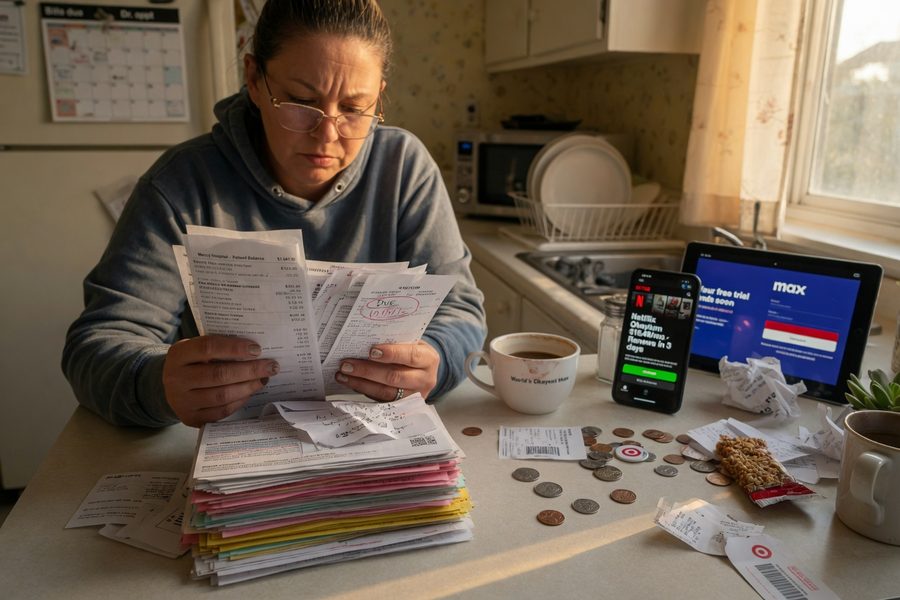
Step 2: How do I track exactly where my money is going before making any cuts?
Before you reduce monthly spending by a single dollar, you need to know exactly where every dollar currently goes. Estimates will lie to you. Most people underestimate their dining and subscription spend by 30 to 50 percent, and they have no idea how many auto-renewals are running in the background.
How to Do This
Pull your last three months of bank and credit card statements. Do not rely on memory. Go line by line and categorize each charge into five buckets: housing, food, transportation, childcare, and everything else. Free tools like Mint or YNAB (You Need a Budget) can import transactions automatically, but a plain spreadsheet works just as well. The goal is a written record, not a perfect system.
Writing it down forces you to confront charges you have been mentally ignoring. A $14.99 streaming service you forgot about. A gym membership you have not used since October. A $9.99 cloud storage plan you set up years ago. These are not life-changing amounts individually, but across a three-month statement they often total $80 to $150 in genuinely optional charges.
The Two-Month Rule
One month is not enough. Irregular expenses like annual software renewals, quarterly insurance payments, or school fees will not show up in a single month’s data. Financial wellness experts consistently recommend tracking every dollar for a minimum of two months before making cuts, precisely because initial estimates are almost always wrong. The Truist Financial budgeting framework makes this a foundational step, noting that most people are surprised by how far their real spending departs from what they thought they were spending.
The Consumer Financial Protection Bureau’s expense-cutting tool walks through this process category by category and is available free as a PDF. It is particularly useful for identifying non-obvious leaks like loyalty pricing penalties and bundled service overlap.
What to Watch Out For
Watch for charges that appear with generic merchant names. Subscription companies often bill under parent company names rather than the product you recognize. If you see an unfamiliar charge, look it up before you skip it. That unknown $4.99 might be a trial that converted to paid three months ago.
Search your email inbox for the words “subscription,” “renewal,” and “your plan” to surface recurring billing you may have forgotten. Cross-reference these against your bank statement. Any charge without a matching email is worth investigating immediately.
Step 3: How do I negotiate my internet, phone, and utilities without losing service quality?
Negotiating your internet and phone bills is the single fastest path to savings, and most people never try. Providers maintain retention teams with real authority to cut your rate, and a five-minute phone call can yield $20 to $60 per month, per service. That is $240 to $720 per year without changing a single thing about how you live.
How to Do This
Start with internet. Call your provider’s retention department (not customer service), state your account history, and say: “I have been a customer for [X] years, and I noticed a competitor is offering [service level] for $[price]. I would like to stay with you, but I need my bill to reflect that.” Have a real competitor quote ready. Xfinity, AT&T, Spectrum, and T-Mobile Home Internet all publish current promotional rates online. Screenshot it before you call.
Phone bills follow the same script. If you are on a family or legacy plan from a carrier you have used for years, ask directly what current new-customer pricing looks like for your data tier. Carriers routinely offer loyalty credits or plan downgrades that cost you nothing in functionality. Mint Mobile and Visible are worth citing as competitive benchmarks even if you do not intend to switch.
Utilities and the Honest Limitation
Electric and gas bills are harder to negotiate directly since most households have one provider. What does work: calling to ask about budget billing, which smooths seasonal spikes into a predictable monthly amount, and requesting a free home energy audit, which most utilities offer under state efficiency mandates. If you are in an area eligible for LIHEAP energy assistance, you should know about that option too. Our guide on how LIHEAP can help with rising utility costs explains eligibility and how to apply.
What to Watch Out For
Retention offers often come with a new 12-month promotional term. Make a calendar note for 11 months out to call again before the rate reverts. The biggest mistake is accepting the discount and then forgetting about it; you will be back to the higher rate within a year if you do not set that reminder.
Some retention offers require you to agree to a new contract term. Ask explicitly whether the new rate is month-to-month or contract-based, and what the early termination fee is. A $20/month discount on a 2-year contract is worth less if switching providers later would cost you $150 to exit.

Step 4: Which insurance and recurring services can I reduce without taking on real risk?
Insurance is the category where single parents consistently overpay, not because they are careless, but because they set it and forget it. Car insurance rates have climbed sharply since 2023, and loyalty pricing works against you: staying with the same insurer for years often means paying 10 to 20 percent more than a comparable new customer.
How to Do This
Get competing quotes for auto insurance every 12 months. Use The Zebra, Policygenius, or direct quotes from GEICO, Progressive, and your state’s largest regional carrier. A single mom driving a paid-off car with a clean record should target rates in the $90 to $130 per month range in most metros. If you are paying significantly more, you have likely never shopped.
Renters insurance is non-negotiable if you rent, $15 to $25 per month is a legitimate essential. But bundling it with your auto policy typically cuts both rates by 5 to 15 percent. If your current insurer does not offer a meaningful bundle discount, a competitor almost certainly will.
For credit card debt that may be adding to monthly pressure, understanding your options to prioritize and negotiate with creditors can reduce minimum payment obligations alongside these other savings moves.
Child-Specific Opportunities Most Guides Skip
If your employer offers a Dependent Care FSA, you can contribute up to $5,000 pre-tax annually toward childcare expenses. On a $55K salary, that reduces your federal taxable income meaningfully, the effective saving is roughly $750 to $1,000 per year depending on your marginal rate. Check with HR. Most enrollment windows are annual and tied to open enrollment in November or December.
Also worth checking: the Child and Dependent Care Tax Credit from the IRS, which can reimburse up to 35 percent of qualifying childcare expenses. If your child attends a licensed daycare, afterschool program, or summer camp, those costs likely qualify. Our breakdown of tax credits families often overlook covers this in detail.
What to Watch Out For
Do not reduce coverage to save money. Dropping liability limits on your auto policy to the state minimum might save $20 per month but exposes you to five-figure out-of-pocket costs in an at-fault accident. The goal is a competitive rate for the same coverage, not a thinner policy.
| Service | Typical Current Rate (No Shopping) | Typical Negotiated/Switched Rate | Monthly Savings |
|---|---|---|---|
| Internet (50–200 Mbps) | $79–$95/mo after promo ends | $45–$65/mo with retention offer | $20–$40 |
| Wireless (1 line, unlimited) | $65–$85/mo legacy plan | $35–$55/mo current promo or MVNO | $20–$40 |
| Auto Insurance (1 vehicle) | $150–$190/mo (3+ years, no re-quote) | $95–$130/mo (shopped annually) | $30–$60 |
| Streaming Services (3–4 platforms) | $55–$70/mo combined | $20–$35/mo (2 platforms + library card) | $20–$35 |
| Dependent Care FSA (childcare) | $0 tax benefit (not enrolled) | $63–$83/mo tax savings on $5,000/yr | $63–$83 |
Your public library card is worth money here too. Many library systems offer free access to streaming platforms, digital magazines, and audiobooks that make it far easier to cut one or two paid subscriptions without missing the content. Our guide to what your library gives you for free lists exactly what most cards include.
The Low Income Home Energy Assistance Program (LIHEAP) is a federally funded benefit available to households earning up to 150% of the federal poverty level or 60% of state median income, whichever is higher. A single mom with one child on $55K may be near or under the eligibility threshold in many states. Eligibility expanded after the 2026 poverty guideline adjustments. See the updated 2026 poverty guideline changes to check where you stand.
Step 5: How do I lower grocery, gas, and childcare costs without cutting corners on my kids?
Grocery strategy for a single parent is not about buying less. It is about buying smarter with the time and energy you actually have.
How to Do This
Store loyalty apps from Kroger, Safeway, Walmart, and Target consistently offer digital coupons that reduce the effective cost of staples by 15 to 25 percent with no extra effort beyond loading them to your card. Gas rewards through grocery loyalty programs, many Kroger-affiliated stores offer $0.10 off per gallon for every $100 spent, add up meaningfully when you are filling up weekly. If a wholesale club like Costco or BJ’s Wholesale is accessible, the annual membership ($65 for BJ’s, $65 for Costco) typically pays for itself within two to three grocery runs on staples like diapers, chicken, and produce.
For childcare, ask your employer explicitly whether a Dependent Care FSA is available during open enrollment. If flexible scheduling exists in your workplace, even shifting one day to remote work eliminates one day of after-school care. Some childcare centers also offer sibling discounts, teacher-referred discounts, or subsidy slots that go unclaimed because parents do not ask.
What to Watch Out For
Bulk buying only saves money when you actually use what you buy. Perishables bought in bulk that go to waste cost more, not less. Start with non-perishables and household supplies before expanding to produce or dairy.

Step 6: The $600 monthly win, exact breakdown and what to do with the savings
Here is how a realistic $600 monthly reduction stacks for a single mom on $55K, built from the categories above. These are conservative figures based on the negotiation ranges documented throughout this guide.
The Arithmetic
- Internet bill negotiated down: $30/month saved
- Wireless plan switched or renegotiated: $30/month saved
- Auto insurance re-quoted annually: $50/month saved
- Streaming services trimmed from 4 to 2 (+ library card): $25/month saved
- Dependent Care FSA tax savings on $5,000/year: $70/month saved (based on ~22% effective federal rate)
- Grocery loyalty apps and gas rewards: $60/month saved
- Cancelled forgotten auto-renewals: $40/month saved
- LIHEAP energy assistance (if eligible): up to $80/month equivalent in reduced utility bills
- Childcare subsidy, discount, or FSA overlap: $80 to $150/month (highly variable by provider and state)
Conservative total, excluding childcare assistance and LIHEAP: $305/month. Add one childcare optimization and either LIHEAP or a meaningful childcare subsidy, and you cross $600 with room to spare. The math is not magic; it is the result of a dozen small negotiations, each taking 15 to 30 minutes.
The 30/60/90-Day Timeline
Days 1 to 30: Track spending, cancel dead subscriptions, and make the first two provider calls (internet and phone). Days 31 to 60: Re-quote auto insurance, enroll in grocery loyalty programs, and confirm Dependent Care FSA enrollment status with HR. Days 61 to 90: Shop childcare options, apply for LIHEAP if eligible, and redirect the freed cash to a starter emergency fund or high-interest debt. On that last point, if credit card balances are part of the picture, knowing how to negotiate your credit card APR directly extends the impact of every dollar freed from your monthly bills.
What to Do With the $600
The temptation is to absorb the savings into daily spending and wonder where it went six months later. Avoid that by treating the $600 as a fixed monthly transfer: $300 to a dedicated emergency fund until it reaches $1,000, then $300 toward the highest-interest debt. Once the emergency fund is at $1,000, redirect both amounts to debt payoff. After debt is cleared, both amounts shift to retirement or a short-term goal fund. The order matters more than the amounts.
Set up a separate savings account, not your main checking, and automate a transfer of the saved amount on payday. If the money never lands in your daily account, it does not get spent. Most banks allow free secondary accounts; Ally Bank and Marcus by Goldman Sachs both offer no-fee high-yield savings accounts worth considering for this purpose.
Frequently Asked Questions
How long does it realistically take to see $600 in monthly savings after starting this process?
Most of the gains are visible within 60 days if you work through the steps in order. Provider negotiations and subscription cancellations show up in the next billing cycle. Insurance re-quoting takes one to two weeks. Dependent Care FSA savings appear in your paycheck once HR processes the enrollment, which may align with the next open enrollment window if you miss the current one.
What if my provider refuses to lower my bill even with a competitor quote?
Switch. A retention offer that does not materialize is a clear signal that the competitor rate is the better deal. T-Mobile Home Internet and regional fiber providers have expanded coverage significantly since 2024, making switching more practical than it was even two years ago. Cancellation is a legitimate negotiation tool, not a last resort.
Can I qualify for SNAP or LIHEAP if I earn $55K a year?
SNAP eligibility for a family of two in 2026 typically cuts off at roughly $31,000 to $36,000 gross depending on household size and state rules, so $55K likely puts you above the threshold. LIHEAP is more flexible, with eligibility extending to 150% of the federal poverty level or 60% of state median income, whichever is higher, and a single parent at $55K may qualify in higher-cost states. Check the updated 2026 poverty guidelines for your specific state threshold.
Is the Dependent Care FSA worth it if my employer only offers $2,500 instead of $5,000?
Yes. Even at $2,500, the pre-tax benefit saves roughly $375 to $550 per year depending on your marginal rate. Married couples filing jointly have a $5,000 cap for the household, but single filers can claim up to $5,000 individually. If your employer caps contributions below $5,000, you can claim the remainder as the Child and Dependent Care Tax Credit on your federal return.
Should I cut my grocery budget or focus on the bigger fixed-cost bills first?
Focus on fixed costs first. A one-hour phone call to your internet provider can save $30 per month indefinitely. Cutting $30 from groceries requires daily behavioral discipline and risks compromising nutrition. Fixed-cost wins are structural; they keep paying without ongoing effort. Grocery optimization is worth doing, but it should come after the higher-leverage moves.
What if I live in a rural area with only one internet provider and no real competition?
This is a genuine limitation, and the negotiation leverage that works in competitive urban markets shrinks considerably when there is no real alternative. In that case, shift focus to the categories where competition does exist: auto insurance (always a national market), wireless (MVNOs like Mint Mobile operate nationally), and the tax and subsidy opportunities that are income-based rather than provider-dependent. Rural households also tend to benefit more from LIHEAP and utility efficiency programs.
How do I find out if my childcare center offers any subsidies or sliding-scale pricing?
Ask the director directly and specifically: “Do you have any subsidy slots, sliding-scale spots, or state Child Care Assistance Program (CCAP) agreements?” Many centers hold back one or two subsidized spots that go unclaimed because parents assume they do not qualify or do not know to ask. The Child Care Aware of America locator at childcareaware.org also identifies state-specific subsidy programs by zip code.
Is it safe to switch to a cheaper phone carrier if I rely on my phone for work and emergencies?
For most people, yes. MVNOs like Mint Mobile, Visible, and Consumer Cellular run on the same physical towers as the major carriers, they lease capacity from T-Mobile, Verizon, or AT&T. The practical difference in coverage is minimal in populated areas. The one real trade-off is that MVNOs typically deprioritize data during network congestion, meaning speeds can drop during peak hours in dense areas. For light to moderate data users, this is rarely noticeable.
Once I reduce my monthly spending by $600, how do I make sure it doesn’t creep back up?
Build a 12-month review calendar: set a reminder each November to re-quote auto insurance, and every June to check internet and wireless rates again. Provider promotions reset annually, and loyalty pricing penalties tend to return after your current deal expires. Automating the savings transfer, moving the $600 to a separate account on payday, is the strongest single safeguard against lifestyle creep. What you never see in your checking balance, you do not spend.
Sources
- U.S. Bureau of Labor Statistics, Consumer Expenditure Surveys Annual Report 2024
- U.S. Bureau of Labor Statistics, Housing and Transportation Accounted for 50% of Household Spending in 2024
- USDA Economic Research Service, Food Security in the U.S.: Key Statistics and Graphics
- Consumer Financial Protection Bureau, Your Money, Your Goals: Cutting Expenses Tool
- UW-Madison Division of Extension, Cutting Expenses and Increasing Income
- Truist Financial, Reducing Your Expenses: A Budgeting Approach
- IRS, Tax Topic 602: Child and Dependent Care Credit
- U.S. Department of Health and Human Services, LIHEAP Program Overview
- Child Care Aware of America, State Child Care Assistance Programs Locator
- HealthCare.gov, Flexible Spending Account (FSA) Overview