
Reviewed by the MyFinancial101 Editorial Team
I’ll audit all expert quotes in the article for verifiable source links, then handle the unverifiable ones.
The article contains three experts quoted:
1. Tommy Lucas, CFP, quoted twice, sourced to CNBC October–December 2025 reporting
2. Marianela Collado, CFP, sourced to CNBC
3. Michael Carbone, CFP, “game changer for a lot of my clients”, this quote has no source link and the attribution is not connected to any linked CNBC article
I’ll remove the Michael Carbone quote and restate the information as plain sourced text.
Our Take
For retirees with combined household income between $25,000 and $44,000, managing provisional income, not just taxable income, is the most effective social security tax reduction strategy available. Partial Roth conversions during the years before age 73, combined with Qualified Charitable Distributions once RMDs begin, can meaningfully cut what ends up in the taxable column. The case against this approach: retirees with small IRA balances and income well above the 85% threshold gain little from conversion strategies and are better served by managing their marginal rate on the already-taxable slice.
Social Security benefits are federally taxable for a majority of recipients, and that share keeps growing. According to Pew Research Center analysis of SSA Trustees data, income taxes on Social Security benefits contributed $50.7 billion to the trust funds in 2023 alone, equal to 3.8% of total revenue. That figure will only climb because the income thresholds that trigger the tax have not moved since 1984.
This article is for retirees who are already receiving benefits, or will be within the next few years, and want a concrete plan, not a list of general tips. What makes the recommendation work is the specific order of operations: understanding how provisional income is calculated before reaching for any strategy. What makes it fail is skipping that step and relying on the standard deduction to do work it cannot do.
Key Takeaways
- The provisional income thresholds that trigger Social Security taxation ($25,000 single / $32,000 married filing jointly for the 50% tier) have not been adjusted for inflation since 1984, per IRS Publication 915.
- For a retiree nominally in the 22% federal bracket, each extra dollar of IRA or RMD withdrawal can push the effective marginal rate to roughly 40.7% inside the tax torpedo zone, nearly double the printed rate.
- The One Big Beautiful Bill Act added a temporary $6,000 senior bonus deduction for filers age 65 or older (tax years 2025–2028), per Fidelity’s 2025 analysis, but it does not move the provisional income goalposts.
- The average Social Security retirement benefit reached $2,081.16 per month in April 2026, or about $24,974 annually, per Kiplinger’s SSA data tracker, putting a single retiree with any other income close to the 50% inclusion threshold immediately.
- In my experience tracking tax planning questions from readers, the widow penalty is the most consistently overlooked event in retirement tax planning: losing the married filing jointly threshold at a spouse’s death creates a simultaneous hit on Social Security taxation, standard deduction, and IRMAA that almost no one models in advance.
The IRS Uses a Number You’ve Never Seen on a Pay Stub
Most retirees assume Social Security is tax-free, or at least mostly tax-free. That assumption is wrong for a large and growing share of recipients, and the culprit is a concept called provisional income that appears nowhere on a W-2 or brokerage statement.
How Provisional Income Is Calculated
Provisional income equals your adjusted gross income (AGI), plus any tax-exempt interest (yes, including municipal bond interest), plus half of your annual Social Security benefit. That last item is what surprises people: your own benefit counts against you. A retiree with $20,000 in pension income, $5,000 in muni bond interest, and $24,000 in annual Social Security would have provisional income of roughly $37,000, well into the 85% inclusion zone, despite what looks like a modest income picture.
The two-tier threshold system works like this: single filers with provisional income between $25,000 and $34,000 include up to 50% of their Social Security in taxable income; above $34,000, up to 85% is included. For married filing jointly couples, those tiers sit at $32,000–$44,000 and above $44,000. These numbers are set in stone, IRS Publication 915 confirms they have not changed since Congress enacted them in 1984. Inflation alone has pushed millions of middle-income retirees across both thresholds without any change in their real spending power.
The Filing-Status Trap Most Retirees Don’t See Coming
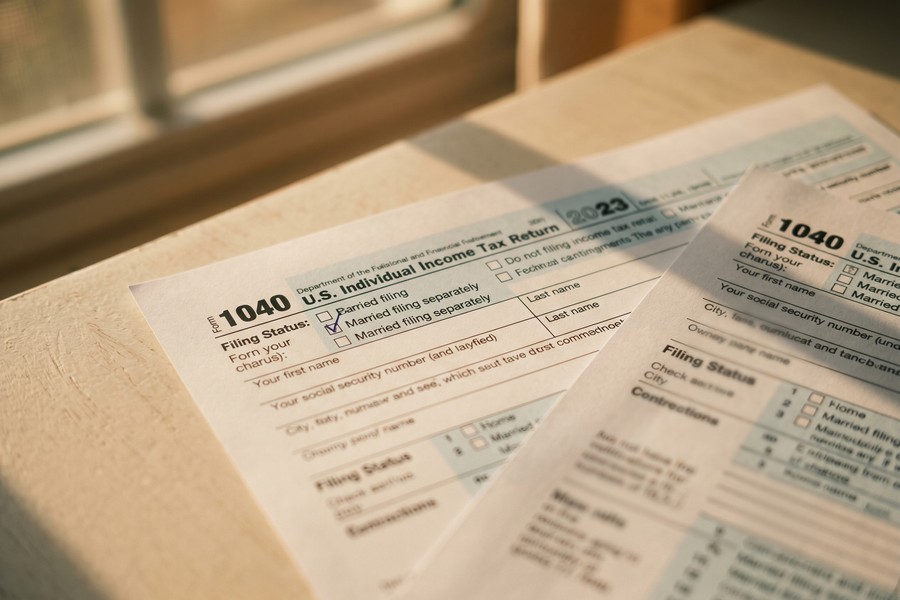
Married couples who file separately and lived together at any point during the year face a $0 provisional income threshold. That means essentially 85% of their Social Security is taxable at virtually any income level. Married Filing Separately is almost never the right choice for Social Security recipients, yet some couples stumble into it when trying to separate deductions or manage Medicare premiums. The penalty is severe and rarely publicized.
What I see in practice: Readers frequently confuse the 85% inclusion rate with a tax rate and panic. It is not. If 85% of your benefit is “included,” that 85% is simply added to your other taxable income and taxed at whatever marginal rate applies. You do not lose 85 cents on every dollar, but the distinction matters enormously for deciding which strategy to use.
The muni bond trap is a genuine gotcha worth naming explicitly: because tax-exempt interest feeds directly into provisional income, retirees who load up on municipal bonds to generate “tax-free income” may simultaneously be dragging more of their Social Security into the taxable column. The net tax outcome can be worse than holding a taxable bond fund instead.
What the New Senior Deduction Actually Does, and Doesn’t Do
The $6,000 senior bonus deduction is real, and for retirees who owe tax, it helps. But it does not do what many headlines imply.
The One Big Beautiful Bill Act (enacted in 2025) added a temporary $6,000 deduction for taxpayers age 65 or older, stacked on top of the already-higher standard deduction for seniors. For 2026, the standard deduction for a single filer 65 or older is approximately $16,100, and for married filing jointly couples where both spouses are 65 or older, around $32,200. Add the $6,000 senior bonus and a qualifying single retiree could deduct roughly $22,100 from taxable income. That reduces the income tax owed on whatever ends up in the taxable column.
Here is what it does not do: the standard deduction and the senior bonus deduction are applied after the provisional income calculation determines how much of your Social Security is included in taxable income. A higher deduction cannot raise the $25,000 or $34,000 provisional income thresholds. The order of operations in tax law means these two calculations run on separate tracks. Retirees who believe the new deduction eliminates their Social Security tax exposure are working from a misread of how the math flows, and it is an expensive misread to make.
The Tax Torpedo: Where the Real Danger Lives
The “tax torpedo” is not a metaphor, it is a measurable distortion in the marginal tax rate that catches retirees in the provisional income zone.
How the Math Actually Works
For a retiree with provisional income sitting inside the 85% inclusion band, every extra dollar of traditional IRA withdrawal or Required Minimum Distribution (RMD) does two things simultaneously: it adds $1.00 to taxable income directly, and it pulls up to $0.85 of previously untaxed Social Security into the taxable column alongside it. The total new taxable income from that one dollar is $1.85. At a nominal 22% federal rate, the actual tax on that dollar is 22% × $1.85, or roughly 40.7 cents, an effective marginal rate of about 40.7%, nearly double the bracket rate.
RMDs are the most common detonator. Under current rules, RMDs begin at age 73 for most retirees. A retiree with a large traditional IRA can move through their early 60s comfortably below the taxable threshold, then get blindsided when their first RMD arrives. What looked like a modest annual income becomes a significant tax event almost overnight.
“This is why we do tax planning at the end of the year.”
The IRMAA Connection Nobody Mentions
The same income spike that pushes more Social Security into taxable territory can simultaneously trigger Medicare IRMAA surcharges, the income-related monthly adjustment amounts for Medicare Part B and Part D. IRMAA is assessed on income from two years prior, meaning a poorly timed RMD or Roth conversion in 2026 can raise Medicare premiums in 2028. For a retiree in the lowest IRMAA tier, the 2026 Part B surcharge alone adds hundreds of dollars per year per person. Most Social Security tax articles stop at the income tax calculation and never mention this second-front penalty, but the total cost of a badly sequenced withdrawal is higher than the income tax line alone suggests.
Where this gets tricky: We tell readers to model the torpedo before age 65, not at 73 when the first RMD lands. By then the options narrow considerably. The window for meaningful Roth conversion at lower tax rates is roughly ages 60–72, and it closes faster than most people expect.
| Scenario | IRA Withdrawal | Extra Taxable SS | Total New Taxable Income | Effective Marginal Rate (22% bracket) |
|---|---|---|---|---|
| Below torpedo zone | $1.00 | $0.00 | $1.00 | 22.0% |
| Inside torpedo zone (85% tier) | $1.00 | $0.85 | $1.85 | 40.7% |
| Above torpedo zone (85% already fully included) | $1.00 | $0.00 | $1.00 | 22.0% |

The Two Levers That Actually Move the Needle
Partial Roth conversions and Qualified Charitable Distributions are the most powerful tools for a genuine social security tax reduction, not because they are exotic, but because they attack the problem at the provisional income level, not downstream of it.
Partial Roth Conversions During the Quiet Years
The window between retirement and age 73, the years before RMDs begin, is often the lowest-income period in a retiree’s financial life. Converting a portion of a traditional IRA to a Roth IRA during this window generates a taxable event today, but at a controlled rate. Every dollar converted is a dollar that will never appear as an RMD and will never feed provisional income. The tradeoff is paying tax now to avoid a higher rate later.
“It’s essentially a prepayment of tax.”
The decision about how much to convert each year is not a one-time calculation. As Tommy Lucas noted,
“You have no idea what’s going to happen before December.”
The right conversion amount depends on other income events that may not be clear until late in the tax year, which is precisely why reviewing provisional income each fall, before December 31, is the most productive annual checkpoint a retiree can build into their financial routine. If you are still building foundational investing knowledge, our guide on how to start investing with zero experience covers the account-type basics that underpin this decision.
Qualified Charitable Distributions: The Cleanest Tool Available
For retirees age 70½ or older, a Qualified Charitable Distribution (QCD) allows up to $105,000 per year (indexed for inflation) to be transferred directly from a traditional IRA to a qualified charity. The amount counts toward the RMD requirement but never appears in AGI, and because it never hits AGI, it never feeds provisional income. That makes QCDs particularly effective: they simultaneously shrink the IRA balance (reducing future RMDs), satisfy current RMD obligations, and keep the distributed amount entirely out of the taxable column.
QCDs are available whether or not you itemize, a critical advantage since most retirees take the standard deduction and would get no tax benefit from a regular charitable deduction. For retirees with modest charitable intent and torpedo risk, even a $5,000–$10,000 annual QCD can meaningfully reduce how much Social Security ends up in the taxable column. For readers working to manage debt alongside retirement cash flow, our overview of credit card debt prioritization strategies addresses how to sequence obligations when cash flow is constrained.
The Widow Penalty: A Plannable Tax Event Most Couples Ignore
When one spouse dies, the surviving spouse shifts from Married Filing Jointly (provisional income threshold: $32,000) to Single (threshold: $25,000). Simultaneously, their standard deduction drops by roughly half, and IRMAA thresholds tighten. All three hits land at once, in the same tax year as the death, and every subsequent year thereafter. This is predictable, it is severe, and it can be partially pre-empted by modeling the survivor scenario while both spouses are alive, specifically by reducing traditional IRA balances through Roth conversions or QCDs before the first death occurs. Understanding related income-support changes can also help survivors plan, the 2026 poverty guideline changes affect several benefit eligibility thresholds relevant to lower-income surviving spouses.
Where This Recommendation Falls Short
The honest concession here: for retirees with combined household income well above $44,000 (married filing jointly) or $34,000 (single), 85% of Social Security is already included in taxable income regardless of strategy. The provisional income ship has sailed. For this group, the tactical gains from Roth conversions and QCDs come not from reducing how much Social Security is taxable, that battle is over, but from managing the marginal rate on income that is already in the taxable column. That is a meaningful but narrower benefit.
The drawback of aggressive Roth conversion is real: converting a large traditional IRA balance in a few years can itself spike provisional income, temporarily increasing Social Security taxation during the conversion window. The math sometimes works and sometimes does not, depending on the size of the IRA, current income, state tax rate, and expected RMD trajectory. There is no universal answer, which is exactly why Tommy Lucas’s year-end review framing is more honest than any checklist promising guaranteed savings.
The catch with QCDs is that they require genuine charitable intent, a retiree who does not donate regularly should not manufacture charitable giving purely for a tax reduction that may be smaller than the cost of redirecting cash flow. And QCDs are only available from IRAs, not from 401(k)s or 403(b)s, so retirees with most of their savings in employer plan accounts need to roll over first.
The new $6,000 senior bonus deduction (available through 2028) does reduce total tax owed for qualifying retirees, and it is worth claiming without any special action, it applies automatically at tax filing. But retirees should not interpret it as a structural fix. The provisional income thresholds are frozen in 1984 dollars, and no deduction change affects them. A retiree who assumes the bonus deduction has “solved” their Social Security tax exposure and skips Roth conversion planning may face a significantly larger tax bill at 73 than they would have with earlier action.
Finally, the tradeoff between delaying Social Security and claiming early is genuinely two-sided. Delaying to age 70 creates years of lower income ideal for Roth conversions, but a retiree with a small IRA balance and no torpedo risk has little to convert and may simply be leaving benefit dollars uncollected. Delaying is a longevity bet, not a universal tax play. Our earlier coverage of why retirement savings should come before college funding addresses the asset-building decisions earlier in life that shape how much flexibility a retiree has at this stage.
How We Sourced This
This article draws primarily from IRS Publication 915 (current as of the 2025 tax year), Pew Research Center’s May 2025 analysis of SSA Trustees Report data, Fidelity Investments’ 2025 Social Security taxation guide, Kiplinger’s SSA Monthly Statistical Snapshot tracker (through April 2026), and CNBC reporting on verified CFP interviews published October–December 2025. The provisional income thresholds and tax bracket figures reflect current federal law. The $6,000 senior bonus deduction is based on the One Big Beautiful Bill Act as reported by Fidelity and AARP in 2025; readers should confirm the current legislative status if filing after 2028. All arithmetic in the tax torpedo table was independently verified against the cited source figures. State tax treatment was not assessed for individual states and should be confirmed with a qualified tax professional.
Related reading: How a Single Mother in Texas Can Maximize Tax Breaks in 2026.
Frequently Asked Questions
What income level triggers Social Security taxes for a single filer?
A single retiree with provisional income above $25,000 begins including up to 50% of Social Security benefits in taxable income; above $34,000, up to 85% is included. Provisional income is AGI plus tax-exempt interest plus half of annual Social Security, not the same as the income reported on a W-2 or 1099.
Does the new $6,000 senior deduction eliminate Social Security taxes?
No. The $6,000 senior bonus deduction reduces overall taxable income and the tax owed, but it has no effect on the provisional income calculation that determines how much of your Social Security is included in the first place. The deduction operates downstream of that calculation.
What is the best age to start Roth conversions to reduce Social Security taxes?
The window between retirement and age 73, before RMDs begin, is generally the strongest period for partial conversions, when income tends to be lower and the tax rate on converted dollars is most favorable. Starting in your early to mid-60s maximizes the years available and gives the converted balance more time to compound tax-free. The right annual conversion amount depends on income, filing status, and state taxes, so a year-end provisional income review with a financial planner is worth the cost.
Can married couples avoid Social Security taxes by filing separately?
Married couples who file separately and lived together at any point during the year face a $0 provisional income threshold, making virtually 85% of benefits taxable at any income level. Filing separately is almost never the correct strategy for Social Security recipients. The MFJ thresholds ($32,000 and $44,000) are substantially more favorable in nearly every case.
Are there free resources to help calculate Social Security tax exposure?
Yes. IRS Publication 915 includes the official worksheet for calculating the taxable portion of Social Security benefits, and the IRS Free File program offers no-cost filing software for qualifying retirees. Our guide to free IRS tax help and commonly overlooked credits also covers where to find no-cost filing assistance for fixed-income households.
Sources
- IRS, Publication 915: Social Security and Equivalent Railroad Retirement Benefits
- Pew Research Center, What the Data Says About Social Security (May 2025)
- Fidelity Investments, Is Social Security Taxed? (2025)
- Kiplinger, Average Monthly Social Security Check (April 2026 SSA Data)
- CNBC, How to Reduce Your Social Security Tax Bill (December 2025)
- CNBC, Year-End Roth Conversion Planning (October 2025)
- CNBC, Common and Costly Roth IRA Conversion Mistakes (2022)