
Fact-checked by the MyFinancial101 editorial team
The Verdict
Cutting $600 a month in household expenses is realistic for a stay-at-home parent family without touching deliberate fun spending. It works when you address at least three categories: groceries, recurring bills, and zombie subscriptions. It does not work when you chase willpower-based cuts rather than structural ones, or skip the 90-minute spending audit that reveals where the money actually goes.
Most families trying to reduce monthly expenses look for one big cut, when the actual savings are spread across four or five categories that no one has reviewed in years. The single factor that swings this fastest is whether you treat the audit as the work, not the cuts that follow. According to the U.S. Bureau of Labor Statistics 2024 Consumer Expenditure Survey, average household spending runs $78,535 a year, or roughly $6,545 a month. That baseline makes a $600 reduction about a 9% adjustment, achievable without an extreme lifestyle change.
Grocery prices have risen approximately 26% cumulatively since January 2020. Families who set budgets before 2020 and never revisited them are almost certainly overspending against their own expectations. That makes a 2026 audit urgent, not just advisable.
| Category | Reasons to Cut Here | Reasons to Be Cautious |
|---|---|---|
| Groceries | USDA thrifty vs. moderate plan gap is ~$480/month for a family of four | Unrealistic cuts cause burnout; protect food traditions |
| Streaming & Subscriptions | Average American spends $51.71/month on streaming alone; zombie services add more | Some subscriptions replace costlier alternatives (e.g., gym, cable) |
| Home Insurance Deductible | Raising deductible from $500 to $1,000 cuts premium ~25%, saving $600+/year | Requires emergency fund to cover the higher deductible if a claim occurs |
| Internet & Phone Plans | Retention offers are common; threatening to switch often triggers a discount | Loyalty rarely earns discounts, you must initiate the call |
| Dependent Care FSA | New 2026 limit of $7,500 saves the 22% bracket household an extra $550 in federal taxes | Requires the working spouse’s employer to offer an FSA plan |
| Food Waste | EPA estimates $728/year per person wasted; family of four loses $60+ monthly | Requires meal planning discipline to sustain the savings |
| Entertainment & Activities | Library systems offer free museum passes, streaming, and park access | Cutting deliberate family experiences damages morale; target autopilot spending only |
Key Takeaways
- Your grocery spending is at or above the USDA moderate food plan (~$1,430/month for a family of four in 2026) and you haven’t reviewed it since before 2022.
- You have at least two streaming or subscription services your household used fewer than four times in the past month.
- Your home insurance deductible is still at $500, and your emergency fund can absorb a $1,000 deductible if needed.
- You or your spouse haven’t called your internet or phone provider to renegotiate in the past 12 months.
- The working spouse’s employer offers a Dependent Care FSA and you are contributing less than the new $7,500 limit (effective January 2026).
- Your household wastes food regularly, produce goes soft, leftovers get tossed, adding up to $60 or more per month in avoidable loss.
- You have not done a line-by-line review of recurring auto-charges in the past six months.
The 90-Minute Audit Most Families Skip
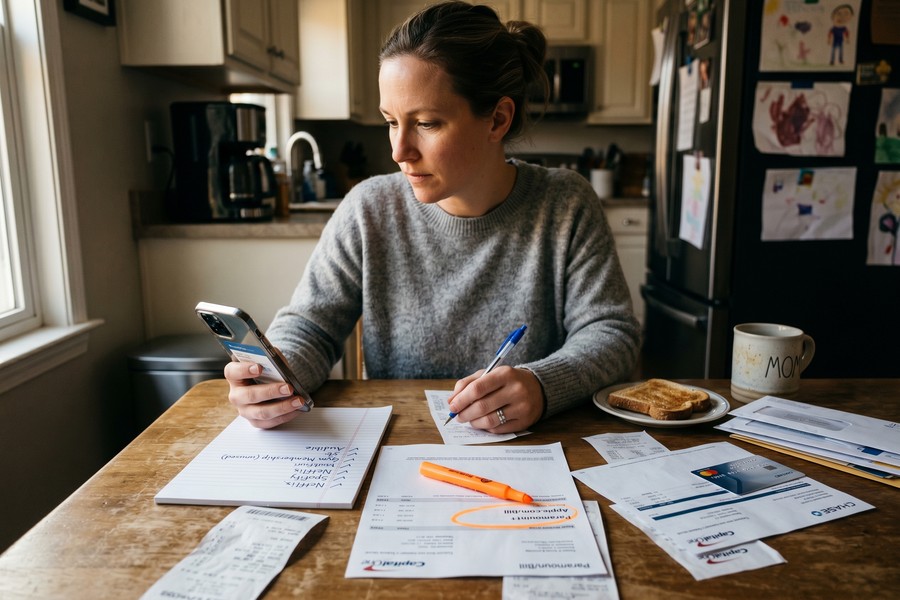
The fastest path to lower spending is not a new habit. It is finding what you are already paying for and no longer use. A 90-minute audit of every recurring charge, pulled from bank and credit card statements for the past two months, consistently surfaces $50 to $150 in cancellable “zombie subscriptions” for services that auto-renewed without anyone noticing. Experian’s credit monitoring tools can help surface recurring charges tied to a card, but the review itself takes nothing more than two months of statements and a spreadsheet.
The Consumer Financial Protection Bureau’s budgeting guide frames this the same way: get a complete picture of income and spending before making any changes. The CFPB’s guidance is explicit that most households underestimate variable spending by 20 to 30 percent before they run an actual line-by-line review. Most families skip this step and go straight to cutting things they can feel, restaurant meals, kids’ activities, while ignoring auto-charges buried in their statements. That is the wrong order.
Separate fixed costs (mortgage, insurance, car payment, subscriptions) from variable costs (groceries, utilities, activities, clothing). Fixed costs are where the largest dollar savings hide, because they compound monthly without any daily decision to spend. Eliminating a $15 subscription takes two minutes and saves $180 over the next year without changing a single day of family life. According to Reviews.org’s 2025 State of Consumer Media Spending report, Americans now spend an average of $51.71 per month on streaming services alone, up 18% from 2024. For most households, two or three of those services are genuinely redundant.
How to Reduce Monthly Expenses on Groceries Without Misery
Groceries are where the math is most compelling, and where staying home full-time is a structural advantage. The USDA’s 2026 food cost data puts a family of four on a moderate food plan at roughly $1,430 per month; the thrifty plan equivalent runs about $950 per month. That is a gap of approximately $480 a month, from food alone, without eliminating a single enjoyable meal.
The single largest driver of that gap is meat frequency. Swapping two beef dinners per week for chicken thighs, eggs, or beans saves $40 to $80 a month on its own. Batch cooking and buying loss-leader proteins on sale (then freezing them) are only practical when someone is home during the week. A dual-income household cannot realistically pull this off at 7 p.m. on a Tuesday; a stay-at-home parent can.
Food waste is the other lever most families ignore. The U.S. Environmental Protection Agency estimates that the average American wastes $728 per year in food purchased but never eaten, about $14 per week per person at retail prices. For a family of four, eliminating even half that waste recovers more than $60 a month before changing a single item on the grocery list. The fix is not elaborate meal planning; it is a weekly “eat what’s in the fridge” dinner and a slightly shorter shopping list.
A quick worked example: if your current grocery spending is $1,350 per month, shifting protein choices and cutting food waste by half gets you to roughly $1,210 per month, a $140 monthly reduction, or $1,680 per year. That single category covers nearly a quarter of the $600 monthly target. If you want more ideas on squeezing the grocery budget without giving up quality, coupon stacking strategies can compound these savings further.
Attacking Fixed Bills: The Calls Most Families Never Make
Bills that reward loyalty are rare. Bills that reward threatening to leave are almost universal. Your car insurance, internet provider, and phone carrier all have retention departments whose job is to keep you from canceling, and a single call, where you mention a competitor’s price, routinely triggers a discount or plan adjustment that saves $20 to $60 per month per service. Carriers like Comcast, AT&T, and Verizon have documented retention offers that never appear in any advertised plan.
Home insurance is the bluntest instrument here. Raising your deductible from $500 to $1,000 typically cuts the annual premium by approximately 25%. Based on current average home insurance rates, that translates to more than $600 saved per year, a one-phone-call change with zero impact on daily life, provided your emergency fund can absorb the higher deductible. The Federal Trade Commission’s consumer energy guidance also flags home energy audits and air-leak sealing as straightforward bill-reduction steps, often yielding $100 to $200 annually in utility savings.
The 2026 Dependent Care FSA change is the most underreported lever available to single-income households right now. The contribution limit rose from $5,000 to $7,500 starting January 2026, the first increase in 25 years, passed under the One Big Beautiful Bill Act. For a working spouse in the 22% federal tax bracket, maximizing the new limit saves an additional $550 in federal income taxes compared to the old cap. That is $45 per month in household cash flow recovered with no change in lifestyle, just a payroll election form. No competitor article on cutting household expenses has addressed this yet.
If your household is carrying high-interest credit card debt, that balance is also a fixed bill eating into cash flow. The APR on the average Chase or SoFi card runs well above 20%, which means carrying even a modest balance costs real money each month. Negotiating your credit card APR directly with the issuer is another call most families skip, despite a documented success rate when the account has a solid payment history and a FICO Score above 700. Issuers check your credit profile before agreeing to a rate reduction, so a strong Experian or TransUnion report gives you more leverage on that call.
Protecting Family Fun While Spending Less
The cut that kills morale is not the streaming service. It is the camping trip. There is a meaningful difference between convenience spending, autopilot charges that exist because canceling them requires effort, and deliberate family investments, which are experiences the household consciously chose. Every cut should land on the former, not the latter.
Convenience spending includes: unused gym memberships, duplicate streaming tiers, app subscriptions, premium delivery fees, and pre-cut produce. Deliberate fun includes: the annual beach trip, birthday dinners, and Saturday morning activities that the family talks about afterward. These are not the same category, and treating them as interchangeable is why most budget overhauls fail within 90 days.
The practical alternative to paid entertainment is better than most families expect. Public library systems in most metro areas now offer free museum passes, state park access, and digital streaming through services like Kanopy and hoopla. The full range of what your library offers for free is genuinely surprising, and replaces several hundred dollars in annual paid subscriptions. For date nights, low-cost dinners that still feel special are a real substitute, not a consolation prize.
Tying savings to a specific goal also matters psychologically. Research consistently shows that linking daily spending choices to a named target, a vacation fund, a home repair, a college contribution, converts the feeling of deprivation into a sense of progress. That shift is what separates a budget that holds for six months from one that collapses in six weeks.

Who Should and Who Should Not
Good candidates
This approach works well for households that have structural flexibility and at least one adult with time to execute category-by-category changes.
- A family of four with a stay-at-home parent who has not audited subscriptions or insurance premiums in over a year, the easiest $150 to $200 in savings is already sitting in their statements.
- A household spending at or above the USDA moderate food plan ($1,430/month for a family of four) where meat appears at dinner five or more times per week.
- A single-income household where the working spouse’s employer offers a Dependent Care FSA and the family is currently contributing $5,000 or less, the 2026 limit increase to $7,500 is an immediate win.
- Families with a home insurance deductible still set at $500 and a sufficient emergency fund to absorb a $1,000 claim, one call, one change, $600 saved annually.
- Any household that has not called their internet or phone provider for a rate review in the past 12 months, retention offers are routinely available to anyone who asks.
Who should skip it
Some households face conditions where this specific approach does not produce $600 in monthly savings, and chasing it anyway creates stress without results.
- Households already on the USDA thrifty food plan with minimal discretionary subscriptions, the low-hanging cuts are already gone, and finding $600 requires more structural change than this framework addresses.
- Renters in high-cost-of-living metros where housing already consumes 50% or more of income, the remaining categories don’t hold enough slack for a $600 reduction without real sacrifice.
- Families where the stay-at-home parent is also a primary caregiver for a child or adult with significant care needs, the time investment required for batch cooking, bill negotiation, and audit work may not be available.
- Single-income households already maximizing the Dependent Care FSA, shopping loss leaders, and holding annual insurance reviews, the marginal gains shrink considerably after the first audit cycle.
Frequently Asked Questions
Can a stay-at-home parent family really save $600 a month without feeling deprived?
Yes, but only if the cuts land on autopilot spending rather than deliberate experiences. The $600 target is achievable across groceries, zombie subscriptions, insurance premiums, and utility adjustments, categories the family is unlikely to notice once changed. The mistake is cutting experiences the family consciously values, which causes resentment and reversal within weeks.
What is the fastest single change to reduce monthly household expenses?
Canceling unused subscriptions. A two-month bank statement review typically surfaces $50 to $150 in recurring charges for services nobody remembers signing up for. It requires no behavior change, no negotiation, and no sacrifice, just 90 minutes and a list.
Is the 2026 Dependent Care FSA limit increase worth acting on?
For a working spouse in the 22% federal tax bracket, increasing FSA contributions from the old $5,000 cap to the new $7,500 limit saves an additional $550 in federal taxes annually, roughly $45 per month. It is one of the highest-return, lowest-effort changes available to single-income families in 2026, and requires only a payroll election update. Check whether your employer’s plan has already updated its limits, as plan amendments sometimes lag the legislative change.
How much can meal planning realistically save on groceries?
For a family of four currently spending at the USDA moderate food plan level (~$1,430/month), shifting toward thrifty-plan habits, primarily reducing beef frequency and eliminating food waste, can save $140 to $200 per month. The EPA’s food waste research puts per-person annual food waste at $728, meaning a family of four recovers meaningful money before changing a single item on the grocery list. Elaborate meal planning is not required; a weekly fridge-first dinner and a slightly shorter shopping list get most of the gain.
Should a stay-at-home parent worry about their credit score if they stop working?
This is a genuine risk most articles ignore. A non-working spouse who stops using credit independently can see their FICO Score erode over time, complicating future refinancing, car loans, or individual financial decisions. Lenders, whether a Chase mortgage officer or a local credit union, will pull the Experian, Equifax, or TransUnion report and factor in thin credit history. Maintaining at least one credit card in the stay-at-home parent’s name, used for small purchases and paid in full monthly, preserves the credit profile without adding debt or increasing the household’s debt-to-income (DTI) ratio. The mechanics of managing credit card debt and utilization apply here even when balances are zero.
What is the retirement savings blind spot for single-income households?
When one partner leaves the workforce, the household loses up to $23,500 per year in 401(k) contribution capacity (the 2026 employee contribution limit). A spousal IRA partially offsets this, the 2026 limit is $7,500 per person, but it requires a deliberate election and is funded from the working spouse’s earned income. Most cost-cutting articles skip this entirely. Saving $600 a month means little if the household is simultaneously falling behind on retirement contributions. The Federal Reserve’s Survey of Consumer Finances consistently shows single-income households retire with meaningfully less saved than dual-income peers at the same income level. For a broader picture on prioritizing retirement, see why retirement savings should come before college funding.
Sources
- U.S. Bureau of Labor Statistics, 2024 Consumer Expenditure Survey News Release
- U.S. Environmental Protection Agency, Food Waste Research (2025)
- Consumer Financial Protection Bureau, Budgeting: How to Create a Budget and Stick With It
- Federal Trade Commission, How to Save Money on Heating and Cooling Your Home
- Truist Financial, Reducing Your Expenses: Budgeting by Values (Brian Ford, Head of Financial Wellness)