
Fact-checked by the MyFinancial101 editorial team
Quick Answer
A stay-at-home parent can realistically cut $600 a month from a household budget by auditing subscriptions and recurring bills (saving $80–$150), reducing food-away-from-home spending, meal planning groceries down by 15–20%, and renegotiating or eliminating a second vehicle ($400–$600/month). Most families reach their baseline savings target within 60–90 days of consistent tracking.
Managing a stay at home parent budget on one income is not about giving things up, it is about redirecting spending toward what your household actually values. According to the U.S. Bureau of Labor Statistics Consumer Expenditure Survey, the average American household spent $78,535 in 2024, which works out to roughly $6,545 per month. Cutting 9.2% of that monthly total, less than one-tenth, gets you to the $600 savings goal. That is a smaller lift than most families expect when they first sit down with their numbers.
The timing of this guide matters., full-time childcare averages $1,200 to $1,600 per month in most U.S. cities, and in 38 states and Washington D.C., the cost of full-time childcare exceeds public college tuition. That single fact reframes the one-income decision: staying home is not a sacrifice, it is an economic calculation. Finding $600 in monthly savings finishes the math that started the day one parent came home.
This guide is written for any parent who has stepped away from paid work to raise children and wants a specific, step-by-step plan for cutting household costs without gutting the things that make daily life worth living. By the end, you will have a working budget audit method, a grocery strategy, a subscription-trimming process, and a clear view of the long-term financial moves most budgeting articles never mention.
Key Takeaways
- Average U.S. household spending was $6,545 per month in 2024, meaning a 9.2% reduction covers the entire $600 monthly savings target, according to the BLS Consumer Expenditure Survey.
- American households spent an average of $3,945 per year on food away from home in 2024, compared to $6,224 on groceries, making restaurant and takeout spending one of the highest-leverage flexible expenses to reduce, per the BLS.
- A full subscription audit typically reveals $80–$150 per month in forgotten or duplicate recurring charges, including streaming services, fitness apps, and kids’ education platforms.
- Eliminating or downsizing to one vehicle can save $400–$600 per month in gas, insurance, maintenance, and registration, enough to hit the headline savings goal on its own.
- The spousal IRA allows a non-earning stay-at-home parent to contribute up to $7,000 per year toward retirement in 2025, a tool that is rarely mentioned in standard budgeting guides but is critical for long-term financial security.
- 78% of stay-at-home parents in two-parent families are mothers, according to the Federal Reserve’s 2024 household survey, underscoring that one-income budget strategies must account for the non-earning partner’s financial independence.
In This Guide
- Why Is $600 a Month a Realistic Savings Target for a Stay-at-Home Parent?
- How Do I Find Where Our Money Is Actually Going Each Month?
- How Can I Cut Our Grocery Bill Without Boring My Family to Death?
- What Is the Fastest Way to Cut Bills Without Feeling the Pain?
- How Do I Stop Overspending Without Giving Up the Things I Actually Enjoy?
- Should We Get Rid of Our Second Car to Save Money?
- How Do I Protect My Financial Future as a Stay-at-Home Parent?
- Frequently Asked Questions
Step 1: Why Is $600 a Month a Realistic Savings Target for a Stay-at-Home Parent?
The $600 goal is grounded in real math, not optimism. When you benchmark your household against average spending data, a 9.2% reduction is modest, and one structural change, like eliminating a second vehicle, can cover the entire target before you touch a single grocery receipt.
How to Do This
Start by anchoring your household against the national average. The BLS reports that housing and transportation alone accounted for 50% of average household spending in 2024, which means those two categories are where the largest opportunities sit. A second vehicle running gas, insurance, maintenance, and registration typically costs $400–$600 per month for an average American family. That one line item, reconsidered, covers the headline savings goal entirely.
There is also an honest starting advantage most one-income families underestimate. Staying home already eliminated real costs: commuting, professional clothing, dry-cleaning, and daily work lunches. The net income loss from one partner stopping work is meaningfully smaller than the raw salary difference suggests. The $600 goal builds on progress that already happened.
What to Watch Out For
One risk worth naming directly: staying home introduces its own cost creep. More daytime hours at home means higher electricity and heating use, more coffee and snacks purchased at home, and, a pattern many parents recognize, more impulse online shopping during nap time or after bedtime. These costs offset some of the work-related savings and need their own line item in your budget review. Most budgeting guides aimed at stay-at-home parents skip this entirely, which is why budgets built without accounting for it tend to underperform.
The average U.S. household spent $78,535 in 2024, or roughly $6,545 per month, according to the BLS Consumer Expenditure Survey. Cutting 9.2% of that monthly figure reaches the $600 savings target, about the same percentage most households waste on unused subscriptions and restaurant spending combined.
Step 2: How Do I Find Where Our Money Is Actually Going Each Month?
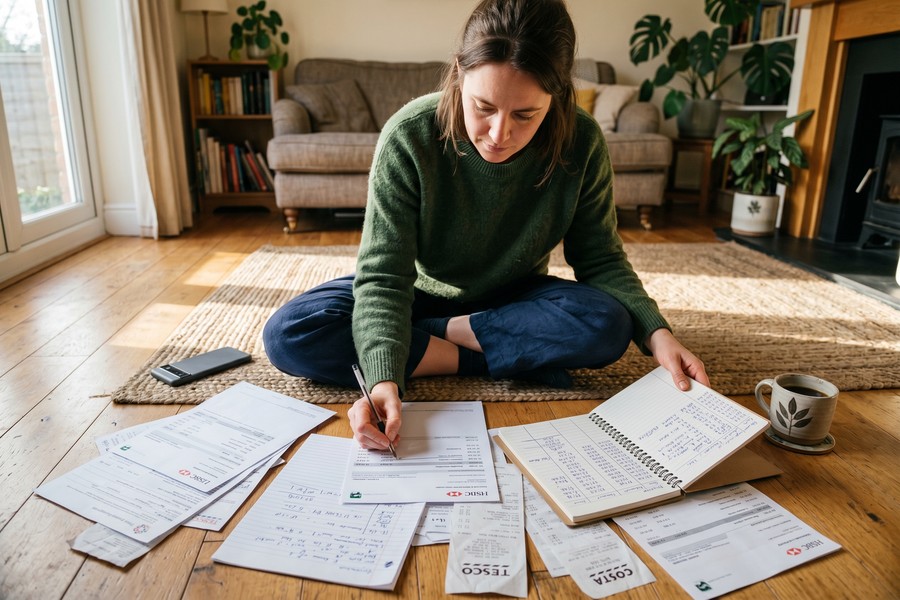
Before cutting anything, you need a category-by-category line audit using real bank statements and credit card records, not guesses. Most families are surprised to find their actual spending differs from their perceived spending by 20% or more in at least one category.
How to Do This
Pull the last three months of bank and credit card statements. The Consumer Financial Protection Bureau (CFPB) recommends a structured approach: track all income sources, log spending by category, map bill due dates, and then build a working budget worksheet that ensures you cover both fixed expenses and savings. Three months gives you a reliable average because one month is often distorted by a seasonal expense or a one-time purchase.
Assign every transaction to one of these six categories: housing, food, transportation, healthcare, subscriptions and services, and discretionary. Once you have totals, look for the gap between what you thought you spent and what you actually spent. That gap is your first source of savings.
One category most budgeting guides skip: irregular annual or quarterly expenses. Car registration, back-to-school supplies, holiday gifts, and annual insurance premiums do not appear every month, so families fail to pre-fund them. Divide each annual irregular cost by 12 and add it to your monthly budget as a line item. Without this step, these costs appear as “emergencies” that blow the budget three or four times a year.
What to Watch Out For
Do not rely on budgeting apps alone for this audit. Many apps miscategorize transactions or miss cash spending. The first pass should be manual, even if it takes a Saturday afternoon. After that, tools like YNAB (You Need a Budget) or EveryDollar work well for ongoing tracking on a single income because both use zero-based budgeting, which gives every dollar an assigned job. Apps built around dual-income assumptions sometimes create confusion about which partner’s income “owns” which expense category.
Schedule a monthly “money date” with your partner to review the previous month’s spending together. Both partners should see the same numbers at the same time. This one habit eliminates most of the resentment that builds when one person feels like the financial enforcer and the other feels monitored. Set a 45-minute limit, use a shared spreadsheet or app, and end with one agreed-upon adjustment for the coming month.
Step 3: How Can I Cut Our Grocery Bill Without Boring My Family to Death?
Groceries are the highest-leverage flexible expense in most household budgets, and a 15–20% reduction in this category alone can deliver $140–$240 per month toward the $600 target. The key is targeting the right spending within the food category, not blanket restriction.
How to Do This
American households spent an average of $3,945 per year on food away from home in 2024, restaurants, delivery, and takeout, compared to $6,224 on groceries at home, according to BLS spending data. The smarter cut is not eliminating all restaurant spending but redirecting some of it. A family spending $330 per month on takeout who pulls that down to $165 frees up $165 with almost no change to daily life quality.
Three tactics deliver the most grocery savings with the least friction:
- Weekly meal planning before shopping. Planning five to six dinners in advance eliminates the “what’s for dinner” panic that drives last-minute takeout orders. It also means you shop with a specific list, which directly reduces impulse purchases.
- Curbside grocery pickup. Ordering groceries for pickup rather than walking the store cuts average grocery bills by removing in-aisle temptation. Multiple studies have found that shoppers spend measurably more when browsing in-store versus ordering online.
- Reducing meat two nights per week. This is the single highest-return food swap available. Replacing two weekly meat-centered dinners with legume, egg, or grain-based meals typically saves $30–$60 per month without requiring cooking skill upgrades.
One important distinction: there is a difference between “fun food spending” (the Friday pizza night your kids look forward to, the coffee you get alone on Tuesday morning) and grocery inflation grief (overpaying for brands, buying produce that goes bad, duplicating pantry staples). The goal is to protect the former while attacking the latter. A blanket “cook everything from scratch” mandate is how budgets fail. Give your household permission to keep the food spending that genuinely matters.
For families already using coupons or cashback apps, check out how coupon stackers are beating inflation with systematic stacking strategies that go beyond basic clipping.
What to Watch Out For
Buying in bulk saves money only when you will actually use the product before it expires. Many families increase food waste when they overbuy at warehouse stores like Costco or Sam’s Club. Track your food waste for two weeks before committing to a bulk-buying strategy; if you are throwing away produce or dairy regularly, bulk buying will increase costs, not reduce them.
U.S. consumers spent 10.4% of disposable personal income on food in 2024, according to the USDA Economic Research Service. That share is down slightly from 10.6% in 2023, but food remains the second-largest flexible expense category after housing for most single-income households.
Step 4: What Is the Fastest Way to Cut Bills Without Feeling the Pain?
Subscription audits and bill negotiation are the fastest path to savings because they produce recurring monthly reductions from a one-time effort. A thorough audit typically uncovers $80–$150 per month in forgotten or low-value recurring charges, and active bill negotiation can reduce fixed expenses most families treat as permanent.
How to Do This
Start with a subscription sweep. Go through every line item in your bank and credit card statements from the past 90 days and flag every recurring charge. Common stacks for families with a stay-at-home parent include multiple streaming platforms (Netflix, Disney+, Hulu, Max, Peacock), Amazon Prime, a meal kit service (HelloFresh, EveryPlate), a fitness app, and one or more kids’ educational platforms (ABCmouse, Khan Academy’s premium tier, Reading Eggs). A full accounting often surprises families who assumed their subscriptions were “just a couple of things.”
Cancel anything you have not actively used in 30 days. For services you want to keep, check whether a lower tier exists. Many streaming services now offer ad-supported tiers at $4–$6 per month versus $15–$18 for ad-free. Switching two services to ad-supported saves $20–$24 per month immediately. Your local library is also worth a serious look: many systems provide free access to streaming content, digital magazines, and audiobooks through apps like Libby and Kanopy. See what your library gives you for free, it is more than most families realize.
Bill negotiation is an active skill, not a passive hope. Call your internet provider, auto insurance carrier, and any subscription service you want to keep but think is overpriced. The script is simple: “I am reviewing my household budget and I am considering canceling. Is there a better rate available?” Internet providers and insurers regularly offer retention discounts of $10–$40 per month to customers who ask. A stay-at-home parent has time during the day to make these calls that a working parent often cannot find, that time is a real financial asset.
If you are carrying credit card balances, consider whether a lower interest rate is negotiable. Our guide to negotiating your credit card APR walks through the exact conversation to have with your issuer.
What to Watch Out For
When you cancel a subscription, set a calendar reminder for the cancellation date and verify the charge actually stops. Many subscription services allow cancellation in-app but continue billing due to billing system errors. Check your next statement and the one after that to confirm the charge is gone.
| Savings Category | Typical Monthly Savings | Effort Required |
|---|---|---|
| Subscription audit | $80–$150 | 2–3 hours, one time |
| Internet bill negotiation | $10–$40 | 30-minute phone call |
| Auto insurance re-shop | $30–$80 | 1–2 hours, annually |
| Meal planning + curbside pickup | $80–$200 | 1 hour per week ongoing |
| Eliminating second vehicle | $400–$600 | One-time decision + logistics |
| Switching 2 streaming tiers | $20–$24 | 15 minutes, one time |
The table above shows why one-time structural changes (vehicle, subscriptions) deliver more monthly savings than ongoing behavioral changes. Prioritize the structural cuts first, then layer in behavioral improvements as habits build.
Step 5: How Do I Stop Overspending Without Giving Up the Things I Actually Enjoy?
Restrictive budgets fail for the same reason restrictive diets do: they eliminate too much at once and create deprivation that eventually breaks the system. The goal is not to spend less on everything, it is to spend less on things that provide little value and protect the spending that makes life feel normal.
How to Do This
Try a “joy ranking” exercise. List every discretionary expense from the past three months. Rank each one from highest to lowest personal satisfaction on a 1–10 scale. Cut from the bottom of the list first. This approach lets a family keep the gym membership that one parent relies on for sanity while eliminating the magazine subscription nobody reads. The 50/30/20 budget framework, popularized by Senator Elizabeth Warren’s work on household finance, explicitly reserves 30% of take-home pay for wants. Even on a tight single-income budget, protecting some discretionary spending is by design, not indulgence.
One cost pressure specific to stay-at-home parents deserves naming directly: social pressure spending. Birthday party gifts for classmates, school fundraiser purchases, neighborhood holiday gift exchanges, and keeping-up-with-neighbors costs fall disproportionately on the parent who is present at drop-off, pickup, and school events every day. These expenses are almost never addressed in generic budgeting content, but they are real, recurring, and socially loaded. Setting a firm per-child gift budget of $20–$25 (or gifting an experience rather than a physical item) is a concrete way to contain this category without social awkwardness.
For low-cost or no-cost entertainment that does not feel like deprivation, look at what your community already offers free. National Park passes, library event programs, and museum free days are resources many families overlook entirely.
What to Watch Out For
Be honest about whether a spending category is “genuinely enjoyed” or “socially expected.” The distinction matters because the right response to each is different. Genuinely enjoyed spending belongs in the protected column. Socially expected spending often disappears without the relationship suffering, most people are spending more on social obligations than their friends actually want from them.
For date nights and couple time on a tight budget, you do not have to choose between spending money and keeping the relationship strong. See our guide to cheap romantic dinners that still impress for specific meal ideas that cost $15–$25 total and do not feel like a budget night.

Step 6: Should We Get Rid of Our Second Car to Save Money?
The one-car question is worth a genuine financial analysis. Gas, insurance, maintenance, and registration on a second vehicle cost the average American family $400–$600 per month, which by itself covers the entire savings target in this guide. The honest framing is not “can we survive with one car?” but “is this car worth $400–$600 per month to us?”
How to Do This
Calculate your actual second-car cost by adding up 12 months of gas receipts, insurance premiums, oil changes, tire rotations, registration fees, and any repair costs, then dividing by 12. Most families underestimate this number because the costs arrive at different times of year. Once you have the real monthly cost, compare it against realistic alternatives: rideshare trips, a car rental for the three or four times per year you genuinely need two vehicles simultaneously, or a second vehicle that costs significantly less to operate.
Insurance re-shopping is the second big move in this category. Dropping to one car, adding a home-bundle discount, or simply calling two or three competing insurers with a request for a better quote are moves that most families make once and then forget to revisit. Insurers will not proactively lower your premium, you have to ask. Bank of America’s Better Money Habits resource advises families transitioning to one income to redirect savings from eliminated commuting costs into an interest-bearing account or toward debt repayment, rather than letting those dollars get absorbed into general spending.
There is also a broader insight buried in this step: most families treat both vehicles and their cable or internet packages as “fixed” expenses that cannot be changed. They are not fixed. They are recurring choices. The distinction between truly fixed expenses (mortgage, property tax, minimum loan payments) and conditionally fixed expenses (a second car, a premium internet tier, a landline nobody uses) is one of the most useful reframes in household budgeting.
What to Watch Out For
Going to one car only works if your household logistics support it. If both partners have time-sensitive medical appointments, school pickups, or work obligations that overlap, the practical friction of sharing one car may cost more in stress and time than the car payment costs in dollars. Run a two-week test: track every time you both needed a car at the same time and how you would have handled it with one. That data is more reliable than a theoretical decision made on a Sunday afternoon.
If you are considering going to one car and your household relies on government assistance programs, check whether a vehicle asset affects your eligibility. Some programs have asset tests that count vehicle value. Resources like updated 2026 poverty guidelines can help you understand current eligibility thresholds before making structural financial changes.
Step 7: How Do I Protect My Financial Future as a Stay-at-Home Parent?
Monthly budget cuts matter, but the long-term financial risks facing stay-at-home parents are rarely addressed in budgeting guides. Three specific issues, the retirement contribution gap, the life insurance blind spot, and credit score erosion, deserve direct attention.
The Retirement Gap and the Spousal IRA
With one earner contributing to a workplace retirement account, the household’s maximum annual retirement contributions are roughly half what a dual-income couple can put away. In 2025, the 401(k) contribution limit was $23,500 per person, meaning a dual-income couple could contribute up to $47,000 annually. A single-income household is limited to one person’s contributions. The gap compounds significantly over 10 or 20 years.
The spousal IRA is the most underused tool available to address this. A stay-at-home parent with no earned income can still contribute up to $7,000 per year (2025 limit) to a traditional or Roth IRA, as long as the working spouse has at least that much in earned income. The contribution comes from household funds, not the non-earning partner’s personal income. Most budgeting articles aimed at stay-at-home parents never mention this, which is why so many non-earning spouses reach their 40s or 50s with no retirement savings in their own name. For a broader introduction to getting started, see our guide to investing with zero experience.
The Life Insurance Blind Spot
The replacement cost of a stay-at-home parent’s labor was estimated at $145,235 in 2025, covering childcare, household management, transportation, cooking, and related tasks. Without a life insurance policy on the non-earning partner, a family’s budget faces a double collapse if that parent dies or is seriously injured: income is still limited to one earner, but now the household must pay for all the services the stay-at-home parent provided.
A term life insurance policy covering a stay-at-home parent typically costs $15–$30 per month for a healthy adult in their 30s with $500,000 in coverage. That is a small line item relative to the risk it covers. If your household does not carry this coverage, getting a quote should be the first financial action you take after completing this guide.
Credit Score Erosion
A stay-at-home parent who stops using credit in their own name, no personal credit cards, no loans in their name alone, can see their credit score decline over several years. Credit scores are partly a function of recent account activity and account age. Dormant accounts that eventually close, combined with no new activity, thin the credit file. This creates real risk if the non-earning partner ever needs credit independently: for workforce re-entry, a car loan, or if the relationship ends. Maintaining at least one credit card in your own name, used lightly and paid in full each month, costs nothing and preserves your credit history. For help managing any existing balances, our overview of how to prioritize and negotiate credit card debt covers the process clearly.
According to the Federal Reserve’s 2024 household survey, 78% of stay-at-home parents in two-parent families are mothers. This demographic concentration makes the credit score erosion risk, the retirement gap, and the life insurance gap specifically important for women who step out of the workforce, yet these issues receive almost no coverage in mainstream budgeting content aimed at this audience.

Frequently Asked Questions
How do I build a budget as a stay-at-home parent when the income fluctuates month to month?
Base your monthly budget on the lowest predictable income month, not the average. If your working partner receives variable pay, bonuses, or commission, treat only the guaranteed base salary as your planning income. Any income above that baseline gets assigned intentionally, to debt, savings, or a specific discretionary category, rather than absorbed into routine spending. The CFPB’s budgeting framework recommends mapping bill due dates alongside income dates to avoid cash flow gaps even when monthly income is consistent.
What budgeting apps work best for a single-income household with a stay-at-home parent?
YNAB (You Need a Budget) and EveryDollar are the two strongest choices for single-income households because both use zero-based budgeting, where every dollar of income is assigned a purpose before the month begins. Apps like Mint or Personal Capital were designed around dual-income tracking and can create confusion about who “owns” which expense. YNAB costs approximately $14.99 per month but typically delivers savings that far exceed that fee within the first 90 days of consistent use; EveryDollar offers a free tier with basic functionality.
How much should a stay-at-home parent budget for groceries each month?
A reasonable grocery target for a family of four is $700–$950 per month, depending on location and dietary needs. The USDA’s food spending data shows the average American household spent $6,224 on groceries at home in 2024, working out to about $519 per month across all household sizes. Families of four in higher-cost metro areas will be above that average; rural families often come in below it. Use your actual three-month spending history as your starting benchmark before setting a target.
Can a stay-at-home parent contribute to retirement savings with no personal income?
Yes. A stay-at-home parent with no earned income can contribute up to $7,000 per year to a spousal IRA (2025 limit, or $8,000 if age 50 or older), as long as the working spouse earns at least that amount. Contributions come from household funds. Both traditional and Roth spousal IRAs are available, and the choice depends on the household’s current tax bracket versus expected retirement tax situation. This is one of the most underused financial tools available to one-income families.
Is it worth staying home financially, or does the lost income outweigh the childcare savings?
In many U.S. markets, the math is genuinely close. Full-time childcare averaged $1,200–$1,600 per month per child in most cities in 2025–2026, and in 38 states and D.C., childcare costs exceed public college tuition. For a parent earning $40,000–$50,000 annually, after taxes, commuting costs, work clothing, and childcare, the net income gain from staying employed can shrink to $500–$1,000 per month or less. The calculation is personal and depends heavily on local childcare rates, the second income’s tax bracket, and the number of children involved.
How do I handle the Child Tax Credit as a stay-at-home parent family?
, the Child Tax Credit increased to $2,200 per qualifying child under the One Big Beautiful Bill Act signed in 2025. For single-income families, this credit can meaningfully reduce annual tax liability or generate a refund. The most financially effective use of a tax refund is to direct it toward a specific one-time goal, paying off a credit card balance, funding the spousal IRA for the year, or building the emergency fund, rather than letting it dissolve into general spending. See our overview of credits families commonly overlook at tax time for additional details on maximizing your refund.
How long does it realistically take to cut $600 a month from a household budget?
Most families reach their full $600 monthly savings target within 60–90 days of starting a structured budget audit. The first month produces the data; the second month is where adjustments take effect; by the third month, the new spending patterns are established. Structural changes (eliminating a subscription, re-shopping insurance) take effect immediately. Behavioral changes (meal planning, reducing impulse purchases) typically take six to eight weeks to become reliable habits.
What should I do if my partner and I disagree about where to cut spending?
Start with the data, not the argument. Pull three months of statements together and let the numbers lead the conversation. Disagreements about spending are almost always easier to resolve when both partners are looking at the same factual baseline rather than operating from different assumptions. From there, use the joy-ranking method: each partner independently ranks discretionary expenses by satisfaction value, then compare lists. Items that rank low for both partners are painless cuts; items that rank high for one partner deserve protection even if the other would not miss them.
What if one of us wants to return to work? How do we prepare the budget for that transition?
Plan the re-entry budget before the job starts. Returning to work adds real costs that are easy to underestimate: childcare, commuting, a work wardrobe refresh, and convenience food spending that replaces home cooking on busy evenings. Map those new costs against the incoming salary net of taxes to calculate the actual take-home gain. If the net gain is smaller than expected, the stay-at-home parent may choose to return part-time first, or to build income from home before committing to full-time employment. Micro-freelancing and local part-time work are increasingly viable options; see how micro-freelancing is growing for specific platforms and entry points.
Sources
- U.S. Bureau of Labor Statistics, Consumer Expenditures in 2024
- U.S. Bureau of Labor Statistics, Housing and Transportation Accounted for 50% of Household Spending in 2024
- U.S. Bureau of Labor Statistics, The New Year and Household Spending (Food Data 2024)
- USDA Economic Research Service, Food Prices and Spending
- Federal Reserve Board, Economic Well-Being of U.S. Households in 2024: Care Work and Living Arrangements
- Pew Research Center, Almost 1 in 5 Stay-at-Home Parents in the U.S. Are Dads
- Consumer Financial Protection Bureau, Budgeting: How to Create a Budget and Stick With It