Fact-checked by the MyFinancial101 editorial team
Quick Answer
Store brands cost 5 to 72% less per serving than name brands in comparable categories, according to Consumer Reports blind taste tests. Switching selectively across pantry staples, dairy, household essentials, and OTC medications can save a family of four up to $5,000 per year with no meaningful drop in quality.
The store brand vs. name brand debate is largely settled for anyone paying attention to the data. Store brands generated $282.8 billion in U.S. sales across supermarkets, drug chains, and mass merchandisers in 2025, according to PLMA and Circana’s 2025 industry report, a figure that reflects millions of households quietly reallocating their grocery budgets without sacrificing shelf quality. That growth outpaced national brands: store brand dollar sales rose 3.3% year-over-year in 2025 versus just 1.2% for name brands.
The real question is where generics match up and where they fall short. This guide breaks it down category by category so you know exactly when to switch and when a name brand still earns its price premium.
Key Takeaways
- Store brands held a 21.3% dollar market share for the 52 weeks ending December 28, 2025, their highest recorded level (PLMA/Circana, 2025).
- 61% of consumers say private label brands offer above-average value for their price (Numerator, 2026).
- Generic OTC medications cost 80 to 85% less than brand-name equivalents while containing identical active ingredients under FDA generic drug requirements.
- Consumer Reports found that 76% of store-brand products tasted just as good as name brands in blind testing across 70 products (Consumer Reports).
- A family switching to store brands strategically can save $5,000 per year, according to retail analyst Burt Flickinger III of Strategic Resource Group (Consumer Reports).
In This Guide
- Why Store Brands Can Save You Thousands Annually
- How Store Brands Are Made, and Why Quality Is Often Identical
- Pantry Staples and Baking Ingredients: Switch with Confidence
- Dairy, Eggs, and Frozen Foods: When to Test First
- Household Essentials and Personal Care: Big Wins on Repetitive Buys
- Over-the-Counter Medications: The Safest Switch of All
- Frequently Asked Questions
Why Store Brands Can Save You Thousands Annually
Most households leave hundreds of dollars on the table every month, not from eating out or impulse buys, but from defaulting to name brands on items where generics are functionally identical. The math compounds fast. Store brands now account for 26% of unit volume across ten major product sectors, per Numerator’s April 2026 private label trends report, and that share keeps climbing precisely because consumers are running the numbers and liking what they see.
The Arithmetic of Switching
Here is a concrete example using verified figures. Consumer Reports documents savings of 5 to 72% per serving when switching from name brands to store brands. Take a conservative middle estimate of 30% savings across a grocery basket. A family of four spending $1,200 per month on groceries, a reasonable 2025–2026 figure given cumulative food inflation tracked by the U.S. Bureau of Labor Statistics Consumer Price Index, would save $360 per month by switching roughly half their cart to store brands. That works out to $4,320 per year, approaching the $5,000 figure cited by retail analyst Burt Flickinger III of Strategic Resource Group.
Redirecting even half of that toward an emergency fund or debt payoff changes the financial picture meaningfully. If you carry a balance on a Chase or Capital One credit card at a high APR, this kind of grocery reallocation is one of the fastest levers available, and the Consumer Financial Protection Bureau (CFPB) consistently points to reduced recurring spending as the most accessible first step toward eliminating revolving debt. If you are already working on prioritizing and paying down credit card debt, the connection is direct.
The savings also do something less obvious: they reduce the psychological pressure of grocery shopping on a tight budget, making it easier to stick to a plan rather than spiraling into trade-off fatigue. That is not a soft benefit. It is how budgeting actually holds together over time.
U.S. consumers chose store brands over national brands at a record pace in 2025, generating $282.8 billion in total store brand sales, up 3.3% year-over-year versus just 1.2% growth for national brands (PLMA/Circana, 2025).
How Store Brands Are Made, and Why Quality Is Often Identical
The most counterintuitive fact in the store brand vs. name brand conversation: the product in the generic box is frequently made by the same manufacturer as the name brand sitting next to it on the shelf. Aldi‘s Millville cereal line, for instance, is widely documented to be produced by the same contract manufacturers that supply General Mills. The difference is not the product, it is the marketing budget and the packaging.
Associate Professor Ernest Baskin of the Food, Pharma, and Healthcare program at St. Joseph’s University has noted that the private label industry is broadly misunderstood by shoppers who assume a lower price signals lower standards. Per a review published by Consumer Reports, Baskin’s research found that “it’s a common misconception that private label is always a lesser version.” The FDA enforces strict manufacturing and labeling standards regardless of whether a product carries a store label or a national brand name, which levels the quality floor considerably across food and pharmaceutical categories.
“It’s a common misconception that private label is always a lesser version.”
Pantry Staples and Baking Ingredients: Switch with Confidence
Pantry staples are the clearest category win for store brands. Sugar is sugar. All-purpose flour milled to the same protein content performs identically in recipes whether it carries a King Arthur label or a Kroger store label. The same holds for white rice, dried pasta, canned tomatoes, chicken broth, and the full spice rack.
Where the Savings Are Sharpest
Price gaps on pantry items typically run 25 to 40% in favor of store brands at major retailers. A 5-pound bag of Domino granulated sugar regularly retails around $4.49 at Walmart; the Great Value equivalent runs $3.48, a 22% gap on one of the most commoditized products on the shelf. Spices show even wider spreads: McCormick ground cumin averages around $5.99 for 1.5 oz while a store-brand equivalent of the same volume lands around $2.49, a difference of more than 58%.
Canned goods are equally safe territory. Canned diced tomatoes, black beans, corn, and green beans are regulated commodities where USDA grading standards define quality tiers, and store brands routinely hit the same grade as name brands at a fraction of the price. If you are already following strategies from our look at winter foods that keep grocery bills under control, swapping canned goods to store brand is the logical next step.
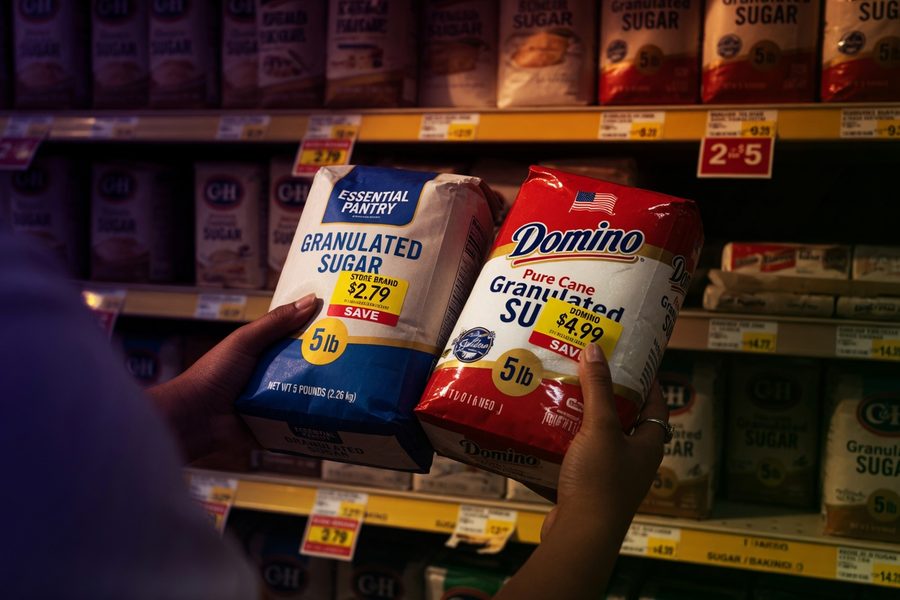
Consumer Reports blind taste tests across 70 store-brand products found that 76% tasted just as good as the name brand, according to Consumer Reports nutritionist Amy Keating, RD. Many cost 5 to 72% less per serving.
Dairy, Eggs, and Frozen Foods: When to Test First
Dairy is mostly a safe switch, with one honest caveat. Milk is a commodity product graded by the USDA and processed under identical pasteurization standards regardless of label. Store-brand butter, shredded cheese, and eggs from major retailers like Publix or Walmart perform virtually identically to national equivalents in taste and cooking applications, at savings of roughly 20 to 35%.
Where Frozen Gets Complicated
Frozen vegetables are a reliable win: the vegetable is the vegetable, and flash-freezing standards are consistent. Frozen pizza and ice cream are where texture and flavor gaps show up most often in consumer testing. Premium national brands like DiGiorno or Häagen-Dazs use specific formulations, cheese blends, crust types, fat content in cream bases, that store brands do not always replicate cleanly. The recommendation here is to test once before committing to a wholesale switch. If your household’s store-brand frozen pizza passes the family test, the savings are real. If it does not, you have spent $4 to find out.
Yogurt sits in a middle ground. Store-brand plain Greek yogurt from Walmart or Kroger is manufactured to the same cultures and protein standards as Chobani or Fage, and most consumers cannot distinguish them in blind tests. Flavored yogurts with specific fruit preparations are more variable; some store versions taste noticeably thinner or more synthetic. Again: one-time test, then decide.
| Category | Typical Store Brand Savings | Recommendation |
|---|---|---|
| Pantry Staples (flour, sugar, rice, pasta) | 25–40% | Switch immediately |
| Canned Goods | 30–45% | Switch immediately |
| Milk and Eggs | 20–30% | Switch immediately |
| Butter and Shredded Cheese | 20–35% | Switch immediately |
| Frozen Vegetables | 25–40% | Switch immediately |
| Frozen Pizza and Ice Cream | 20–35% | Test first |
| Flavored Yogurt | 15–25% | Test first |
| Laundry Detergent | 35–50% | Test first |
| OTC Medications (generics) | 80–85% | Switch immediately |
| Electronics Accessories | 40–60% | Name brand often preferred |
Household Essentials and Personal Care: Big Wins on Repetitive Buys
Repetitive household purchases are where the annual savings calculation really accelerates. Toilet paper, paper towels, dish soap, and laundry detergent are bought on a fixed cycle, meaning a 35 to 50% savings on each item compounds every 2 to 4 weeks without any behavioral change.
Laundry and Dish Products
Store-brand dish soap and laundry detergent perform comparably to Tide or Dawn for standard loads and everyday dishes. The formulations contain the same surfactant classes; the concentration may differ slightly, so comparing cost-per-load rather than cost-per-bottle matters. On a cost-per-load basis, store-brand liquid detergents at Aldi or Walmart typically run $0.08 to $0.12 per load versus $0.20 to $0.28 per load for Tide Original, a gap that adds up to $60 to $80 per year for a household doing six loads per week.
Heavily stained work clothes or specialty fabrics are the one scenario where a premium detergent formulation (OxiClean, Tide Plus Febreze) can genuinely outperform, and that is a reasonable trade-off to make on a targeted basis. Buying Tide for one load type while using store brand for everything else is a valid middle path. Pair this approach with the coupon-stacking strategies covered in our guide on how coupon stackers are beating inflation and the savings stack even further.
Personal Care: More Variable Territory
Shampoo and body wash are where honest nuance matters. Store-brand shampoos clean hair effectively; they carry the same FDA-regulated ingredient categories as name brands like Pantene or Dove. But hair-specific formulations for color-treated, chemically processed, or very fine hair do show performance differences that consumer testing consistently surfaces. For those use cases, Pantene, Dove, or salon-tier brands have earned their premium. For standard daily-use shampoo on unprocessed hair, store brands are a straightforward win.
Before switching any personal care product, buy one unit of the store brand and run it to completion. If there is no meaningful difference in your experience, you have confirmed the switch is permanent. If there is a difference that bothers you, you have spent $3 to $5 to protect a purchase you make every 4 to 6 weeks. The cost of the test is the cost of certainty.
Over-the-Counter Medications: The Safest Switch of All
Generic OTC medications are the single most defensible category switch in the store brand vs. name brand comparison. The FDA requires generic drugs to contain the same active ingredient, in the same dosage and form, with the same route of administration as their brand-name counterparts. There is no regulatory gray area here.
What the Cost Difference Actually Looks Like
The savings are not marginal, they are structural. Generic ibuprofen, acetaminophen, diphenhydramine, loratadine, and omeprazole cost 80 to 85% less than the Advil, Tylenol, Benadryl, Claritin, and Prilosec equivalents sitting next to them on the shelf. A 200-tablet bottle of store-brand ibuprofen at Costco or Walmart typically runs $7 to $10; the Advil equivalent for the same count runs $18 to $24.
The one honest caveat: inactive ingredients, binders, fillers, dyes, and coatings, are not required to be identical. For most people this is irrelevant. For individuals with specific dye sensitivities or filler allergies, checking the inactive ingredient list before switching is worthwhile. This is a narrow exception, not a reason to default back to name brands.
For households managing medical costs carefully, this category alone can reclaim $200 to $400 per year. Lenders and personal finance platforms like SoFi frequently cite discretionary spending reduction as the fastest way to improve your debt-to-income ratio (DTI) and, over time, your FICO Score, both of which affect the APR you qualify for on products ranging from personal loans to credit cards. Reducing monthly outflows is the same principle applied to the grocery aisle. If you are navigating healthcare cost pressures, the resources listed in our article on free health screenings can help offset costs on the preventive side as well.

Switching to store-brand groceries and generics is one of the fastest ways to free up cash for building an emergency fund. Households managing tight budgets may also qualify for assistance programs, including SNAP benefits, that compound grocery savings further.
Frequently Asked Questions
Are store brand products actually made by the same manufacturers as name brands?
Often, yes. Many store-brand products, particularly cereals, canned goods, and dairy items, are produced by the same contract manufacturers that supply national brands. The primary differences are packaging and marketing costs, not ingredients or production standards. Aldi’s Millville cereal line and several Kirkland Signature products at Costco are well-documented examples.
Is it safe to switch to generic OTC medications?
Yes, for the vast majority of users. The FDA mandates that generic drugs contain identical active ingredients in the same dosage, form, and route of administration as brand-name drugs. Inactive ingredients (fillers and dyes) may differ, so individuals with known dye or filler sensitivities should check the label before switching.
Which categories should I avoid switching to store brands?
Electronics accessories, specialized pet food for animals with health conditions, and certain personal care products formulated for specific hair or skin types are the categories where name brands most consistently justify their premium. Durability and formulation consistency matter more in these segments than in commoditized food or pharmaceutical categories.
Do premium store-brand lines (like organic or “private selection” tiers) offer better quality than standard generics?
Premium private label lines, Kroger’s Simple Truth, Whole Foods‘ 365, Target‘s Good & Gather, occupy a middle tier that competes directly with national premium brands, often at 15 to 25% lower prices. They typically use cleaner ingredient lists and better sourcing standards than standard generics, making them a strong option when organic or clean-label matters to you but you still want to spend less than national organic brands.
Can switching to store brands really save $5,000 per year?
It is achievable for a family of four with a full grocery budget, though it requires switching across most eligible categories rather than a handful. The $5,000 figure, cited by retail analyst Burt Flickinger III of Strategic Resource Group, assumes consistent store-brand purchasing across food, household essentials, and health products. A more conservative estimate for a household switching 40 to 50% of its cart would be $2,500 to $3,500 annually.
Do store brands change their formulations over time?
This is a real and underreported issue. Store brands are subject to supplier changes and batch-to-batch reformulation more frequently than name brands, which maintain stricter consistency to protect brand equity. If a store-brand product you rely on tastes or performs differently than it did six months ago, a supplier change is the likely explanation. It is worth checking back periodically rather than assuming a one-time test result holds permanently.
How does grocery spending connect to broader financial health metrics?
More directly than most people realize. Your debt-to-income ratio (DTI) is calculated by dividing monthly debt payments by gross monthly income, a figure that mortgage lenders, credit unions, and institutions like Experian use to assess creditworthiness alongside your FICO Score. Reducing monthly grocery spending frees cash that can go toward debt paydown, which lowers your DTI. Even modest improvements in DTI can affect the APR you qualify for on a mortgage or auto loan, where a half-point difference in rate translates to thousands of dollars over the loan’s life. The CFPB and the Federal Reserve‘s consumer finance research both document this relationship between household cash flow management and long-term borrowing costs. Switching to store brands is not a substitute for a full financial plan, but it is a concrete, repeatable action that connects directly to the numbers lenders look at.
Sources
- Private Label Manufacturers Association (PLMA) / Circana, Store Brand Facts 2025
- Numerator, Private Label Trends Report, April 2026
- Consumer Reports, Store Brand Foods We Love (and a Few We Don’t)
- Consumer Reports, How Store Brand Groceries Can Help You Save
- U.S. Bureau of Labor Statistics, Consumer Price Index, Food at Home
- Consumer Financial Protection Bureau, Budgeting and Household Spending