Fact-checked by the MyFinancial101 editorial team
Quick Answer
A late tax filing penalty costs 5% of unpaid taxes per month, up to a 25% maximum. File your return immediately, even without full payment, to stop the penalty clock. Then pay what you can, set up an IRS payment plan, and request first-time abatement if you have a clean three-year filing history. Most people can resolve this within 30 days.
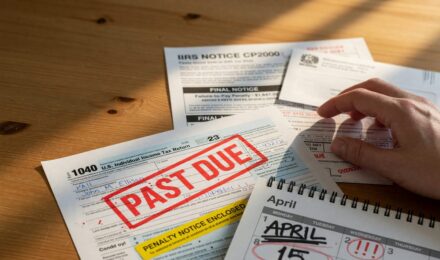
Missing the tax deadline triggers a late tax filing penalty that compounds fast, far faster than most people expect. The IRS charges 5% of your unpaid tax balance for every month (or partial month) your return sits unfiled, according to official IRS guidance on the failure-to-file penalty. That means a $3,000 tax bill left unfiled for five months becomes a $750 penalty before interest is even added.
The scale of the problem is bigger than most realize. The IRS assessed an additional $29.6 billion in taxes tied to returns not filed on time in fiscal year 2025. Meanwhile, state tax agencies run their own penalty clocks independently, and gig workers or self-employed filers often face a third layer: estimated tax underpayment penalties piled on top. If you’ve already missed a deadline this year, or you’re trying to plan ahead for future seasons, understanding exactly how these costs work is the first step to controlling them.
This guide is for anyone who has missed a federal filing deadline, or suspects they might, and wants a clear, step-by-step path to limiting the damage. You’ll learn how penalties are calculated, when filing late costs you nothing at all, and how to request relief the IRS actually grants.
Key Takeaways
- The failure-to-file penalty is 5% per month on unpaid taxes, capped at 25%, per IRS.gov.
- A separate failure-to-pay penalty of 0.5% per month also applies, but in months where both penalties run simultaneously, the failure-to-file rate drops to 4.5%, per IRS Topic No. 653.
- If your return is more than 60 days late, a minimum penalty of $510 (for returns due in 2025) applies, or 100% of what you owe, whichever is smaller, according to IRS failure-to-file guidance.
- No failure-to-file penalty applies if the IRS owes you a refund, per IRS Topic No. 653, though your refund will be delayed.
- The IRS collected $3.5 billion from delinquent returns in fiscal year 2025, per IRS collection statistics.
- First-time penalty abatement can wipe out the entire assessed penalty for taxpayers with a clean three-year filing history, per TurboTax abatement guidance.
In This Guide
- Step 1: What the Failure-to-File Penalty Actually Costs You
- Step 2: Additional Costs That Pile On Top of the Penalty
- Step 3: Scenarios Where Late Filing Triggers No Penalty at All
- Step 4: What to Do the Day You Realize You’ve Missed the Deadline
- Step 5: How to Request Penalty Abatement or Relief
- Step 6: Proven Ways to Keep Future Late-Filing Penalties to a Minimum
- Frequently Asked Questions
Step 1: What the Failure-to-File Penalty Actually Costs You
Most people assume the penalty for filing late is a flat fee. It is not. The charge is a percentage that compounds monthly, starting the day after your deadline passes. The IRS failure-to-file penalty is 5% of the unpaid tax amount for each month or partial month your return is late, with a ceiling of 25% of the total unpaid balance.
How the Calculation Works
The 5% rate applies to the tax you actually owe, not your gross income, not your total tax liability before withholding. If your employer withheld enough to cover the full bill, your unpaid balance is zero, and the penalty calculates to zero. But if you owe even $500, that amount is the base the IRS multiplies against each late month.
Partial months count as full months. File one day into a new month, and the IRS treats it as an entire additional month of delinquency. That single day can cost you another 5%.
Here is a worked example. Say you owe $4,000 and file your 2024 return four months and one day late (late May, using April 15 as the original deadline). The IRS counts five months of failure-to-file, not four. The penalty: $4,000 x 5% x 5 = $1,000. That is before interest and before any separate failure-to-pay charges.
The 60-Day Minimum Penalty
There is a trap many filers do not know about. Once your return is more than 60 days past due, the IRS imposes a minimum penalty. For returns due in 2025, that floor is $510, or 100% of the unpaid tax, whichever amount is smaller. So even if you owe just $300 and file two months late, you could owe the full $300 as a penalty on top of the original debt. For returns with due dates after December 31, 2025, that minimum rises to $525, per IRS guidance.
How Failure-to-File Interacts With Failure-to-Pay
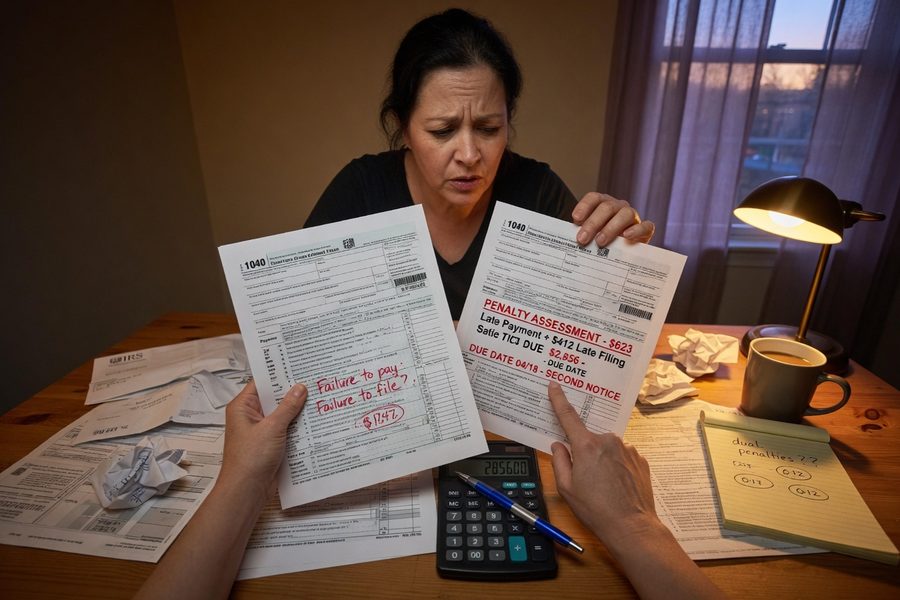
The IRS runs two separate penalty clocks simultaneously when a return is both late and unpaid. The failure-to-pay penalty is 0.5% per month on unpaid taxes, also capped at 25%. In months where both penalties apply at once, the failure-to-file rate is reduced by the failure-to-pay amount, so the combined rate is 4.5% + 0.5% = 5% total per month, not 5.5%. This offset matters: once both penalties reach their 25% caps, you are not looking at 50% in penalties, you are looking at a combined maximum closer to 47.5% depending on timing.
The IRS assessed an additional $29.6 billion in taxes on returns not filed timely in fiscal year 2025, and collected $3.5 billion directly from delinquent filers, numbers that signal enforcement is active, not passive, per IRS collection activity data.
Step 2: Additional Costs That Pile On Top of the Penalty
Penalties are the headline number, but interest quietly makes the bill larger every single day. The IRS charges interest on both unpaid taxes and on any penalties it assesses, and that interest compounds daily.
How IRS Interest Works
The federal short-term interest rate plus 3 percentage points determines the IRS underpayment rate, which the agency adjusts quarterly. The Federal Reserve’s rate decisions flow directly into this calculation, since the IRS underpayment rate tracks the federal funds rate environment. Through much of 2024 and into 2025, that combined rate hovered near 8% annually. Critically, interest accrues even if you filed an extension. An extension buys you more time to file, not more time to pay without interest. If you owed money on April 15 and paid it in October (even with a valid extension), interest ran the entire time.
Per IRS Topic No. 653, the IRS will apply interest on any penalties it assesses for filing and paying late, compounding the cost beyond the penalty percentages alone.
Longer-Term Collection Actions
Ignore a delinquent return long enough, and the IRS moves beyond notices. Federal tax liens can attach to your property, including your home, once the IRS officially assesses the liability and sends a demand for payment that goes unmet. A Notice of Federal Tax Lien becomes public record. Beyond liens, the IRS can issue levies: direct seizures of wages, bank accounts, or Social Security payments. These actions are not theoretical. The agency sends multiple notices first, but the escalation timeline is faster than many filers expect, typically beginning within 12 to 18 months of the missed deadline if no contact is made.
Credit reporting agencies such as Experian, Equifax, and TransUnion no longer include tax liens on consumer credit reports, following changes to their reporting standards. But lenders, including major institutions like Chase, Wells Fargo, and Bank of America, may still discover a filed lien through public record searches during underwriting. A lien showing up in due diligence can derail a mortgage application even when your FICO Score looks fine on paper.
The Impact on Future Refunds and Credits
Self-employed filers and gig workers face an additional layer of risk that salaried employees often miss. If you had estimated tax underpayments on top of a late return, the IRS can assess a separate underpayment penalty (Form 2210) on top of the failure-to-file and failure-to-pay penalties. That is three penalty streams running simultaneously. Managing that estimated tax schedule matters as much as the filing deadline itself. See this overview of what tax season preparation really involves for a practical starting checklist.
Filing an extension does NOT pause the interest clock. Interest on any unpaid balance begins accruing on April 15 regardless of whether you filed Form 4868, many filers discover this only when their October payment is higher than expected.
Step 3: Scenarios Where Late Filing Triggers No Penalty at All
A common misconception: every late return triggers a penalty. That is wrong. If the IRS owes you money, no failure-to-file penalty applies, but your refund sits in limbo until you claim it.
Refund returns carry no financial penalty for late filing because the penalty is calculated as a percentage of unpaid tax. Zero unpaid tax means zero penalty. Your withholding or estimated payments already covered the liability. The downside is that the IRS holds your refund until you file, and IRS Topic No. 653 confirms there is a three-year statute of limitations on claiming a refund. Miss that window entirely, and the money is forfeited. For most taxpayers, this scenario is a delay problem, not a penalty problem. The same logic applies if you have overpaid through withholding: you have no unpaid balance, so the penalty base is zero. If you are curious whether you might also be leaving other tax benefits on the table, our guide to free IRS tax help and one credit families overlook covers refundable credits worth checking before you file.
If you are owed a refund and file more than three years after the original deadline, the IRS legally keeps your money. For a 2024 return due April 15, 2025, the three-year window closes April 15, 2028, after that date, the refund is gone permanently.
Step 4: What to Do the Day You Realize You’ve Missed the Deadline
File the return immediately, even if you cannot pay the full amount. This is the single most impactful action you can take, and the IRS advises filers to submit past-due returns as soon as possible specifically to limit interest and penalty charges.
How to Do This
Use the same filing method you would for any return: tax software like TurboTax, H&R Block, or TaxAct all handle prior-year returns, though you typically cannot e-file a prior-year return and will need to mail it. If you need prior-year forms, IRS Free File Fillable Forms keeps historical versions available at IRS.gov. Once the return is filed, the failure-to-file penalty stops accruing from that day forward, even if a balance remains unpaid.
Pay whatever you can when you file. A partial payment reduces the unpaid balance the IRS uses to calculate the failure-to-pay penalty going forward. If you cannot pay everything, do not wait. The IRS installment agreement program lets you request a payment plan online in minutes through the IRS Online Account portal. Monthly plan payments reduce the remaining balance systematically, and enrolling in a plan can drop the failure-to-pay penalty rate from 0.5% to 0.25% per month.
Financial services companies like SoFi and credit unions sometimes offer personal loans specifically for tax debt. Borrowing to pay the IRS in full can make sense if the loan’s APR is lower than the combined IRS interest and penalty rate, which near 8% annually is not always the case. Run the numbers before assuming a personal loan is cheaper.
What to Watch Out For
Gather records quickly. W-2s, 1099s, and prior-year returns are available through your IRS online account if you do not have the originals. Request a Wage and Income Transcript directly from IRS.gov. One common mistake: waiting until you have everything “perfect” before filing. An imperfect return filed today stops the penalty clock. A perfect return filed next month costs another 5%. You can always file an amended return (Form 1040-X) later if corrections are needed.
Enrolling in an IRS Direct Debit Installment Agreement cuts your failure-to-pay penalty rate in half, from 0.5% to 0.25% per month on the remaining balance. On a $5,000 balance, that saves roughly $150 per year in penalty charges alone.
Step 5: How to Request Penalty Abatement or Relief
Filing and paying late does not mean you are locked into paying every dollar of assessed penalties. The IRS offers formal relief options, and the most accessible one requires no proof of hardship at all.
First-Time Abatement
First-Time Abatement (FTA) is the IRS’s administrative waiver for taxpayers who have a clean compliance history. To qualify, you need to have filed all required returns (or filed a valid extension), have no penalties assessed in the prior three tax years, and have paid or arranged to pay any tax currently owed. Meeting those criteria, you can request FTA by calling the IRS directly at 1-800-829-1040. A phone request is typically resolved in a single call, with abatement confirmed in writing within a few weeks. A written request using Form 843, Claim for Refund and Request for Abatement is an option too, but the phone route is faster.
According to TurboTax’s guidance on IRS penalty abatement, the failure-to-file and failure-to-pay penalties are among the most commonly abated, and the three-year lookback on FTA means the waiver is available to anyone with a clean recent record, not only those who have never filed late in their lives.
“If you miss the tax filing deadline, be sure to file your return and pay as soon as you can to help reduce IRS penalties. You can also check into a penalty abatement, especially if you have a history over the past three years of filing and paying your taxes on time.”
Reasonable Cause Relief
If you do not qualify for FTA, perhaps because you had a late filing in the previous three years, the IRS also grants relief for reasonable cause. Qualifying circumstances include serious illness (yours or an immediate family member’s), a natural disaster, a documented IRS error, or unavoidable absence. The key is documentation: medical records, insurance claims, a declaration from a disaster zone, or a letter from a professional who failed to provide needed information. Submit your reasonable cause argument in writing, attached either to a Form 843 or as a response to an IRS penalty notice. Keep copies of everything you send.
What to Watch Out For
FTA applies to the failure-to-file penalty, the failure-to-pay penalty, and the failure-to-deposit penalty, but it does not eliminate interest. Interest on unpaid tax continues even after a penalty is abated. If abatement is denied, you can appeal through the IRS Independent Office of Appeals. The typical IRS response to a written abatement request runs 30 to 60 days; phone requests are often resolved same-day when the representative has authority to grant them.
Call the IRS before submitting Form 843. A representative can often grant first-time abatement on the phone in under 20 minutes, saving you the several-week turnaround of a mailed written request. Have your Social Security number, the tax year in question, and the penalty notice number ready before you dial.
Step 6: Proven Ways to Keep Future Late-Filing Penalties to a Minimum
Preventing the next late-filing penalty comes down to two habits: separating the filing deadline from the payment deadline in your mind, and automating as much as possible.
Use Form 4868 Correctly
Form 4868 gives you an automatic six-month extension to file, moving your deadline from April 15 to October 15. What it does not do is extend the time to pay. To avoid the failure-to-pay penalty, you must estimate your tax liability and pay at least 90% of what you owe by April 15. Pay the remaining balance when you file in October. This approach eliminates the failure-to-file penalty entirely and reduces the failure-to-pay penalty to the minimum possible: 0.5% on only the remaining 10% of the balance for six months, a small fraction of what a full late filing would cost.
Set Up Automatic Payments and Track State Deadlines
Enrolling in the IRS Direct Pay system or a direct debit installment agreement automates federal payments and, as noted earlier, halves the failure-to-pay penalty rate. State filing deadlines are a separate matter. Most states mirror the federal April 15 deadline, but not all. Delaware, Iowa, and Louisiana have historically used different dates, and some states do not conform to federal extension rules. Check your state revenue department’s website each year, not just the IRS calendar.
It also pays to understand how your debt-to-income ratio (DTI) and overall financial picture shift when a tax installment agreement is in place. Mortgage lenders, including those underwriting FHA and Fannie Mae-backed loans, typically require that IRS installment agreements appear on your credit profile and count the monthly payment in your DTI calculation. A manageable tax plan can still affect what loan amount you qualify for, so factor that in if you are planning a home purchase while resolving a tax balance.
Handling Multiple Years of Unfiled Returns
If you have several years of unfiled returns, prioritize the most recent years first. Those are where penalties are still actively accruing. The IRS generally requires the last six years of returns for taxpayers coming back into compliance voluntarily, though the IRS Voluntary Compliance program can sometimes limit the look-back period. Getting back into compliance matters beyond just stopping penalties: prior unfiled returns can block refunds for more recent years and create complications if you ever need IRS transcripts for a mortgage or a financial assistance application through programs administered by the FDIC or state housing agencies. If mounting tax debt is part of a larger financial pressure, resources like how to prioritize and negotiate with creditors can help you think through the full picture.
Gig workers and self-employed filers face an additional underpayment penalty (Form 2210) if estimated quarterly payments are missed or insufficient, entirely separate from the failure-to-file and failure-to-pay penalties. Keeping estimated payments on schedule is the only way to avoid all three penalty streams simultaneously. For ideas on boosting income to stay ahead of quarterly obligations, see this look at how micro-freelancing is growing as a supplemental income stream.

| Scenario | Failure-to-File Penalty | Failure-to-Pay Penalty | Best Action |
|---|---|---|---|
| Refund owed, filed late | $0 (no unpaid tax) | $0 | File within 3 years to claim refund |
| $2,000 owed, 3 months late | $300 (5% x 3 months) | $30 (0.5% x 3 months) | File immediately, pay in full |
| $2,000 owed, 70 days late | $510 minimum penalty | $20 (0.5% x 2 months) | File now; request FTA if eligible |
| $2,000 owed, filed on time, unpaid | $0 | $10/month (0.5%) | Set up installment plan (0.25%/mo) |
| $2,000 owed, Form 4868 filed, 90% paid by April 15 | $0 | ~$1.50/month on $200 balance | Pay remainder by October 15 |
| Any amount, first late filing in 3+ years | Eligible for full abatement via FTA | Eligible for full abatement via FTA | Call IRS at 1-800-829-1040 |
One honest caveat worth naming: even a successful abatement request does not erase interest. The IRS treats interest as a charge that reflects the time value of money, not a discretionary penalty, and it is almost never waived except in cases of clear IRS error. If you are carrying a large unpaid balance, the interest alone can run into hundreds of dollars by the time abatement is processed and applied. Paying down the principal balance as quickly as possible, even before abatement is confirmed, limits that cost. If you are working on broader debt reduction alongside a tax balance, the strategies in our guide on managing debt under financial pressure offer relevant context.
Frequently Asked Questions
How much is the IRS penalty for filing taxes one month late?
Filing one month late costs you 5% of your unpaid tax balance, per IRS failure-to-file penalty rules. On a $2,000 balance, that is $100 for a single month. A separate failure-to-pay penalty of 0.5% also applies if the balance is still unpaid, but in the same month, the failure-to-file rate drops to 4.5%, so the combined hit is exactly 5%.
What if I can’t afford to pay my taxes, should I still file late?
Yes, file immediately even if you cannot pay a dollar. Filing stops the 5% per month failure-to-file penalty from continuing to grow; the failure-to-pay penalty (0.5% per month) is far cheaper and can be halved further by setting up a payment plan. The IRS explicitly advises filing as soon as possible even when full payment is not available.
Can I get the late filing penalty waived if this is my first time filing late?
First-Time Abatement (FTA) is available if you filed on time (or with a valid extension) and had no penalties assessed in the prior three tax years. Call the IRS at 1-800-829-1040 and request it by phone. Many filers get it resolved in a single call. Per TurboTax’s abatement guidance, the three-year lookback means this waiver is available to anyone with a clean recent compliance record, not only those who have never been late in their lives.
Does filing a tax extension eliminate the late filing penalty?
A valid Form 4868 extension eliminates the failure-to-file penalty entirely, but only if you file your return by the new October 15 deadline. It does not extend the time to pay without interest. If you owe money and do not pay at least 90% of the balance by April 15, the failure-to-pay penalty still accrues from that date forward.
What happens if I have multiple years of unfiled tax returns?
Penalties and interest continue to accumulate on each unfiled year independently, and the IRS can assess a substitute return (SFR) on your behalf, usually with no deductions applied, resulting in a higher liability than if you had filed yourself. The IRS generally requires the last six years of returns to restore compliance. File the most recent years first to stop actively accruing penalties, then work backward.
Does a late tax filing affect my credit score?
Filing a late return does not directly appear on your credit report. Credit bureaus including Experian, Equifax, and TransUnion removed tax lien data from consumer reports in 2018. However, if the IRS files a Notice of Federal Tax Lien, that lien becomes part of public record and may be discoverable by lenders during underwriting, which can affect loan approvals even when your FICO Score looks acceptable on paper. Addressing unpaid balances before they reach the lien stage protects your financial standing. If you are managing multiple financial pressures at once, our article on top credit counseling services offers guidance on getting professional help.
I’m self-employed, are there extra penalties for filing late beyond what a salaried employee faces?
Self-employed filers can face three simultaneous penalty streams: failure-to-file, failure-to-pay, and the estimated tax underpayment penalty (Form 2210) if quarterly payments were missed or insufficient. The underpayment penalty is calculated separately from the other two and applies regardless of whether you eventually file on time. Keeping estimated quarterly payments current, due April 15, June 15, September 15, and January 15, is the only way to avoid all three at once. Platforms like QuickBooks Self-Employed and FreshBooks can automate the quarterly tax estimation process, reducing the risk of underpayment across multiple income streams.
Sources
- Internal Revenue Service, Failure to File Penalty
- Internal Revenue Service, Failure to Pay Penalty
- Internal Revenue Service, Tax Topic No. 653: IRS Notices and Bills, Penalties, and Interest Charges
- Internal Revenue Service, Filing Past Due Tax Returns
- Internal Revenue Service, Taxpayers Who Missed the April Tax Filing Deadline Should File as Soon as Possible
- Internal Revenue Service, Collections Activities, Penalties, and Appeals (FY 2025)
- TurboTax, Filing Your Taxes Late (Kelly Wallace, CPA)
- TurboTax, IRS Tax Penalty Abatement and Relief (Kelly Wallace, CPA)
- Internal Revenue Service, Online Payment Agreement Application
- Internal Revenue Service, About Form 843, Claim for Refund and Request for Abatement