
Fact-checked by the MyFinancial101 editorial team
Here is a number that cuts through the noise: starting with property acquired after January 19, 2025, small business owners can deduct 100% of the cost in the first year, with no phase-out, no sunset, and no guessing game about what percentage applies this year versus next. The 2026 bonus depreciation rules are the most straightforward the tax code has offered since 2017, and yet most business owners I talk to still assume they’re operating under the old phase-down schedule that dropped to 60% in 2024 and 40% in 2025.
That old schedule is gone. The One Big Beautiful Bill Act made 100% first-year depreciation permanent, and the IRS confirmed the details in Notice 2026-11. For small business owners who were delaying major equipment purchases or rethinking their asset strategy because the deduction kept shrinking, this is a material shift worth understanding before the end of your 2026 tax year.
By the time you finish this guide, you’ll know exactly which assets qualify, how the deduction interacts with Section 179, where the real pitfalls hide (state taxes and depreciation recapture chief among them), and what moves to make before December 31, 2026 to put this rule to work in your favor.
Key Takeaways
- The One Big Beautiful Bill Act restored 100% bonus depreciation permanently for qualified property acquired after January 19, 2025, the phase-down schedule is finished.
- Both new and used qualified property with a recovery period of 20 years or less is eligible, provided it was not previously used by the taxpayer.
- The Section 179 deduction cap rose to $2,560,000 for tax years beginning in 2026, with a phase-out starting at $4,090,000 in total asset purchases.
- Passenger automobiles used for business are subject to a luxury auto cap: the maximum first-year bonus depreciation deduction is $18,000, even if the full purchase price is higher.
- Sport utility vehicles placed in service in tax years beginning in 2026 have a dedicated Section 179 cap of $32,000, separate from the general limit.
- Many states have not conformed to the federal 100% rate, meaning a large federal deduction can create an unexpected state tax bill in the same year.
In This Guide
- What Changed for Bonus Depreciation in 2026?
- Which Assets Qualify for 100% Bonus Depreciation?
- How Bonus Depreciation Affects Your 2026 Tax Bill
- Bonus Depreciation vs. Section 179: Choosing the Right Tool
- Vehicle Depreciation: Luxury Auto Caps and the SUV Limit
- Timing Purchases and Elections to Maximize Savings in 2026
- Common Pitfalls and Long-Term Tax Consequences
- State Tax Conformity: The Hidden Cost of a Big Federal Deduction
- Practical Next Steps for Small Business Owners
What Changed for Bonus Depreciation in 2026?
The biggest misconception circulating right now is that the 2026 bonus depreciation rules are just a continuation of prior law. They are not. The Tax Cuts and Jobs Act of 2017 set 100% bonus depreciation from 2017 through 2022, then scheduled a phase-down: 80% in 2023, 60% in 2024, 40% in 2025, 20% in 2026, and zero in 2027. That schedule created real planning headaches, and it would have meant just 20% in 2026 if Congress had done nothing.
Congress did something. The One Big Beautiful Bill Act permanently reset the rate to 100% for property acquired after January 19, 2025. The IRS confirmed this in Notice 2026-11, which provides interim guidance taxpayers can rely on until final regulations are issued. There is no new sunset, no phase-out schedule attached to this version of the law.
The Transitional 40% Election
There is one transitional wrinkle worth knowing even if the window has closed. Taxpayers who placed property in service during the first tax year ending after January 19, 2025 could elect to use 40% bonus depreciation instead of 100% for that year. This election existed for situations where a business preferred to spread the deduction, perhaps to protect net operating loss carryforward value or to stay within a specific income bracket. For calendar-year filers, that window covered 2025 returns. If you are filing or amending a 2025 return, check whether that election applies. For 2026 and beyond, the standard rate is 100% unless you affirmatively elect out.
Under the original TCJA phase-down, bonus depreciation was scheduled to fall to just 20% for 2026, meaning a $100,000 equipment purchase would have generated only a $20,000 first-year deduction. The One Big Beautiful Bill Act changed that to $100,000.
Which Assets Qualify for 100% Bonus Depreciation?
Not everything your business buys qualifies, and getting this wrong is one of the more common errors on Form 4562. The general rule: property must be qualified property under IRC Section 168(k), tangible property with a recovery period of 20 years or less, certain computer software, qualified film or television productions, qualified live theatrical productions, and (new under recent law) qualified sound recordings.
New Property, Used Property, and Exclusions
One of the more taxpayer-friendly pieces of current law is that used property qualifies, provided the taxpayer (or a predecessor) has not previously used that particular asset. This means buying a secondhand piece of manufacturing equipment, a used delivery van, or pre-owned restaurant equipment can all generate a 100% first-year deduction. The acquisition must be from an unrelated party, and the cost must represent genuine consideration rather than a contribution or gift.
The exclusions matter just as much as the inclusions. Real property, buildings, structural components, and land improvements with recovery periods longer than 20 years, does not qualify for bonus depreciation under this provision. Neither does property used in a trade or business that has a tax-exempt use, property used predominantly outside the United States, or certain listed property used 50% or less for business purposes. Qualified improvement property (interior improvements to nonresidential buildings) does qualify, because it carries a 15-year recovery period under current law.
When financing equipment purchases rather than paying cash, it’s worth noting how lenders like Chase, Wells Fargo, and SoFi structure small business loans. The interest rate, or APR, on business equipment financing affects your true cost of acquisition and should factor into your net-present-value comparison between buying and leasing. A loan’s debt-to-income ratio requirements (DTI is a common screen) can also limit how much you borrow in a single year, which has implications for how aggressively you can capitalize on the 100% deduction.
The permanent 100% additional first-year depreciation deduction applies to qualified property acquired and placed in service after January 19, 2025, per the IRS news release on Notice 2026-11. There is no scheduled reduction after this date under current law.

How Bonus Depreciation Affects Your 2026 Tax Bill
For most small business owners operating as sole proprietors, S corporations, or partnerships, income flows through to personal returns. A large bonus depreciation deduction taken on a business return reduces the net income that flows to Schedule E or Schedule C, which means it directly lowers the owner’s adjusted gross income and, potentially, their marginal tax bracket.
A Worked Example
Say you own a landscaping company organized as an S corporation. In June 2026, you purchase a new commercial mower and trailer for a combined $85,000. Both qualify as five-year MACRS property. Under the 2026 bonus depreciation rules, you deduct the full $85,000 in 2026. If your S corp had $180,000 in net income before that deduction, the taxable income flowing to your personal return drops to $95,000. At a 22% marginal federal rate, that’s a tax saving of roughly $18,700 in the current year compared to spreading the cost over five years. The cash you would have sent to the IRS instead sits in your account, available for the next purchase, debt paydown, or operating reserves.
The flip side is worth naming plainly: taking the full deduction now means there is no remaining depreciation left to offset income in years two through five. If your income rises in 2027 or 2028, you have no cushion from those assets. That is a real trade-off, not a footnote.
What I see in practice: Many clients don’t adjust their estimated quarterly payments after a large bonus depreciation deduction. They claim the deduction on their annual return, get a refund, and then underpay the following year because their effective rate assumptions haven’t changed. Updating your Q1 estimates the moment you place an asset in service saves the penalty later.
Estimated Tax Adjustments
If you pay quarterly estimated taxes, a large mid-year equipment purchase creates an opportunity. You can reduce your Q3 or Q4 estimated payment to reflect the deduction you’ll claim. Just be sure the asset is actually placed in service, not just ordered or delivered, before you reduce your payment. The IRS requires that the property be “placed in service” in the tax year the deduction is claimed, meaning it must be in a condition or state of readiness to be used.
Business owners who finance equipment through an SBA loan or a lender like Bank of America or Huntington National Bank should also track whether their loan covenants require maintaining certain income thresholds on their financial statements. A dramatic reduction in reported income from bonus depreciation can occasionally trigger covenant review conversations, even when the underlying business is healthy. It’s a separate issue from federal tax, but worth a quick conversation with your lender.
Bonus Depreciation vs. Section 179: Choosing the Right Tool
These two provisions are not the same thing, and treating them as interchangeable leads to suboptimal returns. Section 179 is an elective immediate expensing provision with explicit dollar caps. For tax years beginning in 2026, the maximum deduction is $2,560,000, and it phases out dollar-for-dollar once total asset purchases exceed $4,090,000. Bonus depreciation, by contrast, has no dollar cap, you can deduct $10 million in qualified assets if you bought them.
When Section 179 Wins, When Bonus Depreciation Wins
Section 179 cannot create a loss. It is limited to your business’s taxable income from active trade or business activities. If you have $60,000 in net income and try to take a $100,000 Section 179 deduction, you can only use $60,000, the remaining $40,000 carries forward to the following year. Bonus depreciation has no such limitation; it can and does create a net operating loss, which can then carry forward (or in some cases backward) to offset income in other years.
The practical upshot: Section 179 is often the better first choice for smaller purchases where you want certainty about the current-year deduction and don’t need a loss. Bonus depreciation becomes more powerful when you’re making large capital investments that exceed your current income, or when you want to create a carryforward NOL for strategic reasons. Most tax software stacks them in the order that minimizes current-year tax, but it’s worth reviewing that logic manually, or with your CPA, rather than accepting the default.
You can apply Section 179 first and bonus depreciation second on the same asset. Claiming Section 179 up to the income limitation and then applying bonus depreciation to any remaining basis can squeeze the maximum deduction out of a single purchase while keeping the NOL impact under control.
| Feature | Bonus Depreciation | Section 179 |
|---|---|---|
| Dollar Cap (2026) | None | $2,560,000 |
| Phase-Out Threshold | None | $4,090,000 in total asset purchases |
| Can Create a Loss? | Yes | No (limited to taxable income) |
| Used Property Eligible? | Yes (if not previously used by taxpayer) | Yes |
| SUV Deduction Cap | $18,000 luxury auto limit applies | $32,000 (separate SUV cap) |
| Election to Opt Out? | Yes, by class of property | Yes, asset-by-asset |
Vehicle Depreciation: Luxury Auto Caps and the SUV Limit
Vehicle depreciation under the 2026 bonus depreciation rules trips up more small business owners than almost any other provision. The IRS has long imposed “luxury auto” limits on passenger automobiles, defined broadly as any four-wheeled vehicle primarily designed for passenger use with an unloaded gross vehicle weight of 6,000 pounds or less. For these vehicles, the maximum first-year depreciation deduction, including bonus depreciation, is $18,000. That cap applies regardless of what the car cost. A $50,000 sedan used 100% for business still generates only an $18,000 first-year deduction.
The SUV Loophole and Its Own Cap
Heavier vehicles, SUVs, trucks, and vans with a gross vehicle weight rating over 6,000 pounds, escape the luxury auto cap. That’s why you hear about business owners buying large pickup trucks or heavy SUVs before year-end. However, the tax code specifically limits the Section 179 deduction for SUVs (defined as any vehicle rated between 6,001 and 14,000 pounds not designed to seat more than eight passengers or to transport cargo) to $32,000 for 2026. The bonus depreciation deduction for these vehicles is not separately capped by this provision, but the interaction between the two rules requires careful calculation. If the vehicle exceeds 14,000 pounds, think a full-size work van or box truck, neither the luxury auto cap nor the SUV cap applies, and the full purchase price is potentially deductible.
Business owners who finance vehicle purchases through dealers or auto lenders should pay attention to the APR being offered relative to what institutions like PNC Bank or a local credit union might quote directly. The effective cost of the vehicle, factoring in total interest paid over the loan term, changes the net benefit calculation even when the full purchase price is deductible in year one.

Timing Purchases and Elections to Maximize Savings in 2026
One argument for the old phase-down schedule was that it created urgency: buy now or lose a higher percentage. That urgency is gone. With 100% bonus depreciation now permanent, there is no longer a strong tax incentive to rush a purchase into December just to catch a higher rate. The rate is the same whether you buy in February or November.
Placed-in-Service vs. Acquisition Date
What still matters is the placed-in-service date. An asset ordered in November but not delivered and put to use until January of the following year belongs to the following tax year, not the year you wrote the check. This catches business owners who sign equipment contracts late in the year expecting a current-year deduction and then discover delivery delays pushed them into the next calendar year. Document both the acquisition date and the placed-in-service date carefully, because Notice 2026-11 provides specific rules for determining which date controls eligibility under the post-January 19, 2025 framework.
Electing out of bonus depreciation is also a legitimate strategy in certain situations. If your business has low income in 2026 but expects significantly higher income in 2027, it can make sense to opt out for a given asset class and take regular MACRS depreciation instead, preserving deductions for the higher-income year. The election must be made by class of property (all five-year property, all seven-year property, etc.) on a timely filed return, including extensions.
Cost segregation studies, which reclassify components of a building purchase into shorter-lived property categories, can convert otherwise ineligible structural costs into 5-year, 7-year, or 15-year property that qualifies for 100% bonus depreciation. For small business owners who own commercial property, this can be a significant planning tool.
Common Pitfalls and Long-Term Tax Consequences
The allure of a full immediate deduction can obscure some real downstream costs. The most significant: depreciation recapture. When you sell an asset you claimed 100% bonus depreciation on, the entire amount you deducted is subject to recapture as ordinary income under Section 1245, taxed at your ordinary rate, not the favorable 15% or 20% capital gains rate. Sell that $85,000 mower two years later for $40,000, and you owe ordinary income tax on the $40,000 gain (not capital gains), because your adjusted basis is zero after claiming full bonus depreciation.
QBI Deduction Interaction
For pass-through entities, there is another wrinkle that most articles miss. The Qualified Business Income (QBI) deduction under Section 199A allows eligible business owners to deduct up to 20% of their qualified business income. When a large bonus depreciation deduction significantly reduces QBI, it also reduces the QBI deduction, sometimes to zero. Owners in the W-2 wage or qualified property limitation phase of the calculation face additional complexity, because the 2.5% of unadjusted basis component of the QBI limitation decreases when assets are fully expensed rather than depreciated over time. The tax savings from bonus depreciation may be partially offset by a reduced QBI deduction, and this interaction should be modeled before you finalize elections.
Taking 100% bonus depreciation resets your asset’s adjusted basis to zero. If you later convert a business asset to personal use, or if the business use percentage drops below 50%, you may face immediate recapture of the entire deduction as ordinary income, not just the portion attributable to excess depreciation.
There’s also the matter of passive activity rules for business owners who aren’t materially participating. A depreciation-driven loss on a rental or passive activity cannot offset active business income or W-2 wages, it suspends and carries forward. Confirm your participation status before counting on a bonus depreciation loss to offset other income. If you’re also tracking how other policy changes in 2026 affect low-income households, a topic covered in our piece on rising poverty guidelines in 2026, the big picture of federal tax and benefit policy this year is unusually active.
One more risk worth flagging: if your business carries significant debt and you’re applying for new credit, a large bonus depreciation deduction that drives your reported income to near zero can complicate loan applications. Lenders using FICO Score models or proprietary underwriting tools, including major institutions like JPMorgan Chase, U.S. Bancorp, and Truist, evaluate business income from tax returns. A sudden drop, even one driven by a favorable deduction, may require a letter of explanation or additional documentation to prevent a denial. Experian and Dun & Bradstreet both maintain business credit profiles that lenders reference separately from personal FICO Scores, so maintaining strong payment history on trade lines remains important regardless of your depreciation strategy.
State Tax Conformity: The Hidden Cost of a Big Federal Deduction
This is where small business owners get blindsided, and most tax articles on this subject skip it entirely. Federal bonus depreciation is a federal law. State income tax is a separate calculation, and many states have not conformed to the 100% rate.
States like California, Illinois, and several others have historically decoupled from federal bonus depreciation, requiring businesses to add back a portion of the federal deduction when computing state taxable income. In some states, you might deduct 100% federally and only 20% or 0% at the state level, meaning you owe state income tax on the full cost of the asset while paying little or no federal tax in the same year. That state liability is a real cash expense that needs to be factored into your purchase timing and cash flow modeling. Check your state’s conformity status with a local CPA before assuming your state return mirrors your federal return.
New York, New Jersey, and Massachusetts each have their own partial conformity rules, and they change with some frequency as state legislatures respond to federal law changes. The Federation of Tax Administrators tracks state conformity updates, and the American Institute of CPAs (AICPA) publishes guidance on state-level responses to major federal tax legislation. Neither is a substitute for state-specific professional advice, but both are useful starting points if you operate in multiple states and need a quick conformity overview before your CPA meeting.
Practical Next Steps for Small Business Owners
Understanding the rules is only useful if it leads to action. The 2026 bonus depreciation rules are genuinely favorable, but they require deliberate choices about which assets to buy, when to place them in service, which elections to make, and how the deductions interact with other provisions on your return.
Keeping Records That Hold Up
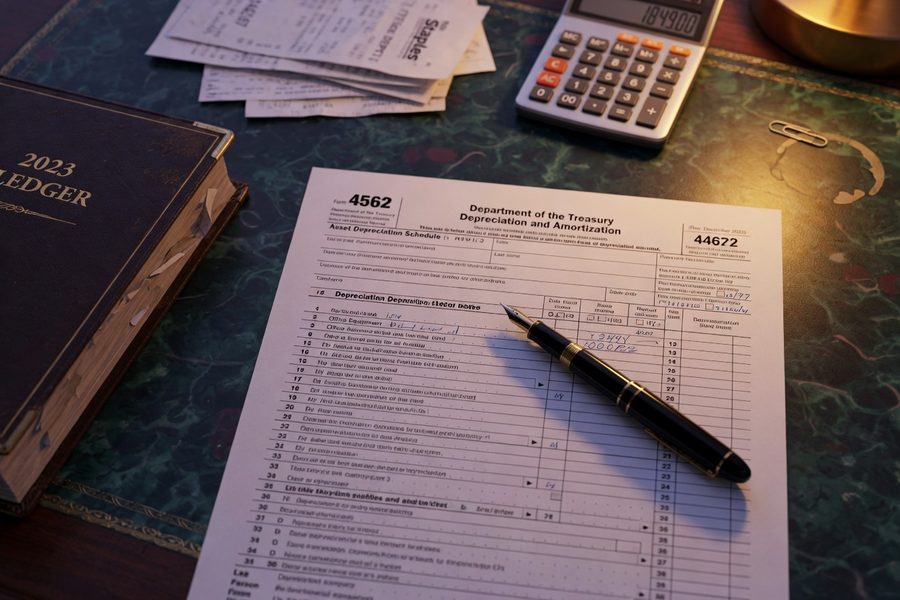
Form 4562, “Depreciation and Amortization,” is where all of this gets reported. Every asset you claim bonus depreciation or Section 179 on must appear there with the correct acquisition date, placed-in-service date, business-use percentage, and recovery period. Sloppy records are among the easiest audit triggers for depreciation claims. Keep purchase receipts, delivery confirmations, and evidence of business use, especially for vehicles and any asset with personal-use potential.
Good tax planning this year also connects to your broader financial picture. If a large deduction eliminates your estimated tax payments for Q3, those freed-up funds deserve a plan, whether that’s paying down high-interest debt (our guide on credit card debt prioritization and negotiation covers practical strategies) or building operating reserves. And if you’re thinking longer-term, the same discipline that informs depreciation planning applies to retirement contributions, a topic worth revisiting at why saving for retirement often takes priority over college costs.
The IRS’s Publication 946 was updated for 2025 to reflect the One Big Beautiful Bill Act changes, including the permanent 100% bonus depreciation allowance and the new qualified production property provisions. It’s the primary reference document for depreciation questions and is freely available online.
Your Action Plan
-
Confirm Which Assets You Plan to Purchase in 2026
List every significant asset purchase planned for this year and identify the expected acquisition date and placed-in-service date. Confirm each qualifies as property with a recovery period of 20 years or less under MACRS. For real property, check whether a cost segregation study could reclassify any components into shorter-lived categories. Get this list in front of your CPA before, not after, you sign contracts.
-
Model the Deduction Against Your Projected 2026 Income
Run two scenarios with your tax software or CPA: one using 100% bonus depreciation, one using regular MACRS. Factor in the QBI deduction impact for pass-through entities, and check whether a large deduction creates an NOL you’d carry forward. If your 2027 income is projected to be significantly higher, electing out of bonus depreciation for certain asset classes may produce better long-term results.
-
Check Your State’s Conformity Status
Contact your CPA or state tax authority to confirm whether your state conforms to the federal 100% bonus depreciation rate for 2026. If it doesn’t, estimate the state tax liability separately so it doesn’t surprise you at filing. Some states offer a partial conformity or an alternative election, these require affirmative action on the state return and can’t be applied retroactively after the due date.
-
Adjust Estimated Tax Payments Promptly
Once you have a firm placed-in-service date and a confirmed deduction amount, recalculate your remaining quarterly estimated tax payments. Overpaying estimated taxes is an interest-free loan to the government; underpaying triggers a penalty. Use the annualized income installment method (Form 2210) if your income is uneven across quarters, this is especially common for businesses with large mid-year equipment purchases.
-
Track Adjusted Basis and Plan for Future Asset Sales
For every asset you fully expense, record the adjusted basis as zero and note the depreciation recapture consequence if you sell. Build a simple spreadsheet tracking purchase date, original cost, deduction claimed, adjusted basis, and tentative sale year. If you anticipate selling an asset within three to five years, model the recapture tax at your ordinary rate against the time-value benefit of the early deduction, it’s not always worth taking the full bonus in year one.
Frequently Asked Questions
Is 100% bonus depreciation really permanent, or will Congress change it again?
Under the One Big Beautiful Bill Act, the 100% rate is written into law without a scheduled phase-out or sunset date, unlike the TCJA version, which had a built-in phase-down. Congress can always amend the tax code. What’s different this time is that there is no automatic expiration written into the statute, so any future reduction would require affirmative legislative action rather than simply letting a deadline pass. Plan for current law as it stands; revisit if Congress proposes changes.
Can I claim bonus depreciation on a vehicle I also use personally?
Yes, but only the business-use percentage of the cost is eligible. If you use a qualifying vehicle 70% for business, your depreciable basis is 70% of the purchase price. For passenger vehicles subject to the luxury auto cap, the $18,000 first-year maximum is further limited to the business-use percentage, so 70% business use on a $50,000 car yields a maximum first-year deduction of $12,600 (70% of $18,000). Vehicles used less than 50% for business do not qualify for bonus depreciation at all and must be depreciated using straight-line over five years.
What is the difference between the acquisition date and the placed-in-service date?
The acquisition date is when you purchased or contracted to purchase the property. The placed-in-service date is when the asset is in a condition or state of readiness and availability to be used in your trade or business. Both dates matter under Notice 2026-11’s eligibility rules: property must be acquired after January 19, 2025, and must be placed in service during the tax year for which you’re claiming the deduction. If those dates fall in different tax years, the deduction belongs to the placed-in-service year.
Does bonus depreciation affect my self-employment tax?
No. Self-employment tax is based on net earnings from self-employment, which is calculated before the bonus depreciation deduction on Schedule C reduces your adjusted gross income. However, if your Schedule C shows a loss as a result of bonus depreciation, that loss can offset other income on your personal return, reducing your overall federal income tax, just not the SE tax calculation itself. S corporation owners escape SE tax on distributions entirely, which is one reason S corp election is worth reviewing if your profits are substantial.
Can a startup business with no income use bonus depreciation?
Yes. Unlike Section 179, bonus depreciation is not limited to the amount of your taxable business income. A startup can claim 100% bonus depreciation, generate a net operating loss, and carry that loss forward to offset income in future profitable years. The NOL carryforward under current law is indefinite but limited to 80% of taxable income in the year it’s applied. This makes bonus depreciation a useful pre-revenue planning tool for capital-intensive startups.
What is qualified improvement property, and does it qualify?
Qualified improvement property (QIP) refers to improvements made to the interior of a nonresidential building after the building was first placed in service. Under current law, QIP carries a 15-year MACRS recovery period, which means it qualifies for 100% bonus depreciation. This is particularly relevant for small business owners who lease commercial space and make interior renovations, the full cost of eligible improvements can be deducted in year one rather than amortized over 39 years as a building improvement.
How does bonus depreciation interact with the QBI deduction?
This interaction has two effects. First, a large bonus depreciation deduction reduces your qualified business income, which directly reduces the 20% QBI deduction, sometimes to zero for lower-income owners. Second, for owners whose QBI deduction is calculated using the wage and qualified property limitation (applicable when taxable income exceeds the 2026 threshold), fully expensing an asset reduces the unadjusted basis used in that calculation, potentially shrinking the allowable QBI deduction further. Model this interaction before finalizing elections, especially in higher-income years.
Is there a recapture risk if I close or sell my business?
Recapture applies to the assets themselves, not to the business entity. If you sell the business and its assets, each asset’s sale price above its adjusted basis (which is zero after full bonus depreciation) is taxable as ordinary income under Section 1245 recapture rules. This can produce a significant ordinary income tax bill in the year of sale, even if the overall transaction is structured as a capital sale. Buyers and sellers of small businesses should account for this in their purchase price allocation negotiations under IRC Section 1060.
Can I claim bonus depreciation on assets I lease to another party?
Generally, the party who owns the property claims bonus depreciation, not the lessee. If you own equipment and lease it to another business, you can claim bonus depreciation as the owner. However, the property cannot be used in a tax-exempt use or leased to a tax-exempt entity, and certain leasing arrangements involving related parties face additional scrutiny. Equipment leasing businesses should review the specific at-risk rules and passive activity rules that apply to their structure before claiming large first-year deductions.
Where can I find free help understanding my depreciation options?
The IRS offers Publication 946 as a comprehensive free resource covering all aspects of depreciation, including the updated bonus depreciation rules. For hands-on help, the IRS’s free tax assistance programs include VITA and TCE sites staffed by trained volunteers, though these are better suited to straightforward returns than complex business depreciation questions. For asset-intensive decisions, a CPA or enrolled agent who specializes in small business taxation is worth the fee, a single missed election or miscalculated deduction typically costs far more than professional advice. You can also explore our overview of top credit counseling services if business cash flow management is a related concern.
Sources
- Internal Revenue Service, Notice 2026-11: Interim Guidance on Permanent 100% Additional First-Year Depreciation Deduction
- Internal Revenue Service, Treasury, IRS Issue Guidance on the Additional First-Year Depreciation Deduction Under the One Big Beautiful Bill
- Internal Revenue Service, Publication 946 (2025): How To Depreciate Property
- Internal Revenue Service, Tax Cuts and Jobs Act: A Comparison for Businesses
- Internal Revenue Service, About Form 4562: Depreciation and Amortization