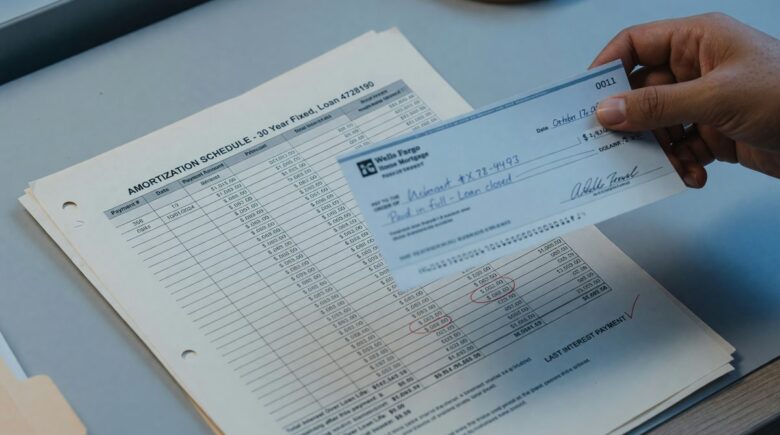
You make an extra lump-sum payment on your mortgage, feel good about the progress, then get a letter from your lender with a surprise fee attached. That fee is a mortgage prepayment penalty, and it catches homeowners off guard more often than you’d expect. What looks like a smart financial move can quietly cost thousands of dollars before you’ve had a chance to run any numbers.
According to the Consumer Financial Protection Bureau, prepayment penalties typically apply only when you pay off the entire balance within the first few years or make a large lump-sum payment. Not every mortgage has one, but plenty still do. This article walks you through how to find out if your loan includes one, what it could actually cost you in 2026, and the other hidden financial trade-offs of paying down your mortgage early that rarely get discussed.
Key Takeaways
- Under Qualified Mortgage rules, prepayment penalties are capped at 2% of the loan balance in years one and two, and 1% in year three, meaning a $200,000 balance could trigger a $4,000 fee.
- FHA, VA, and USDA loans prohibit prepayment penalties entirely, so borrowers with government-backed mortgages are protected from this cost.
- Paying off your mortgage early means losing the mortgage interest deduction, at a 24% tax bracket with $15,000 in annual interest, that’s roughly $3,600 in extra taxes per year.
- Home equity is illiquid. Once you pay down your principal aggressively, accessing that cash later requires a HELOC, cash-out refinance, or sale, none of which are quick or free.
Do You Even Have a Prepayment Penalty? How to Check Your Loan
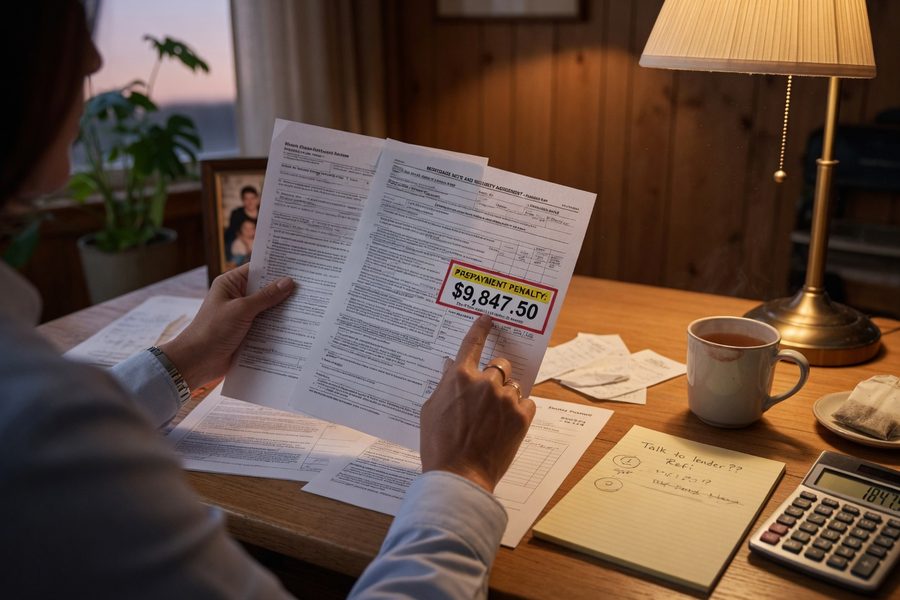
Most homeowners never actually read their full loan documents after closing. That’s understandable, the stack of papers is thick and the moment is overwhelming. But the prepayment clause is buried in there somewhere, and finding it before you make extra payments is worth the effort.
Start with your promissory note or any attached riders. Look for language mentioning “prepayment,” “early payoff,” or “accelerated payment.” Some lenders include it as a standalone prepayment rider rather than in the body of the note itself. If you can’t locate your closing documents, your loan servicer is required to tell you whether a penalty applies, per CFPB guidance on early payoff charges. Ask them directly and get the answer in writing.
Hard vs. Soft Penalties, and Extra Payment Limits
There are two types of prepayment penalties. A hard prepayment penalty applies whenever you pay off the loan early, whether by selling the home, refinancing, or making a large lump sum. A soft prepayment penalty only triggers on refinancing; if you sell the home, you’re usually in the clear. Knowing which type you have changes the calculus significantly.
Some loans also cap how much extra principal you can pay each year without triggering a penalty. Kate Bulger, Vice President of Business Development at Money Management International, explains it this way: “That’s because your $30,000 accelerated payment is less than the 20 percent maximum your lender will allow annually as a prepayment amount.” A modest extra payment each month may be fine, while one large annual payment could cross the threshold.
Government-Backed Loans Are Different
If your mortgage is an FHA, VA, or USDA loan, you don’t need to worry about this. Federal rules prohibit prepayment penalties on all three of these loan types. The FHA single-family loan program rules have long barred such fees, and the VA Home Loan program extends the same protection to veterans. The same principle applies to most loans meeting Qualified Mortgage (QM) standards under the Dodd-Frank rules, as codified in Regulation Z, Section 1026.43. Penalties on QM loans are capped at 2% of the remaining balance in years one and two, and 1% in year three, with no penalty allowed after that.
What Mortgage Prepayment Penalties Actually Cost in 2026
The dollar amount can sting. Anna DeSimone, a New York City–based personal finance expert and author, notes that “the penalty is always disclosed with your mortgage rate quote when you shop around for a loan. Typically, you’ll see a statement such as ‘prepayment penalty fee equal to three months’ interest shall be paid in the event the mortgage is terminated within the first 12 months.'” Three months of interest on a $300,000 loan at 6.5% is roughly $4,900. That’s real money.
Kate Bulger offers a concrete refinancing example: “In this case, because you are refinancing within the first two years of the loan, you would be charged a $4,000 penalty, equating to 2 percent of your balance.” If you refinance hoping to lock in a lower rate, that penalty could cancel out months of interest savings before you even start benefiting from the new loan. Bankrate’s overview of prepayment penalties includes a useful breakdown of how quickly those fees erode refinancing gains.
| Loan Balance | Year 1 Penalty (2%) | Year 2 Penalty (2%) | Year 3 Penalty (1%) | After Year 3 |
|---|---|---|---|---|
| $150,000 | $3,000 | $3,000 | $1,500 | $0 |
| $200,000 | $4,000 | $4,000 | $2,000 | $0 |
| $300,000 | $6,000 | $6,000 | $3,000 | $0 |
| $400,000 | $8,000 | $8,000 | $4,000 | $0 |
| $500,000 | $10,000 | $10,000 | $5,000 | $0 |
Opportunity Cost: What That Money Could Earn Instead
Even when there’s no prepayment penalty involved, throwing large sums at your mortgage has a real cost: the returns you give up by not investing that money elsewhere. Historical after-tax stock market returns have averaged above 7% annually over long periods, a figure consistent with SEC investor education data on long-term compounding. If your mortgage rate is 4.5% or 5%, the math often favors investing over early payoff, especially when the mortgage interest deduction is factored in.
Consider a simple comparison: $20,000 paid toward a 5% mortgage saves you about $1,000 in interest that year. That same $20,000 in a diversified index fund, growing at a historically average 7%, generates roughly $1,400, before accounting for tax-advantaged growth inside a 401(k) or IRA. Over ten years, the compounding difference widens considerably. If you’re carrying high-interest debt at the same time, the priority order becomes even clearer. Learning how to prioritize credit card debt before tackling your mortgage is often the smarter first move.
The honest caveat here: this comparison depends heavily on your mortgage rate, your tax situation, and your ability to actually stay invested without panic-selling during a downturn. If your rate is above 6.5% and you don’t have other high-interest debt, the calculus shifts and early payoff becomes more defensible. No single answer works for every borrower.
The Tax Hit From Losing Your Mortgage Interest Deduction
Paying off your mortgage means losing access to the mortgage interest deduction, and the 2026 tax environment makes that loss more relevant than it’s been in years. The One Big Beautiful Budget Act (OBBBA) raises the SALT deduction cap to $40,000, which means more homeowners in high-tax states may find it worthwhile to itemize again. If you’re itemizing, losing $15,000 in annual mortgage interest at a 24% marginal tax rate costs you about $3,600 in additional taxes each year. That’s a recurring cost, not a one-time hit. The IRS guidance on mortgage interest deductions (Topic 505) spells out exactly which interest qualifies and under what conditions.
The interaction with the standard deduction matters here. If your total itemized deductions, mortgage interest, SALT, and charitable giving, only barely exceed the standard deduction, the actual tax value of your mortgage interest is smaller than it looks. Run the comparison before assuming the deduction is worth preserving. For some borrowers, particularly those in lower tax brackets or states with modest property taxes, the deduction provides little benefit and early payoff makes more sense. But for others, especially in higher-tax states now that the SALT cap has expanded, the math cuts the other way.
Liquidity and Emergency Access Problems
Home equity does not spend like cash. Once you pay down your principal aggressively, that money is locked inside the home. Accessing it later requires either selling the property, taking out a HELOC (home equity line of credit), or doing a cash-out refinance. In a rising rate environment or a tightening credit market, none of those options are guaranteed to be available, and even when they are, they take time and come with their own costs.
This matters most when something goes wrong. A job loss, a medical expense, or a major home repair after you’ve funneled every extra dollar into equity can leave you cash-poor and house-rich. If you’re also trying to build emergency savings or invest for retirement, paying down your mortgage too aggressively can work against both goals at once. The Federal Reserve’s Report on the Economic Well-Being of U.S. Households consistently finds that a meaningful share of homeowners have insufficient liquid savings, a risk that aggressive mortgage prepayment can worsen. If you’re looking for ways to shore up cash flow without sacrificing long-term progress, exploring how to start investing with limited resources can help clarify where each dollar works hardest.

Post-Payoff Surprises Most Homeowners Don’t Expect
Paying off the mortgage feels like the finish line, but a few administrative and financial surprises tend to show up right after. The biggest one involves your escrow account. As long as you have a mortgage, your lender typically collects property taxes and homeowner’s insurance as part of your monthly payment, then pays those bills on your behalf. Once the loan is paid off, that responsibility falls entirely on you. Miss a tax installment or let your insurance lapse, even briefly, and the consequences can be severe: tax liens, penalties, or force-placed insurance, which is far more expensive than a standard homeowner’s policy.
There’s also a credit score dimension that often gets overlooked. Closing a long-standing mortgage account removes one of your oldest lines of credit from your profile. Lenders look at account age as part of your credit score calculation, and losing a 10- or 15-year mortgage can cause a noticeable short-term dip, according to FICO’s published breakdown of score factors. If you’re planning to finance anything in the year or two after payoff, a car, a business loan, or a HELOC on the property itself, that timing matters. Solid credit counseling resources can help you plan around that transition if needed. It’s also worth remembering that property taxes, homeowner’s insurance, and maintenance costs don’t disappear just because the mortgage does. If those carrying costs are putting pressure on your budget elsewhere, you might benefit from reviewing broader strategies for managing household expenses, including areas like reducing the cost of high-interest debt that often competes with mortgage prepayment for the same dollars.
Frequently Asked Questions
Are prepayment penalties common on mortgages in 2026?
Less common than they used to be. Government-backed loans (FHA, VA, USDA) prohibit them entirely, and Qualified Mortgage rules have significantly limited them on conventional loans. Non-QM loans and some older conventional mortgages, particularly those originated before 2014, may still carry these penalties. The only way to know for certain is to check your loan documents or ask your servicer directly.
Can I avoid a prepayment penalty by making smaller extra payments?
Often, yes. Many loan agreements allow you to prepay up to a set percentage of the original balance each year, commonly 20%, without triggering a penalty. Spreading extra payments across the year in smaller increments rather than one large lump sum can keep you under that threshold. Check your specific loan terms first, because the rules vary by lender and loan type.
Is paying off my mortgage early always a bad idea?
No. For borrowers with high mortgage rates, no other high-interest debt, strong retirement savings already in place, and a solid emergency fund, early payoff can be a perfectly rational choice. The peace of mind from owning your home free and clear has real value that doesn’t show up in a spreadsheet. The point is to make the decision with full information, including the costs, rather than assuming early payoff is always the obvious win.
What happens to my escrow account when I pay off the mortgage?
Your lender closes the escrow account and refunds any remaining balance, typically within 30 days of payoff. From that point on, you’re responsible for paying property taxes and homeowner’s insurance directly. Set up calendar reminders and consider paying those bills as soon as they arrive. Missing a property tax payment can lead to penalties and, eventually, a tax lien on your home, an outcome that’s entirely avoidable with some basic organization after payoff.
Sources
- Consumer Financial Protection Bureau, What is a prepayment penalty?
- Consumer Financial Protection Bureau, Can I be charged a penalty for paying off my mortgage early?
- Bankrate, Mortgage Prepayment Penalties: What They Are and How to Avoid Them
- IRS, Tax Topic 505: Interest Expense and Mortgage Interest Deduction
- U.S. Department of Veterans Affairs, VA Home Loans: Loan Policies and Prepayment Protections
- Consumer Financial Protection Bureau, Regulation Z, Section 1026.43: Qualified Mortgage Standards
- U.S. Department of Housing and Urban Development, FHA Single-Family Loan Program
- SEC Investor.gov, Compound Interest and Long-Term Returns
- Federal Reserve, Report on the Economic Well-Being of U.S. Households, 2023
- FICO, What Factors Affect Your Credit Score?