Fact-checked by the MyFinancial101 editorial team
Key Takeaways
- The average U.S. household spent $6,224 on food at home in 2024, according to the Bureau of Labor Statistics, a pantry challenge can realistically cut that figure by $1,000 or more in a single year.
- A focused 2-week challenge using only existing stock can avoid $350 or more in new grocery purchases, with some households reporting drops from $250 to under $110 per month during the challenge period.
- The method requires zero coupons, zero store-hopping, and zero app downloads, savings come entirely from not spending, not from discounting.
- Middle-income households spend an average of $9,097 per year on food, or roughly 12.2% of before-tax income, even a 10% annual reduction translates to roughly $910 back in the budget.
- Initial inventory and meal planning require an upfront investment of 2 to 4 hours; results vary significantly based on how much usable stock a household already has on hand.
- Repeating the challenge quarterly can yield cumulative annual savings of up to $2,500, according to personal finance practitioners who use it as a recurring budget reset.
In This Guide
- What Is the Pantry Challenge and Why It Works
- How to Inventory and Audit Your Current Stock
- Setting Realistic Rules and Duration
- Creating Meal Plans from What You Already Own
- Tracking Your Spending and Measuring Real Savings
- Overcoming Common Obstacles and Staying Motivated
- Turning One Challenge into Lasting Grocery Budget Habits
- Handling Dietary Restrictions and Non-Food Household Items
What Is the Pantry Challenge and Why It Works
Most grocery savings advice starts with coupons. The pantry challenge grocery savings method starts with a completely different premise: you already have the food, you just haven’t used it yet. The core idea is to stop buying groceries entirely for a set period, typically one to four weeks, and cook exclusively from what is already in your pantry, refrigerator, and freezer. No coupon apps. No store-hopping for sales. Just a deliberate pause on new purchases while you work through existing stock.
The mechanism behind the savings is straightforward. According to the U.S. Bureau of Labor Statistics, the average household spent $6,224 on food at home in 2024. That breaks down to roughly $519 per month, or about $130 per week. A family that pauses new purchases for two weeks and draws from a well-stocked pantry and freezer can realistically skip $250 or more in spending. That single two-week stretch, done four times a year, produces $1,000 in annualized savings, without a single clipped coupon.
The reason this method can cut a grocery bill in half is that most households are already sitting on $200 to $500 worth of food they have forgotten about or are delaying. Canned beans behind the soup cans. Frozen chicken thighs under the ice cream. Three half-used bags of pasta. A pantry challenge forces you to confront all of it, and eat it, before it expires or gets quietly thrown out. After reading this guide, you will know exactly how to run a challenge from start to finish, measure your actual savings, and build habits that reduce your baseline spending long after the challenge ends.
Pantry Challenge vs. Couponing
Couponing has real value, and if you are already doing it effectively, keep going. But the pantry method and the coupon method are structurally different. Couponing requires ongoing time investment: clipping, organizing, timing purchases to sales cycles, and sometimes buying items you would not otherwise need just because the deal is good. The pantry challenge requires one-time effort up front, a thorough inventory, and then disciplined restraint. No new purchases means no new spending, discounted or otherwise.
If you want to see how coupon strategies compare to a no-buy approach over a full month, our breakdown of how coupon stackers are beating inflation is worth reading alongside this guide. The two methods are not mutually exclusive; many households run a pantry challenge to reset their baseline, then return to selective couponing on a leaner shopping list.
Middle-income U.S. households spent an average of $9,097 on food in 2024, representing 12.2% of before-tax income, according to the USDA Economic Research Service. A pantry challenge targeting a 10% reduction in annual food spending would return roughly $910 to that household’s budget.
How to Inventory and Audit Your Current Stock
Before you run a single day of a pantry challenge, you need to know what you are working with. This step is where most people either succeed or fail. Skipping the inventory means you will burn through the obvious items, the pasta, the soup cans, the breakfast cereal, and then feel stuck when those are gone, even though the freezer still holds three pounds of ground beef and enough frozen vegetables for a week of stir-fry.
The University of Illinois Extension recommends shopping your pantry first before buying more as a core strategy for reducing both grocery costs and food waste. That advice sounds obvious until you actually pull everything out of the cabinet and put it on the counter. Most people are surprised by what they find.
Where to Look (Beyond the Obvious Shelves)
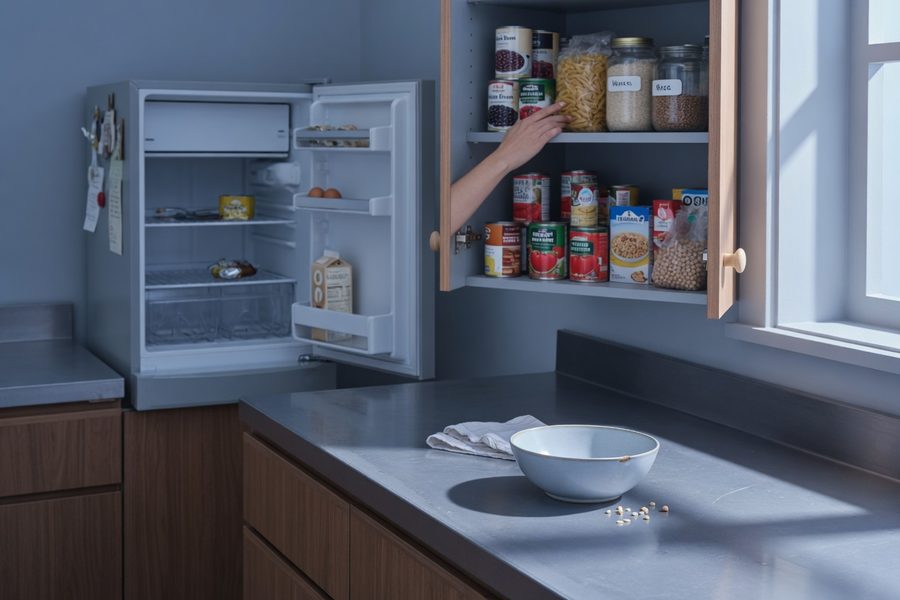
A thorough audit hits every storage area: the main pantry shelves, the spice rack, the back of the refrigerator, every freezer drawer and basket, and whatever cabinet holds the overflow items, baking supplies, specialty sauces, holiday ingredients. Pull items fully forward so nothing hides behind something else. Check expiration dates and set aside anything that is genuinely past use. Everything else is fair game.
Organize what you find into four working categories: proteins (meat, beans, eggs, tofu, canned fish), carbohydrates (pasta, rice, bread, potatoes, oats), vegetables and fruit (fresh, canned, or frozen), and flavor builders (sauces, broths, spices, condiments). Once you have those four groups visible, you can see how many complete meals your current stock supports. A household with six proteins, four carbohydrate sources, and five vegetable options has the raw material for dozens of different meal combinations.
Calculating the Dollar Value of Your Stock
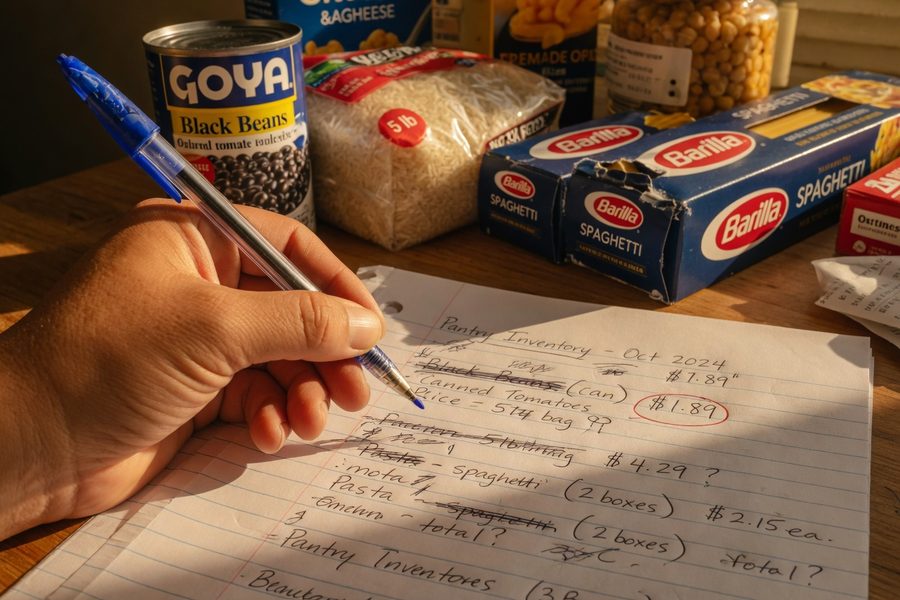
This step is optional but motivating. Walk through your inventory and assign rough current prices to each item, a bag of rice that cost $3, a can of beans at $1.29, a pound of frozen chicken at $4. You do not need to be exact. The goal is to arrive at a ballpark total. Most households doing this exercise for the first time find $150 to $400 worth of food already on hand. That number becomes your personal savings target: if you use all of it before buying more, that is money you did not spend this month.
The Mayo Clinic recommends taking a full inventory of your pantry, fridge, and freezer before meal planning specifically to avoid buying duplicates and reduce food waste, two outcomes that directly lower grocery spending.
Setting Realistic Rules and Duration
The most common reason a pantry challenge fails mid-week is that the rules were never clearly defined. Specifically, families get confused about what counts as an “essential” purchase and what does not. Without a clear policy, it is easy to rationalize a full shopping trip as “just picking up a few things.”
Choosing Your Duration
A 7-day challenge works well as a first attempt, especially for smaller households or those with a lightly stocked pantry. It limits the discomfort and produces measurable results quickly. A 14-day challenge hits the sweet spot for most families: long enough to force real creativity with ingredients, but short enough to sustain motivation. A full 30-day challenge is achievable, but it requires a genuinely deep pantry and strong family buy-in from day one.
| Challenge Duration | Best For | Estimated Savings | Difficulty |
|---|---|---|---|
| 7 Days | First-timers, small pantry | $65 – $130 | Low |
| 14 Days | Most families, moderate stock | $130 – $260 | Medium |
| 21 Days | Experienced, well-stocked pantry | $195 – $390 | Medium-High |
| 30 Days | Seasoned challenge runners | $260 – $520+ | High |
The savings ranges above are based on an average weekly grocery spend of $130, which aligns with the BLS’s $6,224 annual food-at-home figure. Your actual results will be higher or lower depending on your household size and current stock level.
Defining “Essential” Purchases
The rules need to be written down before the challenge starts, not debated in the grocery store parking lot. A reasonable essential list includes: milk or a dairy alternative if you have young children, fresh produce to replace items that run out (one specific trip, not a full shop), and any prescription-driven dietary staples. Pet food is worth deciding on in advance, if you have enough on hand, include it in the no-buy rule; if not, allow targeted repurchase of pet food only, with no add-ons.
What does not count as essential: snacks you are bored without, beverages beyond basics, and ingredients for a specific recipe you want to try. The challenge forces you to cook what you have, not what sounds appealing on any given Tuesday.
Defining your essential purchases list after the challenge starts almost always leads to scope creep. One “quick milk run” easily turns into $40 of unplanned items. Write your rules before day one and share them with everyone in the household.
Creating Meal Plans from What You Already Own
Here is the part most guides skip: you do not need recipes that match your ingredients. You need a meal template that works with almost anything. The most reliable template is: grain or starch + protein + vegetable + sauce or seasoning. Rice, chicken, frozen broccoli, and soy sauce. Pasta, canned tuna, olive oil, and garlic. Oats, peanut butter, banana (if you have one), and honey. Once you see meals as templates rather than fixed recipes, a pantry challenge becomes significantly less stressful.
Batch Cooking to Stretch Ingredients
Batch cooking is your primary tool for avoiding mid-week desperation. On the first day of the challenge, cook a large pot of grains, rice, quinoa, or dried lentils, and refrigerate it. That base can serve as a side dish, a grain bowl base, a soup filler, or a breakfast porridge depending on what you pair it with. Similarly, a full sheet pan of roasted vegetables lasts three to four days and adds nutrition to almost any meal format.
Proteins require the most planning. If your freezer has chicken breasts, ground beef, and frozen shrimp, rotate through them on a schedule rather than defaulting to one and leaving the others untouched. Variety keeps the challenge from feeling like a sentence. For families with picky eaters, keeping flavors flexible, plain proteins with customizable toppings, reduces pushback without requiring separate meals.
When Fresh Produce Runs Out
Fresh produce typically runs out first, usually within the first five to seven days. This is not a failure, it is a predictable phase of the challenge. Shift immediately to frozen vegetables and canned fruit. Nutritionally, frozen vegetables are comparable to fresh in most cases; they are harvested at peak ripeness and frozen within hours. Canned tomatoes, canned corn, and canned chickpeas can fill the gap for sauces, soups, and salads.
If you are looking for budget-friendly meal ideas that work well with pantry staples, our piece on winter foods that keep grocery bills under control has practical examples that translate directly into challenge-period cooking.
Write out a rough 7-day meal plan before your challenge begins, using only items from your completed inventory. Even an imperfect plan prevents the 5:00 PM scramble that leads to ordering takeout and breaking the challenge entirely.
Tracking Your Spending and Measuring Real Savings
Savings that are not measured are easy to underestimate, or overestimate. Before your challenge begins, pull your last two or three grocery receipts and calculate your average weekly spend. If you do not have receipts, check your bank or credit card statement and total every transaction at a grocery store or supermarket. That number is your baseline.
What to Track During the Challenge
Keep a simple log: every “essential” purchase made during the challenge period goes on the list with the date and dollar amount. If you made one produce run for $18 on day eight, that $18 counts against your savings. At the end of the challenge, your total savings equals your baseline weekly spending multiplied by the number of weeks, minus whatever you spent on approved essentials.
Here is a worked example using real figures. A household with a $519 monthly grocery budget (derived from the BLS’s $6,224 annual average) runs a 14-day challenge. Their two-week baseline spend would normally be approximately $260. They make one produce run at $22 and one milk purchase at $6. Total challenge-period spending: $28. Total savings: $232 over two weeks. Annualize four such challenges per year and the total savings reach $928, a genuine 14.9% reduction in annual food-at-home spending, achieved with no coupons and no change to how or where they shop the rest of the year.
U.S. consumers, businesses, and government entities spent a combined $2.51 trillion on food in 2025, according to the USDA Economic Research Service. Even a modest 5% reduction in household food spending, at scale, would represent billions in aggregate savings, most of which stays in household budgets rather than at the checkout line.
Accounting for Indirect Savings
Direct receipt comparisons capture most of the savings, but they miss a few real benefits. Fewer shopping trips mean less fuel or transit cost. Less time in the store means less exposure to end-cap displays and impulse purchases. And using food before it expires means less food thrown away, which is equivalent to recovering the full purchase price of whatever would have been wasted. The Boston University Wellness program notes that planning meals around what you already have reduces food waste alongside grocery costs, and both outcomes contribute to the same financial outcome: more money stays in your account.
Overcoming Common Obstacles and Staying Motivated
No pantry challenge goes perfectly. The households that finish successfully are not the ones who had no problems, they are the ones who planned for the predictable ones.
Managing Takeout Temptation and Family Pushback
Day five is the hardest. The novelty has worn off, the easy meals are gone, and someone in the household wants to order pizza. The most effective response is a pre-planned “break meal” that is still pantry-based but feels like a treat: homemade pizza using canned tomato sauce and whatever cheese is in the fridge, tacos using canned beans and seasoning, or a breakfast-for-dinner night. These feel like a departure from the routine without actually breaking the rules.
Family pushback is real and worth taking seriously. If one household member is genuinely opposed, forcing a full challenge is unlikely to produce lasting habits, and may create enough friction to undermine shared budgeting goals. A better approach: involve skeptical family members in the inventory and meal planning process from the start. People are significantly more willing to eat food they helped choose to cook.
What to Do When You Run Short
Running out of a key staple, cooking oil, salt, or coffee, for example, does not mean the challenge is over. It means you make a targeted purchase of that specific item and nothing else. The discipline is keeping that one item from becoming a full cart. If this happens repeatedly, it is a data point: your household has specific items that need to be maintained as constants, and future shopping lists should reflect that.
Loudoun County’s government budgeting resources recommend taking pantry inventory often, not just during a challenge, as a routine practice that directly supports household budget planning and reduces unnecessary spending over time.
Turning One Challenge into Lasting Grocery Budget Habits
A single pantry challenge produces real savings in the short term. Repeating it quarterly is what produces structural change in a household’s grocery baseline. Personal finance practitioners who run the challenge annually, typically once per season, report cumulative savings of up to $2,500 per year, because each challenge also resets the tendency to overbuy between rounds.
The review after each challenge is where the real learning happens. What categories did you run out of quickly? What items are still sitting untouched? Those answers reshape your next grocery list, you stop buying what you do not actually use, and you stop underbuying the things that run out first. Over two or three challenge cycles, a household’s routine shopping list becomes noticeably leaner and better calibrated to actual consumption patterns. That is the mechanism behind lasting savings, not just temporary ones.
Handling Dietary Restrictions and Non-Food Household Items
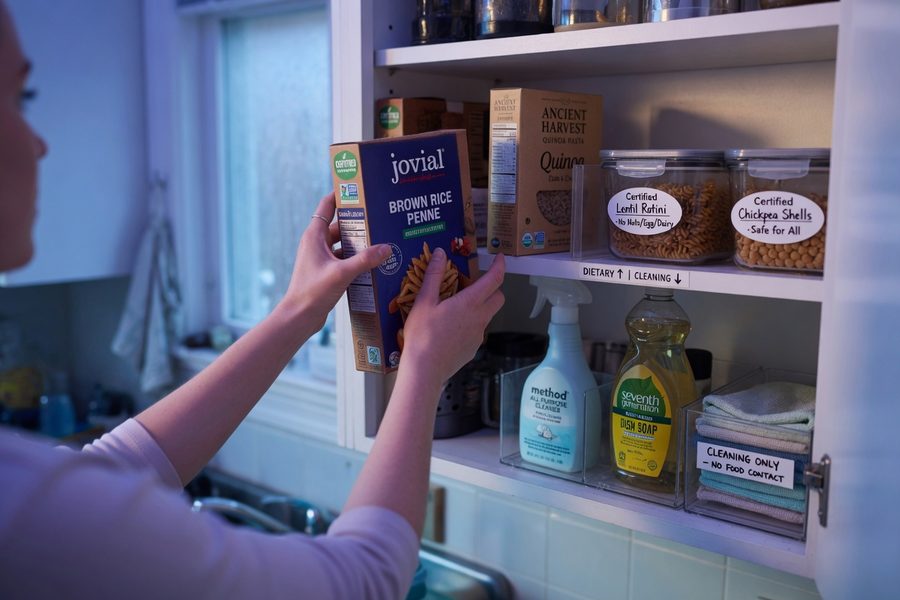
Dietary restrictions require specific planning before a pantry challenge begins, not improvisation mid-week. Gluten-free households need to confirm their existing stock is certified gluten-free, cross-contamination from shared pantry items is a real concern, not just a preference. Vegetarian and vegan households generally fare well during challenges because plant-based proteins like beans, lentils, tofu, and canned chickpeas store well and have long shelf lives. The limitation is variety: without planned substitutions, a vegetarian challenge can quickly narrow to rice and beans every other day.
Non-food household items occupy a grey area in the challenge rules. Toilet paper, dish soap, laundry detergent, and similar supplies are not groceries, but they appear on the same receipt and deplete on their own schedule. The cleanest rule: allow non-food repurchase as needed, but do not bundle it with a grocery trip. Order household supplies for delivery or make a separate targeted run. Keeping the two categories separate prevents “I’m already at the store” logic from turning a soap purchase into a full shop.
Households receiving assistance through SNAP or WIC face additional constraints during a pantry challenge, since those benefits are tied to specific purchasing windows. Our coverage of SNAP benefits and current federal budget pressures explains how benefit structures affect household food planning, relevant context for anyone running a challenge while managing assistance income.
The average U.S. household spent $6,224 on food at home in 2024, per the Bureau of Labor Statistics. Four two-week pantry challenges per year, each saving $230 on average, would reduce that figure to approximately $5,300, a 14.8% reduction achieved with no change to where or how a household shops the rest of the year.
| Savings Method | Time Required | Upfront Cost | Avg. Monthly Savings | Coupon Required? |
|---|---|---|---|---|
| Pantry Challenge | 2-4 hrs upfront | $0 | $115 – $260 | No |
| Coupon Stacking | 3-6 hrs/week ongoing | $0 – $30 (apps) | $50 – $150 | Yes |
| Meal Kit Services | Minimal planning | $60 – $100/week | Rarely saves | No |
| Bulk Buying Only | 1-2 hrs/month | $40 – $200 upfront | $20 – $80 | Sometimes |
| Store Brand Switching | Minimal | $0 | $15 – $40 | No |
| Household Type | Typical Pre-Challenge Monthly Grocery Spend | Estimated Challenge Savings (14 Days) | Annual Savings (4 Challenges) |
|---|---|---|---|
| Single adult | $200 – $280 | $80 – $120 | $320 – $480 |
| Couple, no children | $350 – $450 | $130 – $190 | $520 – $760 |
| Family of four | $600 – $800 | $220 – $340 | $880 – $1,360 |
| Large family (5+) | $900 – $1,200 | $300 – $500 | $1,200 – $2,000 |
A pantry challenge is most effective when your existing stock is genuinely usable. If your pantry holds mostly expired items, specialty ingredients with no practical use, or products your household dislikes, the savings potential drops sharply. Do the inventory honestly, and discard expired items before counting the dollar value of your stock.
Real-World Example: A Family of Four Cuts Monthly Groceries from $720 to $310
Consider an illustrative example: a family of four in a mid-size Midwestern city with a typical monthly grocery budget of $720, slightly above the national household average when scaled for family size. Before their first pantry challenge, they had never done a formal inventory. When they pulled everything out, they found: 4 pounds of frozen chicken, 2 pounds of ground beef, 6 cans of beans, 3 pounds of rice, 2 boxes of pasta, a full spice rack, 5 types of canned vegetables, 2 jars of pasta sauce, 3 bags of frozen vegetables, oats, flour, and enough condiments to stock a small restaurant. Estimated value: approximately $185.
They set a 14-day challenge with two allowed exceptions: a fresh produce run of no more than $30, and milk purchases as needed. They batch-cooked rice and lentils on day one, roasted a sheet pan of frozen vegetables, and made a simple weekly template: two nights of chicken-based meals, two nights of beef, two nights of plant-based, one “clean-out” night using whatever needed to be used. The fresh produce run on day seven came to $24. Milk cost $12 across two purchases. Total spending during the 14-day challenge: $36.
Their normal two-week grocery bill would have been approximately $360. Actual spending: $36. Net savings for the two-week period: $324. They extended the challenge by three additional days using remaining stock, bringing total savings to approximately $378. Their grocery bill for the full month: $36 spent during the challenge plus a normal $360 second-half shop, totaling $396, a 45% reduction from their baseline $720 for that month.
After the challenge, they revised their standing grocery list based on what they actually ran out of versus what stayed unused. Three months later, their baseline monthly spend had settled at $580–$140 lower than before, sustained by better shopping habits rather than ongoing restriction. Over a full year with four challenge periods, their projected savings reached $1,120.
Your Action Plan
-
Complete a Full Pantry, Refrigerator, and Freezer Inventory
Set aside two to three hours before your challenge begins. Pull every item from every storage area, check expiration dates, discard anything expired, and group usable items into four categories: proteins, carbohydrates, vegetables and fruit, and flavor builders. Assign rough current prices to estimate your stock’s total dollar value, this becomes your personal savings target for the challenge period.
-
Write Your Rules Before Day One
Decide on your challenge duration (7, 14, or 30 days), define your approved essentials list in writing, and share it with everyone in the household. Specify whether non-food items like cleaning supplies require a separate purchase or are covered under a blanket no-buy rule. Written rules prevent mid-challenge negotiation and scope creep.
-
Build a Rough 7-Day Meal Plan Using Only Inventory Items
Use the grain + protein + vegetable + sauce template for each dinner, and plan breakfasts and lunches from whatever you have on hand. Write the plan down. It does not need to be perfect, it needs to exist. A loose plan prevents the 5:00 PM uncertainty that turns into a delivery order.
-
Batch Cook on Day One to Create a Foundation
Cook a large pot of grains or legumes and refrigerate it. Roast or prep any vegetables that are close to turning. Portion and thaw proteins on a rotating schedule based on your meal plan. These initial investments reduce daily cooking time and make it easier to assemble meals quickly throughout the week.
-
Log Every Purchase During the Challenge
Keep a simple running total of any spending during the challenge period, whether on approved essentials or any exception you make. At the end of the challenge, compare this total to your pre-challenge baseline spending for the same number of days. The difference is your real savings figure, calculated honestly.
-
Conduct a Post-Challenge Review
After the challenge ends, review your inventory log and your spending log together. Note which categories ran out quickly (plan to stock these more intentionally going forward) and which items remained untouched (remove them from future shopping lists or find a way to incorporate them into regular meals). This review is where the challenge’s lasting value is captured.
-
Schedule Your Next Challenge on the Calendar
The difference between a one-time savings event and a structural change in grocery spending is repetition. Schedule the next challenge before the current one’s memory fades, aim for quarterly. If managing overall household expenses feels overwhelming alongside a food budget reset, our overview of how to prioritize and negotiate credit card debt covers the broader picture of household budget triage that a pantry challenge fits within.
Frequently Asked Questions
How much can I realistically save with a pantry challenge?
Results depend heavily on your pre-challenge stock level and your current grocery spending. A family spending $700 per month on groceries who runs a 14-day challenge with minimal essential purchases can realistically save $250 to $350 in that two-week window. A single adult spending $250 per month may save $80 to $120 in the same period. Four challenges per year compound those savings into $300 to over $1,000 annually, without any change to how you shop during the non-challenge months.
Do I really need to do a full inventory, or can I just wing it?
Skipping the inventory is the single most common reason pantry challenges fail early. Without a clear picture of what you have, you will exhaust the obvious items by day four and assume you are out of options, even though the back of the freezer still has usable food. The inventory takes two to three hours once. That upfront investment is what makes the rest of the challenge manageable.
What counts as an “essential” purchase during the challenge?
There is no universal list, because households have different needs. A reasonable framework: allow milk or a dairy substitute if you have young children, allow a single focused produce run if fresh vegetables run out, and allow any medically necessary dietary item. Pet food is allowed on a repurchase-only basis, buy the specific brand your pet needs, nothing else. Snacks, beverages beyond water or coffee, and ingredients for a specific new recipe do not qualify.
Can a pantry challenge work for people with dietary restrictions like gluten-free or vegetarian diets?
Yes, but the inventory step becomes more critical. Gluten-free households must verify that existing pantry items are certified gluten-free before assuming they are safe to use, since cross-contamination labeling varies by brand. Vegetarian and vegan households often find the challenge easier than omnivores because plant-based staples, dried beans, lentils, canned chickpeas, tofu, store well and create significant meal variety. The main challenge for vegetarians is flavor variety; building a diverse spice inventory before the challenge starts helps considerably.
What should I do about non-food household items like toilet paper or cleaning supplies?
Treat non-food household items as a separate category with a separate rule. The cleanest approach: allow targeted repurchase of household supplies as they run out, but handle those purchases independently from any grocery trip. Keeping the two categories separate prevents the “I’m already at the store” logic that consistently turns a soap purchase into $60 of unplanned groceries. Order household supplies for delivery or make a dedicated non-grocery stop.
How do I handle family members who are not on board with the challenge?
Forcing the challenge on an unwilling household rarely works and can create conflict that undermines shared financial goals. A better strategy: involve resistant family members in the inventory and meal planning before day one. People are more willing to eat meals they had a role in choosing. If full participation is not realistic, consider a modified version where one or two days per week allow a small budget for the holdout’s preferences, while the rest of the week stays pantry-based. A partial challenge still produces meaningful savings.
How does a pantry challenge interact with rising grocery prices in 2026?
In an environment where grocery prices have continued rising through 2025 and into 2026, the pantry challenge is actually more valuable than it was two years ago. Every item you consume from existing stock was purchased at a previous (lower) price. You are not just avoiding a grocery trip, you are avoiding buying at current inflated prices. For fixed-income households or single-person households where food costs represent a higher percentage of income, this timing advantage is real and worth considering when deciding when to run a challenge.
Will my savings be permanent, or do they reset once I go back to normal shopping?
A single challenge produces temporary savings. Repeated challenges produce structural savings, because each review reveals permanent adjustments to your shopping list, items you buy out of habit but do not actually use, and items you consistently run out of that need to be stocked more deliberately. Personal finance practitioners who run the challenge quarterly report that their baseline monthly grocery spend drops 15 to 25% over the course of a year, not just during challenge periods. The savings persist because the shopping habits change.
Can I do a pantry challenge while also using SNAP or WIC benefits?
Yes, with some modifications. SNAP benefits have monthly disbursement windows, so a pantry challenge may be most effective in the first two weeks of a benefit month after a standard restocking. WIC benefits are tied to specific approved items and cannot simply be deferred, so those purchases should be treated as essential within the challenge rules. For households navigating benefit structures alongside budget pressure, our reporting on SNAP benefit uncertainty at the federal level provides important context for planning.
Is a pantry challenge worth it if I already use coupons regularly?
The two approaches address different problems. Couponing reduces the per-unit cost of what you buy; a pantry challenge reduces how much you buy in total. If you are already an effective couponer, a pantry challenge still has value because it resets overbuying patterns, including the tendency to buy more of something just because a coupon makes it cheap. Running a challenge once or twice a year alongside your regular coupon strategy is a reasonable combination, and the challenge’s review phase will clarify which coupon-driven purchases you actually use versus which ones accumulate unused on the shelf.
Sources
- U.S. Bureau of Labor Statistics, The New Year and Household Spending (2026)
- USDA Economic Research Service, Food Prices and Spending
- Boston University Wellness, Tips for Budget-Friendly Meal Planning
- Mayo Clinic, Eating Healthy on a Budget
- Loudoun County Government, Pantry Inventory and Budget Planning Tips
- MyFinancial101, How Coupon Stackers Are Beating Inflation
- MyFinancial101, The Winter Foods Keeping Grocery Bills Under Control
- MyFinancial101, SNAP Benefits at Risk as Federal Budget Standoffs Continue
- MyFinancial101, Credit Card Debt: How to Prioritize and Negotiate with Creditors