Fact-checked by the MyFinancial101 editorial team
The Verdict
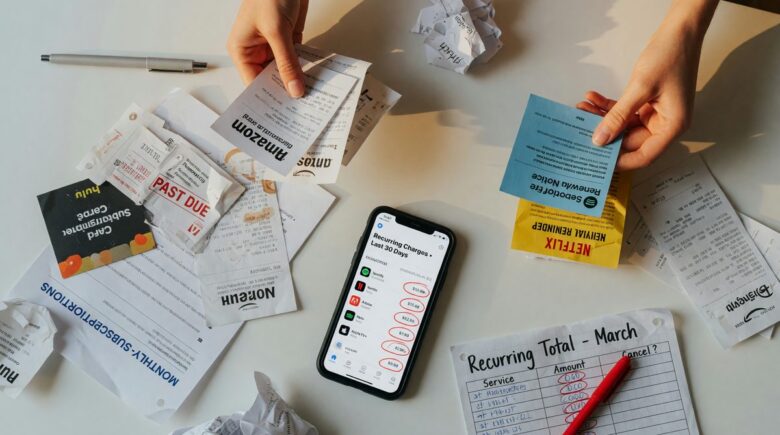
A subscription audit is worth doing for virtually every household. The typical American spends $219 per month on subscriptions but estimates only $86, meaning most people are paying more than twice what they think. The audit is especially urgent if you have not reviewed your recurring charges in the past 90 days; even a one-hour review routinely recovers $200 to $500 or more per year.
The single factor that determines how much subscription audit savings you can capture is not how many services you have, it is how long since you last looked. According to a 2025 YouGov survey published by CNET, US adults who subscribe to one or more services spend an average of $1,080 per year on subscriptions, with roughly $204 of that going to services they never actually use. The gap between what people spend and what they think they spend is not a rounding error; it is the product of autopay invisibility, forgotten free trials that converted to paid plans, and price hikes absorbed silently in the background.
In 2026, that gap is wider than ever. Streaming prices have climbed sharply over the past two years, software companies have shifted to subscription models for products that used to be one-time purchases, and the average household now juggles services across multiple payment methods, making a single bank statement review insufficient. If you have not done a formal audit recently, the odds are high that money is leaving your account for something you would not consciously choose to pay for today.
| Reason to Audit | Reason to Skip (or Delay) |
|---|---|
| Real money is leaking. The average subscriber wastes $204/year on unused services. | You already track every charge. If you review statements monthly and know each line item, your exposure is lower. |
| The perception gap is large. Most people estimate their spend at $86/month; the reality averages $219/month, a 2.5x error. | Many subscriptions do deliver value. Not every recurring charge is waste; some are cheaper than alternatives you would use instead. |
| Annual and quarterly charges hide easily. A $99/year plan billed in January is nearly invisible by July. | Cancellation friction takes time. Some companies make cancellation deliberately difficult, requiring phone calls or waiting periods. |
| Retention offers exist. Many services discount 15–20% for annual billing or offer pause options when you threaten to cancel. | Resubscribing can cost more. Some introductory prices are gone once you cancel; rejoining may mean paying the full current rate. |
| Redirected savings compound. $350/month at 7% annual return grows to roughly $182,000 over 20 years. | Your time has a cost too. A full audit of 12 payment sources takes two to three hours; that trade-off matters if your financial leakage is genuinely small. |
| Free replacements exist. Libraries, ad-supported tiers, and family plans cover many paid services at no cost. | Shared accounts complicate cancellations. Ending a family plan affects other users, requiring coordination rather than a solo decision. |
Key Takeaways
- You have not reviewed recurring charges in the past 90 days across all payment methods, including credit cards, debit accounts, PayPal, and app stores.
- Your estimated monthly subscription spend is more than $50 below your actual bank statement total once you add it up.
- At least one service in your current lineup has not been actively used in the past 30 days.
- You are paying for two or more services that largely overlap in function, such as multiple streaming platforms or two cloud storage plans.
- You have at least one annual charge of $50 or more that you did not consciously renew this year.
- You are carrying credit card debt at a high interest rate while also paying for entertainment or convenience subscriptions you rarely use.
- You have never asked a subscription service for a retention discount, an annual billing switch, or a pause before canceling outright.
Why Your Subscriptions Are Costing More Than You Think
The arithmetic is blunt: $219 per month is what the average consumer actually spends on subscriptions, according to C+R Research’s 2024 analysis of itemized expenses, yet the same respondents estimate their monthly outlay at roughly $86. That is not a rough guess, it is a 2.5x underestimation baked into how autopay works. When a charge never disrupts your account balance in a noticeable way, your brain stops registering it as a spending decision.
Price hikes accelerate the problem. Streaming services, in particular, have raised prices repeatedly since 2022, and many of those increases arrived as a small-print email that most subscribers never read carefully. A $15.99 plan that became $22.99 over three billing cycles added $84 per year without any active choice on your part. Software companies have done the same, converting desktop apps into annual subscriptions and bundling features you may never use into tiers that cost more than the previous one-time purchase. By mid-2026, it is common for a household to have a half-dozen services whose current prices they could not accurately name.
There is also the hidden non-financial cost. Some subscriptions, like a monthly craft supply box or a curated recipe service, trigger follow-on purchases of materials or ingredients. The subscription itself might be $25, but the actual monthly impact on spending is $60 or more once you account for what it prompts you to buy. A genuine subscription audit has to reckon with that downstream effect, not just the line-item charge.
What a Real Audit Actually Looks Like
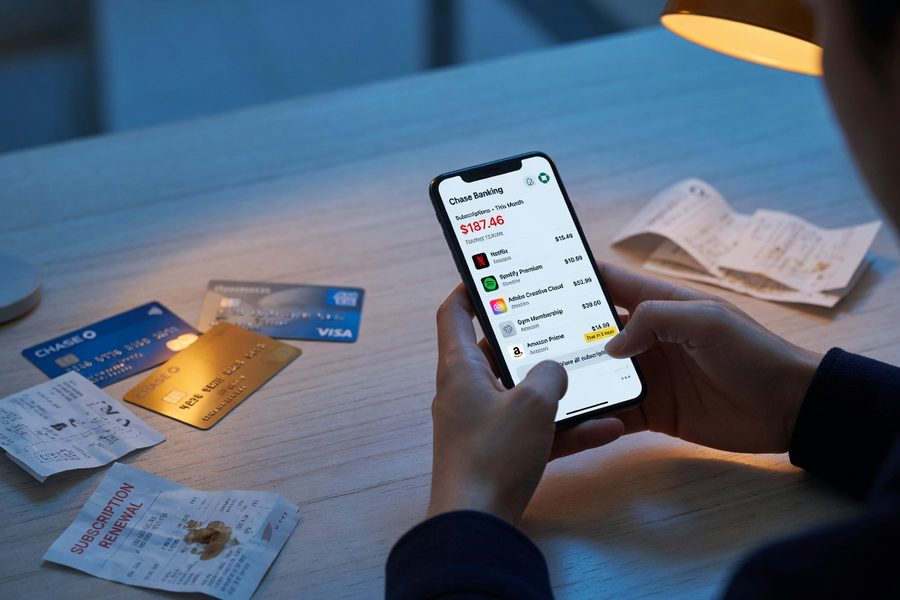
Pull three to six months of statements, not one. A single month will miss quarterly charges like a $45 antivirus renewal and annual charges like a $99 cloud storage plan. You need statements from every payment source: primary credit cards (Chase, Citi, Amex, or whichever issuers you use), backup debit accounts, PayPal or Venmo linked billing, and the purchase history inside your Apple ID and Google Play accounts. Most people find at least one charge they cannot identify until they look at six months of data side by side.
Start a simple spreadsheet with five columns: service name, monthly cost (annualize any quarterly or annual charges by dividing down), last date used, category (entertainment, software, fitness, etc.), and a keep/cut/negotiate flag. Do not rely on memory to fill in “last date used,” check the app itself, your watch history, your activity logs. If you genuinely cannot remember the last time you opened something, that is a strong signal.
Free tools from personal finance platforms like SoFi or services that pull from your bank via Plaid can automate part of this process, scanning linked accounts for recurring charges and flagging duplicates. They are a useful starting point, but they rarely catch charges billed through Apple’s App Store or Google Play because those appear as a single merchant line item. Manual review of those two stores is still necessary.
Do not overlook shared accounts and family plans. A family streaming plan split four ways at $7 per person is good value; that same plan carrying three inactive members who left the household is not. Annual charges in particular slip through basic monthly reviews. If your audit covers only the past 30 days, you will miss a meaningful portion of your recurring spend. For families managing multiple budget priorities alongside subscriptions, the same discipline that makes a subscription audit work also applies to larger spending categories, and the skills transfer directly to other areas like negotiating with creditors on high-interest debt.
The Negotiate-Before-Cancel Step Most Guides Skip
Canceling unused subscriptions is the obvious first move, but the step most audit guides skip is negotiation. Before canceling any service you actually use, ask for a better deal. Many subscription companies, especially streaming platforms and software providers, have retention teams authorized to offer discounts of 15 to 20 percent for annual billing, a free month, or a downgraded tier at a lower price. The offer rarely appears on the website; it appears when you initiate a cancellation.
The Federal Trade Commission requires that businesses make cancellation at least as easy as sign-up, which means you have regulatory backing when a company makes the process difficult. The Consumer Financial Protection Bureau (CFPB) also fields complaints about deceptive billing practices and negative-option subscriptions, so you have more than one agency to turn to if a service refuses to cancel cleanly. As the FTC’s guidance on auto-renewals and negative-option subscriptions makes clear, consumers should contact companies directly to cancel unused subscriptions and report to the FTC if cancellation is obstructed. Knowing your rights makes the conversation easier.
Annual billing switches deserve special attention. If you pay $14.99 per month for a service you genuinely use, that adds up to roughly $179.88 per year. Switching to an annual plan priced at $119.99 per year saves you about $60 annually, a reduction of around 33 percent. That math holds across many productivity tools, VPNs, and fitness apps. The caveat is that you are committing for 12 months, so only make the switch for services with strong recent usage history, not borderline ones.
Subscription Audit Savings: The Long-Term Math Rarely Discussed
One hour of audit work that recovers $175 per month is not just $2,100 per year, it is a potential transformation of your long-term financial position. Here is a concrete worked example using verified figures: if the average subscriber is wasting $204 per year and another $2,424 per year on services they actively use but could replace with free or lower-cost alternatives, the combined recoverable amount for many households sits around $200 to $350 per month. Redirect $350 per month into a broad-market index fund averaging 7 percent annual returns, and after 20 years you have approximately $182,000. That number comes directly from compounding $4,200 per year at 7 percent over two decades. The arithmetic is not magic; it is the ordinary consequence of redirecting money that currently goes toward forgotten billing cycles.
For households already carrying high-interest credit card debt, the calculus shifts slightly. The guaranteed return of paying off a card charging 24 percent APR exceeds any reasonable investment expectation, so subscription savings redirected to debt payoff have an even higher effective yield. Your debt-to-income ratio (DTI) also improves as balances fall, which matters if you plan to apply for a mortgage or refinance. If you are in that position, the strategies for negotiating your credit card APR pair well with subscription cuts to accelerate payoff simultaneously from both directions.
Experian data consistently shows that consumers who reduce revolving balances see measurable FICO Score improvements within one to two billing cycles, which means subscription savings redirected to credit card debt can have a compounding benefit beyond the interest saved. The Federal Reserve’s consumer credit data similarly shows that revolving debt costs American households tens of billions in interest annually, much of it on balances that could shrink faster with modest recurring expense reductions.
The honest concession here: not every dollar recovered from subscriptions will actually reach savings or debt repayment without a deliberate system. Research consistently shows that “found” money absorbed into general spending disappears within one to three months. The audit itself is not enough; you need to redirect the savings to a specific account or debt payment within the first billing cycle after cancellation, before the money becomes invisible income.

Free and Low-Cost Replacements That Actually Hold Up
Cancellation only sticks when there is a workable alternative. The most underused free resource for replacing paid subscriptions is the public library. Beyond physical books, most library systems now offer free access to digital magazines, audiobooks via Libby, streaming documentaries through Kanopy, and in some cases free museum passes and language learning apps. If you are paying for any of those services, your library card may already cover them, and a recent piece on what your library gives you for free breaks down the full range of what most people overlook.
For streaming specifically, 80 percent of US adults have paid for at least one streaming service in the past year, according to CNET’s 2025 survey data, and Pew Research Center found that 83 percent of US adults watch streaming TV services. That near-universal penetration means most households have significant overlap between services. Tubi, Pluto TV, and Peacock’s free tier collectively cover a large portion of what most people watch, and the trade-off is ads rather than a monthly bill. The ad-supported tiers of Netflix, Hulu, and Max also cut costs by 30 to 40 percent compared to ad-free plans while keeping the catalog largely intact.
Software is a more nuanced category. Microsoft 365 and Adobe Creative Cloud are difficult to replace entirely if you use them professionally, but many casual users pay for them out of habit rather than need. LibreOffice handles most word processing and spreadsheet tasks at no cost; Canva’s free tier covers the design needs of most non-professionals. Cloud storage is another area where paid plans exceed actual use for most people. Google’s free 15GB and Apple’s free 5GB cover light users, and a one-time external hard drive purchase often costs less than two years of premium cloud storage.
Who Should and Who Should Not
Good candidates
A subscription audit delivers the clearest, fastest payoff for these households.
- Anyone who has not reviewed recurring charges across all payment sources in the past 90 days, especially if they use more than two credit cards or payment accounts.
- Households carrying credit card debt alongside entertainment subscriptions, the interest rate on that debt almost certainly exceeds the value of the discretionary services.
- People who signed up for multiple streaming services during a promotional period and never pruned them back as prices increased.
- Anyone who receives app store charges they cannot immediately identify by name, which signals at least one forgotten trial-to-paid conversion.
- Households where one person manages subscriptions but others in the family use (or do not use) them, making the true per-user value easy to overestimate.
Who should skip it
A few profiles genuinely have less to gain, or face a different priority first.
- Someone who already reviews every recurring charge monthly and can name the current price and last-used date of each subscription without looking, the audit is effectively done continuously.
- Households in acute financial crisis where the more urgent task is addressing income rather than trimming expenses; in that case, looking at available higher-wage job opportunities or side income may deliver a faster, larger impact.
- Anyone whose total subscription spend is genuinely under $50 per month and each service has been actively used in the past two weeks, the effort-to-return ratio is poor at that level.
Frequently Asked Questions
How often should I do a subscription audit?
Once per quarter is the right cadence for most households, with a more thorough review once per year. Set a calendar reminder for the first week of each quarter; a quarterly check catches annual charges before they renew and keeps price creep from compounding silently for months.
What is the fastest way to find all my subscriptions?
Pull three to six months of statements from every payment source, including credit cards, debit accounts, PayPal, and your Apple or Google app store purchase history. Searching your email inbox for “receipt,” “renewal,” and “invoice” catches additional charges that billed to a secondary card or an old payment method.
Will canceling subscriptions hurt my credit score?
No. Canceling a subscription service has no effect on your credit report or credit score. Subscriptions are not credit accounts, and the only credit-related risk is if you let a forgotten subscription charge go unpaid long enough to reach collections, which an audit prevents. Your FICO Score is unaffected by subscription cancellations; it responds to payment history, credit utilization, and account age, none of which change when you drop a streaming service.
Is it worth switching to annual billing instead of canceling?
Only for services you have used consistently for at least 60 days and expect to keep for the next 12 months. Annual billing typically saves 15 to 33 percent compared to monthly rates, but you lose the flexibility to cancel mid-cycle, so do not make the switch for anything borderline. If you are also thinking about how to put those savings to work, starting to invest with zero experience is a natural next step once the recurring savings are locked in.
What should I do if a company makes it hard to cancel?
Document the attempt, then contact the company again in writing via email so you have a record. If the company continues to charge you after a clear cancellation request, file a complaint with the Federal Trade Commission at ReportFraud.ftc.gov or submit a complaint to the Consumer Financial Protection Bureau (CFPB), and dispute the charge with your credit card issuer. The FTC’s rules on negative-option subscriptions require that cancellation be as easy as sign-up.
Sources
- CNET, Subscription Survey 2025 (YouGov)
- C+R Research, Subscription Service Statistics and Costs (2024)
- Pew Research Center, 83% of US Adults Use Streaming Services (2025)
- Federal Trade Commission, Getting In and Out of Free Trials, Auto-Renewals, and Negative-Option Subscriptions
- MyFinancial101, Credit Card Debt: How to Prioritize and Negotiate with Creditors
- MyFinancial101, Stop Paying for What Your Library Gives Free