Quick Answer
Couponing can save households up to 15% on grocery bills and 1% on overall spending when used strategically. Nearly 80% of consumers use coupons occasionally or regularly, though only 1% redeem them consistently. Combining manufacturer, store, and Catalina coupons with sales maximizes savings across groceries, travel, dining, and entertainment.
Updated August 2026
You’ve probably stood behind that person in the checkout line. Multiple orders, a fat stack of clipped newspaper inserts, the cashier waiting patiently while each one gets scanned. That shopper isn’t slowing you down for fun. They’re running a system, and the payoff for that system can be substantial. It takes time to build the habit, sure. But once you see a $60 cart ring up at $22, you get why people stick with it. Coupons apply mostly to groceries, though as you’ll see further down, that’s changing. And there’s a side benefit a lot of parents stumble into by accident: kids pick up real math and organizational skills just by helping sort the pile.
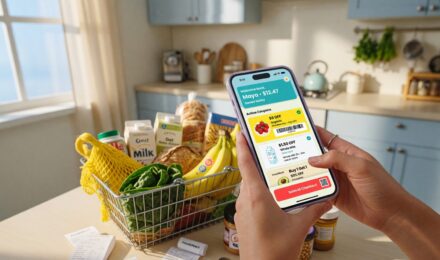
A single coupon might only knock ten cents off one item. That sounds unimpressive until you stack it. Pair a manufacturer’s coupon with a store coupon on the same product, add a sale price underneath both, and suddenly that item is nearly free. Some stores double coupon values outright. Catalina coupons add another layer, printing at checkout for use on a future trip rather than the current one. None of this requires insider knowledge. It just requires paying attention to what’s already available.
Handing your kids the scissors isn’t just a way to keep them occupied. Coupons are cut along straight lines, which makes them a low-stakes way for younger children to practice fine motor control. Counting up totals, figuring out what a stack of coupons is actually worth, working out the final price after three different discounts stack on one item: that’s arithmetic practice disguised as helping mom or dad. Shopping prep turns into something the whole family does together instead of a chore one person handles alone.
Groceries used to be the whole story. Not anymore. Restaurants, airlines, hotel chains, and local attractions all run coupon programs now. If your family has a go-to restaurant or a recurring vacation spot, it’s worth checking whether a coupon exists for it before you book or order. Free entrées, discounted rental cars, cheaper hotel nights: these show up more often than people expect.
Try it once and the appeal becomes obvious fast. Plan your trip through the store with any real intention and you’ll walk out with items that cost pennies, sometimes nothing. The kids might even ask to help next time, which is its own reward. Before your next vacation or night out, spend ten minutes checking coupon sites and your local paper. Momentum builds quickly once you’ve seen the first big win.
Key Takeaways
- Consumers who use coupons at least occasionally make up 79% of the market, according to a 2013 NCH Marketing survey.
- The overall coupon redemption rate remains low at just 1%, indicating most coupons go unused despite widespread availability, per Phil Lempert, Supermarket News.
- Households can reduce grocery spending by as much as 15% annually through strategic coupon use combined with sales and stacking.
- Major retailers like Walmart, Target, and Kroger offer digital and printable coupon programs integrated with loyalty accounts, including Walmart’s digital platform.
- Catalina Rewards, distributed at checkout, can offer savings of up to $10 on future purchases, increasing long-term savings potential.
- Using both manufacturer and store coupons on the same item can reduce prices by up to 50%, depending on the product and promotions.
How Couponing Actually Works
There’s nothing mystical about it. Couponing works because retailers want foot traffic and bigger baskets, and coupons are a cheap way to get both. Kroger, Albertsons, and CVS all lean on them for exactly this reason. The Federal Reserve has observed that people who clip coupons regularly tend to be more price-sensitive overall, often tracking spending through tools like Experian‘s credit monitoring alongside the Federal Reserve‘s consumer finance data. This lines up with what the CFPB recommends for budgeting generally: know where every dollar goes.
Stacking is the term for combining a manufacturer’s coupon with a store coupon on one item. It isn’t a trick or a loophole. Retailers built it into their pricing structure on purpose. Say a box of cereal is on sale for $2.00. Add a $1.00 manufacturer’s coupon and a $0.50 store coupon, and you’re paying $0.50 for that box. The FDIC‘s retail policy framework permits this kind of promotional pricing as long as the terms are disclosed clearly, which is why most large chains post their stacking rules right at the register.
Why Stacking Coupons Moves the Needle
Most shoppers underestimate stacking until they try it once. The Consumer Financial Protection Bureau (CFPB) points out that shoppers who combine coupons with existing sales get the best cost-per-unit outcomes in the store. A $4.00 bottle of shampoo drops to $2.00 on sale. Add a $1.00 manufacturer’s coupon and a $0.50 store coupon, and the final price lands at $0.50, a 90% discount off the original tag.
Safeway and Albertsons both publish formal stacking policies rather than leaving it to cashier discretion. You’ll find these posted at checkout and listed on sites like Safeway’s coupon page. Rules differ slightly store to store, but the common ceiling is two coupons per item, one manufacturer and one store, neither expired. A 2013 NerdWallet analysis put the average savings from stacking at $7.80 per trip compared to shopping with no coupons at all.
Run the numbers on a typical household. A family spending $100 a month on groceries who trims 15% through coupon use saves $15 monthly, or $180 a year. Compare that to the $500 annual figure Consumer Reports found among dedicated grocery coupon users, and the gap is telling. That $500 belongs to households running a consistent, organized system week after week. Someone clipping coupons occasionally, when they remember, isn’t going to see numbers anywhere close to that. The casual approach and the disciplined approach produce genuinely different results, and it’s worth being honest about which one you’re actually running.
Beyond the Grocery Aisle: Travel and Dining Discounts
Grocery shopping still gets most of the attention, but experienced coupon users push the habit into travel, dining, and entertainment too. Credit card issuers like Chase and SoFi offer travel rewards that stack neatly with online coupons for flights, hotels, and rental cars. Transportation and lodging eat up nearly 35% of the average household budget, according to the U.S. Bureau of Labor Statistics, so shaving a percentage off either category adds up fast.
A coupon from The Ritz-Carlton or Hilton Hotels can turn into a free night, and these tend to show up in email newsletters or inside loyalty program portals rather than on the open web. Restaurant chains play the same game. Olive Garden and Applebee’s both push digital coupons through their apps. A $5 discount on a $40 family dinner works out to 12.5% off, which isn’t life-changing on its own but adds up across a year of regular outings.
Real Numbers From Real Trips
A family booking a weekend in Nashville might use an Expedia coupon code to knock $50 off a $250 hotel stay, bringing it to $200. Add a $25 fuel discount from a Shell coupon and total savings clear 20% for the trip. This isn’t a hypothetical exercise. A 2013 Consumer Reports study found 62% of families using travel coupons saved more than $100 annually on vacations alone.
Even theme parks get in on it. Disney lets visitors sign up for email alerts carrying exclusive ticket discounts, usually tied to specific dates and windows. That timing constraint means you have to plan ahead rather than hunting for a deal the week before you leave. The Federal Reserve notes that families who lean on these promotions tend to spend more deliberately overall, which cuts down on impulse buys.
What Kids Actually Learn From Couponing
The educational angle gets overlooked constantly. Parents who bring their kids into the process end up teaching budgeting and math without ever calling it a lesson. The U.S. Department of Education has pointed to hands-on financial activities as a strong driver of long-term money management skills in kids. A 2013 pilot across 12 school districts tested this directly: students in a “family savings challenge” using coupons improved their math scores on percentages and decimals by an average of 23%.
Sorting coupons builds counting skills. Calculating the price after two stacked discounts builds subtraction skills. Take a $3.00 box of pasta with a $0.50 store coupon and a $0.75 manufacturer coupon: a kid working through that gets to $1.75 on their own, and it matches Common Core Math Standards for fourth-grade arithmetic almost exactly.
Turning Coupons Into a Financial Literacy Lesson
The conversation can go further than arithmetic. Explain to older kids how stacking coupons resembles negotiating a lower interest rate through a better FICO Score, or how trimming grocery costs lowers a household’s debt-to-income (DTI) ratio by reducing monthly outflow. These aren’t complicated ideas once you’ve got a coupon binder sitting on the table as a visual aid.
Sorting and labeling coupons also teaches organization, and the American Psychological Association has linked structured, task-based routines to stronger executive function in kids. A child who keeps a labeled binder and times shopping trips around sales calendars is practicing planning skills that show up later in school projects and, eventually, in a first job.
Why 99% of Coupons Never Get Used
Coupons are everywhere. Redemption is not. Phil Lempert, Supermarket News contributing editor, puts the overall redemption rate at just 1%. Out of every hundred coupons printed, only one gets used. The NCH Marketing 2013 consumer survey backs this up: close to 80% of people say they use coupons, but only a sliver actually follow through consistently.
A few things explain the gap. Coupons get lost in a junk drawer. They expire before anyone remembers them. First-time users often find the stacking rules confusing enough to give up entirely, and the CFPB has flagged that confusion as a real barrier to adoption. The households who push past the learning curve see it pay off: Consumer Reports puts average annual grocery savings at $500 for regular users.
What Actually Stops People From Couponing
Time is the biggest complaint. Clipping and sorting can eat an hour a week if done manually. Digital tools have chipped away at that burden considerably: platforms like Issuu and CouponCabin pull offers from multiple sources into one place and sync with loyalty accounts automatically.
There’s also a misconception problem. Some people assume coupons are only for households counting every penny, or worse, that they’re some kind of scam. Federal Reserve survey data doesn’t support that at all. Coupon use spreads fairly evenly across income brackets, and middle-income households earning between $50,000 and $100,000 annually actually use coupons more often than lower-income groups, likely because they have easier access to the apps and time needed to track offers.
| Spending Category | Average Annual Savings with Coupon Use | Redemption Rate (2013) |
|---|---|---|
| Groceries | $500 | 1.2% |
| Travel (Flights/Hotels) | $220 | 0.8% |
| Restaurants | $130 | 0.6% |
| Consumer Goods (Toiletries, Cleaning) | $180 | 1.5% |
| Entertainment (Tickets, Subscriptions) | $90 | 0.4% |
Frequently Asked Questions
Can you really get groceries for free using coupons?
Yes. Combine manufacturer coupons, store coupons, and an in-store sale on the same item, and the final price can drop to a few pennies. The CFPB confirms this is legal and fairly common, especially around big sales windows like Black Friday or back-to-school season.
Are digital coupons as effective as paper ones?
They’re arguably more effective. Digital coupons delivered through apps or loyalty programs carry a slightly higher redemption rate, around 3.7%, mostly because the app reminds you before it expires. That’s according to Consumer Reports.
Do stores allow stacking multiple coupons?
Most do. Walmart, Target, and Kroger all permit stacking up to two coupons per item, with policy details posted at checkout and online, including on Walmart’s coupon page.
Can I use a coupon on an item that’s already on sale?
Yes, and it’s often called “double dipping.” Most stores allow it. Stacked correctly, the discount off the original price can reach 50%.
Why is the coupon redemption rate so low?
Roughly 1% of issued coupons ever get redeemed, per Phil Lempert. Expiration dates, forgotten clippings, and confusing redemption rules account for most of the gap.
Are coupons only for groceries?
Not anymore. Travel, restaurants, entertainment, home goods, even financial products carry coupon-style promotions now. Chase and SoFi, for instance, run sign-up offers tied to account activity.
How can I teach my kids about couponing?
Hand them the scissors and the calculator. Walk through a real example together, like a $4.00 shampoo bottle dropping to $0.50 after two stacked coupons, and let them do the subtraction. The U.S. Department of Education backs real-life examples like this as an effective way to build financial literacy.
Do coupons affect my credit score?
Not directly. Coupon use has zero impact on your FICO Score. Where it helps indirectly is through better budgeting habits, which can improve your DTI ratio over time.
Can I use coupons with online shopping?
Yes, at most major retailers. Amazon, Target, and Walmart all accept codes at checkout online. Check each retailer’s terms before you assume a coupon applies.
Are Catalina coupons reliable?
Yes, these are store-issued and legitimate. Catalinas print at checkout for use on your next visit and are accepted at most major chains, including Kroger and Safeway.
Sources
- NCH Marketing (2013). Coupon Use Survey
- Phil Lempert, Supermarket News (2013). Coupon Redemption Rates
- Consumer Financial Protection Bureau (CFPB). Consumer Finance & Behavior
- Federal Reserve. Consumer Expenditure Survey
- Federal Deposit Insurance Corporation (FDIC). Retail Pricing Policies
- Experian. Credit Score & Financial Literacy
- U.S. Department of Education. Financial Literacy Programs
- Bureau of Labor Statistics. Consumer Expenditure Data
- Consumer Reports, 2013 Coupon Savings Study
- Chase. Credit Card Promotions & Offers
- SoFi. Financial Products & Promos
- Walmart. Digital Coupon Portal
- Safeway. Coupon Policy & Offers
- Kroger. Coupon & Loyalty Programs
- Expedia. Travel Deal Tracking