Fact-checked by the MyFinancial101 editorial team
Quick Answer
The most common W-4 withholding mistakes include incorrect filing status, failing to coordinate multiple jobs, and over-claiming dependents, errors that can leave you owing a balance plus an underpayment penalty calculated at the federal short-term interest rate plus 3 percentage points (IRS, 2026). Submitting a corrected W-4 mid-year is free and takes under 15 minutes.
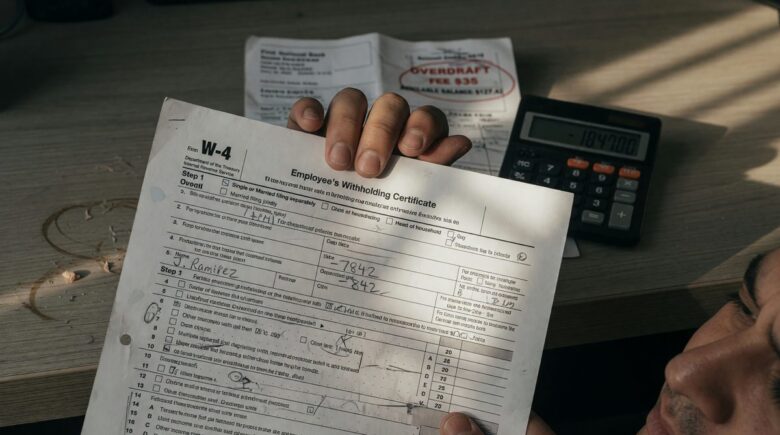
Most people fill out a W-4 once when they start a job and never look at it again, and that single oversight is what turns April into a financial emergency. W-4 withholding mistakes are rarely dramatic. They accumulate quietly across 26 or 52 pay periods, and by the time you file, the shortfall has already happened. The IRS operates on a pay-as-you-go system: taxes are owed throughout the year, not in a lump sum when you file, and falling short of that threshold triggers both a balance due and a potential penalty.
According to the IRS, reviewing and adjusting withholding using the Tax Withholding Estimator is the single most reliable way to prevent owing a balance or incurring penalties at filing. The agency recommends this review at least once a year and after any significant life or income change. That guidance is direct, it is free to follow, and most taxpayers ignore it.
This guide walks through the specific errors that cause under-withholding, identifies the life events that quietly break a working W-4, and shows exactly how to use IRS tools and Line 4(c) to recalibrate before the damage is done. Where relevant, it also covers a few angles most withholding articles miss: what happens when divorced parents both claim the same child, how bonus income escapes standard W-4 math, and how federal and state withholding forms can compound each other’s errors.
Key Takeaways
- The IRS safe-harbor threshold requires paying at least 90% of your current-year tax liability (or 100% of last year’s tax) through withholding or estimated payments to avoid the underpayment penalty (IRS Pay-As-You-Go guidance).
- Only one spouse in a married household should claim dependents on their W-4; double-claiming the same children across two forms causes systematic under-withholding (IRS Form W-4 instructions, 2025).
- Line 4(c) of Form W-4 allows a precise additional dollar amount per paycheck, the most targeted correction available without reworking the entire form (IRS, 2025).
- The IRS Tax Withholding Estimator is free, accounts for multiple jobs and spouse income via Step 2, and outputs exact W-4 line entries rather than general guidance (IRS Taxpayer Advocate Service, April 2026).
- Marking yourself “Exempt” on Line 4 of the W-4 is only valid if you had zero federal tax liability in the prior year and expect zero liability in the current year, claiming it otherwise triggers under-withholding from the first paycheck (IRS Form W-4 instructions, 2025).
- Gig, freelance, and investment income are not subject to automatic withholding; a worker earning even $400 in net self-employment income owes self-employment tax and must account for it separately (IRS Publication 505, 2025).
In This Guide
- Why Your W-4 Can Leave You Owing Money at Tax Time
- The W-4 Withholding Mistakes That Actually Trigger a Bill
- Life Events That Make Your Current W-4 Outdated
- How to Check Your Withholding Mid-Year Without Guessing
- Submitting a New W-4 and Getting It Right the First Time
- What to Do If You Already Owe or Face a Penalty
- How Bonus and Irregular Income Break Standard W-4 Math
- Federal Versus State Withholding Forms: The Double Under-Withholding Risk
- Building a Habit to Prevent Future Surprises
Why Your W-4 Can Leave You Owing Money at Tax Time
Under-withholding does not produce a penalty because you filed late or made a mistake on your return. It produces one because the IRS expects taxes to be paid continuously, throughout the year. That is the pay-as-you-go system in practice. A shortfall in January accrues interest from January forward, not from April 15.
The Safe-Harbor Threshold You Need to Know
To avoid the underpayment penalty entirely, you must pay at least 90% of your current-year federal tax liability through withholding and estimated payments, or at least 100% of the prior year’s total tax (110% if your prior-year adjusted gross income exceeded $150,000). The IRS pay-as-you-go guidance explains both thresholds clearly. Missing either one means the penalty applies even if you eventually pay in full by the filing deadline.
The distinction between a refund and a bill comes down to whether cumulative withholding exceeded your final liability. A refund means you overpaid throughout the year, which sounds pleasant but represents an interest-free loan to the government. A balance due means you underpaid. The W-4 is the lever that controls which outcome you get.
Why “Getting a Big Refund” Is Not the Goal
Many filers treat a large refund as a sign that their withholding is working. It is not. A $3,000 refund means $250 per month that could have stayed in your paycheck. The better target is breaking even: minimal balance due, minimal overpayment. Getting close to that target requires an accurate W-4, one that reflects your current filing status, income, deductions, and credits. Most taxpayers are using a W-4 that reflects none of those things accurately.
The IRS underpayment penalty is calculated quarterly, not annually. A shortfall in the first quarter of the year costs more in penalty interest than the same shortfall in the fourth quarter, because it accrues longer.
The W-4 Withholding Mistakes That Actually Trigger a Bill
The 2020 redesign of Form W-4 eliminated withholding allowances, but it did not eliminate the human errors that cause under-withholding. The form is more intuitive now, and the mistakes are more specific.
Wrong Filing Status in Step 1
Choosing “Married Filing Jointly” in Step 1 without completing Step 2 is one of the most consequential W-4 withholding mistakes a dual-income household can make. That status instructs your employer to withhold as though your combined household income is earned by one person in one bracket, which produces too little withholding the moment a second income pushes the household into a higher bracket. Step 2 exists precisely to correct this, but many filers skip it.
Double-Claiming Dependents Across Two W-4s
In a two-income household, both spouses sometimes claim the same children in Step 3. The Child Tax Credit is worth up to $2,000 per qualifying child under current law (IRS, 2025), and claiming it reduces the withholding amount on that form. When both spouses do it, the household’s total withholding is reduced by twice the credit amount, against a tax liability that only allows the credit once. The IRS recommends that only the higher-earning spouse enter dependents in Step 3.
The coordination problem is even sharper for divorced or separated parents sharing custody. Both parents may be entitled to claim a child in alternating years under a divorce decree, but only the parent who legitimately claims the child in a given year should reflect that credit on their W-4 for that year. The other parent’s W-4 should show zero dependents for that child. Many parents update their W-4 once and leave it static across alternating years, creating systematic under-withholding in the years they are not the claiming parent.
Marking “Exempt” Without Qualifying
Line 4 of Form W-4 allows a filer to claim exemption from federal income tax withholding. The eligibility test is strict: you must have had zero federal income tax liability in the prior year and expect zero liability in the current year. Claiming exempt when you do not qualify results in zero withholding from every paycheck, and a full-year tax bill plus penalty at filing. The exemption also expires; a new W-4 claiming exempt must be filed by February 15 of each year or withholding reverts to the default single filer rate.
Claiming “Exempt” in a prior year and forgetting to renew by February 15 means your employer may now be withholding at the default single-filer rate regardless of your actual situation. Check your most recent pay stub to confirm what is actually being withheld.
Skipping Line 4(c) Entirely
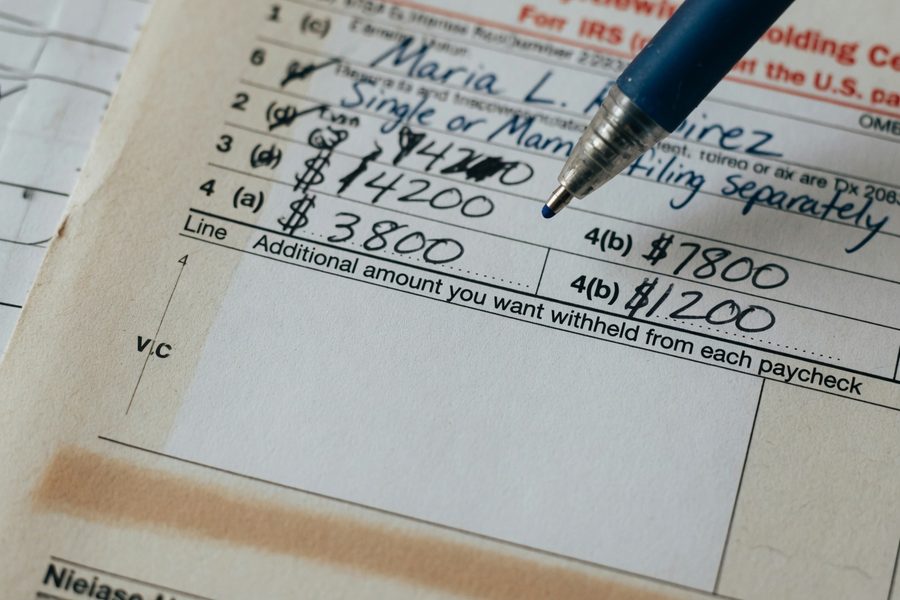
Line 4(c), the additional withholding line, is the most underused tool on the form. It accepts a flat dollar amount added to every paycheck’s withholding. For workers who have irregular income, claimed credits they are not sure they will fully qualify for, or just want a cushion against an unexpected liability, this line provides precise control without requiring a full recalculation of Steps 2 through 4. Most people leave it blank. That is often the right choice, but it is rarely a deliberate one.
| Common W-4 Mistake | Typical Annual Under-Withholding Impact | Correction Method |
|---|---|---|
| Both spouses claim same 2 children in Step 3 (dual income, $148,000 combined) | $2,000 (double-counted Child Tax Credit) | Remove dependents from lower earner’s W-4; only higher earner claims Step 3 |
| Married Filing Jointly selected in Step 1 with Step 2 left blank (2 incomes, combined $148,000) | $800–$1,400 depending on income split | Complete Step 2 using IRS Withholding Estimator or Multiple Jobs Worksheet |
| Child ages out of $2,000 Child Tax Credit (turns 17 during tax year); W-4 not updated | Up to $1,500 (credit drops from $2,000 to $500 Other Dependent Credit) | Reduce Step 3 entry; rerun Withholding Estimator |
| Bonus withheld at flat 22% supplemental rate; marginal rate is 24% | 2% of each bonus payment (e.g., $100 per $5,000 bonus) | Add supplemental amount to Line 4(c) to pre-fund expected shortfall |
| Freelance net income of $10,000 not entered in Step 4(a) or covered by estimated payments | $1,530 in self-employment tax alone (15.3%), plus ordinary income tax owed | Enter non-wage income in Step 4(a) or make quarterly payments via Form 1040-ES |
| Claimed “Exempt” without qualifying; zero withholding all year | Full annual income tax liability (amount varies by income level) | Submit corrected W-4 immediately; contact payroll to expedite processing |
Life Events That Make Your Current W-4 Outdated
A W-4 goes stale the moment your financial life changes. The form you completed at onboarding three years ago reflects a version of your tax situation that may no longer exist.
Marriage, divorce, a new child, or a child aging out of the Child Tax Credit all shift your filing status or credit eligibility. Starting a side hustle or receiving investment income introduces dollars that carry no automatic withholding at the source. Buying a home may add mortgage interest deductions that justify reducing withholding, or may not, if you take the standard deduction anyway. A promotion or raise pushes more income into higher brackets, and the old W-4’s withholding percentage will not automatically adjust upward to match. The IRS advises submitting a new Form W-4 after any of these events rather than waiting until the next filing season.
A child turns 17 during the tax year, and loses eligibility for the full $2,000 Child Tax Credit, dropping to at most a $500 Other Dependent Credit instead. Not updating the W-4 after that birthday means withholding is understated by up to $1,500 in credit value for that year (IRS, 2025).
How to Check Your Withholding Mid-Year Without Guessing
The fastest accurate check is the IRS Tax Withholding Estimator, a free online tool that takes 10 to 15 minutes if you have a recent pay stub and last year’s tax return available. The estimator accounts for multiple jobs, spouse income, deductions, and credits, and outputs specific W-4 line entries rather than general advice. The IRS Taxpayer Advocate Service recommends this tool explicitly for anyone wanting to prevent tax-day surprises.
The Manual Projection Method
Prefer to run the numbers yourself? The approach is straightforward. Take your year-to-date federal income tax withheld from your most recent pay stub. Divide by the number of pay periods elapsed, then multiply by the total pay periods in the year. That gives you projected annual withholding. Compare that figure to 90% of your estimated total tax liability for the year (using last year’s tax as a baseline if this year is similar). Projected withholding falling short of that 90% threshold means you need a correction.
What to Look for on Your Pay Stub
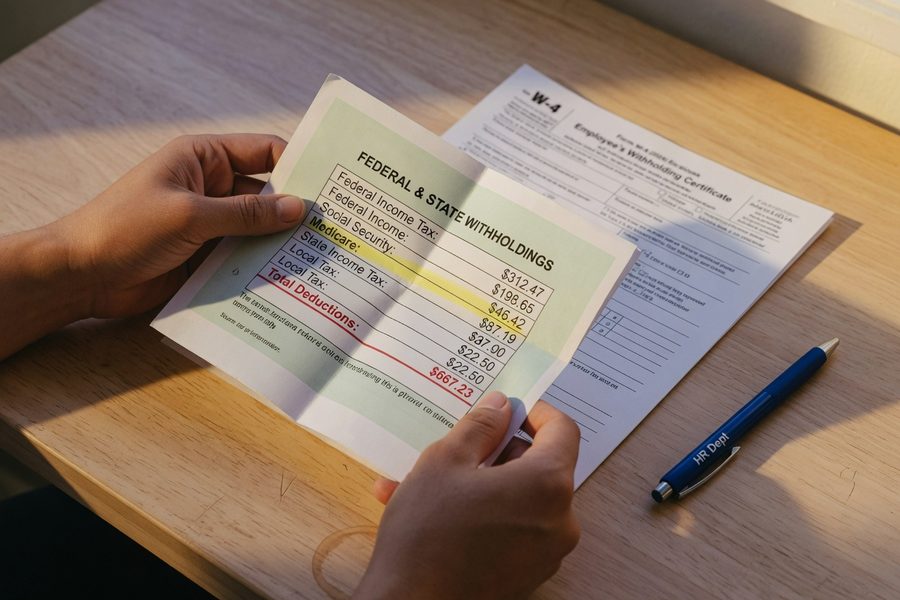
Check the “Federal Income Tax Withheld” line, not “Total Taxes.” Social Security and Medicare (FICA) are separate and not controlled by the W-4. A federal income tax line reading zero or close to it, when you are not legitimately exempt, signals something on your W-4 is wrong. This happens most often when a filer claimed an implausibly large deduction amount in Step 4(b) or entered a large credit amount in Step 3 that offsets withholding to near zero.
What I see in practice: A surprising number of clients come to me in March having never looked at the “Federal Income Tax Withheld” column on a single pay stub all year. That one number, checked even once mid-year, would have flagged the problem with enough time to correct it across the remaining pay periods.
Run the IRS Tax Withholding Estimator twice: once using this year’s projected income, and once using last year’s actual tax as your baseline. Use whichever calculation produces the higher required withholding. That approach satisfies both the 90% current-year and 100% prior-year safe-harbor rules simultaneously.
Submitting a New W-4 and Getting It Right the First Time
A corrected W-4 takes effect on the next payroll run after your employer processes it, not retroactively. Submit it as early in the year as possible, because every pay period that passes is one fewer opportunity to make up a shortfall through higher withholding.
Step-by-Step Focus for Married Filers
Step 1: Enter your legal name, address, Social Security number, and correct filing status. For a married household with two incomes, do not stop at “Married Filing Jointly”, complete Step 2.
Step 2: Choose one of three options. The most accurate is the IRS Withholding Estimator, which outputs the exact additional amount to enter in Step 4(b). The Multiple Jobs Worksheet (included with the W-4 instructions) is the manual alternative. The checkbox option in Step 2(c) works only if both spouses earn roughly equal incomes; otherwise it over-withholds for the lower earner and under-withholds for the higher one.
Step 3: Enter dependents only on one spouse’s W-4, the higher earner’s, per IRS guidance. Not both. Calculate the credit amount per the instructions, not a round number.
Step 4(c): When the Withholding Estimator recommends additional withholding, enter that exact dollar amount here. This line is the most precise correction available and does not require revisiting Steps 1 through 3.
After Submission: Verify on Your Next Pay Stub
Confirm the change appeared in your withholding by checking the first pay stub issued after the new W-4 was processed. Payroll departments occasionally process forms on a delay. A number unchanged by the second paycheck warrants a direct follow-up. You cannot assume the form was received and processed correctly.
What to Do If You Already Owe or Face a Penalty
Having already filed and owing a balance, or finding the estimator shows you are on track to owe, the response depends on where you are in the calendar year. A balance due at filing is paid directly with your return. The penalty for underpayment, if it applies, is computed on IRS Form 2210 and either assessed automatically or waived under specific exceptions.
Mid-Year Correction Options
Before October 1, with multiple pay periods still remaining, a corrected W-4 with a meaningful additional withholding amount in Line 4(c) can bring you close enough to the safe-harbor threshold to avoid the penalty entirely. The math is simple: take the projected shortfall, divide by the remaining pay periods, and enter that amount in Line 4(c). That is the cleanest mid-year fix for a W-4 problem.
For income not subject to withholding, freelance income, rental income, capital gains, the correction mechanism is estimated tax payments via IRS Form 1040-ES. The quarterly deadlines are April 15, June 15, September 15, and January 15 of the following year. Missing these adds to the underpayment calculation independently of any W-4 corrections.
When the Employer Made the Error
When your employer withheld less than your W-4 instructed, not a case of you submitting incorrect information but actual payroll processing error, the employer is responsible for the employer’s share of any underpayment and may be subject to IRS penalties. Document the discrepancy with pay stubs and your submitted W-4. The IRS can issue a 2802C letter directly to an employer when it suspects the employer is not withholding the correct amount based on a submitted W-4. As an employee, your liability is limited to the employee’s share of taxes owed, not the employer’s portion.
The IRS underpayment penalty rate is tied to the federal short-term interest rate plus 3 percentage points, adjusted quarterly. At 2025 rates, that translated to a 7% annualized penalty rate on underpaid amounts (IRS Revenue Ruling 2025-1).
Owing a larger balance and being unable to pay in full, the IRS offers installment agreement options at IRS.gov/payments. Setting up an installment plan does not eliminate interest or the underpayment penalty already assessed, but it does prevent collection actions. A significant unpaid balance from prior years deserves a structured approach to prioritizing what you owe before you call the IRS.
How Bonus and Irregular Income Break Standard W-4 Math
Bonus income creates a withholding gap that the standard W-4 almost never captures accurately. An employer can withhold on a bonus using either the flat 22% supplemental rate (for bonuses under $1 million) or the aggregate method, adding the bonus to regular wages and calculating withholding at the blended rate. Neither approach accounts for whether 22% is actually your effective marginal rate on that additional income.
The Problem With the Flat Rate
A marginal rate of 24% or higher on that bonus, plausible for a household income above roughly $94,300 (single) or $188,550 (married filing jointly) in 2025, means withholding at 22% creates a guaranteed shortfall on every bonus payment. That shortfall compounds across multiple bonuses or commissions throughout the year.
Employers applying a mechanical withholding percentage have no way of knowing whether that percentage matches an employee’s actual marginal rate, as CNBC reported in February 2024. The correction falls entirely on the employee: entering a supplemental amount on Line 4(c) to pre-fund the expected shortfall from bonus periods (IRS Publication 505, 2025).
The same logic applies to irregular commission income, severance pay, and stock vesting events (RSUs). Any of these income types in your compensation means the base W-4 math will not cover them. A tax professional or the IRS estimator, run specifically with those additional income amounts included, is the appropriate tool for sizing the correction.
Federal Versus State Withholding Forms: The Double Under-Withholding Risk
Fixing your federal W-4 is only half the job if your state imposes an income tax. Most states use their own withholding forms: New York uses Form IT-2104, California uses DE-4, Illinois uses IL-W-4. Errors on those forms run entirely parallel to federal errors. A correct federal W-4 paired with a misconfigured state form produces a state tax bill that arrives separately, often as a surprise even for filers who thought they had addressed their withholding issues.
States That Default to Federal W-4 Data
Some states automatically apply the federal W-4 entries to state withholding calculations, which means a federal error propagates to state withholding automatically. Others require a separate form, and many employees never submit one, leaving state withholding at the default rate, which may be too low for higher earners. Check your state’s Department of Revenue website for the specific form and instructions. Submitting both the federal W-4 and the applicable state form at the same time is cleaner than treating them as separate tasks.
The compounding effect matters. A federal withholding shortfall of $800 for the year paired with a state shortfall of $400 means $1,200 in total exposure at filing, across two separate tax authorities, two separate payment deadlines, and potentially two separate underpayment penalties. Complex state income situations may warrant reviewing available tax filing assistance options before submitting updated forms.
Building a Habit to Prevent Future Surprises
The best time to review your W-4 is immediately after filing your prior-year return, when your actual tax liability is freshest, the prior year’s data is assembled, and you still have most of the new year’s pay periods ahead of you to make corrections count.
The Annual Paycheck Checkup
This process is what the IRS calls the Paycheck Checkup. File your return, note the final liability versus what was withheld, open the Tax Withholding Estimator with the prior return on hand, enter your current income and expected changes, and submit a new W-4 if the estimator recommends one. The entire process takes less than 30 minutes for most filers. Doing it in April or May leaves roughly 20 pay periods in the year to distribute any needed correction, which keeps the per-paycheck adjustment small.
Workers who have taken on gig work, started a side hustle, or moved into roles with variable compensation should not wait for the annual review. A mid-year check in July, using actual year-to-date figures, adds a second guardrail. Anyone concerned about the interaction between withholding and income variability will find how gig and freelance income affects your overall tax picture a useful starting point for that July review.
Non-W-2 Income Sources to Track
Bank interest, dividends, capital gain distributions, rental income, and self-employment income all arrive without any automatic federal withholding. A worker who is otherwise on track with their W-4 can still owe at filing because these sources pushed total liability above what paycheck withholding covered. The practical fix is to estimate these amounts by mid-year, run them through the Tax Withholding Estimator as additional income in Step 4(a), and either increase Line 4(c) or make a quarterly estimated payment for Q3 to cover the gap.
Self-employed workers and those with significant freelance income owe both the employee and employer portions of FICA, a combined 15.3% self-employment tax on net earnings, on top of ordinary income tax. This rate is not reflected in any W-4 calculation for W-2 income, and it must be funded separately through estimated payments or Line 4(c) adjustments (IRS Publication 505, 2025).
Real-World Example: Dual-Income Household Discovers a $2,200 Shortfall
Consider an illustrative example: a married couple, both employed, filing jointly with two children, ages 14 and 17. Combined household income is $148,000. Both spouses completed their W-4s independently at their respective employers, both selecting “Married Filing Jointly” in Step 1 and both entering the two children in Step 3, claiming a total of $4,000 in Child Tax Credit reductions across the two forms. Their actual credit for the year is $2,000 (the 17-year-old no longer qualifies for the full credit; only the 14-year-old does). Total over-claimed credit across both forms: $2,000. Neither completed Step 2, meaning withholding also failed to account for the combined bracket effect on $148,000 of household income.
By the time they filed in March, their total federal income tax liability was $18,700. Their combined withholding was $16,500. The shortfall: $2,200, plus an underpayment penalty because they missed the 90% safe-harbor threshold. Had either spouse run the IRS Tax Withholding Estimator in May of the prior year, the tool would have flagged the Step 2 gap and the double-counting in Step 3, and recommended roughly $85 per paycheck in additional withholding via Line 4(c) to close the gap across the remaining 26 pay periods.
Your Action Plan
-
Pull your most recent pay stub and last year’s tax return
Before touching your W-4, assemble the inputs you need. Your pay stub shows year-to-date federal income tax withheld and total wages. Your prior return shows last year’s total tax liability, the baseline for the 100% safe-harbor calculation. Without both documents, any W-4 change is a guess.
-
Run the IRS Tax Withholding Estimator at IRS.gov
Navigate to IRS.gov/W4app and complete the estimator with your current income, expected deductions, and all income sources, including any freelance, investment, or bonus income. The tool outputs specific W-4 line entries. Save or screenshot the results.
-
Check whether Step 2 is complete if you have multiple income sources
Married with two incomes, or holding more than one job, confirm that Step 2 of your W-4 is completed using either the Multiple Jobs Worksheet or the Withholding Estimator output. Leaving Step 2 blank with a “Married Filing Jointly” status in Step 1 is the single most common source of significant under-withholding in dual-income households.
-
Reconcile dependent claims across your household
Married filers should confirm that only one spouse’s W-4 reflects dependents in Step 3, the higher earner’s. Parents sharing custody of a child should confirm which one is legitimately claiming that child for the current tax year and that only that parent’s W-4 reflects the credit. Adjust accordingly.
-
Enter a specific dollar amount in Line 4(c) if the estimator recommends it
Do not leave Line 4(c) blank by default. When the estimator recommends additional withholding, enter that exact amount. You can update this figure at any time by submitting a new W-4; it does not obligate you to any particular withholding level permanently.
-
Submit the corrected W-4 to your employer’s payroll department promptly
Deliver the updated form in writing, most employers accept a PDF submitted via HR portal or email. Note the submission date. Confirm the change appeared in your withholding on the next available pay stub. No change within two pay periods warrants a direct follow-up with payroll.
-
Set a calendar reminder to review withholding every April and again in July
April: review immediately after filing, with actual liability data in hand. July: re-check using year-to-date figures if your income is variable or you have added gig work, investment income, or a side hustle since April. Complex situations may benefit from a session with a CPA or enrolled agent, particularly during tax season, when free IRS tax assistance programs may be available, to catch issues the online estimator might miss.
Frequently Asked Questions
How often should I update my W-4?
The IRS recommends reviewing your W-4 at least once a year and after any significant life or income change. The optimal time is immediately after filing your prior-year return, when your actual tax liability is known and you have most of the new year’s pay periods available to make corrections.
Does submitting a new W-4 affect taxes I already owe from prior years?
No. A new W-4 only changes withholding going forward from the next payroll run. Any under-withholding from prior pay periods is already recorded and will appear as a balance due when you file. The corrected W-4 prevents the problem from worsening but does not erase what has already accumulated.
Can my employer refuse to honor my W-4?
An employer must honor a properly completed W-4 submitted by an employee. The one exception: a lock-in letter (also called a 2800C or 2802C letter) issued directly by the IRS to the employer requires the employer to withhold at the IRS-specified rate regardless of what a new W-4 says. Lock-in letters are issued when the IRS determines an employee is not having enough withheld, typically after a pattern of under-withholding.
What is the penalty for under-withholding?
The underpayment penalty is calculated quarterly at the federal short-term interest rate plus 3 percentage points, applied to the amount by which withholding and estimated payments fell short of the safe-harbor threshold. It is not a flat fee; it accrues from the date each quarterly installment was due, so earlier shortfalls cost more than later ones.
Should I claim zero dependents on my W-4 to avoid owing at filing?
Claiming zero dependents increases withholding and reduces the risk of owing, but it may also mean you consistently overpay throughout the year. A better approach is to claim the accurate number of dependents you legitimately qualify for, then use Line 4(c) to add a buffer amount if you want extra cushion without abandoning an accurate calculation entirely.
Does the W-4 cover self-employment or freelance income?
It can, but not automatically. With both W-2 income and freelance or self-employment income, you can enter your expected non-wage income in Step 4(a) of the W-4 to increase withholding to cover it. Alternatively, separate quarterly estimated payments via Form 1040-ES work just as well. Either approach works; the income needs to be covered by one mechanism or the other. Expanding freelance income alongside a regular job creates compounding tax obligations worth understanding early, and how micro-freelancing affects your overall income picture is useful context for that planning.
What if I think my employer made a payroll error rather than me making a W-4 mistake?
Compare the withholding amount on your pay stub to what your W-4 should have produced given your wages. A submitted W-4 that was correct, with employer withholding that does not match, is a discrepancy worth documenting with pay stubs and the W-4 itself. Bring it to your payroll department first. Unresolved disputes can be escalated to the IRS, which has a formal process for addressing employer compliance issues, and you may not be liable for the employer’s share of any resulting underpayment.
Our Methodology
This article was researched using primary sources from the IRS, the IRS Taxpayer Advocate Service, and IRS Publication 505 (Tax Withholding and Estimated Tax). All withholding rules, safe-harbor thresholds, and penalty rate descriptions are drawn from official IRS guidance current through April 2026. Expert commentary was sourced from a verified CNBC interview with a named CPA and CFP. No statistics were estimated or fabricated; where specific numbers were not available from named sources, qualitative descriptions were used instead. The article was reviewed for consistency with the 2025 Form W-4 instructions and the 2025-2026 federal income tax brackets. Rates and thresholds are subject to change; readers should verify current figures at IRS.gov before taking action.
Sources
- IRS, Tax Withholding: How to Get It Right
- IRS, Pay As You Go: A Guide to Withholding, Estimated Taxes, and the Estimated Tax Penalty
- IRS Taxpayer Advocate Service, Adjust Your Withholding to Ensure There’s No Surprises on Tax Day (April 2026)
- IRS, Tax Withholding Estimator
- IRS, Form W-4 (2025) Employee’s Withholding Certificate
- IRS Publication 505, Tax Withholding and Estimated Tax (2025)
- IRS, Estimated Taxes for Self-Employed and Small Business
- IRS, Payment Plans and Installment Agreements
- CNBC, This Costly Withholding Mistake Is Always a Surprise, Tax Pro Says (February 2024)
- IRS Tax Topic 306, Penalty for Underpayment of Estimated Tax
- IRS Tax Topic 753, Form W-4, Employee’s Withholding Certificate
- IRS, About Form 1040-ES, Estimated Tax for Individuals
- IRS, Self-Employment Tax: Social Security and Medicare Taxes