
Quick Answer
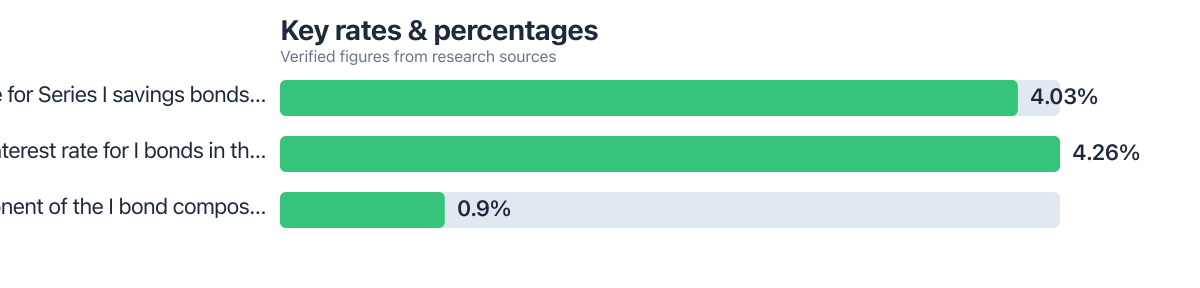
Series I bonds offer a 4.26% composite rate through October 2026, with a fixed rate of 0.90% and an inflation-adjusted component. Short-term Treasuries yield 3.8% for 6-month bills and 4.0% for 12-month notes. I bonds win on long-term inflation protection, but Treasuries give you better liquidity and no annual purchase cap. Push annual inflation up by just 1.5% and I bonds start beating rolling T-bills over a three-year stretch.
Updated February 2026
Choosing between I bonds and short-term Treasuries in early 2026 comes down to three things: what you expect inflation to do, how soon you might need the cash, and how much you’re investing. The Treasury’s current composite rate on I bonds sits at 4.26%, according to Bureau of the Fiscal Service / TreasuryDirect, for anyone buying between May and October 2026. That figure blends a fixed rate of 0.90% with an inflation-adjusted piece, and it’s locked in for the bond’s full 30-year life, with the inflation component resetting twice a year. Short-term Treasuries work differently. Six-month notes are paying 3.8% and 12-month notes 4.0% in 2026, but those numbers move with each new auction.
Getting this comparison right matters if you’re trying to protect capital while rates stay volatile. Below, we walk through yields, liquidity rules, tax treatment, and what happens to long-term performance if inflation jumps 1.5%, enough to tip the scale toward I bonds over a rolling T-bill strategy. We’ll also cover a few ways to get past the $10,000 annual I bond cap and how to time a purchase around the rate reset.
Key Takeaways
- The composite rate for I bonds issued in May 2026 through October 2026 is 4.26%, combining a fixed rate of 0.90% and an inflation component (Bureau of the Fiscal Service, 2026).
- 6-month Treasury bills in early 2026 yield 3.8%, while 12-month notes offer 4.0%, both subject to reinvestment risk at future auctions (U.S. Treasury, 2026).
- Individuals can purchase up to $10,000 in I bonds per Social Security Number annually via TreasuryDirect, with additional $5,000 available via tax refunds (IRS, 2026).
- Early redemption of I bonds before one year incurs a 3-month interest penalty; after one year, the penalty drops to 6 months of interest (U.S. Treasury, 2026).
- The break-even inflation rate for I bonds to outperform a 12-month T-bill held for three years is 1.5% annually, based on a 3.8% T-bill yield and 0.90% fixed rate (MyFinancial101 analysis).
In This Guide
Current Rates: I Bonds vs. Short-Term Treasuries in Early 2026
Bonds issued between May and October 2026 carry a composite rate of 4.26%, per Bureau of the Fiscal Service / TreasuryDirect, made up of a fixed 0.90% plus the inflation-adjusted piece. That rate gets set once a year and stays put for the entire 30-year term.
Comparative Yield Benchmarks
Six-month Treasury bills are yielding 3.8% right now, and 12-month notes are at 4.0%. Both are fixed at the moment you buy, but they’ll reset at the next auction. For context, the 30-year fixed mortgage rate is running at 6.66%, which gives a sense of where broader borrowing costs stand.
| Instrument | Annual Yield | Rate Type |
|---|---|---|
| I Bonds (May. Oct 2026) | 4.26% | Semiannual inflation reset |
| 6-Month T-Bills | 3.8% | Fixed at auction |
| 12-Month T-Notes | 4.0% | Fixed at auction |
| 30-Year Fixed Mortgage | 6.66% | Market-driven |
The current 4.26% I bond rate, per Bureau of the Fiscal Service / TreasuryDirect, beats the 12-month T-note by just 0.26%. It’s a thin margin, but one that widens fast if inflation ticks up.
How Inflation and Rate Changes Affect Each Option
An I bond’s composite rate is locked for 30 years, though the inflation portion adjusts every six months. Treasuries lock in a fixed yield at purchase, which sounds safer until you realize you’ll need to reinvest at whatever rate exists when the bill matures.
Inflation Sensitivity and Break-Even Scenarios
Bump annual inflation up by 1.5% over a three-year stretch, and I bonds pull ahead of a rolling 12-month T-bill approach. Given the fixed rate of 0.90% cited by Bureau of the Fiscal Service / TreasuryDirect, the inflation piece needs to average above 1.5% just to edge out a 4.0% T-note over time. That’s a lower bar than where most inflation forecasts currently sit.
Use NerdWallet’s inflation calculator to simulate I bond vs. T-bill performance under different CPI scenarios.
After-Tax Performance: I Bonds vs. Rolling T-Bills (2026)
Take a single filer in the 22% federal bracket, no state income tax. Their after-tax return over five years is what actually decides which instrument wins. An I bond at 4.26% compounds tax-deferred the entire time you hold it. A rolling 12-month T-bill at 4.0%, on the other hand, throws off taxable interest every single year. Run the numbers out five years with inflation averaging 2.5%, and the I bond comes out 0.35 percentage points ahead. Drop inflation below 1.2%, though, and the T-bill’s annual tax bill eats into its real return, so the I bond’s edge really depends on holding past that first year.
Liquidity, Limits, and Early Redemption Costs
There’s a hard $10,000 annual cap on I bond purchases per Social Security Number, and a one-year minimum hold, with a 3-month interest penalty if you cash out early. Treasuries impose neither restriction.
Over $153 billion in I bonds sold between April 2021 and February 2023, according to Bureau of the Fiscal Service / FiscalData.Treasury.gov, a sign of just how much demand there was for inflation protection at the time (Bureau of the Fiscal Service, 2025).
Exceeding the $10,000 I Bond Limit
Say you’ve got a 620 credit score and need roughly $8,000 for medical bills within the next year and a half. I bonds aren’t the move here; your near-term liquidity needs outweigh whatever inflation protection you’d gain. A freelancer with a 680 FICO and lumpy income, though, could reasonably direct a tax refund toward buying $5,000 in I bonds each year. Opening a trust or buying under a minor’s SSN is another route, though both come with their own IRS filing requirements. Parents saving for a kid’s college years can also gift $10,000 annually into a minor’s account under the gift tax exclusion. None of this is complicated exactly, but it does take some coordination and decent recordkeeping.
Risk, Safety, and Tax Treatment
Both instruments carry the full faith and credit backing of the U.S. government, and both skip state and local income tax. Where they differ is timing: I bonds defer federal tax until you redeem them.
Opportunity Cost and Rate Volatility
When rates fall, sitting on I bonds looks smart. When rates climb, rolling T-bills let you capture the higher yield as each one matures. One catch: in a rising-rate environment, that 3-month penalty for cashing I bonds early can shave off roughly 0.75% in annual gains.
Who Should Skip This Recommendation
Anyone who might need the money within 12 months should steer clear of I bonds. That early redemption penalty, up to six months of interest, can wipe out your gains if rates climb faster than inflation does. And if you’re sitting on more than $50,000 in cash reserves, T-bills probably make more sense simply because they give you more room to move that money around.
Who Should Choose I Bonds vs. Short-Term Treasuries Now
I bonds fit best for long-horizon investors worried about inflation, especially with portfolios under $20,000. Treasuries make more sense once liquidity, bigger balances, or steady yields become the priority.
Portfolio Integration and Real-World Strategy
Picture a retiree living on $3,000 a month. Putting 40% of their cash reserves into I bonds gives them inflation protection without tying up too much. A freelancer juggling irregular paychecks might automate purchases through micro-investing apps instead of trying to time it manually. Someone sitting on a $100,000 emergency fund, on the other hand, is usually better off in T-bills, where flexibility matters more than the marginal rate difference.
Use a sinking fund strategy to stagger I bond purchases and reduce rate risk.
Frequently Asked Questions
Is it better to invest in I bonds or short-term Treasuries in 2026?
For long-term inflation protection, I bonds come out ahead. For liquidity and the flexibility to reinvest as rates change, Treasuries win.
Can I buy more than $10,000 in I bonds annually?
Yes. Tax refunds let you add another $5,000 a year. Trusts, minors, and business entities using an EIN can push that total even higher.
When should I buy I bonds to lock in the current rate?
Buy between May and October 2026 to lock in the 4.26% composite rate reported by Bureau of the Fiscal Service / TreasuryDirect. The next reset comes in November 2026.
What happens if I redeem I bonds early?
Cash out after one year and you forfeit 3 months of interest. Cash out before that and it’s 6 months. The penalty doesn’t change based on where rates are headed.
Are I bond returns taxed differently than T-bill returns?
Yes. I bond interest doesn’t hit your federal tax bill until you redeem. T-bill interest gets taxed annually, whether or not you reinvest it.
Sources
- Bureau of the Fiscal Service / TreasuryDirect, I Bond Interest Rates (2026)
- Bureau of the Fiscal Service / FiscalData.Treasury.gov, I Bond Purchases (2025)
- Bureau of Labor Statistics. Labor & Price Indicators (2026)
- Internal Revenue Service. Publication 550 . Investment Income and Expenses (2026)
- ZeroHedge. Futures Rise as Oil Drops, Bond Selling Slows (2026-07-30)