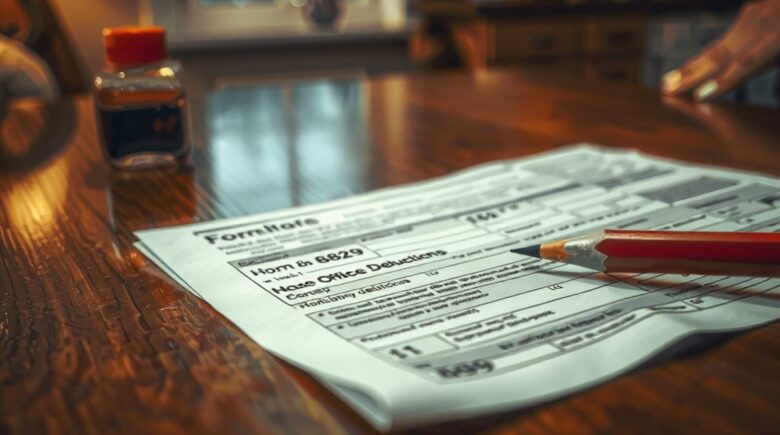
Quick Answer
Only self-employed individuals should file Form 8829 if their actual home office expenses exceed $1,500. The IRS offers a simplified method: deduct $5 per square foot, up to $1,500, with no documentation required. Most W-2 employees cannot claim this deduction due to current tax laws.
The IRS requires that the space be used exclusively and regularly for business. It must be your principal place of business or a place where you meet clients. Upon sale, filing Form 8829 triggers depreciation recapture.
Key Takeaways
- Self-employed individuals can deduct up to $6,000+ in actual expenses using Form 8829, far beyond the simplified cap of $1,500, as per IRS Publication 587.
- Only 10% of self-employed taxpayers claim the home office deduction due to strict documentation rules, according to recent IRS data.
- Depreciation claimed via Form 8829 results in a 25% recapture tax upon sale, higher than long-term capital gains rates under Section 1250.
- California disallows the home office deduction on state returns, while New York follows federal rules. W-2 employees are barred from this deduction until at least 2026.
- IRS audits are more likely for deductions over 10% of adjusted gross income, especially when linked to home office claims, as noted by the CFPB’s audit trends.
Who Can Actually Claim a Home Office Deduction?
Self-employed individuals filing Schedule C. That’s really the whole list. W-2 employees got shut out by the Tax Cuts and Jobs Act (TCJA), and that exclusion holds through at least 2026. The IRS is explicit:
“Self-employed taxpayers filing Schedule C first compute this deduction on Form 8829.”
Beyond employment status, the space itself has to clear a high bar. The IRS demands exclusive and regular business use, not mostly business, not primarily business. A corner of your bedroom where you occasionally answer emails won’t qualify. A dedicated spare room you’ve furnished as an office, used only for client calls and project work, probably will. The space can be as small as a closet, but it has to serve as either your principal place of business or a location where you meet clients on a regular and ongoing basis.
Not every self-employed person benefits equally, either. If you’re renting a small apartment in Denver with modest monthly costs, the simplified method’s $1,500 ceiling might actually cover your real expenses. But freelancers carrying a heavy mortgage in a high property-tax county like Westchester, New York, or Travis County, Texas, often find the actual-expense method worth the extra paperwork. The IRS tracks every deduction here. Misreported claims are a known trigger for IRS audits.
Key Takeaway: Only self-employed individuals can claim a home office deduction. W-2 employees are excluded until at least 2026. The space must be used exclusively and regularly for business. A room used intermittently won’t cut it. Check the IRS Instructions for Form 8829.
Simplified vs. Regular Method
The simplified method is exactly what it sounds like. Multiply your office square footage by $5, cap at 300 square feet, and you’re done. Maximum deduction: $1,500. No Form 8829, no depreciation schedules, no receipts to organize. Clean and fast.
The regular method is a different animal entirely. You’re calculating actual expenses: mortgage interest, property taxes, homeowner’s insurance, utilities, repairs, and depreciation. Each gets multiplied by your business-use percentage. The math takes longer, but the payoff can be substantial. A freelance consultant in Austin with a $2,800 monthly mortgage, $6,000 in annual property taxes, and a 12% business-use percentage would be looking at a deduction well above $4,000 annually, nowhere near the simplified cap.
Here’s a concrete comparison. Say you have a 200 square foot office in a 1,600 square foot home in Phoenix. Simplified method: $1,000. Regular method, using $36,000 in annual housing costs at 12.5%: $4,500. That $3,500 gap matters at tax time.
Renters generally see smaller spreads between the two methods. Homeowners carrying large loans in high-tax states almost always come out ahead with Form 8829.
Key Takeaway: The simplified method caps at $1,500. The regular method can yield significantly more, up to $6,000 for high-income homeowners. Use the regular method only if actual expenses exceed $1,500. Check the IRS Instructions.
When Do You Actually Need to File Form 8829?
Only when you’re using the actual expense method. Skip it entirely if you’re taking the simplified deduction.
One form covers one home. Move mid-year, and you’ll file two. Use a dedicated workspace in a vacation property where you also meet clients, and that’s another form. The IRS doesn’t allow you to combine multiple properties onto a single Form 8829. Each address gets its own filing.
Carryover deductions from prior years also require Form 8829. This catches a lot of people off guard. If your home office deduction exceeded your Schedule C income in 2023, that excess carried forward. Reporting it properly in 2024 means filing the form again, even if your actual expenses this year are modest. And records must be contemporaneous: dated receipts, utility bills, mortgage statements, square footage documentation. Reconstructing records after the fact is something IRS auditors specifically look for and flag.
One more wrinkle worth knowing. A large home office deduction can complicate mortgage refinancing. Lenders at institutions like Wells Fargo and Chase typically average two years of Schedule C income when qualifying self-employed borrowers, and a big deduction shrinks that number fast.
Key Takeaway: File Form 8829 only when using the actual expense method. One form per home. No Form 8829 for the simplified method. Carryover expenses require filing too. Separate forms are needed if you have multiple properties or mid-year moves.
Calculating Your Deduction Step by Step
Start with Part I of Form 8829. Divide your office’s square footage by your home’s total square footage. That’s your business-use percentage, and it drives everything else on the form.
Take a real example. A 150 square foot office in a 1,500 square foot home in Atlanta gives you 10%. That percentage applies to every indirect expense: mortgage interest, property taxes, homeowner’s insurance, electricity, gas, and depreciation. Direct expenses, like repainting only the office walls or replacing the office’s carpet, go on line 1 at 100%. Indirect expenses go on line 4, then get multiplied by that 10% figure.
Say total indirect housing costs run $30,000 for the year. Ten percent of that is $3,000. Add $400 in direct office repairs. Your gross deduction is $3,400, still subject to the Schedule C income limit.
That cap is the part many first-timers miss entirely. The deduction cannot push your Schedule C profit below zero. Whatever you can’t use this year carries forward to the next return, reported on line 43 of Form 8829.
Key Takeaway: The business-use percentage is crucial. Use exact square footage. Multiply total indirect expenses by this percentage for your deduction. It can’t exceed your business income. Excess carries forward. Consult the IRS Form 8829.
Hidden Costs and Long-Term Tax Consequences
The depreciation piece is where Form 8829 gets expensive later.
Every year you claim depreciation through Form 8829, your home’s cost basis decreases by that amount. When you eventually sell the house, the IRS recaptures those depreciation deductions as unrecaptured Section 1250 gain, taxed at 25%. Not at the 0%, 15%, or 20% long-term capital gains rates you might expect. Assume five years of $2,400 annual depreciation deductions on a home office. That’s $12,000 in cumulative depreciation. At sale, you’d owe $3,000 in recapture tax, regardless of whether you still used the office in year five.
State taxes add another layer. California does not conform to the federal home office deduction, so California-based freelancers get no state benefit from Form 8829. New York generally follows federal rules, so filers there can claim the deduction on both returns. Check your state’s conformity before assuming your federal deduction carries through.
Audit exposure rises with deduction size. Claims that represent more than 10% of adjusted gross income draw more scrutiny. Keep records for seven years. Software like TaxAct or TurboTax Self-Employed can generate the form, but neither replaces actual documentation if the IRS comes calling.
Key Takeaway: Claiming depreciation triggers a 25% recapture tax upon sale, even if you used the simplified method in other years. State rules may differ. Keep records for seven years using advanced tracking tools.