
Updated January 2026
Key Takeaways
- For most federal student borrowers with a 6.52% interest rate, investing in a Roth IRA first outperforms debt payoff due to historical equity returns averaging 10% annually, according to the Federal Reserve Bank of New York (Q3 2025).
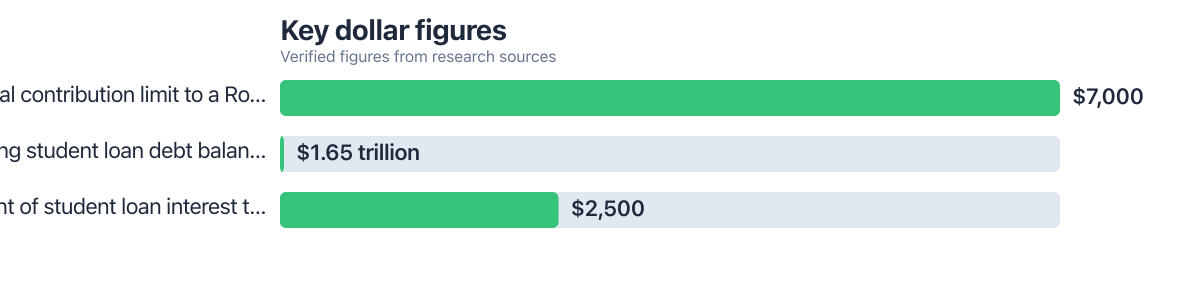
- The IRS allows a maximum annual contribution of $7,000 to a Roth IRA in 2025 for those under 50, with no income phase-outs, making it accessible to most earners, per the IRS.
- For borrowers on Income-Driven Repayment (IDR) or Public Service Loan Forgiveness (PSLF), a Traditional IRA contribution of $7,500 can reduce Modified Adjusted Gross Income (MAGI), lowering monthly payments and accelerating forgiveness, as outlined by the IRS.
- Over 10 years, a $7,000 annual Roth IRA contribution at a 10% return grows to $114,230, while paying off a $40,467 loan at 6.52% saves only $8,200 in interest, based on standard investment compounding models.
- High-interest private loans above 7.5% should be paid off before investing, as even a 10% return on investment may not outperform the cost of carrying debt at that rate.
- Married couples filing separately for IDR or PSLF cannot contribute directly to a Roth IRA due to phase-out thresholds starting at $0 income; a backdoor Roth IRA is the only alternative, per IRS rules.
Here’s the tension every borrower with a spreadsheet eventually runs into: pay down the loan, or fund the Roth? The answer isn’t a coin flip. It comes down to your interest rate, how the IRS treats your contribution, and what your repayment plan actually rewards. Federal undergraduate loans sit at a fixed 6.52% right now. Meanwhile, the S&P 500 has averaged roughly 10% a year over the long haul. That spread is the whole argument. For borrowers not chasing PSLF or parked on an IDR plan, it tilts hard toward investing. The IRS caps Roth contributions at $7,000 according to Internal Revenue Service per year for anyone under 50 in tax year 2025, and unlike Traditional IRAs, there’s no income phase-out standing in the way.
When Should You Invest in a Roth IRA Instead of Paying Off Your Debt?
Pick the Roth when your loan sits below 10%. That’s most federal student debt right now, since the going rate is 6.52%, comfortably under the long-run equity average. Money in a Roth grows tax-free and comes out tax-free, which compounds faster than shoveling after-tax dollars at a loan balance. Under 50? The $7,000 according to Internal Revenue Service annual cap is worth leaning on hard, especially if you’re also getting an employer match or an auto-pay rate discount on the loan side.
But flip to an IDR plan or PSLF track and the calculus reverses. A Traditional IRA or 401(k) contribution is deductible, which shrinks your Modified Adjusted Gross Income (MAGI), and a smaller MAGI means a smaller monthly IDR payment plus faster progress toward forgiveness. Put $7,500 according to Internal Revenue Service into a Traditional IRA and your MAGI drops by that exact amount, cutting your payment directly. That’s a real edge over a Roth for anyone actually in repayment.
Key Takeaway: If your federal student loan rate is 6.52%, investing in a Roth IRA first outperforms payoff over time. But if you’re on an IDR plan or PSLF, a Traditional IRA or 401(k) reduces your MAGI and lowers payments. Use IRS 2025 limits to guide contributions.
Who Can’t Contribute to a Roth IRA and Why
For 2025, anyone under 50 can put in up to $7,000 according to Internal Revenue Service. That number hasn’t moved since 2024. Income doesn’t touch the limit itself, but it does trigger phase-outs for high earners filing jointly. Married and filing separately? The phase-out kicks in at $0, so direct contributions are basically off the table. That’s a real problem for borrowers who file separately specifically because it helps their IDR or PSLF numbers.
Above the phase-out line, the backdoor Roth is really your only move. Fund a Traditional IRA, which has no income limit, then convert it to a Roth. It’s legal, it’s been done for years, though the conversion can create a tax bill on any earnings that accrued before you moved the money. Even someone carrying student debt and earning well above the phase-out can still make this work, particularly if retirement puts them in a higher bracket than they’re in today.
Key Takeaway: The $7,000 Roth IRA contribution limit applies to all under 50 in 2025, but joint filers earning over $218,000 face phase-outs. Married filers separating for IDR or PSLF must use a backdoor Roth. A backdoor strategy allows high earners to build tax-free retirement savings.
Why 10% Returns Make Investing Over Debt Payoff Worth It
Run the numbers 30 years out. A $7,000 annual Roth contribution at 10% turns into over $1.2 million. Compare that to paying off the average federal balance of $40,467 at 6.52%, which only saves around $13,000 in interest over a decade. There’s just no contest once compounding gets 30 years to work. Even the auto-pay discount most servicers offer, typically 1%, only knocks your rate down to 6.45%. Still nowhere near the long-run equity average.
Zoom into a 10-year window and the gap holds. Put $7,000 a year into a Roth at 10% and you end up with $114,230. Send that same $7,000 a year at your student loan instead, and you save $8,200 in interest, tops. This was never really about risk tolerance. It’s opportunity cost, plain and simple. Even a five-year delay in starting Roth contributions can cost you north of $400,000 at the finish line, and that’s assuming nothing more than modest returns.
Important limitation: None of this holds up for someone who genuinely can’t sleep with debt hanging over them, or who won’t stick with contributions when things get tight. If you’re the type to bail on investing the moment the market dips, or to raid that money for short-term spending, paying off the loan first is probably the smarter call, math be damned. Behavioral cost is real, and it can wipe out a theoretical advantage fast if your habits don’t match the plan.
Key Takeaway: Investing $7,000 annually in a Roth IRA at a 10% return grows to $114,230 in 10 years. Paying off a $40,467 loan at 6.52% saves only $8,200 in interest over the same period. Use IRS 2025 rules to maximize compounding.
When to Prioritize Debt Payoff Over Investing
Not everyone should default to the Roth. On an IDR plan or working toward PSLF, your payment is tied directly to MAGI. Drop $7,500 into a Traditional IRA and your MAGI falls by the same amount, which lowers the payment and speeds up forgiveness. Take a borrower earning $85,000 with a $3,000 monthly IDR bill: a Traditional IRA contribution could knock that down to $2,000, freeing up $1,000 a month for anything else on the list.
Private loans north of 7.5% are a different story entirely; pay those off first. A $10,000 loan at 8% costs $800 a year in interest. Put that same $7,000 into a Roth at 10% and you’d earn $700, which is actually a $100 net loss once you account for what the loan is costing you. Debt wins in that scenario. Refinancing could help, but only if you land below 6.52%, and nothing guarantees that.
Important limitation: This whole framework assumes you can juggle multiple goals without your discipline slipping. Struggling to cover minimum payments, or sitting on a thin emergency fund? Debt reduction probably needs to come first, even at a lower rate. Falling behind or eating penalty fees costs more than any long-term investing gain, if your cash flow can’t absorb the hit.
Key Takeaway: If you’re on an IDR plan or PSLF, a Traditional IRA reduces your MAGI and slashes monthly payments. For private loans above 7.5%, pay them off first. A $2,500 student loan interest deduction is less valuable than a $7,500 Roth contribution for long-term wealth.
| Factor | Roth IRA First | Debt Payoff First |
|---|---|---|
| Loan Rate | Below 7% | 7% or higher |
| Repayment Plan | IDR, PSLF, or standard repayment | Standard, private loans |
| Contribution | $7,000 annually | Full payments |
| Long-Term Growth | ~$1.2M in 30 years | Interest savings: ~$13K in 10 years |
Frequently Asked Questions
Should I pay off my student loans or invest in a Roth IRA first?
For most federal borrowers with rates under 7%, investing in a Roth IRA first is better. The average equity return of 10% outpaces your loan rate. Pay off high-interest private loans first, but not federal ones.
Can I contribute to a Roth IRA if I have student loan debt?
Yes. Student loan debt doesn’t block Roth IRA contributions. The IRS allows $7,000 according to Internal Revenue Service annually for those under 50 in 2025, with no income limits. Higher earners can use a backdoor Roth IRA.
How does the student loan interest deduction affect Roth IRA decisions?
The $2,500 annual deduction reduces taxable income by up to $550 at a 22% bracket. But a $7,500 Traditional IRA contribution saves $1,650 in the same bracket. For PSLF and IDR borrowers, pre-tax contributions are more valuable than Roth ones.
What if I’m married and filing separately due to student loan debt?
Married filers separating for IDR or PSLF can’t contribute directly to a Roth IRA. The phase-out begins at $0 income. Use a backdoor Roth IRA or a Traditional IRA instead.
Does investing in a Roth IRA affect my student loan forgiveness?
No. Roth IRA contributions don’t affect PSLF or IDR forgiveness. But they do increase your MAGI if you’re a Traditional IRA contributor. For PSLF, prioritize pre-tax contributions to lower your MAGI and monthly payments.
Sources
For more on managing debt and investing, see Buy Now Pay Later vs. Saving Up First: When Does Each Option Make Sense? or Roth IRA vs Traditional IRA: Which Account Wins Based on Your Tax Situation?. A sinking fund strategy can help balance both goals. For gig workers, building a portfolio without a 401(k) is possible. And controlling lifestyle creep keeps you on track.